With an exhibition that pits primal instinct against hyperrealist control, the Bulgarian painter fuses the sacred discipline of iconography with the visceral energy of the skatepark. In an era desperate for authenticity, Ivanov’s duality is a masterclass in contemporary cool.
There is a particular silence that hangs in the air when a painter stands before a blank canvas. It is not the silence of emptiness, but of coiled potential – a tension between the first impulsive mark and the meticulously constructed image it might become. For Yasen Ivanov, a 27-year-old Bulgarian artist whose exhibition Instinct and Image has just closed at Sofia’s Vivacom Art Hall, that silence is not a void to be feared. It is the entire point.
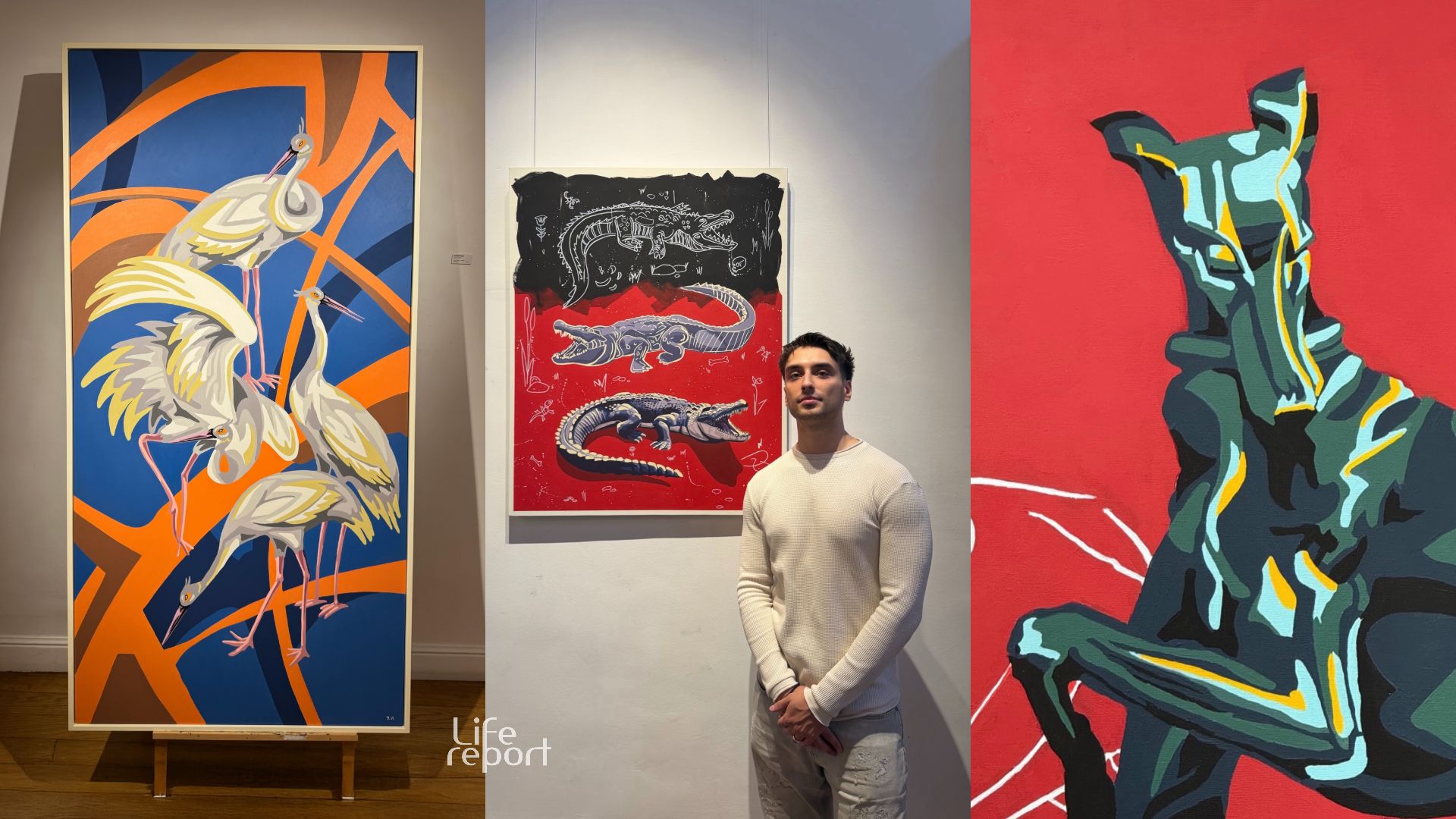
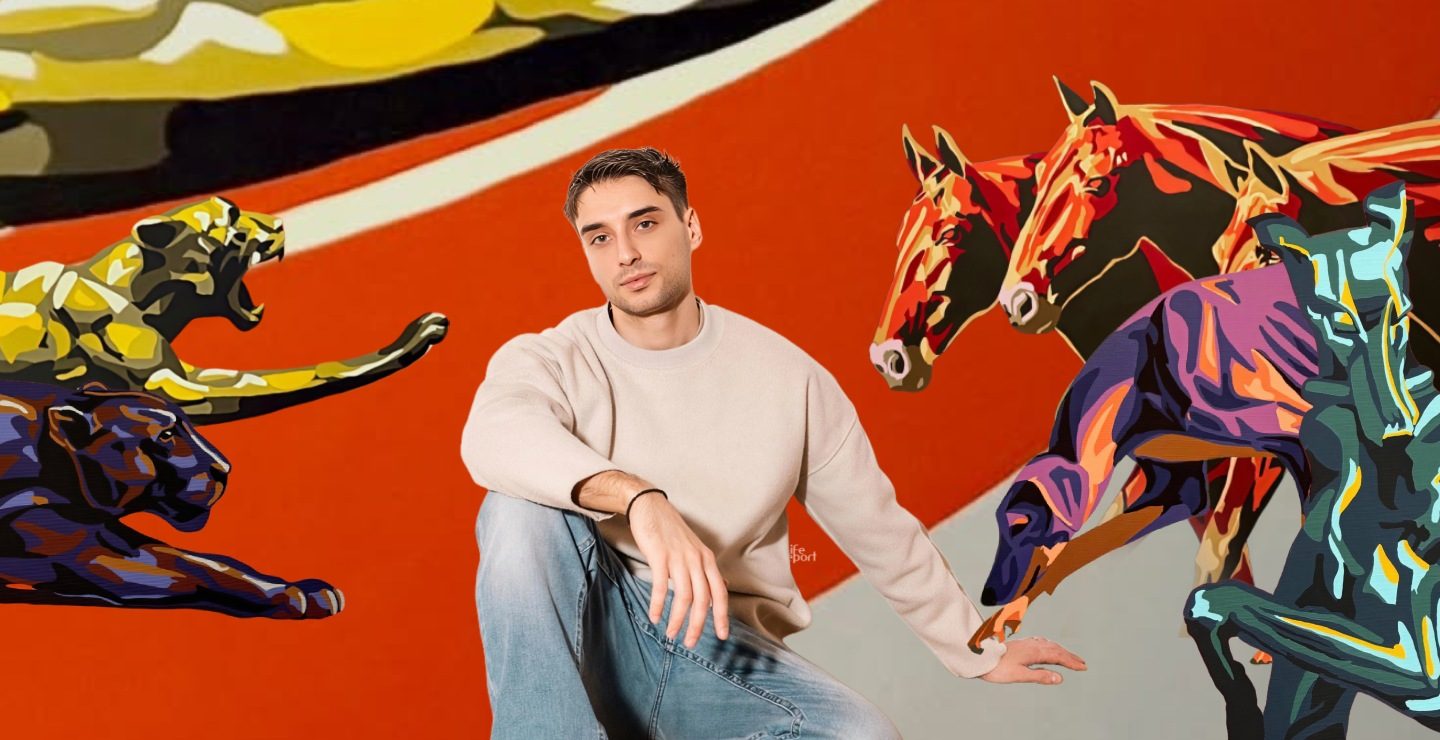
The exhibition, a taut visual dialogue between two seemingly irreconcilable artistic languages, unfolded within the sleek, high-ceilinged gallery space. On the same wall, often within a single frame, black-and-white gestural works existed alongside explosions of colour in striking coexistence. Urgent, scribbled, almost naïve depictions of jaguars, hunting dogs, birds and human figures feel excavated from the collective unconscious – a direct line to the cave paintings of Lascaux, or perhaps a Cy Twombly blackboard after hours. Beside them, the very same subjects emerge in meticulously composed, hyperreal bursts of colour, so vivid they seem lifted from a dream, suspended within minimalist voids that evoke the cosmic stillness of a Denis Villeneuve establishing shot. The subject remains unchanged. The soul is identical. Only the visual language transforms. And that, Ivanov insists, is the essence of his practice. “You cannot have one without the other,” he says with the quiet assurance of someone who has spent a lifetime reconciling opposites. “At the core of the colourful, hyperrealistic scenes lies the journey of abstraction.”
In a global art market increasingly captivated by figurative painting – where auction records at Christie’s continue to be driven by young artists who combine technical virtuosity with personal mythology – Ivanov arrives not as a provocateur, but as a gentleman-scholar of opposites. His biography reads like a meditation on discipline and release. He began his artistic education not in a playground but in the stillness of the icon studio, at the improbable age of seven. While other children were mastering video games, Ivanov was learning the archaic techniques of egg tempera, the symbolism of gold leaf, and the severe yet beautiful grammar of a tradition that demands the ego be sublimated into the divine. He only started, he confesses with almost comical nonchalance, because his older brother was doing it too. Sibling rivalry, it seems, has rarely produced anything quite so Byzantine.
View this post on Instagram
That early immersion in the sacred – where every brushstroke is a prayer and invention borders on heresy – planted a seed of precision that would later flourish in unexpected soil. After iconography came traditional printmaking at the National Academy of Arts in Sofia, a medium that punishes imprecision with the bite of acid and the ghost of a misaligned register. There, he developed a draughtsman’s obsession with detail, but, crucially, he also learned when to abandon it. “My sense of simplification developed later through my years of working in illustration and graphic design,” he explains. It is a remarkably mature reflection for an artist of his generation: an acknowledgement that the practical, often commercial demands of design – the work he still undertakes daily in a busy Sofia studio – sharpened his instinct for recognising what a painting truly needs, rather than everything it could possibly contain. In an age of maximalist oversharing, Ivanov edits. It is a luxury of restraint that aligns him philosophically with the understated elegance of a Brunello Cucinelli jacket or the uncompromising precision of an A. Lange & Söhne Lange 1: everything that remains is intentional.
Mentorship came in the form of Strahil Nenov, a professor of mural painting, and a grandfather who was both architect and painter – a lineage that suggests an almost preternatural comfort with scale. Ivanov speaks of his largest canvases with genuine affection, the way a sculptor might speak of marble. Yet the grounding influence was not purely academic. He is, delightfully, a skateboarder. “Fitness gives me consistency, cycling gives me a sense of freedom, and skateboarding fuels my creativity,” he says, offering a trinity of pursuits that would not look out of place in a Palace Skateboards campaign. It is a crucial piece of the puzzle. Skateboarding is an urban ballet of failure and recovery, a constant negotiation between control – the precise flick of an ollie – and chaos, embodied by unforgiving concrete. It is, in other words, the very tension that his exhibition so elegantly materialises.
The exhibition’s title, Instinct and Image, is not marketing poetry. It is a thesis. The animal became the unifying motif almost as a provocation to himself – a test of whether a single subject could survive the journey from pure gesture to polished icon. “The animal represents our connection to nature as human beings,” Ivanov says. “The primal instinct expressed in my black-and-white works connects us to our ancestors… That is why coexistence is so important to me. I am not interested in presenting one visual language as simply evolving into another, because evolution alone suggests that we leave the past behind.” It is a profoundly anti-modern yet strikingly contemporary assertion. In a culture obsessed with the next update, the next trend and the next algorithmic improvement, Ivanov suggests that the primitive mark and the hyperreal image can occupy the same wall, the same breath and the same cultural value. For the new generation of collectors – digital natives curating physical spaces in penthouses at the Burj Khalifa or beachfront villas on Saadiyat Island – this coexistence of the raw and the refined feels less like nostalgia than a blueprint. They understand instinctively that a Boccara rug can anchor a Jean Nouvel interior just as convincingly as a prehistoric artefact can electrify a white-cube gallery.
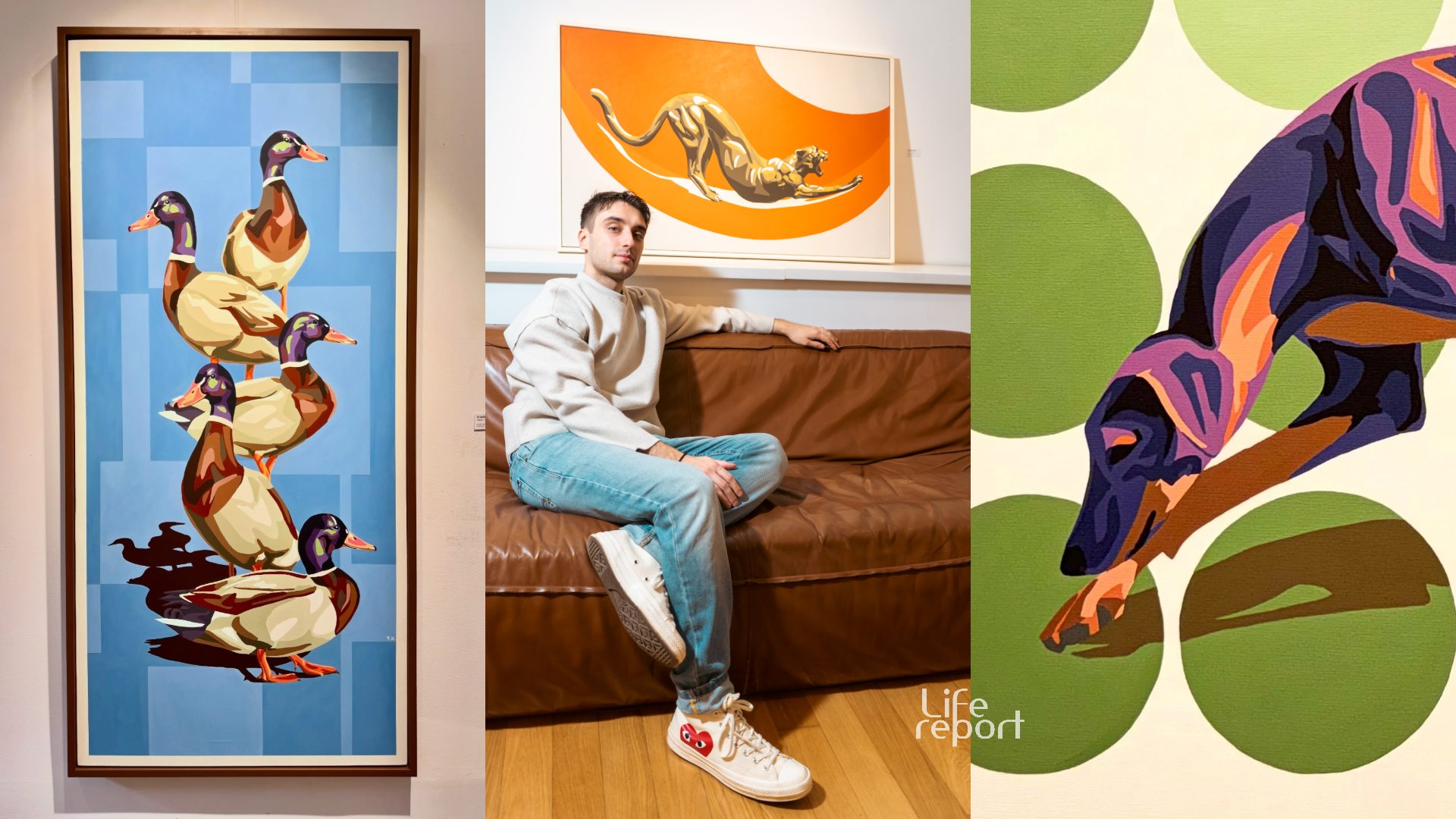
His visual library is tellingly cinematic. Listening to Yasen Ivanov list his influences is like leafing through a Criterion Collection curated by a design obsessive. Christopher Nolan’s architectural manipulation of time. Denis Villeneuve’s Dune and Blade Runner 2049 – films that marry monumental scale with intimate textural detail. There is a hint of the epic in Yasen’s silences, a sense that his minimalist environments are stages waiting for a Hans Zimmer score to swell. In his hyperreal works, one recognises the same reverence for atmosphere that Roger Deakins captures in a single frame of smog-filled Los Angeles. Yet, for all the grandeur, his aesthetic remains deeply tactile. He cites Werner Bronkhorst and Yulia Bas – contemporary artists exploring the space between figuration and emotion – alongside the enduring influence of Rembrandt, for his etchings, and Bernini, for his astonishing treatment of marble. It is a guest list drawn from the artistic canon, and Ivanov moves through it without the slightest hint of pretension.
Asked what sustains his practice beyond the studio, Ivanov paints a portrait of a life so balanced it might provoke envy in even the most overworked gallerist. He spends his days working as an illustrator among “highly creative people”, immersed in a collaborative environment that keeps artistic solipsism at bay. Evenings belong to his girlfriend, whose perspective on art provides a welcome counterpoint. Together they wander through Sofia’s galleries, two discerning pairs of eyes exploring the city’s increasingly vibrant cultural scene. It is a world away from the mythology of the tortured artistic genius. Ivanov is, by his own admission, “relatively calm”. The surprise, he says with a wry smile, is that at just 27 he already possesses the breadth of experience and consistency of vision that many expect from someone a decade older. “Many expect someone older, but I simply try to stay curious,” he says – a remark that is both quietly humble and unmistakably ambitious.
That ambition crystallises when the conversation turns to the invisible masterpiece every artist pursues. He approaches each new project as though it might become his finest work and, once it is complete, the horizon shifts once more. “For now, my ultimate artwork is still ahead of me, and I look forward to discovering what it will become. I imagine it as something ambitious and deeply meaningful.” There is no sense of impatience, only the steady confidence of a creator who trusts the process. It is a mindset that resonates with a luxury audience increasingly weary of performative disruption and drawn instead to craftsmanship whose value accumulates slowly, like the patina on a Patek Philippe.
As the art world’s centre of gravity continues to shift towards the global, multidisciplinary practitioner – someone capable of painting a saint on Monday, art-directing a campaign on Tuesday and opening a solo exhibition on Wednesday – Yasen Ivanov has little need to chase relevance. His practice already embodies the sophisticated synthesis that defines contemporary cultural intelligence. From the incense-scented discipline of the icon studio to the adrenaline-fuelled freedom of the skatepark, he has woven together a visual language that speaks simultaneously to our ancient past and our image-saturated present. In Instinct and Image, the animal gazes back from the canvas – at once a primal mark and a mirror. The dialogue has only just begun. And the smart money, from the Balkans to the Gulf, is already paying attention.
Also Read: Rolex’s Secret New Daytona: An Alchemy of Smoke and Enamel