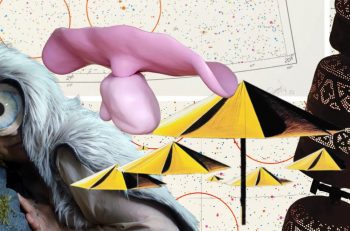
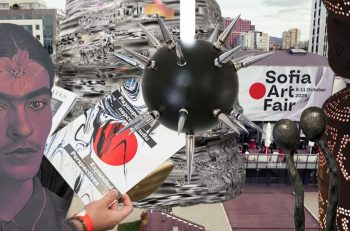
The artist who wrapped the Reichstag and the Pont Neuf was born in Gabrovo. This October, DG Art Gallery brings previously unseen works by Christo and Jeanne-Claude to Sofia Art Fair – and quietly rewrites the city’s cultural coordinates.
There is a particular species of Bulgarian cultural pride that expresses itself not through flag-waving, but through the studied nonchalance of mentioning, at a dinner party, that Christo Vladimirov Javacheff – the man who wrapped the Reichstag, the Pont Neuf, and a stretch of the Australian coastline – was born in Gabrovo. It is the same energy with which a Milanese might mention that Leonardo once lived down the street. The implication is not jingoism. It is something closer to vindication: proof that genius can emerge from a textile town in the Balkans just as readily as from a Parisian atelier.

This October, that quiet pride gets a stage worthy of it. The third edition of Sofia Art Fair, running from October 8 to 11 at the John Atanasov Innovation Forum in Sofia Tech Park, will gather twenty-seven exhibitors and eighty-eight artists from five continents. Among them, at Booth No. 6, DG Art Gallery will present a selection of works by Christo and Jeanne-Claude that has never before been shown to a Bulgarian audience – lithographs, signed editions, collages, and preparatory studies drawn from some of the duo’s most iconic projects. It is, by any measure, a significant moment. But the real story here is not simply the art. It is the architecture of return.
A Gallery in Transition
DG Art Gallery is not, strictly speaking, a new enterprise. It is the latest iteration of a project that has been gestating for more than fifteen years under the stewardship of Denitsa Atanasova-Gergova, an art director whose curriculum vitae reads like a syllabus for Contemporary Art 101 – Warhol, Picasso, Hirst, Blake, all presented to Sofia audiences through the gallery’s previous incarnations.
The gallery’s official arrival coincides with the closure of Vivacom Art Hall Oborishte 5, the space Gergova helmed for nine years and through more than 300 exhibitions. That venue, a fixture of Sofia’s cultural scene, ceased operations in its previous format on July 1, 2026, its event-management functions passing to new stewardship. Gergova’s curatorial projects, however, have simply migrated – from the institutional chassis of a corporate art hall to the more agile frame of a gallery bearing her own initials. “It was an irreplaceable school,” she has said of the former space, with the measured gratitude of someone who knows that endings are often just rebrandings. The selection of Christo and Jeanne-Claude for the gallery’s Sofia Art Fair debut is, in this light, anything but arbitrary. It is a statement of continuity disguised as a homecoming.

The Art of Wrapping, the Art of Unwrapping
What will visitors actually see at Booth No. 6? The highlights are, predictably, exquisite. A unique collage related to the monumental Mastaba project – that truncated pyramid of oil barrels that Christo envisioned for Abu Dhabi and partially realised in London’s Serpentine Lake in 2018. A limited-edition lithograph from the London Mastaba, produced in an edition of only twenty. Signed lithographs from The Gates in Central Park and The Umbrellas in Japan and the United States. A work connected to the wrapped portrait of Jeanne-Claude, whose original resides in a San Diego museum. And preparatory studies for Wrapped Reichstag, Pont Neuf, and L’Arc de Triomphe, Wrapped – the trio of Parisian and Berlin interventions that cemented the duo’s reputation as the great poet-engineers of the ephemeral.
For the uninitiated, Christo and Jeanne-Claude’s practice can seem like a elaborate practical joke played on the institutions of art and state. They wrapped things. Bridges, parliaments, coastlines, trees. They spent decades negotiating permits, environmental impact assessments, and the exquisite bureaucracy of democratic governance – all to create works that would exist for weeks, sometimes days, before being dismantled and recycled. The Reichstag, wrapped in 1995, lasted fourteen days. The Pont Neuf, wrapped in 1985, lasted fifteen. The Arc de Triomphe, wrapped posthumously in 2021, lasted sixteen days. The art was not the object. The art was the event, the conversation, the collective gasp of a city confronted with the unfamiliar silhouette of its own landmarks.
This is why the lithographs and collages matter. They are not souvenirs, exactly. They are the archaeological record of an idea – the preparatory drawings, the technical studies, the signed editions that financed the projects themselves. Christo famously refused sponsorship, funding his installations through the sale of his preparatory works and original lithographs. To own one is to own a fragment of the logistics of wonder.
The Bulgarian Connection
Christo Javacheff was born in Gabrovo on June 13, 1935, into a family of industrialists. He left Bulgaria in 1957, first for Prague, then Vienna, then Paris, where he met Jeanne-Claude de Guillebon, the woman who would become his wife, collaborator, and – by his own account – the engine of his ambition. Together they relocated to New York in 1964, and for the next half-century, they operated as a single artistic entity, their names always paired, their credits always shared.
View this post on Instagram
The Bulgarian connection, however, never fully dissolved. It manifested in odd, intimate ways. When Gergova and her husband purchased a drawing directly from Christo’s studio, he told them they were the first Bulgarians to do so. That drawing, part of Gergova’s personal collection, was shown briefly in Sofia earlier this year at an exhibition of seventeen previously unseen works at Vivacom Art Hall – an exhibition that served, in retrospect, as a prelude to the gallery’s fair presentation.
The institutional apparatus around Christo’s legacy has also been quietly consolidating in Bulgaria. In 2025, the Council of Ministers officially established the Christo and Jeanne-Claude Regional Centre for Contemporary Art in Gabrovo, housed in the building of the former Vocational Secondary School for Textiles and Fashion Design. The centre opened its doors in 2023, three years after Christo’s death, and functions not merely as a museum but as a residency for young artists from across the globe. “This centre is for young artists,” its curator, Margarita Dorovska, has said. “While it will showcase the works of Christo and Jeanne-Claude, it is equally a place for creating art”.
There is something almost too neat about this symmetry – the textile school producing the artist who would wrap buildings, the centre for young artists standing where the industrial machinery of Gabrovo once hummed. But neatness is not the same as falseness. The narrative holds because it is true.
The Market Speaks
For collectors, the fair offers more than aesthetics. Christo and Jeanne-Claude’s market has proven remarkably resilient. When works from the couple’s private collection went to auction at Sotheby’s Paris in 2025, they realised €8 million against an estimate of €2.5 to €3.8 million, with more than three-quarters of lots selling above estimate. A preparatory drawing for The Umbrellas set a new record for a work by the Bulgarian-born artist at €1.7 million. At Sotheby’s Paris in April 2026, a 1985 study for The Pont Neuf Wrapped, which had never before appeared at auction, sold for $605,000 – 161 per cent above its low estimate.
These figures matter because they contextualise what will be on offer at Booth No. 6. Signed lithographs and limited-edition prints, while not unique works, carry their own investment logic. The London Mastaba lithograph – the one in an edition of twenty – is a case in point. Christo’s prints from the Serpentine Galleries exhibition of 2018, hand-signed and produced in editions of 100 or fewer, have consistently performed well at auction, and the Mastaba series occupies a peculiar position in his oeuvre: it is both a document of a realised project and a fragment of an unrealised ambition, the Abu Dhabi Mastaba being the largest work Christo never completed.

DG Art Gallery has indicated that all works presented at the fair will be available for purchase on site, with collectors receiving detailed provenance information and certification. For the Bulgarian buyer – particularly the younger collector with an eye on both cultural significance and resale value – this is not a trivial offering. It is, in effect, an access point to a tier of the global art market that has historically bypassed Sofia in favour of London, Basel, and Miami.
The Fair as Cultural Infrastructure
None of this would matter if Sofia Art Fair were not itself a phenomenon worth attending. Now in its third year, the fair has grown from a regional curiosity to a genuine international platform. The 2025 edition, held under the motto “IMAGINE,” featured twenty-seven galleries and creative collectives from fourteen countries, with nearly half the booths occupied by international exhibitors. The 2026 edition will bring together galleries from eight countries, including first-time participants from as far afield as Georgia and South Korea.
The fair’s ancillary programming is equally ambitious. SAF Talks, the fair’s conference component, will feature speakers including Vladimir Yavachev, Christo’s nephew and the man who managed his uncle’s major projects from a young age. There will be curatorial tours, AR/VR installations, a children’s area, and a VIP lounge – the full infrastructure of a contemporary art fair, adapted to the specific rhythms of a Balkan capital still finding its footing in the global art circuit.
Sofia Tech Park, the venue, is itself a symbol of this transition. Bulgaria’s first science and technology park, it hosts a rotating calendar of cultural and technological events, its glass-and-steel architecture a deliberate contrast to the socialist-era concrete that dominates much of the city’s periphery. The choice of venue is not incidental. It signals that Sofia’s art scene intends to be understood as part of a broader ecosystem – innovation, technology, entrepreneurship – rather than a quaint folkloric annexe of the European cultural map.
The Quiet Power of Return
There is a tendency, when writing about art fairs in smaller capitals, to reach for the language of arrival. Sofia is no longer arriving. It arrived some time ago, quietly, while the international art world was busy looking at Venice and Basel and Art Basel Miami Beach. The city has a functional contemporary art ecosystem, a growing collector base, and – crucially – a generation of curators and gallerists who have spent the last decade building relationships with the global art market without sacrificing local specificity.
Denitsa Gergova is one of those curators. Her decision to lead DG Art Gallery’s Sofia Art Fair debut with Christo and Jeanne-Claude is, on one level, a commercial calculation. Christo sells. His market is liquid. His name carries weight with collectors from London to Seoul. But it is also, on another level, a curatorial argument: that Bulgarian identity and global art are not opposing forces, but complementary ones. “Christo is a symbol of how Bulgarian roots and genius can reach the highest global level,” Gergova has said. “It is precisely this synergy between Bulgaria and the international art scene that we want to showcase”.
View this post on Instagram
The wrapped portrait of Jeanne-Claude, the Mastaba collage, the preparatory studies for the Reichstag and the Arc de Triomphe – these are not Bulgarian works in any nationalistic sense. They are the products of a life lived between Gabrovo and New York, between the textile mills of the Balkans and the wrapped bridges of Paris. They belong to everyone and to no one. But they return to Sofia this October, carried in the arms of a gallery that understands that the most powerful cultural statements are often made with restraint rather than fanfare.
The wrapping, after all, was never really about concealment. It was about making the familiar strange again, forcing the eye to reconsider what it thought it knew. A wrapped Reichstag is not a hidden Reichstag. It is a Reichstag that has been made visible in a new way. Perhaps the same can be said of Sofia. Perhaps the city, wrapped in the familiar rhetoric of cultural aspiration, has been waiting for someone to pull the fabric back and reveal what was always there.
Sofia Art Fair runs from October 8 to 11, 2026, at the John Atanasov Innovation Forum, Sofia Tech Park. DG Art Gallery will be at Booth No. 6.
ALSO READ: Sofia Art Fair: How a Young Art Fair is Redrawing the Cultural Map