Dubai is a city that treats history like a draft folder – perpetually open, rarely saved. Its skyline is a permanent construction site; its past, something usually demolished to make room for a taller future. So there is a deliciously perverse irony in the fact that this most future-drunk metropolis has become the unlikely custodian of a 2,500-year-old secret. This November, a replica of a Celtic torque – a rigid gold collar twisted into a shape of brutal elegance – will take up residence here, arriving not as a relic but as a question: can a gesture, once forgotten, ever truly be recovered?
The exhibition, Recreating Gesture: Crafting a Gold Necklace from the Iron Age, opens on 5 November at L’École, School of Jewelry Arts, in Dubai Design District, timed, with characteristic precision, to Dubai Design Week. It runs until 24 April 2027. The project, supported by Van Cleef & Arpels, is a study in experimental archaeology – an attempt to reverse-engineer a masterpiece of the La Tène period (450–25 BC) by reproducing it from scratch. The object in question is the Torque of Montans, discovered by a plough in 1843 in the Tarn region of southern France: a twisted band of almost pure gold with conical terminals adorned with stylised floral motifs. Each bud, as one observer noted, seems perpetually on the verge of blooming, a floral gesture frozen in metal since the third century BCE.

The original torque is held at the National Museum of Archaeology in Saint-Germain-en-Laye. Its replica, fashioned from 24-carat gold with patience and what the French call l’intelligence de la main, was produced by a team that included goldsmith Antoine Legouy, a master chaser and recipient of the Meilleur Ouvrier de France distinction, alongside Grégory Weinstock, Van Cleef & Arpels’ Director of High Jewellery Métiers, and Barbara Armbruster of the CNRS. The breakthrough, fittingly, came not from a laboratory but from a grave. The discovery of an Iberian goldsmith-warrior from the fourth century BCE, buried with his tools and evidence of a tar-like pitch made from organic matter and crushed brick, provided the missing piece of the puzzle. The past, it turns out, is often best understood through the tools of the dead.
L’École itself has become something of an archaeological project in its own right – excavating the knowledge embedded in jewellery culture and placing it in the hands of the public. Established in 2012 with the support of Van Cleef & Arpels, the school now operates permanent campuses in Paris, Hong Kong, Shanghai and Dubai, the latter inaugurated in April 2024 by Her Highness Sheikha Latifa bint Mohammed bin Rashid Al Maktoum. The Dubai campus, designed by Constance Guisset, occupies Building 10 in Dubai Design District (d3), a space that has quietly become one of the city’s more thoughtful addresses for those who prefer their luxury with a side of erudition.
View this post on Instagram
The exhibition’s public programme, which begins with an Open House Day on Saturday, 7 November, is a study in democratic access. There will be hands-on course demonstrations, guided exhibition tours and gold-themed workshops for children, designed to awaken young minds to the twin pleasures of history and craftsmanship. A talk exploring the connection between Iron Age goldsmithing and archaeology will be followed by an outdoor screening in collaboration with Cinema Akil, the UAE’s pioneering independent arthouse cinema, whose Jewels of Cinema series has previously paired films with L’École’s exhibitions. The Voice of Jewels podcast, meanwhile, will be available in the exhibition space in three Arabic-translated episodes – a gesture of linguistic hospitality that one wishes were more common in the region’s cultural programming.
Throughout its six-month run, the exhibition will invite visitors to trace the connections between Celtic goldsmithing techniques and the gold heritage of the Gulf, a conversation that feels both overdue and quietly radical. The UAE’s own archaeological record, after all, is rich with evidence of ancient metallurgical sophistication – a fact that tends to get lost in the shuffle of more recent, shinier histories.
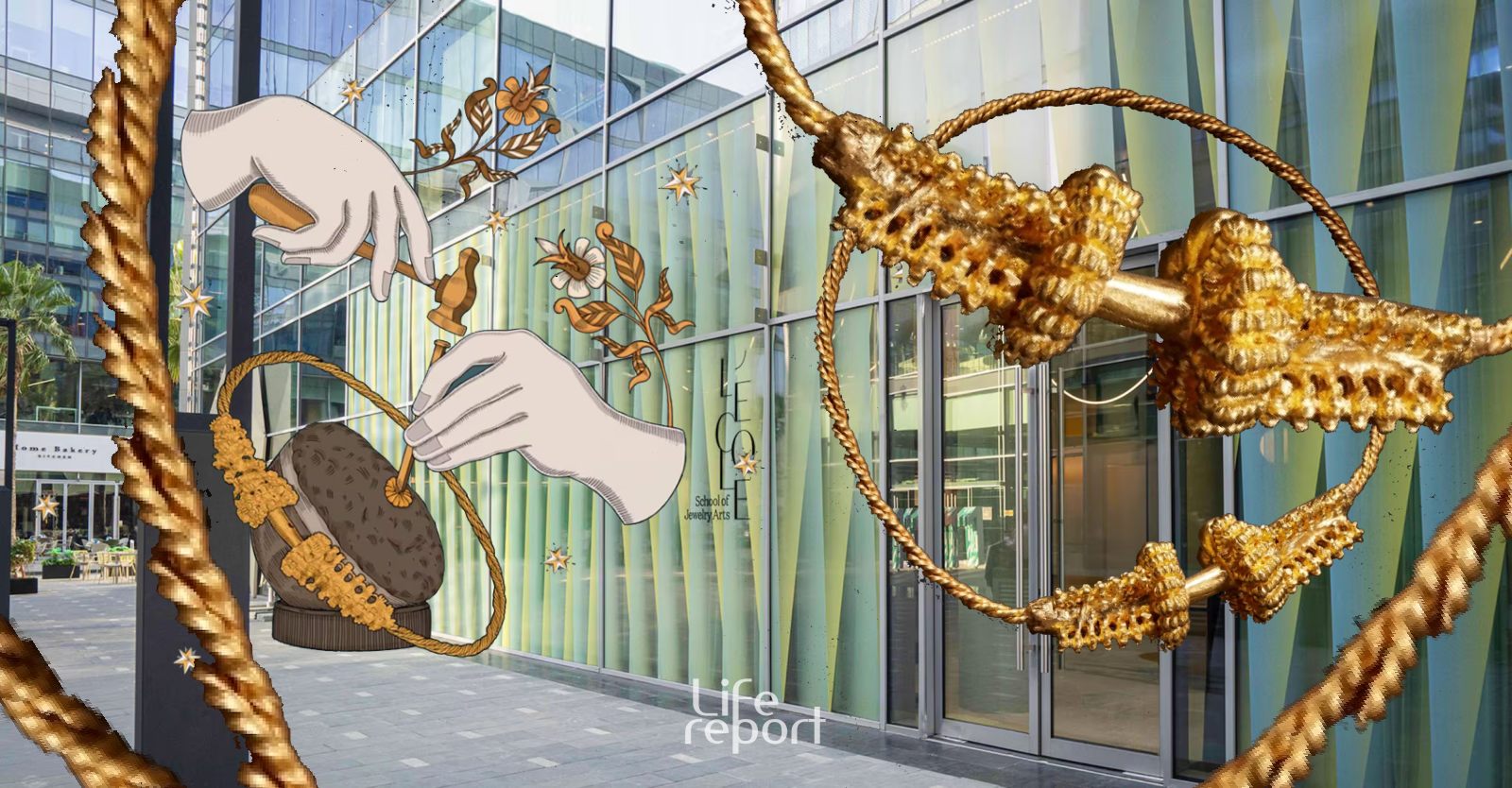
What makes the project compelling, beyond the technical bravura, is its implicit argument about value. A torque is not merely an ornament; it is a statement of power, a marker of identity, a gesture encoded in metal. The Celts wore theirs at the base of the neck, a position of both vulnerability and display. To recreate one is not simply to copy a shape, but to inhabit a way of thinking about the body, about adornment and about the relationship between the hand and the material it transforms. Antoine Legouy described the challenge as one of “following in their footsteps” – a phrase that, in the context of a Dubai exhibition, acquires a certain resonance. This is a city that has spent five decades sprinting away from its past. Here, for six months, it will pause and consider what it might mean to walk backwards, carefully, into the darkness of the Iron Age.
All proceeds from L’École Middle East’s public courses and talks are donated to Dubai Cares, supporting youth education programmes – a reminder that the most valuable thing one can transmit across time is not gold, but knowledge. The torque will eventually return to its case. The gesture, with any luck, will not.
ALSO READ: Pomellato’s Stile Libero: The High Jewellery Collection Breaking Every Luxury Rule