With around twenty monumental works scattered among pines and infinity pools, the Habsburg scion and curator Stefan Stoyanov have created a quietly subversive open-air gallery on the Bulgarian Riviera – where imperial lineage meets contemporary cool.
The late afternoon sun on the Black Sea coast arrives with a certain cinematic generosity, slicing through the maritime pines and splashing across the polished flank of a stainless steel giant that seems to have grown organically from the lawn of Vaya Beach Resort. For one long, suspended moment, the sculpture holds a perfect reflection of a passing cloud, then shifts as the light tilts, transforming into a liquid mirror of burnished gold. A dragonfly, fooled by the illusion, taps the metal with a faint, crystalline ping. This is the quiet theatre of Double Trouble Art Series I, the new open-air exhibition that has turned a discreet luxury hideaway into the most elegant sculpture park.
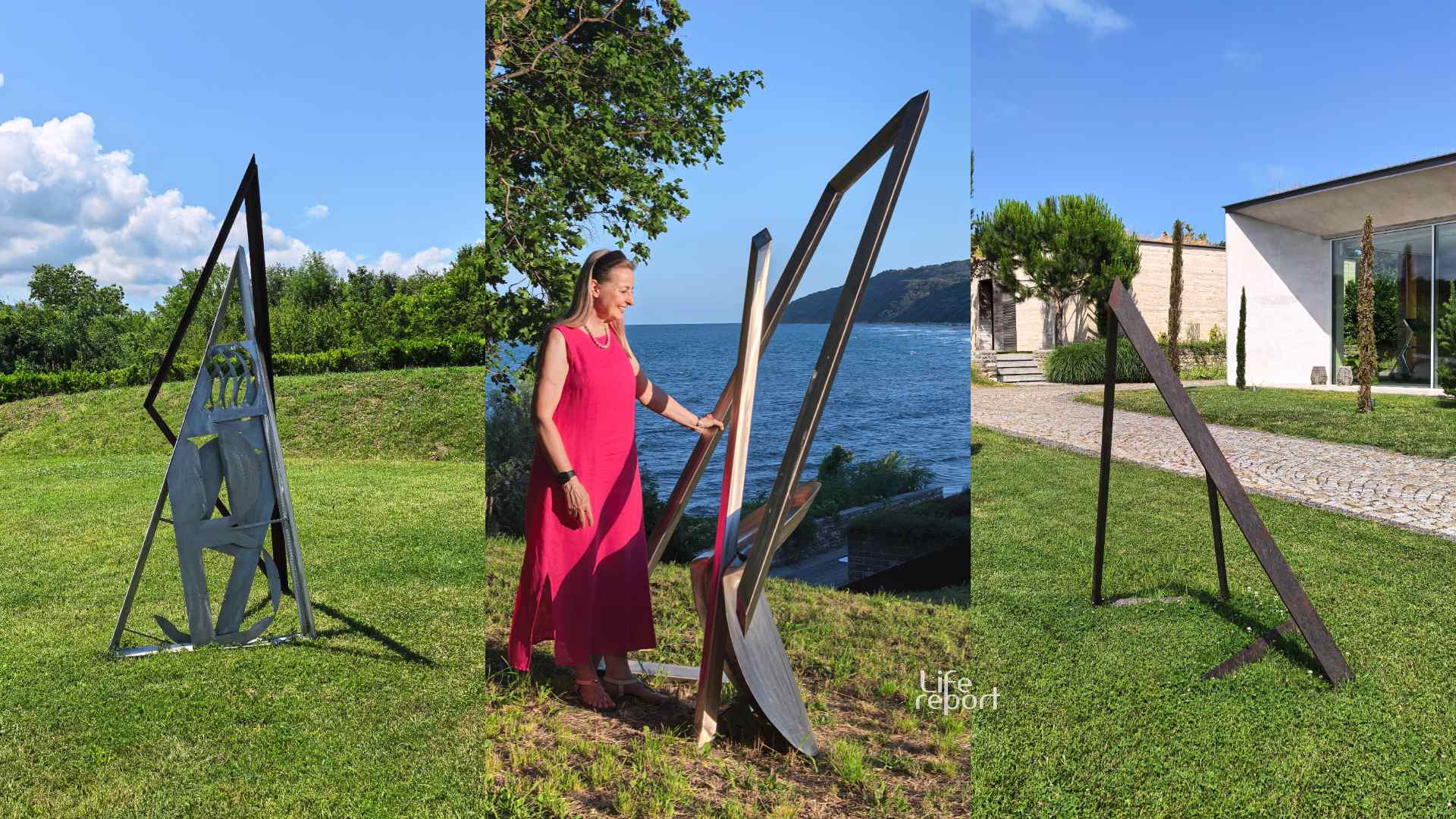
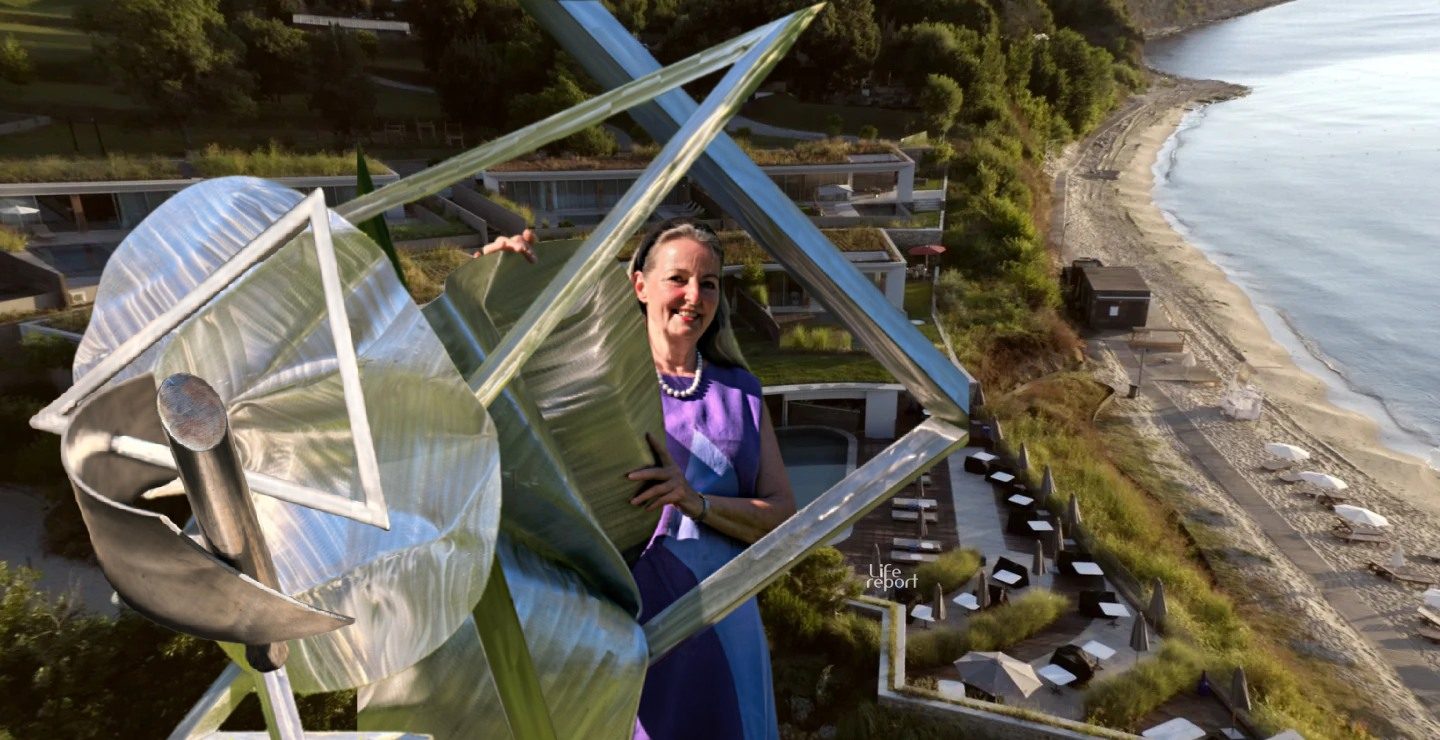
Curated by the peripatetic art dealer Stefan Stoyanov, the show places around twenty medium- and large-scale works by Gabriela von Habsburg across the resort’s grounds, turning a stroll from the cabana to the sea into an unhurried cultural pilgrimage. It is the artist’s second major exhibition in Bulgaria – her first solo exhibition in the country debuted in 2021 – but the first to be so intimately woven into the fabric of a destination designed for the sensuous deceleration of time. Here, stainless steel becomes a medium not of cold industrial prowess but of almost painterly responsiveness, its mirror-finished surfaces breathing with the weather and the passing hours.
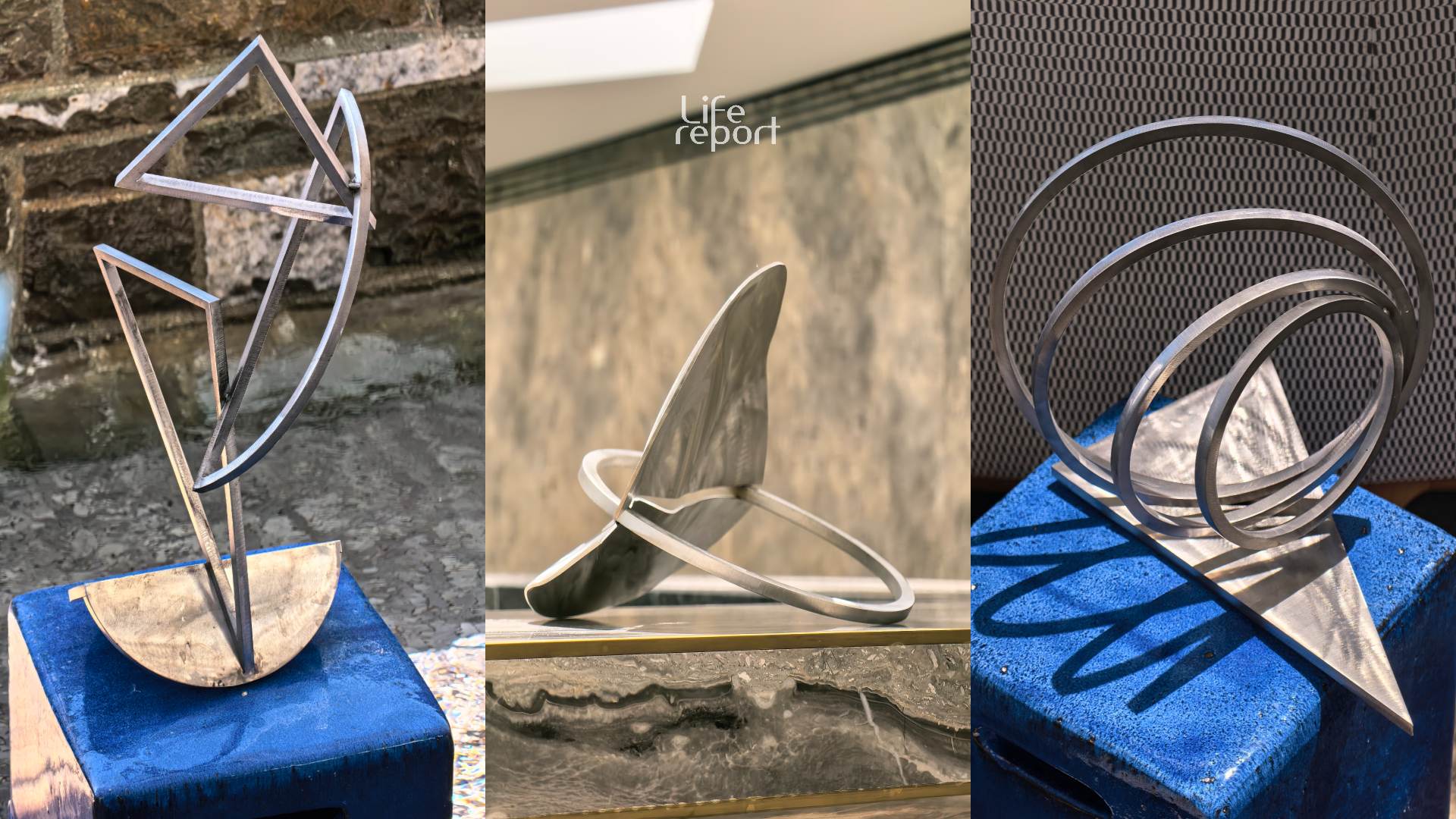
Gabriela von Habsburg, the granddaughter of the last Austrian emperor, speaks of the material with the ardour of a winemaker describing a cherished vintage. Stainless steel, she notes, is a shape-shifter: it catches the sun with the precision of a polished gemstone, casts a shadow as sharply drawn as a charcoal sketch, and changes its countenance with every passing cloud. For her, the true protagonist is the space between the folded geometric volumes – the invisible architecture of negative form that gives a sculpture its breath. In works titled Pythagon, Metamor, Niseko and Paki, sharp-edged planes intersect, hover and embrace in compositions that feel both mathematically rigorous and surprisingly tender. Stand close, and the hand-finished welds reveal a surface with the lustre of a Grand Seiko’s Zaratsu polish – artisanal, obsessive and quietly luxurious.
View this post on Instagram
The vocabulary is unapologetically Constructivist, a lineage that traces back to the utopian experiments of Naum Gabo and Antoine Pevsner, for whom industrial materials became the syntax of a new world. Yet Gabriela von Habsburg’s idiom is less manifesto than meditation. In an era when stainless steel has become the darling of both blockbuster art – Jeff Koons’s bauble-perfect Rabbit, Anish Kapoor’s selfie magnet Cloud Gate – and the superyacht set, her work occupies a rarefied middle ground. It tempts the lens with its flawless sheen but rewards only those who circle it slowly, noticing how a sculpture named Gesmis seems to dematerialise at its edges when the mist rolls in from the sea. It is, one might say, an antidote to the scrolling gaze: a steel-forged invitation to look longer.
The title of the series, Double Trouble, arrives with a wink and a pedigree. Stefan Stoyanov, a Bulgarian-born curator who divides his time between New York and Europe, drew inspiration from a beloved painting by the Bulgarian artist Miryana Todorova. But the name also carries a deliciously ironic second layer: the “trouble” of managing two high-born creators who defied centuries of protocol to pursue their métier. Until the 1960s, the notion of a member of a royal family exhibiting as a professional artist was virtually taboo – a peculiarity discreetly hidden behind palace walls. Gabriela von Habsburg, who honed her craft in Munich’s rigorous ateliers, far removed from the gilded expectations of her lineage, and Sheikh Rashid Al Khalifa, the other artist represented by Stoyanov, both broke that unwritten rule. In an age when every minor aristocrat with a smartphone considers themselves a content creator, a genuine Habsburg who mastered TIG welding is almost a form of dynastic redemption. The trouble, it turns out, was worth it.

The setting amplifies the frisson. Vaya Beach Resort, nestled where the mountains fold into the Black Sea, is a low-slung sanctuary of sun-bleached timber, locally quarried stone and vanishing-edge pools that appear to pour directly into the horizon. Its architecture – a modernist whisper with a Thracian soul – provides a tactile counterpoint to the sleek metal forms. Where a sculpture like Metamor – a poised, angular creature from 1994 – rises from a bed of wild grasses, the contrast between machined perfection and unruly nature creates a composition that feels both considered and serendipitous. The siting is strategic: each work calibrates a distinct relationship with the light at different times of day, offering the early riser and the sunset cocktail aficionado entirely different chromatic experiences.
This is precisely the kind of cultural alchemy that speaks to the luxury travel zeitgeist. The Millennial and Gen Z vanguard, raised on a diet of experiential hospitality and Instagram geotags, has developed a radar for places where art is not a decorative afterthought but a reason to book a flight. Vaya’s sculpture park delivers the ultimate win: a supremely photogenic backdrop that, with gentle irony, coaxes visitors to forget the phone in their hand. The gleam of the steel against the cobalt sea is, undeniably, the Platonic ideal of the travel gram. Yet the deeper pleasure lies in the sensory slow dance – the scent of pine resin mingling with salt air, the drone of cicadas underscoring the silence between forms, the way a piece like Paki holds a penumbral secret within its interior fold that no camera can capture.
Stefan Stoyanov, who has long championed the placement of monumental art in unexpected locations, understands the quiet subversion at play. The Double Trouble series positions the Bulgarian Riviera as a new node on the cultural map, far removed from the white-cube orthodoxies of Basel or Mayfair. It is a gambit that transforms a resort into an al fresco Wunderkammer, where contemporary sculpture is as elemental as the sea itself. And it plants a flag for a future in which such artistic interventions are not seasonal pop-ups but permanent dialogues between place and perception.
As dusk bleeds into the water and the steel sentinels turn from gold to violet to ink, von Habsburg’s empire of reflections reveals its final, most elegant trick. The Habsburg name, once synonymous with the grand geopolitical chessboard of Mitteleuropa, now finds resonance in an entirely different grammar of power – one measured in millimetres of welded precision, in the weightlessness of a shadow, and in the charged stillness between two slabs of polished metal. For a new generation of cultural nomads, that is a legacy worth travelling for.