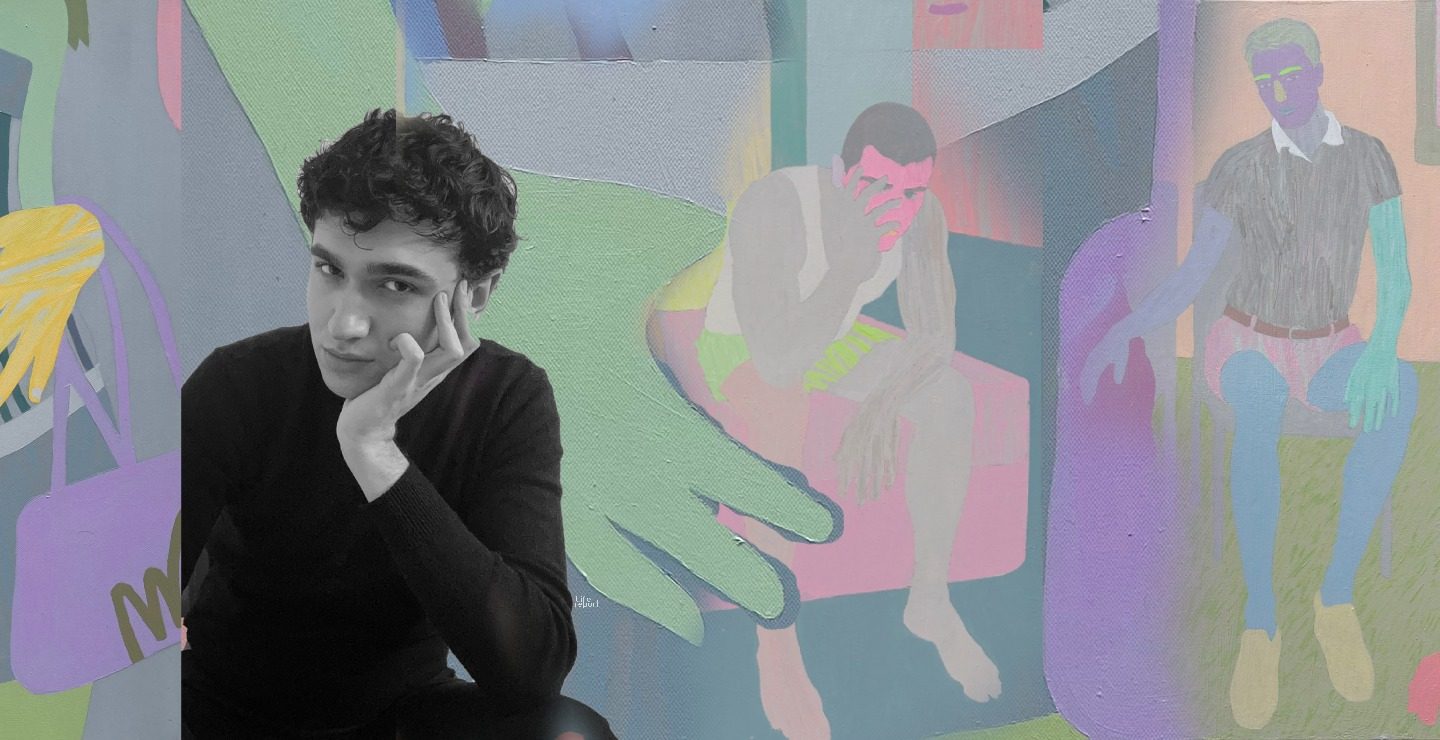
Artist Samuil Velev makes paintings that behave like editorials: composed, styled, quietly theatrical and almost insolently sure of their own allure. The Bulgarian artist has already moved through fashion, an exchange at Milan’s Brera Academy, a residency in Madrid and the more treacherous terrain of other people’s assumptions. He has emerged with a practice that treats the canvas as a place where looking becomes a form of trespass. His figures do not explain themselves. They arrange their limbs, their clothes and their proximity, then leave the rest to you – which, in an age that treats every image as an invitation to comment, is either an act of generosity or a very elegant trap.
Velev trained in painting at the National School of Fine Arts “Ilia Petrov” before enrolling in fashion at the National Academy of Art in Sofia, a detour that lasted four semesters and left a permanent residue. “I enrolled in fashion because I felt the need to explore something else,” he says. “But even with such an intensive programme, I spent all my free time painting.” His return to painting was less a conversion than a correction. Fashion, however, did not leave empty-handed. “Fashion influenced the way I approach a project, and I often treat my images like editorials, styling the figures’ clothes and surroundings.” You can see it in the way a sleeve falls, the deliberate awkwardness of a pose, the sense that someone has been dressed for a scene that has not yet been written.
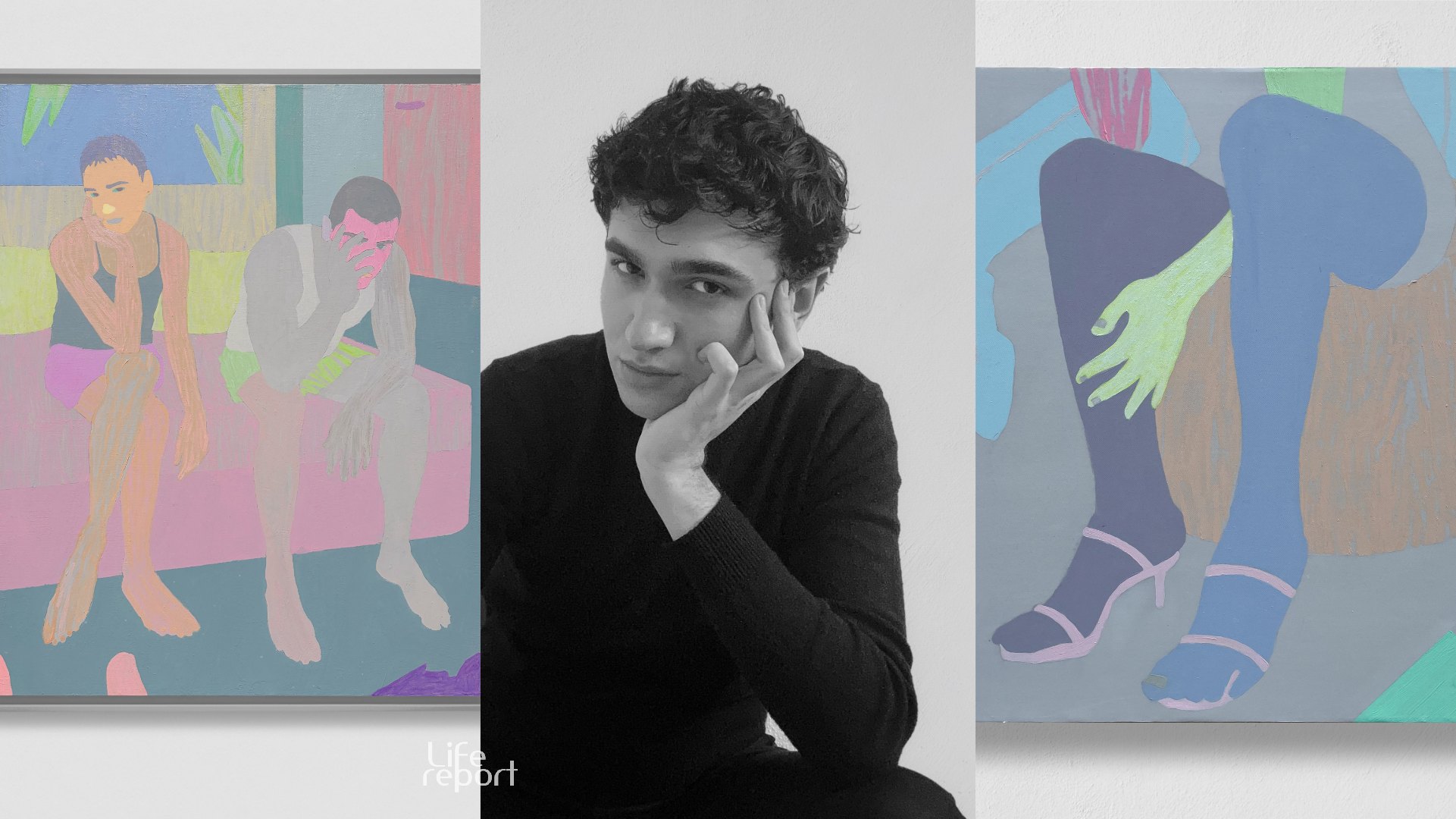
His debut exhibition, Stranger, comprised 44 works on canvas and paper and announced a preoccupation with public perception: how quickly we assemble a person from surface evidence. Between Two, his second solo exhibition, opened at Intro Gallery in Sofia on 9 December 2025 and ran until 7 January 2026. Six large canvases and four smaller ones stage encounters that feel at once intimate and staged, with full figures and fragments sharing a frame with the polished inevitability of a fashion spread and the unease of a documentary photograph taken without consent. The curator Boyana Raycheva described the series as an invitation to consider “how we judge the relationships between people and the extent to which our impressions reflect our own experience, beliefs and fears”. Velev puts it more plainly: “I’m interested in how quickly we form opinions about people based on what we see. I construct the images carefully, but I don’t want to tell the viewer exactly what to think.”
The gap between looking and assuming is his real subject, and he tends it with the patience of a gardener who knows the weeds will come anyway. He leaves the narrative unresolved on purpose, though he admits to a quiet reciprocation: “I make my own assumptions about them based on their interpretations.” It is a neat inversion of the gallery contract, the artist watching the watchers, and it lends the work a faintly ironic shimmer that suits the current mood of a collector class raised on Instagram and trained to read a room in half a second.
Younger collectors are becoming an increasingly consequential audience for the Gulf’s art market. In June 2026, Christie’s managing director for the UAE said that 44 per cent of the house’s UAE clients were millennials or younger, compared with 28 per cent globally. Velev’s paintings are built for exactly the double life that such a market demands. They photograph beautifully – graphic, seductive, full of unresolved tension – but withhold the resolution that a thumbnail cannot supply. “For me, a hand-painted image has a presence that an AI-generated image, or even a photograph of the painting, can’t fully reproduce,” he says. “Seeing my work online gives you an idea of what the experience might be like in person, but it can’t replace it.” In a region where the digital-first encounter is the default, that is not a nostalgic complaint but a quiet commercial advantage: the screen advertises, the surface delivers.
View this post on Instagram
The surface has been changing. Velev’s practice has ranged across canvas, paper and mixed media and, most recently, polyurethane fabric, a material whose plastic sheen becomes part of the argument. His fourth solo exhibition, Object of Mine, opens at Atelier Trotoar in Sofia on 3 November 2026 and runs until 26 November. It comprises eight paintings that isolate body parts and gestures, removing them from the whole so that they acquire an unsettling independence. The series draws on Audre Lorde’s Uses of the Erotic: The Erotic as Power and examines the contradiction between sexualisation as a form of constraint and desire as a route to self-possession. “The series explores body parts and aspects of the human gaze that are often sexualised and objectified,” Velev says. “It looks at how these same things can become grounds for oppression, particularly for femme-presenting people and explores the possibility of reclaiming the objectified body.” The polyurethane surface, with its synthetic skin, completes the thought: the body turned into material, the material turned back into a body, the whole exchange conducted under the sign of the gaze.
Madrid helped him get there. His residency at La Tercera Nave produced nine paintings across three connected series – What Are You Looking For?, Handle and Reached – and, perhaps more importantly, forced him to acknowledge that the studio is not a hermitage. “It mostly helped me develop my communication skills and taught me the importance of networking,” he says. “I realised that building relationships with people is just as important as developing the work itself.” It is the kind of admission that would have sounded cynical a decade ago and now sounds merely professional, which may be the more damning observation. The romantic figure of the painter alone with the muse has been replaced by the painter who understands that a career is a collaborative fiction, sustained by galleries, collectors, fair directors and the occasional journalist who knows how to ask a question without answering it first.
The fair circuit has followed. Arma Gallery presented Velev at Contemporary Art Now in Madrid from 5 to 8 March 2026, where his work was singled out in El Periódico Gentleman’s preview of the fair’s tenth-anniversary edition at Matadero Madrid. From 5 to 8 November, he is due to appear at ByInvitation in Barcelona, the art fair held at the Círculo Ecuestre, bringing three works that extend Between Two and three from Object of Mine. The distinction between a fair and a solo show is not lost on him. “A solo exhibition is much more intimate and focused on a single concept,” he says. “At an art fair, the works don’t necessarily need to be connected, and you have to communicate more about your practice as a whole.” It is a diplomatic answer to an undiplomatic reality: the fair is where the practice becomes a proposition, and the proposition had better be legible by the second glass of cava.
View this post on Instagram
Velev’s career has been accelerated by a network of Bulgarian support that is worth noting precisely because it is not the kind of thing that usually makes it into the glossy narrative. He won the Stoyan Kambarev Foundation’s Visual Arts award in 2025, and a project grant from collector Nikolay Nedelchev helped fund Between Two. “All of that support helped me build my career,” he says, “but probably international gallery representation made the biggest change.” The hierarchy is telling. Institutional trust, local patronage and community matter, but the door that opens onto the wider market is the one held by a gallery with a passport.
What that market will make of him is still being written. Velev is young enough to be described as “emerging”, a word that has the useful quality of meaning everything and nothing, and old enough to have already developed the one thing that cannot be taught: a recognisable way of withholding. His figures are imagined but never vague; his scenes are styled but never merely decorative; his surfaces are seductive but never entirely comfortable. He is, in other words, a painter for people who have learned to distrust the image and cannot quite stop looking at it anyway. “A genuine leap forward,” he says, “would be developing a project that takes my practice somewhere I haven’t explored before.” The next room is always the one he has not yet painted. The rest of us are invited to stand in the doorway and assume.
ALSO READ: The Cosmos on Your Wrist: Why Jaeger-LeCoultre’s Five-Piece Masterpiece Is the Ultimate Quiet Flex for Dubai’s Discerning Few