The white cube is dead. Long live the street corner, the promenade, the unassuming patch of gravel between two museums that cost more than a small nation’s GDP. Abu Dhabi, a city that has spent the better part of two decades acquiring cultural infrastructure with the quiet determination of a collector filling a wall, has now turned its attention to something far more slippery: the spaces in between. The second edition of the Public Art Abu Dhabi Biennial, running until 15 February 2027, is a nearly four-month experiment in what happens when contemporary art is untethered from the velvet rope and left to fend for itself among the fishermen, the flâneurs and the Ferraris.
The timing is not accidental. Christie’s held its first dedicated fine-art auction in Abu Dhabi on 1 November, realising $8.94 million, with more than 30 per cent of registrants belonging to the Millennial and Gen Z generations – a statistic that should make every heritage-brand boardroom in Europe sit up a little straighter. The Guggenheim Abu Dhabi, designed by the late Frank Gehry, finally opens its doors on 11 December after two decades in the making. The Saadiyat Cultural District, long regarded as an exercise in architectural ambition, is finally taking shape as a cultural neighbourhood. And into this ecosystem of blockbuster museums and auction-house theatre steps a biennial under the artistic direction of Elvira Dyangani Ose, presented under the deceptively gentle title Home: A Glossary for a Communal Sense of Place. It is a curatorial framework that could easily have dissolved into sentimentality. Instead, it has produced a handful of works that are genuinely worth rearranging an afternoon for – which, in a city of air-conditioned alternatives, is the only review that matters.
View this post on Instagram
Agora: A Dance of Umbrella Forests by blaxTARLINES
The first stop is Souq Al Mina, where a forest has grown out of the asphalt. AGORA: A Dance of Umbrella Forests by blaxTARLINES, the open-source collective and pedagogical network based at the Kwame Nkrumah University of Science and Technology in Kumasi, Ghana, is exactly the kind of proposition that sounds whimsical on paper and quietly devastating in person. A cluster of Ghanaian royal umbrellas – the kyiniyɛ, traditionally a symbol of kingship – has been reimagined as civic architecture: a portable agora for gathering, play and the kind of unscripted conversation that the experience economy has largely eradicated. The installation’s layout draws inspiration from the historical routes of the Underground Railroad, the nineteenth-century network of safe houses that helped enslaved people escape the American South. The title itself is lifted from Wole Soyinka’s landmark 1960 play A Dance of the Forests, a work preoccupied with the debris of history and the impossibility of a clean inheritance.
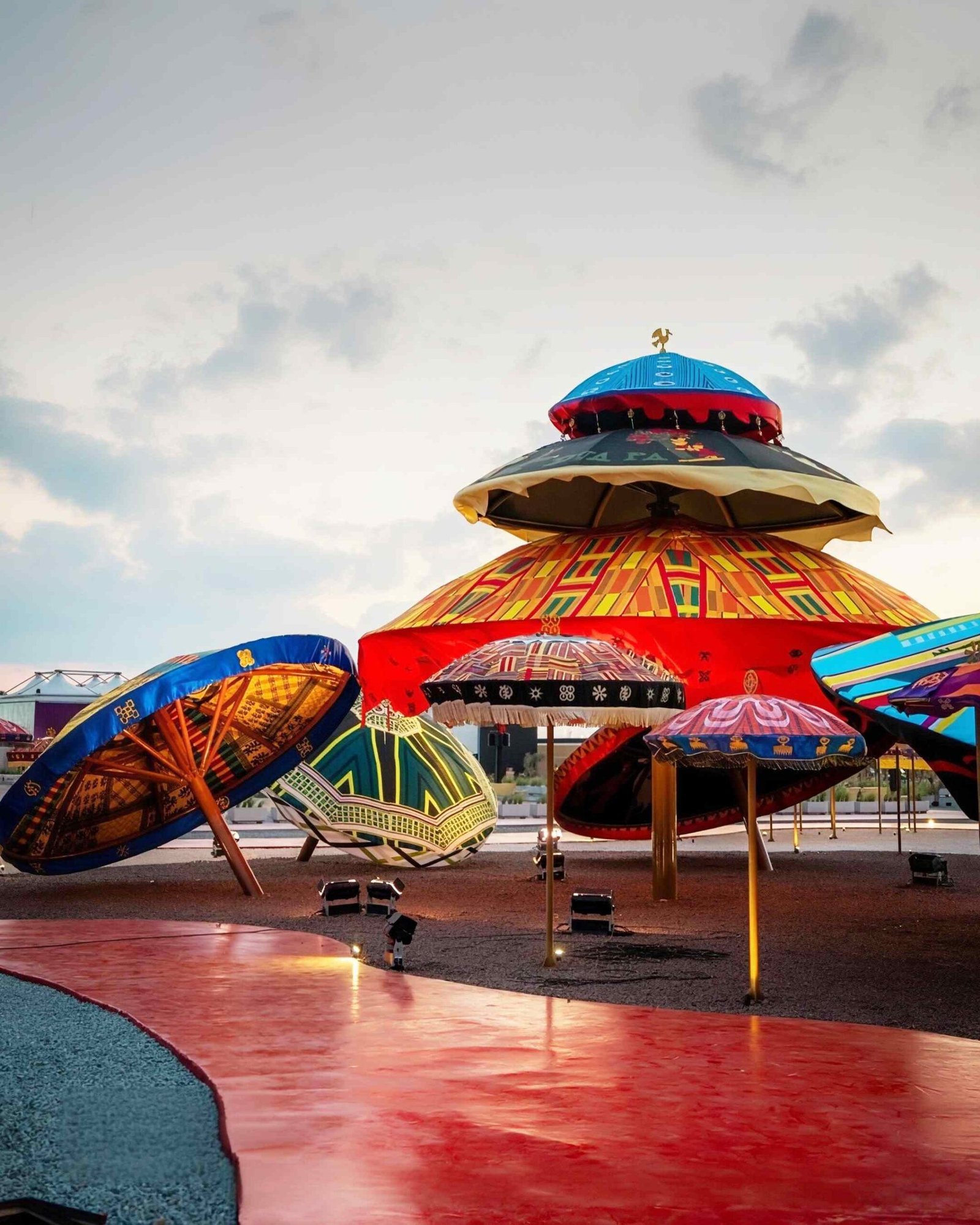
Agora: A Dance of Umbrella Forests by blaxTARLINES at the Public Art Abu Dhabi Biennial 2026
What makes the installation more than a pretty canopy is its refusal to sentimentalise ‘home’. It creates a shared civic space in which Ghanaian and Emirati traditions of leadership are brought into dialogue. The umbrellas are regal and slightly absurd, their shadows falling across a port district that has seen more than its share of arrivals and departures. To stand beneath them is to be implicated in a conversation about leadership, solidarity and the portable nature of self-governance. In a city where the skyline is a monument to permanence, a civic space that can be folded up and moved is a quietly radical gesture. blaxTARLINES, which has featured in ArtReview’s Power 100 every year since 2022 and participated in documenta fifteen, understands that the most sophisticated critique of monumentality is often the one that fits in a suitcase.
Gargour by Khalid Al Banna
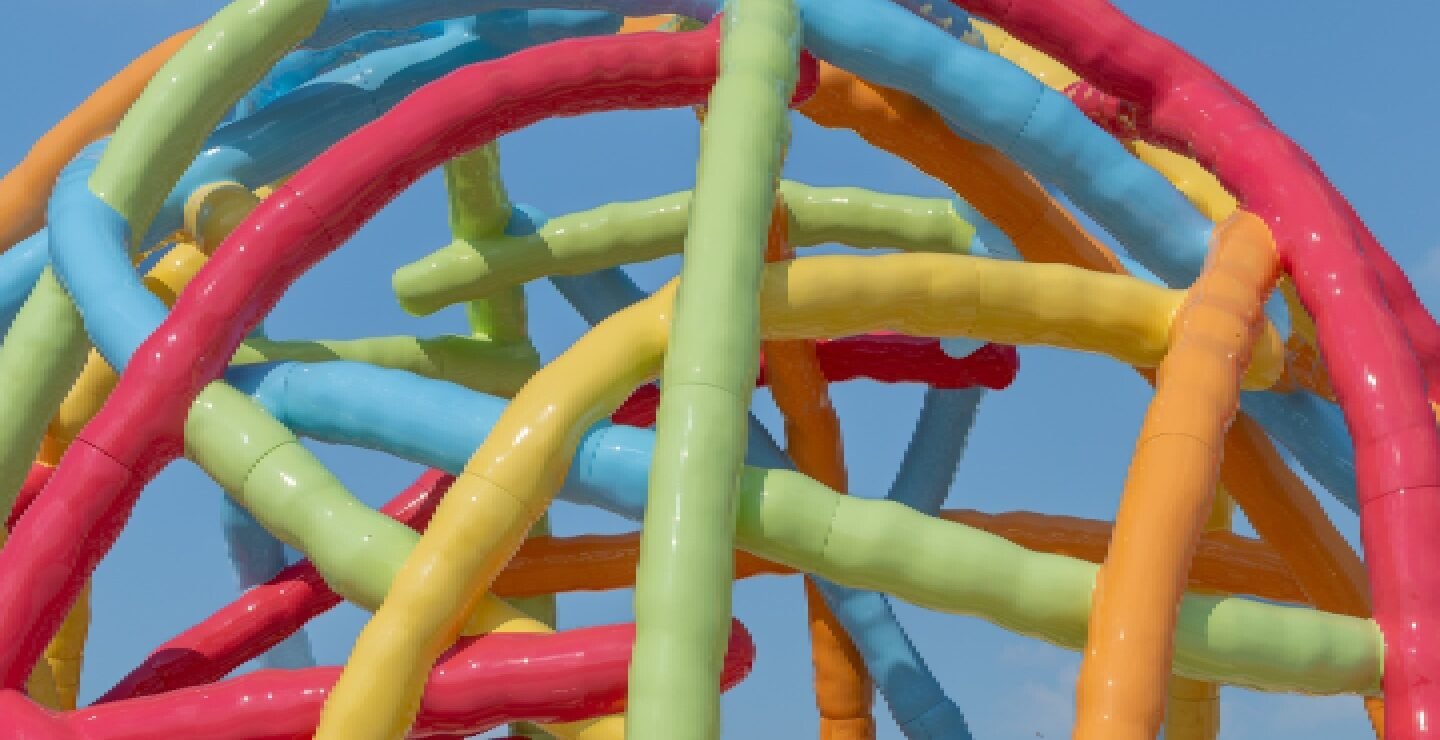
A few minutes’ walk away, Khalid Al Banna has turned a fishing trap into a lesson in negative space. Gargour reimagines the traditional Emirati fishing trap – a familiar symbol of the region’s maritime heritage – through the language of architectural engineering, which is Al Banna’s academic background. Made from painted fibreglass, the sculpture renders the trap’s inner void as its central subject, a hollow that shapes perception as forcefully as any solid. The palette consists of soft primary and secondary colours – red, orange, yellow, green and blue – that deliberately distance the object from its utilitarian origins and place it in conversation with the abstract sculptural traditions of the twentieth century. But there is a wit here, too: the gargour is a device designed to contain, and Al Banna has made containment visible by emptying it out. The trap catches nothing but air, and in doing so, it catches the viewer.
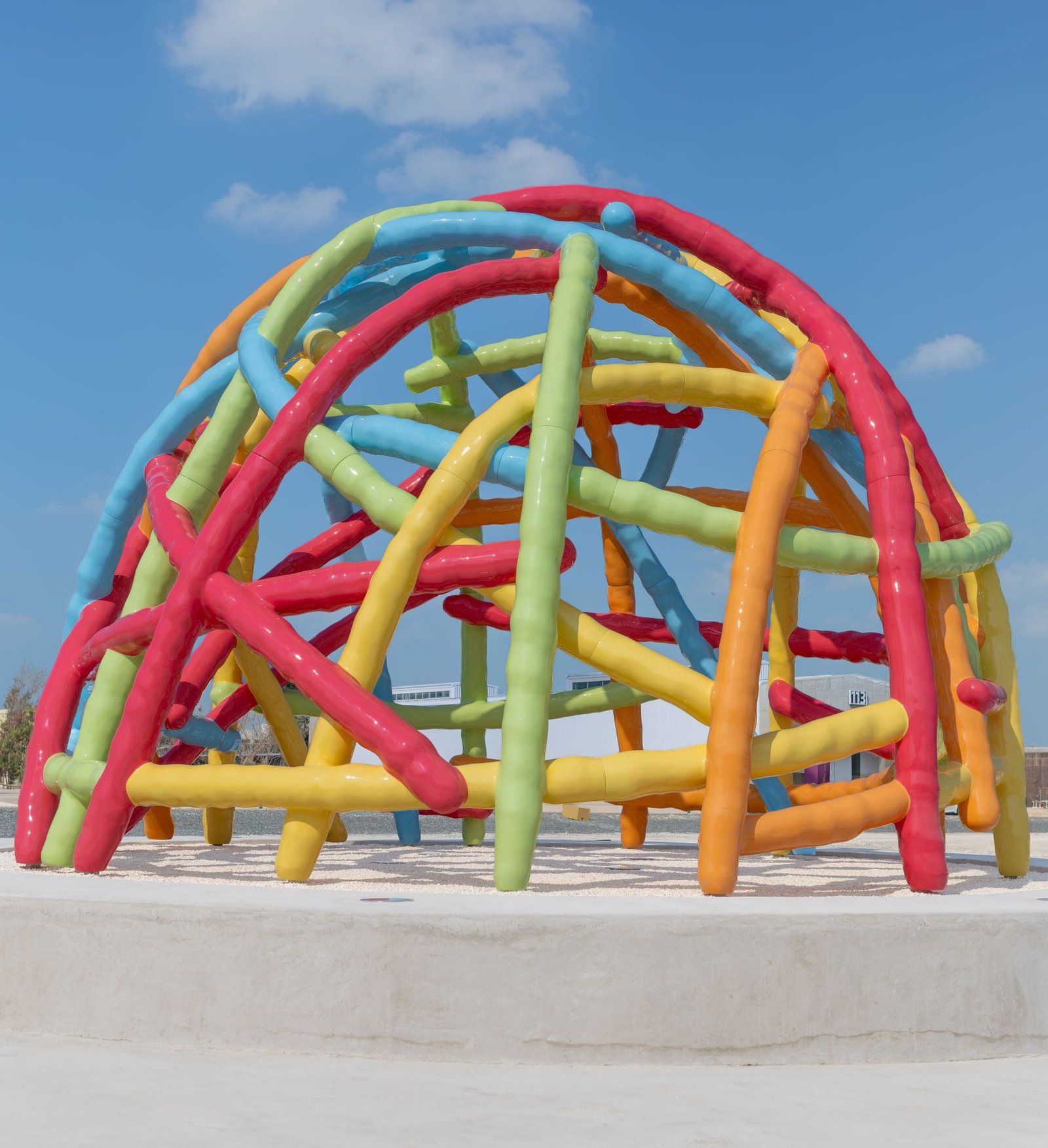
Gargour by Khalid Al Banna at the Public Art Abu Dhabi Biennial 2026
Al Banna’s background in architectural engineering gives his work a structural rigour that is rare in public art, where scale often substitutes for substance. His previous projects – including Union of Artists, commissioned by Dubai Culture, Dhai Dubai at Expo City Dubai, a public-art commission for Art Dubai 2026 and the Tanweer Festival in Mleiha, Sharjah – have established him as an artist who understands that a sculpture is not simply an object but a system of relationships. Gargour is a system of relationships with memory, too. The trap is an object associated with the pre-oil maritime economy, but it is also a form that has been reimagined through generations of lived experience. To see it enlarged and abstracted is to understand that heritage is not a fixed asset to be curated but a living material that can be bent, welded and repainted. The colours are a quiet rebuke to the beige minimalism that passes for luxury in too many Gulf interiors.
Figurines by Iván Argote
Iván Argote, meanwhile, has built a seesaw. It is fifteen metres in diameter, and it is the most honest piece of social sculpture in the emirate. At Souq Al Mina, the Colombian artist presents installation, Figurines, is a sculptural landscape comprising seven works inspired by archaeological objects from sites across Abu Dhabi, including Umm Al Nar and Jebel Hafeet. Enlarged from the scale of museum artefacts to human dimensions, these forms become inhabitable spaces for sitting, climbing and gathering. The logic is simple and subversive. Archaeological artefacts are typically presented as precious, fragile and untouchable – objects that belong to the past and to the institution. Argote has transformed them into furniture for the present. The past, in his hands, is not a diorama but a playground.
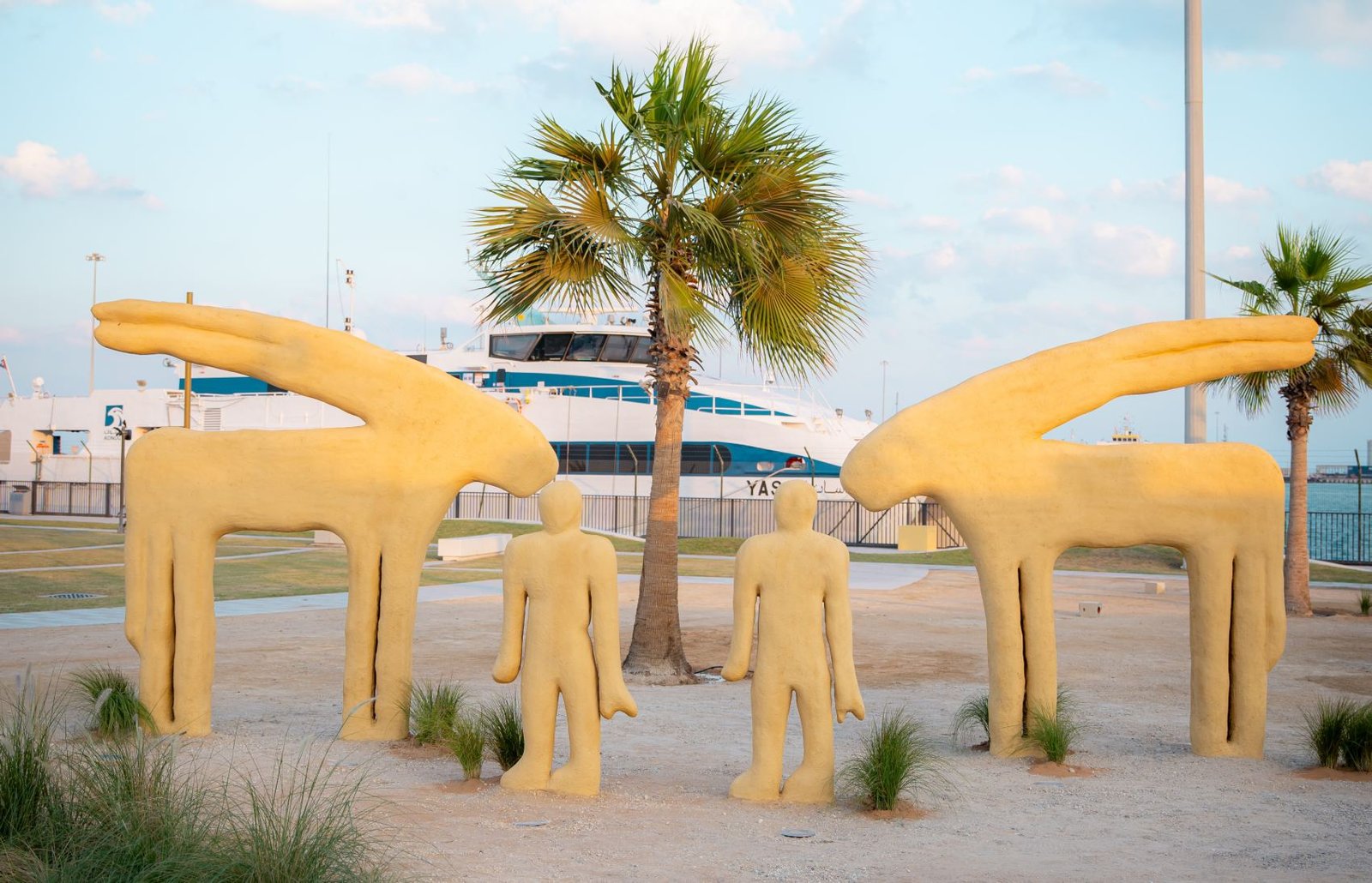
Figurines by Iván Argote at the Public Art Abu Dhabi Biennial 2026
The seesaw, meanwhile, challenges another contemporary habit. The selfie-industrial complex has trained audiences to approach installations as backdrops for individual portraits; a seesaw makes that impossible. You cannot pose on a seesaw without noticing the other person. Argote’s practice, which has been presented at the Palais de Tokyo, the Centre Pompidou and the 60th Venice Biennale, is built on this kind of poetic intervention – humour and tenderness deployed against the granite of official memory. In a city that has often preferred its history polished and framed, Figurines is a reminder that the past was once messy, tactile and shared.
Ground Break Duty by Nari Ward
At MiZa, in Mina Zayed, Nari Ward has built a boat out of rebar, and it is the most elegiac object in the exhibition. Ground Break Duty recreates the outline of a traditional dhow in steel reinforcement bars, copper, concrete blocks, fishing nets and locally gathered found objects. The dhow is the vessel that made the Gulf a zone of exchange long before the first glass tower was poured; the rebar is the material of the city that replaced it. Ward’s genius is to hold both in the same frame. The work does not resolve the tension between the maritime past and the terrestrial present. It lets the two rust together.
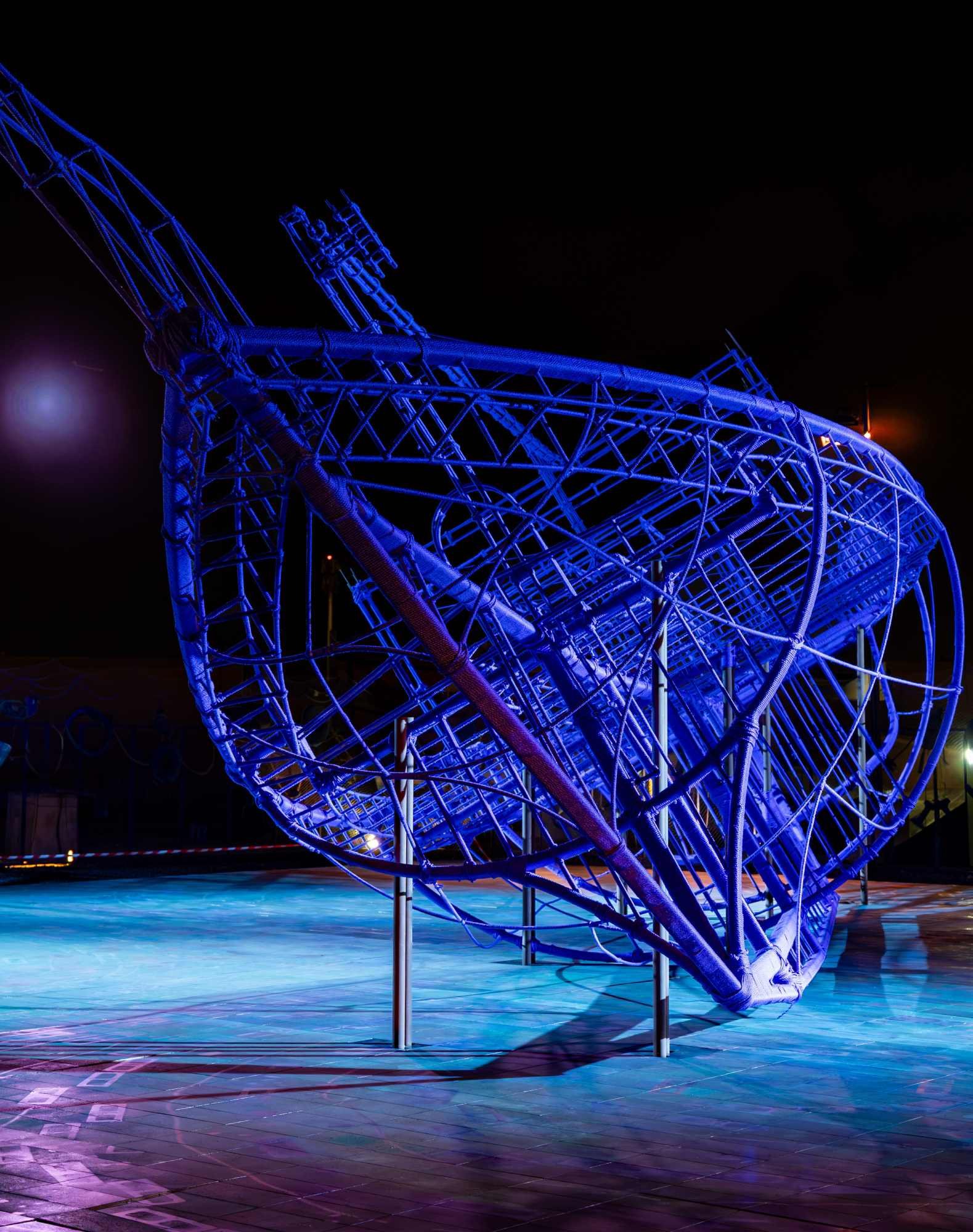
Ground Break Duty by Nari Ward at the Public Art Abu Dhabi Biennial 2026
Ward, a Jamaican-born, New York-based artist whose assemblages transform discarded objects collected in his Harlem neighbourhood, has earned a place in the collection of the Museum of Modern Art and presented a major survey at the New Museum in 2019. He is a poet of salvage. His practice transforms discarded materials into vessels of memory, and Ground Break Duty extends that logic to an entire port city. Mina Zayed is itself a palimpsest – a working harbour, a design district, a site of constant reinvention. The copper ground from which the dhow rises is the colour of old coins and new money. The fishing nets carry the ghosts of labour. The rebar is the skeleton of every tower that now shadows the water. To walk around the installation is to feel the strange dignity of repair, the idea that a city is not a finished product but a continuous act of reclamation. In a biennial devoted to ‘home’, Ward offers the most unsentimental definition of the term: home is what you build from what is left over.
Wind Sculpture (TG) III by Yinka Shonibare
Finally, in the Saadiyat Cultural District, Yinka Shonibare has done what Yinka Shonibare does best: made a beautiful object that is also a trap for the unwary. Wind Sculpture (TG) III, installed in the outdoor grounds of Zayed National Museum, captures the billowing form of a sail caught mid-gust. Its hand-painted surface brings together his signature Dutch wax-print motifs – inspired by Indonesian batik, industrially produced by Dutch manufacturers and subsequently embraced across West Africa – with Emirati Al Sadu motifs, drawn from the centuries-old Bedouin weaving tradition. Traditionally woven from camel hair, goat hair or sheep’s wool, Al Sadu is distinguished by its geometric patterns and deep connections to desert life. The result is a visual language that refuses to sit still. Dutch wax prints are themselves artefacts of colonial circulation, textiles that became ‘African’ through a series of commercial accidents and acts of cultural appropriation. Al Sadu, meanwhile, is a craft rooted in the desert, now finding its way into contemporary fashion and luxury interiors. To bring these traditions together across the sail-like form of a sculpture is to propose that cultural identity is not a root but a route.
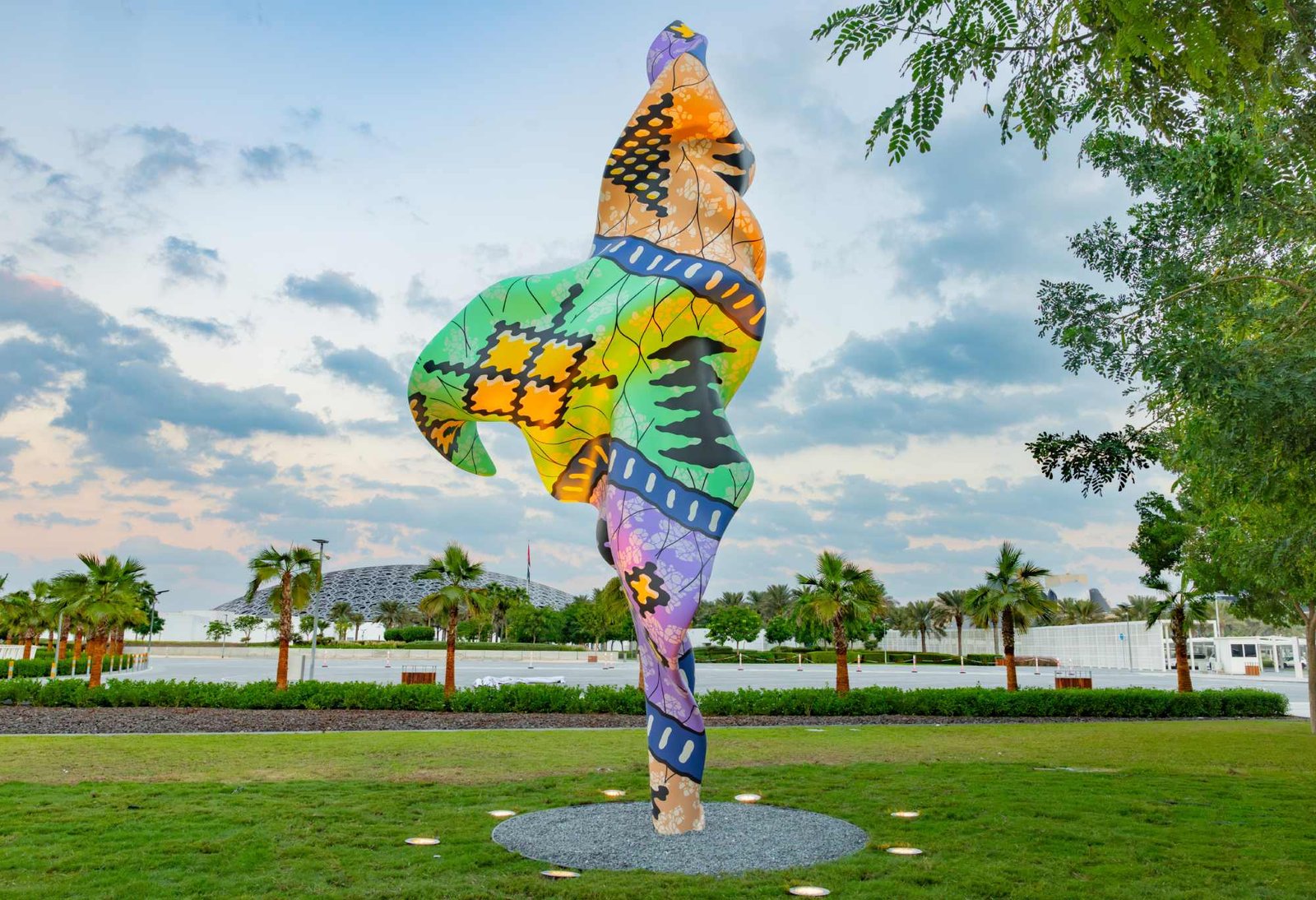
Wind Sculpture (TG) III by Yinka Shonibare at the Public Art Abu Dhabi Biennial 2026
Shonibare, a Turner Prize nominee, Royal Academician and veteran of the Venice Biennale, has spent his career exposing the fiction of the ‘authentic’. Wind Sculpture (TG) III is a monument to circulation – of people, ideas, textiles and power. The sail is a form that only makes sense in motion, and the sculpture’s apparent lightness belies its conceptual weight. In a city that is itself a meeting point of Indian Ocean trade routes, Bedouin heritage and hyper-contemporary global capital, the work feels less like an import than a mirror. It is also, frankly, a pleasure to look at – and there is no shame in admitting that public art should sometimes be beautiful. The trick is to be beautiful and rigorous at the same time, which is precisely what Shonibare has managed.
The Public Art Abu Dhabi Biennial is not a perfect exhibition. Public art never is. The works compete with traffic noise, with the vagaries of the weather, with the indifference of passers-by who have not read the wall text. But that is the point. Dyangani Ose’s ‘glossary’ is not a thesis to be mastered but a set of propositions to be tested in the open air. The biennial’s free-to-visit installations and their dispersal across Souq Al Mina, MiZa, Hidd Al Saadiyat and the park between the Zayed National Museum and Louvre Abu Dhabi are an invitation to treat the city as a collection – not of objects, but of encounters.
View this post on Instagram
For a generation of Emirati and expatriate millennials and Gen Z who have grown up with the Louvre on their doorstep and Christie’s in their Instagram feeds, this is the cultural infrastructure that matters. Not another air-conditioned gallery, but a reason to walk. Not another masterpiece behind glass, but a seesaw that requires a partner. The biennial understands that the luxury of the future is not exclusivity but participation, and that the most valuable thing in Abu Dhabi right now is not a painting but a public space that has been thoughtfully, wittily and temporarily reclaimed. The white cube can wait. The city is outside.
ALSO READ: The Painter Who Left Fashion Behind – and Took Its Tricks With Him