Somewhere between the last sip of a salt-rimmed cocktail and the first flicker of evening stars, Bulgaria’s southern Black Sea coast has quietly shed its reputation as a bargain-bin Riviera. This summer, the real currency isn’t a sunbed or a seafront table – it’s a conversation between a Bahraini sheikh’s kinetic aluminium and a local painter’s bruised, emotional blue. At VAYA Beach Resort, a low-slung sanctuary of stone and timber that whispers rather than shouts, the exhibition Double Trouble II has transformed a stretch of shoreline into something far more compelling than a backdrop for the well-rehearsed rituals of leisure. It has become a gallery where Mediterranean light is not art’s enemy – fading pigments and punishing canvases – but its most unpredictable collaborator.
The premise carries the faint whiff of an Architectural Digest fever dream: a royal artist, a rising Bulgarian painter, a self-styled “trouble maker” curator, and a luxury resort that decided its infinity pool needed more intellectual competition. In lesser hands, this could have become an exercise in branded cultural programming, the kind that mistakes a monumental sculpture for a poolside selfie station. Yet Double Trouble II sidesteps cliché with an agility that suggests its curatorial compass is calibrated not by algorithms but by a genuine understanding of space, material, and the quiet drama of the natural world.

ALSO READ: Inside Bahrain’s Cultural Renaissance: A Conversation with Sheikh Rashid Al Khalifa
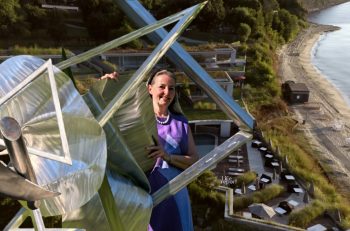
Sheikh Rashid Al Khalifa is no dilettante dabbling in paint between diplomatic engagements. For more than five decades, the Bahraini royal – born in 1952 into a family more accustomed to statecraft than studio floors – has explored the volatile relationship between light, colour and architectural volume with a rigour that has brought his work to London’s Saatchi Gallery, the Venice Biennale, and institutions from Seoul to São Paulo. His signature visual language is instantly recognisable: sweeping aluminium constructions whose undulating, powder-coated surfaces act as both mirrors and mirages. Stand still and the work seems to hold its breath. Shift your weight, and the entire composition recomposes itself, light splintering into fresh geometries. It is Op Art with a Gulf sensibility – kinetic without a motor – as though the sea breeze itself had become the sculptor’s assistant.
At VAYA, these sculptures are not cordoned off with velvet ropes or accompanied by a docent’s script. They rise from the sand, nestle among wild grasses, reflect the pool’s turquoise shimmer and, in one particularly inspired placement, face the open water like sentinels awaiting a ship from Manama. The effect is both disorienting and deeply luxurious – the luxury of attention, of allowing an artwork to perform its slow chromatic transformation while a swallowtail butterfly traces its own erratic flight nearby. For a generation of UAE millennials and Gen Z tastemakers raised on the immersive spectacles of teamLab and the reflective behemoths of Anish Kapoor, Al Khalifa’s work offers a more intimate proposition: spectacle without the crowds, contemplation without the queues.
View this post on Instagram
Enter Mika Sav, whose contribution risks being described simply as “the paintings” – a woefully inadequate label for canvases that behave more like emotional weather systems. Sav’s series of ultramarine works – deep, aqueous and unabashedly romantic – was conceived, she explains, during a period of profound personal upheaval.
“This series was made in a moment that was extraordinarily powerful and emotional.”
Her words carry the specific gravity of an artist who has wrung pigment from catharsis. The blue is not a single note but a chord: Yves Klein’s monochrome mysticism filtered through the bruised light of a Black Sea dusk. Installed within the resort’s cool, white-walled interiors, the paintings become a chromatic counterweight to Al Khalifa’s outdoor shimmer. They are the midnight to his midday, the introspection to his extroversion.
What elevates Double Trouble II from a well-meaning entry on the summer cultural calendar to something genuinely covetable is the intelligence of its curation. Stefan Stoyanov, the exhibition’s orchestrator, wears the label “trouble maker” with the wry satisfaction of someone who has spent one gallery opening too many explaining conceptual rigour to bankers.

“I’d never done an outdoor sculpture exhibition in nature,” he admits with a half-smile. “A piece or two outside a museum, yes – but nothing like this. I dreamed of using VAYA’s grounds five or six years ago. Now, as you walk through the space, the works feel as though they have always belonged here.”
That sense of ease is, naturally, a meticulously constructed illusion – the sort that separates thoughtful curatorship from a hotel lobby scattered with decorative objects. Self-taught and cheerfully anarchic, Stefan Stoyanov has long championed self-taught artists, a fact that lends an additional layer of poetic symmetry to his pairing of a sheikh who built his artistic practice outside the academy with a painter whose ultramarine series bypasses irony in favour of emotional honesty.
The dialogue between the two bodies of work is not merely aesthetic; it is quietly political in the gentlest sense. Double Trouble II explicitly supports Burgas’s candidacy for European Capital of Culture 2032, a bid intended to shift perceptions of a region too often reduced to the economics of its tourist season. To visit the exhibition is to participate – however unwittingly – in a cultural narrative that positions Bulgaria’s southern Black Sea coast as the thinking traveller’s alternative to the over-curated hedonism of Mykonos or the algorithmic predictability of the Côte d’Azur.
The audience, Sav observes with obvious delight, is “awake, young, and enormously curious”. They are not merely collecting content; they are, one suspects, actually looking. And what they discover is a familiar landscape – the resort they may have visited for years – reimagined as something strange, luminous and quietly transformative.

As the afternoon slowly dissolves into evening, the exhibition reaches its daily crescendo – a moment no lighting designer could hope to replicate. Al Khalifa’s metallic forms absorb the sunset, their surfaces shifting from rose gold to copper before settling into a deep indigo that echoes Sav’s canvases indoors. The sea, that eternal trickster, contributes its own commentary in a rhythmic score of gentle percussion. It is at this hour that Double Trouble II reveals its true ambition: not simply to be viewed, but to be absorbed – a multisensory memory filed alongside the taste of chilled Assyrtiko and the scent of sun-warmed pine.
Some exhibitions are checklist attractions, dutifully ticked off between lunch and aperitivo. This one lingers instead – a chapter in the story of a particular coastline, a particular summer and perhaps, by 2032, a European Capital of Culture that first dared to dream in ultramarine and aluminium.
ALSO READ: Art, Steel and Empire: Gabriela von Habsburg’s Dazzling Exhibition Is Transforming Bulgaria’s Black Sea Coast