In a year of quiet upheavals and ever-escalating auction records, Rolex has chosen not to amplify its voice but to lower it. The release of the Cosmograph Daytona ref. 126502 arrives without fanfare, absent from standard catalogues and designated internally as one of two “Exceptional” watches for 2026. In an industry where the scarcity game is often played at full volume, this piece is genuinely whispered about – a watch that will not be advertised, may never appear in a boutique window and will, by design, exist only in the slipstream of private conversations from Geneva to Gate District 4.
For those fortunate enough to encounter it, the first impression is one of cognitive dissonance. The dial, a disc of immaculate white grand feu enamel, reads at first glance as a pristine vintage survivor. Yet this is no mid-century relic. Rolex, the arch-industrialist of Swiss watchmaking, has ventured into a métier d’art usually reserved for artisan ateliers in the Vallée de Joux. Enamelling, by its nature, resists predictability. Powdered glass, mixed with water and fired at temperatures exceeding 800°C, can blister, craze or warp. No two dials emerge entirely alike. Here, however, the manufacture has methodically engineered the artisanal out of the artisanry: the enamel is fired not onto a metal blank but onto four individual ceramic plates – one for the main dial and three for the sub-dials – which are then fitted to a brass base. The result is a surface of liquid alabaster, with a gloss so uniform that it feels almost digitally rendered, as though a piece of AI-generated perfection had been transplanted into a mechanical heart. Under a loupe, the blackened-gold appliqué indices hover like glyphs on a frozen pond, their shadowless precision a small marvel of controlled craftsmanship.
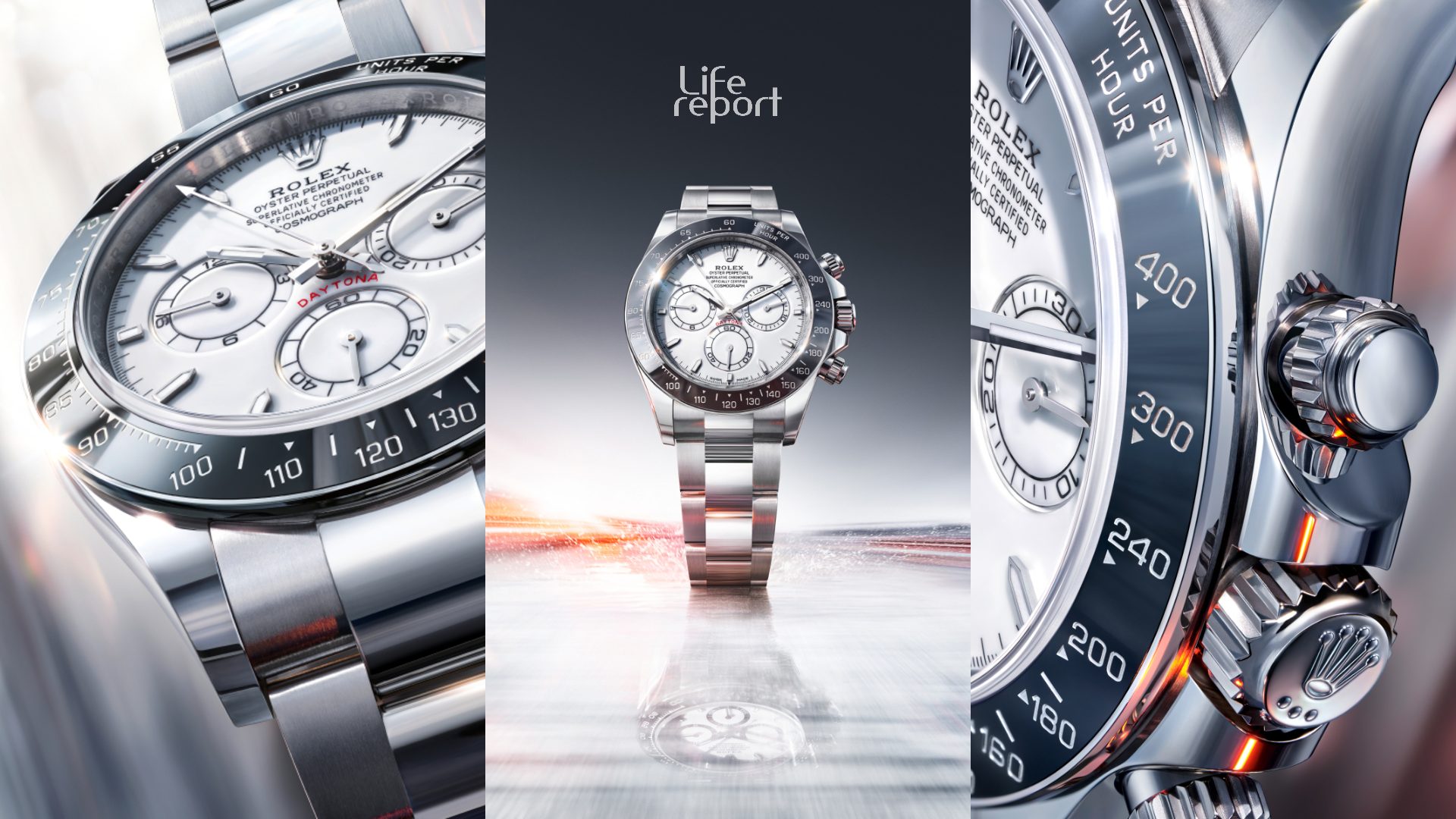
That Rolex should debut its enamel experiment on a steel watch, rather than on a precious-metal canvas, is a plot twist worthy of a prestige drama. The ref. 126502 introduces to the Daytona line an unprecedented material equation: a middle case and Oyster bracelet in Oystersteel, a platinum bezel ring and a platinum case back. It revives the Rolesium concept – steel married to platinum, a term Rolex trademarked in the 1990s – yet one never before applied to its sacred chronograph. The decision reads like an inside joke for the culturally fluent: luxury here is not announced but encrypted, a metallurgical whisper discernible only to those who understand the periodic table of prestige. The platinum case back, delicately fluted and screwed down with the solemnity of a bank vault, is fitted with a sapphire-crystal porthole, a concession to exhibitionism that the Crown has long resisted in its sports models.
The bezel, meanwhile, steals the visual narrative. Gone is the familiar black Cerachrom; in its place sits a new anthracite shade that defies the static connotations of the word. Rolex has developed a specific ceramic composite – zirconia enriched with tungsten carbide, for which a patent application has reportedly been filed – that imbues the insert with a metallic, almost oily lustre. Under the relentless glare of a Dubai summer, it shimmers like graphite catching the light, shifting from deep smoke to silvery gunmetal with every turn of the wrist. The tachymetric scale has been entirely restyled: numerals are oriented horizontally and remain upright at every position, echoing the layout of the original 1963 models. The inversion at six o’clock, a signature of every contemporary Cerachrom Daytona, has been erased. The font is crisp and modern, while the graduations are platinum-filled via physical vapour deposition. It is a detail that separates the mere collector from the true scholar, a subtle genealogical marker that rewards the connoisseur’s gaze.
View this post on Instagram
Turn the watch over and the spectacle continues. Calibre 4131, Rolex’s chronograph movement distilled to a high-energy core, reveals itself through the anti-reflective sapphire window. The architecture is familiar – column wheel, vertical clutch, patented Chronergy escapement in nickel-phosphorus, blue Parachrom hairspring with a Rolex overcoil, Paraflex shock absorbers and a 72-hour power reserve – but the aesthetics represent a departure. The bridges are decorated with Rolex Côtes de Genève, distinguished by the slender polished groove separating each band, a micro-variation known chiefly to insiders. Then there is the rotor: a cut-out oscillating weight in yellow gold, skeletonised to reveal the movement beneath. In a watch otherwise dressed in cool, industrial tones, that gilded spinner is a burst of warmth, like a glimpse of bronze sculpture inside a concrete-and-glass pavilion. It is both an engineering choice and an ornamental wink, the sort of hidden luxury that appeals to a generation raised on the coded exclusivity of streetwear collaborations and members-only drops.
Context amplifies the watch’s resonance. The Emirates, where horological literacy has matured at remarkable speed, now boasts a community capable of parsing the difference between grand feu and cold enamel as readily as it distinguishes among oud profiles. At private gatherings in Jumeirah, in the lounges of Alserkal Avenue or trackside at Dubai Autodrome, the ref. 126502 reads as the ultimate stealth asset. It pairs naturally with the monastic silhouettes of The Row, the twisted heritage of a Loewe runway piece or the patinated leather of a Porsche 911 reimagined by Singer. For millennials who have outgrown logo mania and Gen Z savants who trade in rarity rather than volume, this Daytona functions as a masterclass in understated cultural capital. It signals not merely wealth, but a studied detachment from the need to signal at all.
Rolex’s Superlative Chronometer certification, reinforced in 2026 with new tests for magnetism, reliability and sustainability, guarantees that the poetry is supported by almost obsessive precision: –2/+2 seconds per day after casing. The Oysterlock safety clasp, the Easylink extension and the Triplock crown – all the familiar architecture of robustness remains, as though to remind the wearer that this object, despite its rarefied aura, is still engineered to endure.

The watch’s off-catalogue status is the final masterstroke. In an era when even hyper-limited editions are teased on Instagram, Rolex operates with the opacity of a sovereign state. The ref. 126502 will not be reviewed in the usual places, nor displayed beneath halogen lights in a glass vitrine. It will travel via encrypted messages, appear in a single blurry image on a trusted dealer’s story and then vanish. To own one is to become part of a silent confraternity, a circle where the password is observation and the handshake is the absence of explanation. It is anti-hype rendered as luxury, the luxury object as omertà.
What Rolex has crafted is not merely a new variation of a legendary chronograph. It is a carefully composed argument about what constitutes value in a saturated market – an alchemy of fire, ceramic and platinum that transforms steel into something rarer than gold. For those who understand the language, the Cosmograph Daytona ref. 126502 speaks volumes while barely raising its voice. In the minimalist suite of a beachfront hotel, beneath the rotating shadow of a ceiling fan, its anthracite bezel catching the last light of the Arabian day, time is measured with a kind of quiet poetry. It is a reminder that the most profound statements are often delivered in a murmur, to an audience of exactly one.
Also Read: From Towels to Thrones: Dubai’s Beach Clubs Are the Ultimate Gen Z and Millennial Currency