Van Cleef & Arpels has just introduced the first-ever pink-enamel Alhambra: a new material inspired by a 17th-century gold-ruby glassmaking process, five new creations, and a shade of pink that reads less “Barbie” and more “Belle Époque”.
There is a particular kind of Dubai jewellery-box mathematics that any resident will recognise: the safe stacked with inherited 22-carat gold on one side, and a single, almost aggressively understated designer piece on the other. The former is heritage; the latter is taste. For decades, the two have coexisted in uneasy silence. Now, Van Cleef & Arpels has found a way to make them speak the same language – and it happens to be pink.
This September, the Maison unveiled its first-ever pink-enamel Alhambra collection, a five-piece set spanning the Vintage and Magic Alhambra lines, and the arrival is less a colour update than a quiet coup in the rarefied world of fine jewellery. The Alhambra motif, that ubiquitous four-leaf-clover silhouette introduced in 1968 and famously worn by Princess Grace of Monaco, has been interpreted in mother-of-pearl, onyx, carnelian, guilloché gold and numerous other materials. But never in enamel. Until now.
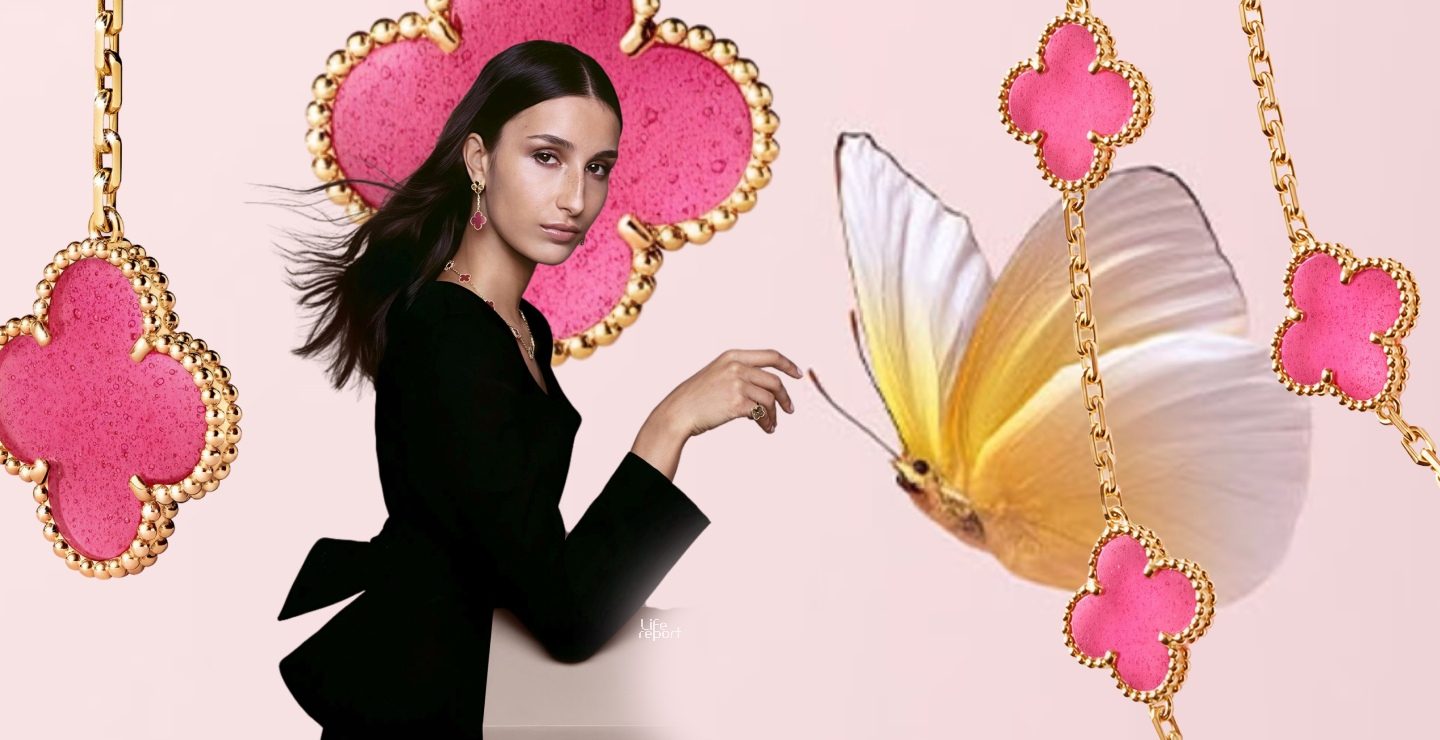
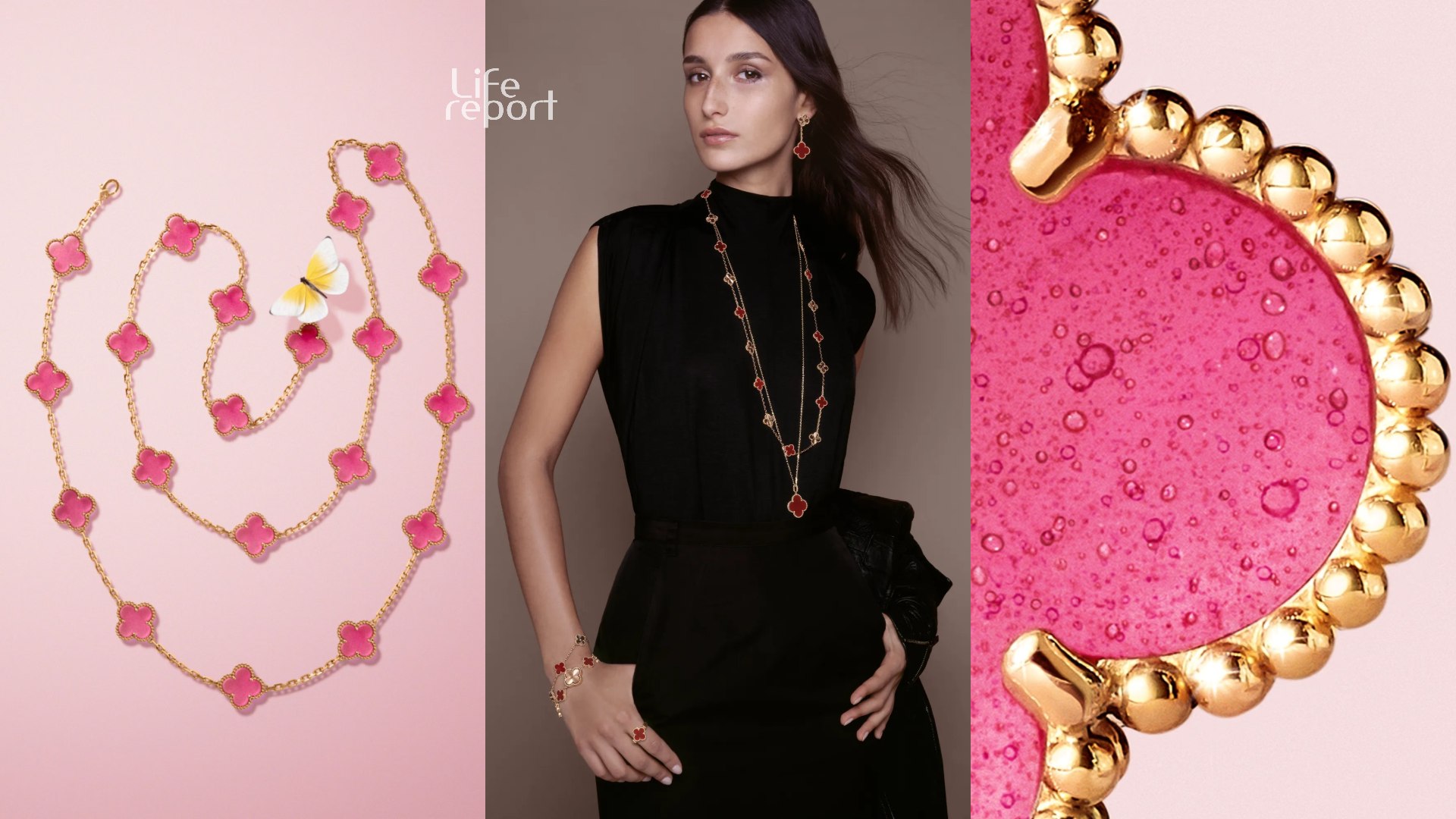
The shade itself is a translucent, almost electric pink – one that Catherine Renier, President and CEO of Van Cleef & Arpels, describes as vivid enough to carry the visual impact of the collection across its five-piece set. Look closely and you’ll notice tiny bubbles suspended within the enamel, like trapped champagne, giving each clover a slightly different character. The effect brings life, depth and a distinctive character to the material. I call it a very elegant loophole in the quiet-luxury rulebook: a piece that is instantly recognisable to those who matter, yet suffused with a colour so unexpected that it borders on insouciant.
The five pieces – a 20-motif long necklace, a 10-motif necklace, a five-motif bracelet, a single pendant and a pair of two-motif earrings – are all set in yellow gold and framed by the collection’s signature border of golden beads. The entry point, the pendant, is priced at $3,300, while the long necklace costs $20,800. These are not impulse purchases, even by Dubai standards. But that, of course, is precisely the point. In a market where quiet jewellery – the deliberate choice of one meaningful piece over five adequate ones – has become a defining aesthetic, the pink-enamel Alhambra arrives as a sort of philosophical resolution. It is, at once, a flex and an act of restraint.
View this post on Instagram
The Gulf’s relationship with gold has always been more intimate than transactional. It is heritage, security and a language of affection passed from mother to daughter. Traditional forms such as the Habbah and Marsa have long occupied a place in the region’s jewellery vocabulary, while a newer mood of quiet jewellery places greater emphasis on wearability, individuality and meaning. The global quiet-luxury movement, therefore, can feel less like an imported trend here than a return to an instinct already understood.
What is changing is the way younger luxury consumers increasingly frame the purchase. The question is less whether a piece is the latest design and more whether it has the craftsmanship, personality and staying power to remain relevant. There is greater interest in provenance, material and the story behind an object – and, increasingly, in buying fewer pieces that feel more personal.
This shift sits within a broader regional luxury boom. According to Chalhoub Group’s 2025 GCC Personal Luxury report, the Gulf’s personal luxury market reached $12.8 billion in 2024, up 6 per cent year on year, and is projected to reach $15 billion by 2027 at a compound annual growth rate of 6 per cent. The group attributes the growth to favourable macroeconomic conditions, strong willingness to spend, tourism, retail development and the continued expansion of e-commerce.
Which brings us back to the pink. The colour was achieved using a technique inspired by the 17th-century gold-ruby process, in which colour is generated not through conventional pigments but through the precise size, shape and concentration of fine gold particles within the composition. The method was developed and refined in Europe in the late 17th century, with the German alchemist and glassmaker Johann Kunckel closely associated with its development. Gold-ruby glass soon became a coveted luxury material.

Van Cleef & Arpels’ enamel workshops in Switzerland spent several years of research and development perfecting the procedure for the Alhambra motifs, and the result is a material whose light-reflecting capacity, according to the Maison, is slightly greater than that of emerald. Each motif is subtly domed to maximise the play of light, while the translucent surface and tiny bubbles create a sense of depth and movement. It is an unusually sophisticated piece of alchemy for something that, at first glance, appears simply pink.
It would be easy, of course, to dismiss all of this as marketing mythology – the kind of elaborate origin story that luxury houses spin to justify a price point. But the Maison’s relationship with enamel runs genuinely deep. Since its founding in 1906, enamel has appeared across an extraordinary range of its creations, from precious objects and vanity cases to jewellery, clips and watches. Today, Van Cleef & Arpels’ enamel workshop masters more than 15 enamelling techniques, while a three-year training programme helps preserve these specialised skills.
There is a gentle irony in the fact that a heritage house has reached into the 17th century to produce the freshest thing in the room. But the Alhambra has always been a study in precisely this kind of temporal negotiation. When Van Cleef & Arpels created the first 20-motif yellow-gold long necklace in 1968, it was remarkably stripped back – a departure from the elaborate conventions of high jewellery in favour of something almost casual. Princess Grace of Monaco was photographed wearing three Alhambra sautoirs in 1979, a styling choice that remains the jewellery equivalent of wearing couture to the supermarket.
Over the decades, the motif has been reinterpreted in enough materials and configurations to fill a monograph, yet its silhouette remains so deeply embedded in the visual language of jewellery that it could be shown to almost anyone, anywhere, and still receive the same recognition. The Maison itself describes Alhambra as a collection continually enriched with new materials, colours and symbols while retaining its unmistakable identity.
View this post on Instagram
The new pink-enamel pieces are the latest chapter in that continuity. And they arrive at a moment when the region’s younger luxury consumers are particularly receptive to their proposition. Jewellery is increasingly worn as part of personal styling rather than reserved exclusively for formal occasions, making a piece such as the pink-enamel Alhambra unusually versatile. A single pendant worn against a white linen shirt or the ubiquitous monochrome abaya performs a very specific kind of social signalling: it says that you know exactly what you are wearing, and that you do not need anyone else to know it too. It is jewellery as whispered confidence rather than shouted declaration.
One might argue, with some justification, that a pink clover is not the most obvious candidate for cultural profundity. And one would be right. But the Alhambra has never been about profundity in the traditional sense. It is about the ability of a simple, beautiful object to move seamlessly between contexts – from a Parisian atelier to a Dubai majlis, from Grace Kelly’s wrist to a Gen Z wardrobe, from the 17th-century alchemist’s laboratory to the 21st-century luxury boutique. The pink enamel is not simply a new colour. It is a measured, artful continuation of an existing creative language, and a reminder that the most successful luxury objects are those that manage to evolve without ever losing sight of what makes them recognisable.
In a region where the light itself is a luxury – where the sun sets over the Gulf in shades of rose and amber that no filter can replicate – there is something almost inevitable about this particular pink. It catches the light, holds it and returns it differently every time. Rather like the city it now calls home.
ALSO READ: Ladies, Liquor and Quiet Revolutions: Inside Hisham Sharif’s Provocative Dubai Debut