
In the grand theatre of the global art market, where vanity often masquerades as connoisseurship and speculation parades as passion, a quiet revolution has been unfolding on the shores of the Arabian Gulf. For two decades, the cognoscenti have watched Abu Dhabi transform itself from a pearl-diving backwater into a cultural crucible of considerable ambition – a place where the Louvre shares a postcode with teamLab and where the forthcoming Guggenheim promises to make Saadiyat Island the kind of destination that makes Basel look positively provincial.
Now, Christie’s is placing its chips squarely on the table with Mawasim, a landmark auction taking place on 1 November 2026 at The Abu Dhabi Edition, marking twenty years since the auction house first held a sale in the UAE and, more pointedly, signalling that the Middle East’s artistic patrimony is no longer content to play the role of exotic sideshow in Western salerooms. The title is a knowing nod to the Arabic word for ‘seasons’, and there is something almost elegiac in its deployment here – a recognition that art movements, like empires, have their rhythms of flourishing and fallow, and that the past two decades have witnessed the former in abundance. When Christie’s staged its inaugural Dubai auction in May 2006, the sceptics were legion and vocal. The sale, featuring International Modern and Contemporary Art, confounded expectations by generating $8.5 million, a result that prompted a collective recalibration of the region’s cultural gravity. Those early buyers were, in the main, newcomers to the auction game, and their enthusiasm was viewed in some quarters as a charming provincial eccentricity rather than the opening movement of a sustained symphony.
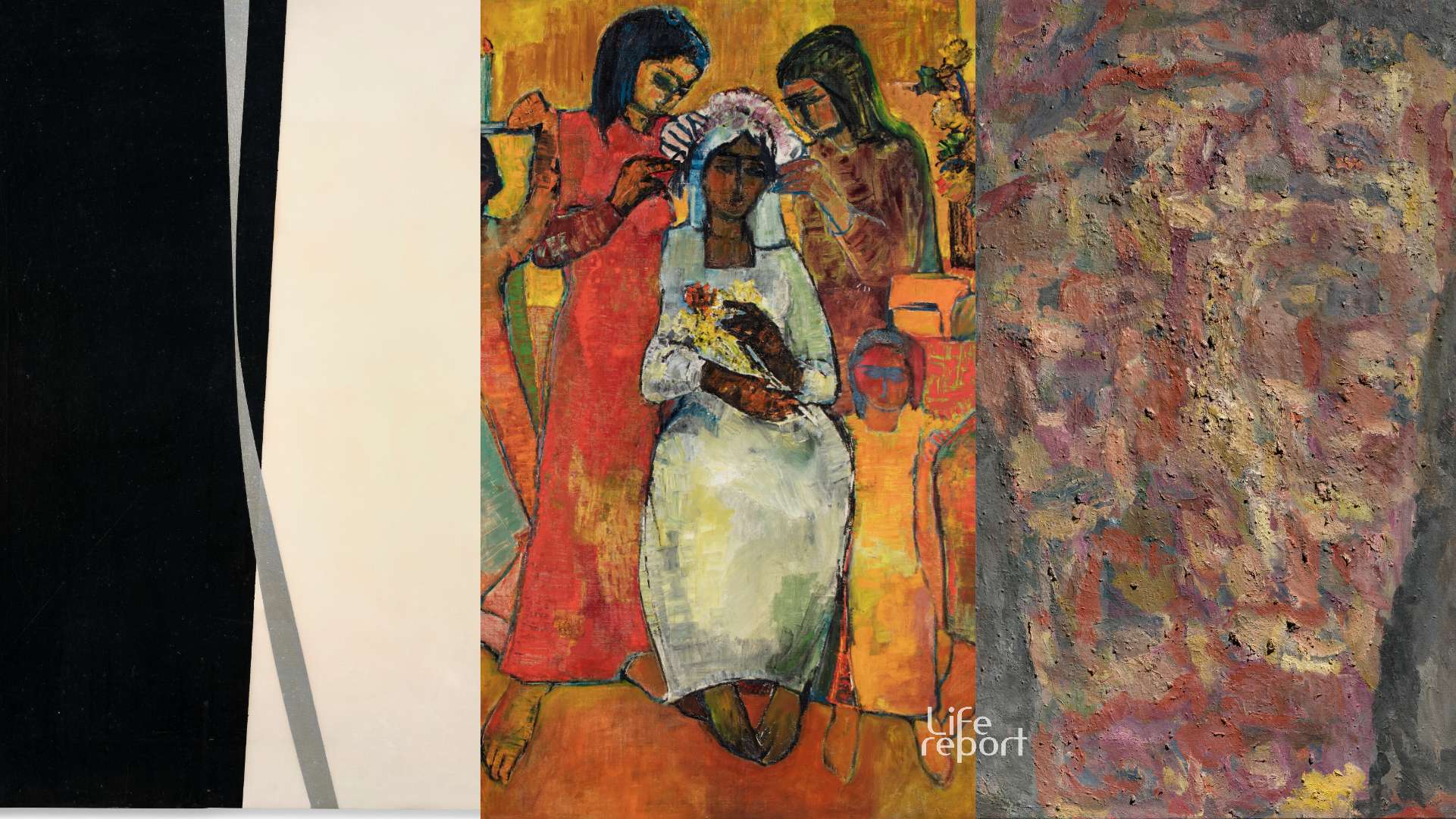
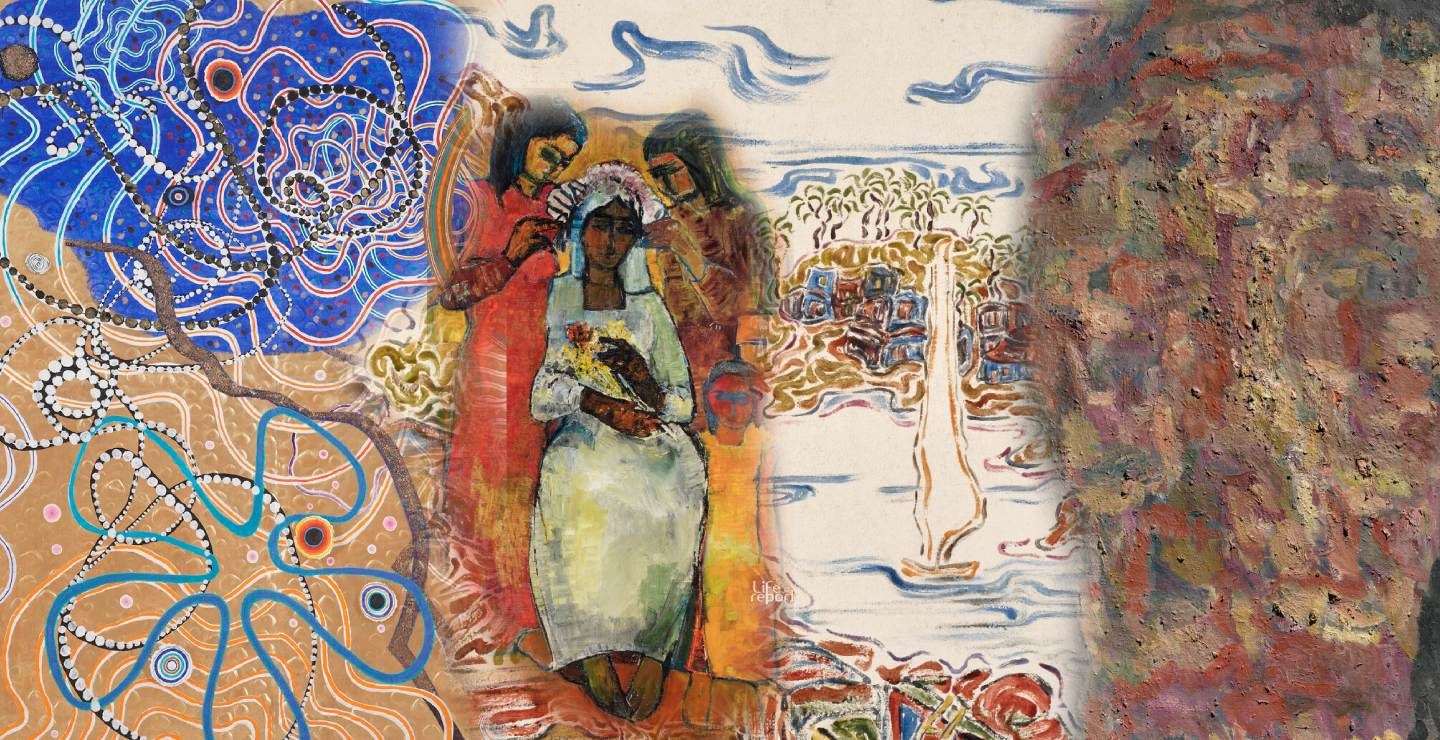
Mohamed Melehi, A30, 1962. Paul Guiragossian, Noces, 1958-59. Marwan, Kopf (Head), 1987.
Two decades later, the numbers tell a rather different story. The GCC luxury-goods market was valued at approximately $15 billion in 2025 and is projected to reach almost $27 billion by 2031, with the UAE alone accounting for an estimated $8.5 billion in 2025. At Sotheby’s inaugural Collectors’ Week in Abu Dhabi in December 2025, which generated approximately $133 million in sales, nearly a third of bidders were under forty – a demographic fact that should make any traditionalist clutching their gilt-framed credentials sit up and pay attention. These are not your grandfather’s collectors, and they are not necessarily interested in the dusty hierarchies that once governed taste.
What makes Mawasim particularly compelling, however, is not simply the money it promises to move but the curatorial intelligence it brings to a category that has too often been reduced to a handful of marquee names. The sale gathers more than seventy works spanning six decades, drawing from the prestigious Dalloul Collection in Beirut and the Barjeel Art Foundation in Sharjah – two major regional collections whose commitment to preserving Arab modernism has, in effect, helped shape the art history that the market is now belatedly rediscovering. Dr Ramzi Dalloul and his wife, Saeda El Husseini, assembled their collection with the zeal of true believers, and the eight works offered here from their holdings represent a rare opportunity to acquire pieces with strong provenance and genuine scholarship behind them. Sultan Sooud Al Qassemi, the founder of Barjeel, has long operated on the principle that a collection should be a public trust rather than a private indulgence – ‘if you love a collection, set it free’, as the title of a recent profile put it – and the five works from his foundation in this sale carry that philosophy woven into their very conception.
View this post on Instagram
The headlining lot, Paul Guiragossian’s Noces (Wedding) from 1958–59, is estimated at $300,000–$500,000, and it is not difficult to see why. A monumental canvas from the Lebanese-Armenian master’s early period, it depicts a wedding scene with the kind of vibrant, almost ecstatic brushwork that Guiragossian deployed to explore themes of home, community and the stubborn persistence of human connection in the face of displacement. Exhibited at his first major exhibition in Lebanon in 1959 and most recently at Saleh Barakat Gallery in Beirut in 2023, the painting arrives with the kind of exhibition history that separates serious art from mere decoration. Guiragossian’s story – born in Jerusalem, raised in Beirut and shaped by the experience of displacement – gives the work a biographical weight that collectors of a literary persuasion will find irresistible.
Samia Halaby’s Yesterday from 1978 offers a different kind of pleasure, albeit no less cerebral. The Palestinian-American artist, now in her late eighties and still working, forged her distinctive language of geometric abstraction during a period when the art world was not exactly falling over itself to recognise the contributions of Arab women. Yesterday comes from her celebrated 1970s period, when she was experimenting with squeegees to create subtle variations of depth and space, and it bears the marks of that technical restlessness – the surface seems to vibrate with a quiet, almost musical intensity. Halaby’s retrospective, Lasting Impressions: Samia Halaby, held at Sharjah Art Museum in 2023–24, offers useful institutional context for buyers who like their acquisitions anchored in scholarship as well as provenance.
Then there is Mohamed Melehi’s A30 from 1962, an exceptional example from the Moroccan modernist’s seminal ‘black works’ series, created during his formative years in Rome. Melehi, who died in 2020, became something of a posthumous star in the auction world – a 1963 work from the same series, The Blacks, fetched an artist record at Sotheby’s London in 2020 – and this almost entirely monochromatic composition, with its engagement with Zen philosophy and Islamic Sufi traditions, should appeal to collectors who appreciate their radicalism served with a side of intellectual heft.
The selection is not merely a parade of blue-chip names, however. Nadia Saikali’s Mandala Bleu Nuit from 1982, estimated at a comparatively accessible $30,000–$50,000, offers an entry point for younger collectors who want to begin their journey with a work of genuine meditative power. Saikali, born in Beirut in 1936 and long resident in Paris, belongs to that generation of Lebanese abstractionists whose contributions are only now receiving their due. The deep blue and black composition, which originates from the Barjeel Art Foundation and was exhibited at Maraya Art Centre in Sharjah in 2025, possesses the kind of contemplative stillness that feels almost transgressive in a world of relentless visual noise.
Marwan Kassab-Bachi’s Kopf (Head) from 1987, estimated at $200,000–$300,000, represents a pivotal moment in the Syrian-German artist’s celebrated portraiture, marking his move from the horizontally stretched facial landscapes of the 1970s towards the vertical, frontal heads that would become his mature signature. The painting’s vigorous impasto of earthy ochres, burnt sienna and deep crimson gives it a psychological intensity that borders on the uncomfortable – which is, presumably, precisely the point. It was exhibited at the Institut du monde arabe in Paris in 1988, and its reappearance in Abu Dhabi feels like a homecoming of sorts.
Inji Efflatoun’s Untitled, dated 1987 and drawn from the Dalloul Collection, is one of the Egyptian modernist’s final works, and it carries the weight of a life lived in defiance of convention. Efflatoun was not merely a painter; she was a Marxist and feminist activist who spent four years in prison during the Nasser era, and her subsequent work – a lyrical synthesis of nature and the built environment rendered in expressive colour and line – acquired a luminous quality born of a life lived through upheaval. Estimated at $40,000–$60,000, it is one of eight works from the Dalloul Collection in the sale, and it offers collectors the chance to own a piece of Egyptian history that is also, quite simply, beautiful.
Nabil Nahas, meanwhile, is currently representing Lebanon at the 61st International Art Exhibition of La Biennale di Venezia with an immersive installation titled Don’t Get Me Wrong, and his Inka Dinka Doo from 2013, estimated at $300,000–$400,000, demonstrates why he remains one of the most intriguing figures in contemporary Lebanese art. The painting belongs to a group of works the artist describes as ‘fields of energy’, and the description is apt – fluid forms and vividly coloured paint chips combine in a richly tactile surface that shifts between the microscopic and the cosmic, evoking both celestial bodies and organic life. It is the kind of painting that rewards sustained attention, the kind that reveals new details with each viewing, and it should appeal to collectors who understand that the best art is never fully exhausted by a single encounter.
The timing of Mawasim is, of course, anything but accidental. The sale unfolds against a backdrop of remarkable cultural activity in Abu Dhabi, with the inaugural Frieze Abu Dhabi scheduled for 19–22 November at Manarat Al Saadiyat, featuring 84 galleries from 64 cities across 37 countries and regions, and the long-awaited opening of Guggenheim Abu Dhabi set for 11 December. Dr Ridha Moumni, Chairman of Christie’s Middle East and Africa, has spoken of the sale as contributing to ‘an especially dynamic period in the region’s cultural calendar’, and one can almost hear the understatement. This is not merely a dynamic period; it is the culmination of a twenty-year arc that began when Christie’s first dipped its toe into Gulf waters and discovered, to its considerable commercial delight, that the water was fine.
There is a certain irony in the fact that Christie’s, a British institution founded in 1766, should find itself at the vanguard of a movement to recalibrate the geography of artistic value. But the art world has always been a place where money and taste perform an elaborate dance, and the Gulf – with its combination of sovereign wealth, youthful demographics and genuine cultural curiosity – has become an increasingly confident partner in that dance. Meagan Kelly Horsman, Managing Director of Christie’s UAE, has noted that the past two decades have witnessed ‘the growing recognition of artists from the Middle East internationally’, and the evidence for that recognition is not merely in the prices achieved but in the institutional attention devoted to artists who were once relegated to the margins of art history.
The Young Collectors Circle, founded by Dubai-based art adviser Nadine Khoury in 2023, offers a useful window into how this generational shift is manifesting on the ground. Khoury’s organisation, which hosts studio visits, suppers with established collectors and group outings to exhibition openings, has attracted a following of young professionals who are interested in art but intimidated by the traditional gatekeepers of the market. ‘From the start, I wanted to break down the barrier of art being a luxury,’ Khoury has said, and her approach – informal, accessible and social-media-savvy – is precisely the kind of outreach that the auction houses themselves are increasingly compelled to emulate.
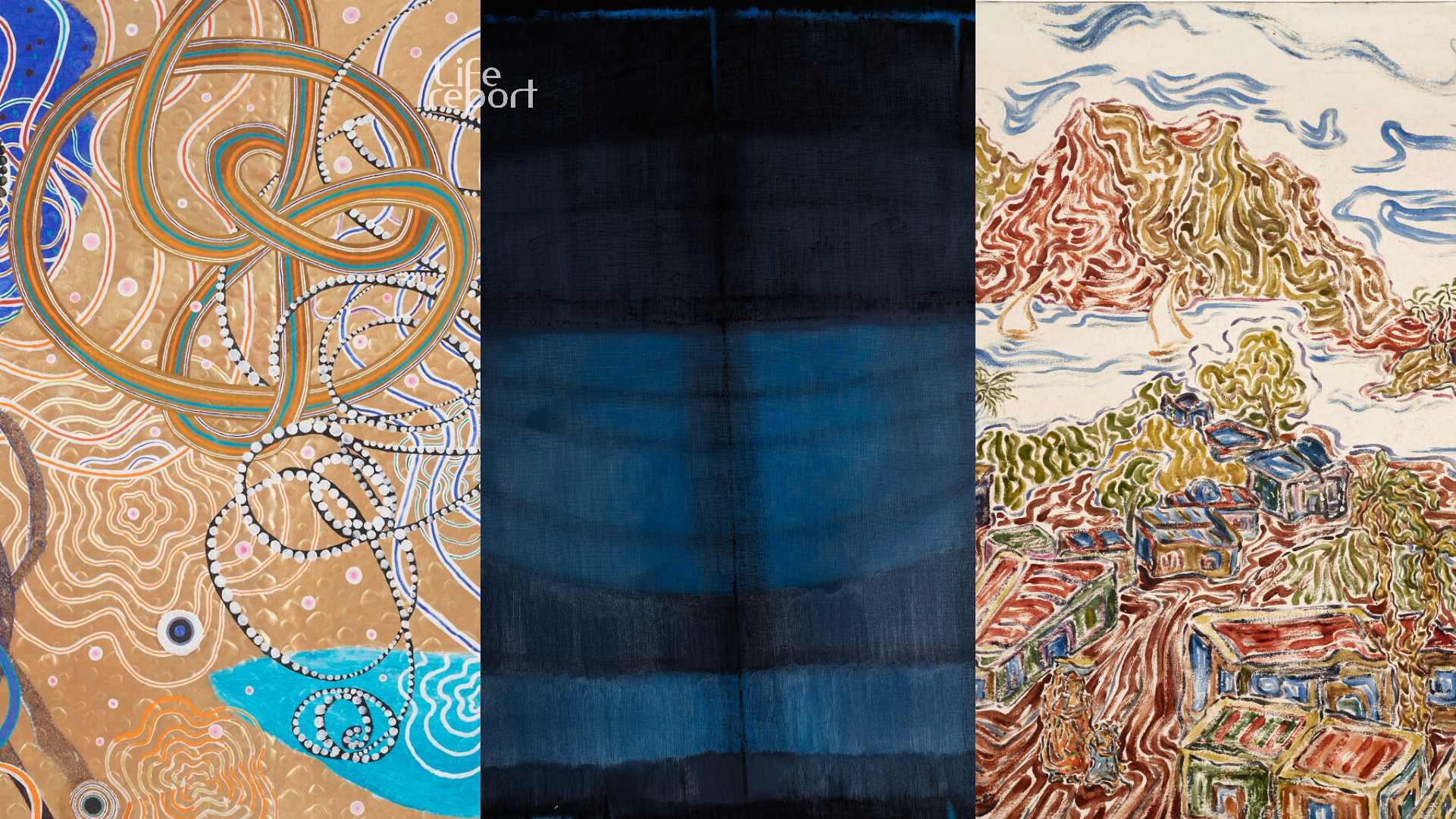
Nabil Nahas, Inka Dinka Doo, 2013. Nadia Saikali, Mandala Bleu Nuit, 1982. Inji Efflatoun, Untitled, 1987.
For the millennial and Gen Z collectors who are now entering the market, Mawasim offers a masterclass in how to build a collection that is both culturally significant and potentially valuable. The works on offer range from the museum-quality – the Guiragossian, the Halaby and the Melehi – to the more accessible, and the presence of pieces from the Dalloul and Barjeel collections means that even the lower-priced lots come with the kind of provenance that would make a seasoned collector’s eyes light up. The pre-sale exhibition, which travels to New York, Paris and London before arriving at The Abu Dhabi Edition from 28 October to 1 November, provides ample opportunity for prospective buyers to see the works in person and to participate in the programme of talks and educational events that Christie’s has organised around the sale.
The Abu Dhabi Edition itself, with its 198 guest rooms and 57 serviced residences overlooking Al Bateen Marina, provides a suitably glamorous setting for the proceedings. Home to the Michelin-selected Oak Room and situated in the heart of Abu Dhabi’s downtown district, the hotel is an ideal venue for an auction that seeks to position itself at the intersection of art, luxury and lifestyle – a Venn diagram that increasingly defines the aspirational aesthetic of the Gulf’s young elite.
What distinguishes Mawasim from the countless other auctions that will take place this season is not merely the quality of the works on offer, which is considerable, but the historical moment it represents. In 2006, when Christie’s held its first UAE sale, the art market in the region was embryonic, the collectors were few, and the institutional infrastructure was largely aspirational. Twenty years later, Abu Dhabi stands as one of the world’s most dynamic cultural destinations, with an expanding museum district that commands international attention and a collector base that is younger, more diverse and more sophisticated than anyone might have predicted.
The title Mawasim, with its evocation of seasonal cycles, is a reminder that the art market, like nature, has its rhythms of growth and consolidation. The past two decades have been a season of remarkable expansion, but the next season promises to be something else entirely – a period in which the artists and collectors of the Middle East no longer need to seek validation from the West because the West has come to them. The auction on 1 November is not merely a sale; it is a statement of intent. And for those who have been paying attention, the message is unmistakable: the seasons are changing, and the art world’s centre of gravity is shifting, slowly but inexorably, towards the Gulf.
ALSO READ: The Bilbao Blueprint: 10 Masterpieces You Need to See Before the Guggenheim Lands in Abu Dhabi


