

What do you buy when you have already bought everything worth showing off? In the Gulf, a new breed of luxury collector has become almost impervious to spectacle. They have seen the diamond-encrusted excess, the rainbow-coloured chronographs, the hyped limited editions that disappear faster than they arrive.
They have walked the corridors of Dubai Watch Week, where more than 49,000 visitors and over 90 brands gathered in November 2025, and learned to distinguish genuine horological artistry from the noise of marketing. For these Millennial and Gen Z collectors, a mechanical watch is no longer simply a badge of status. It is a declaration of taste, knowledge and achievement. They are looking for something rarer now: craftsmanship with a story, complexity with a soul, and the kind of luxury that does not need to announce itself. They want meaning. They want mastery. And, perhaps most importantly, they want to feel something. Which brings us, inevitably, to the stars.
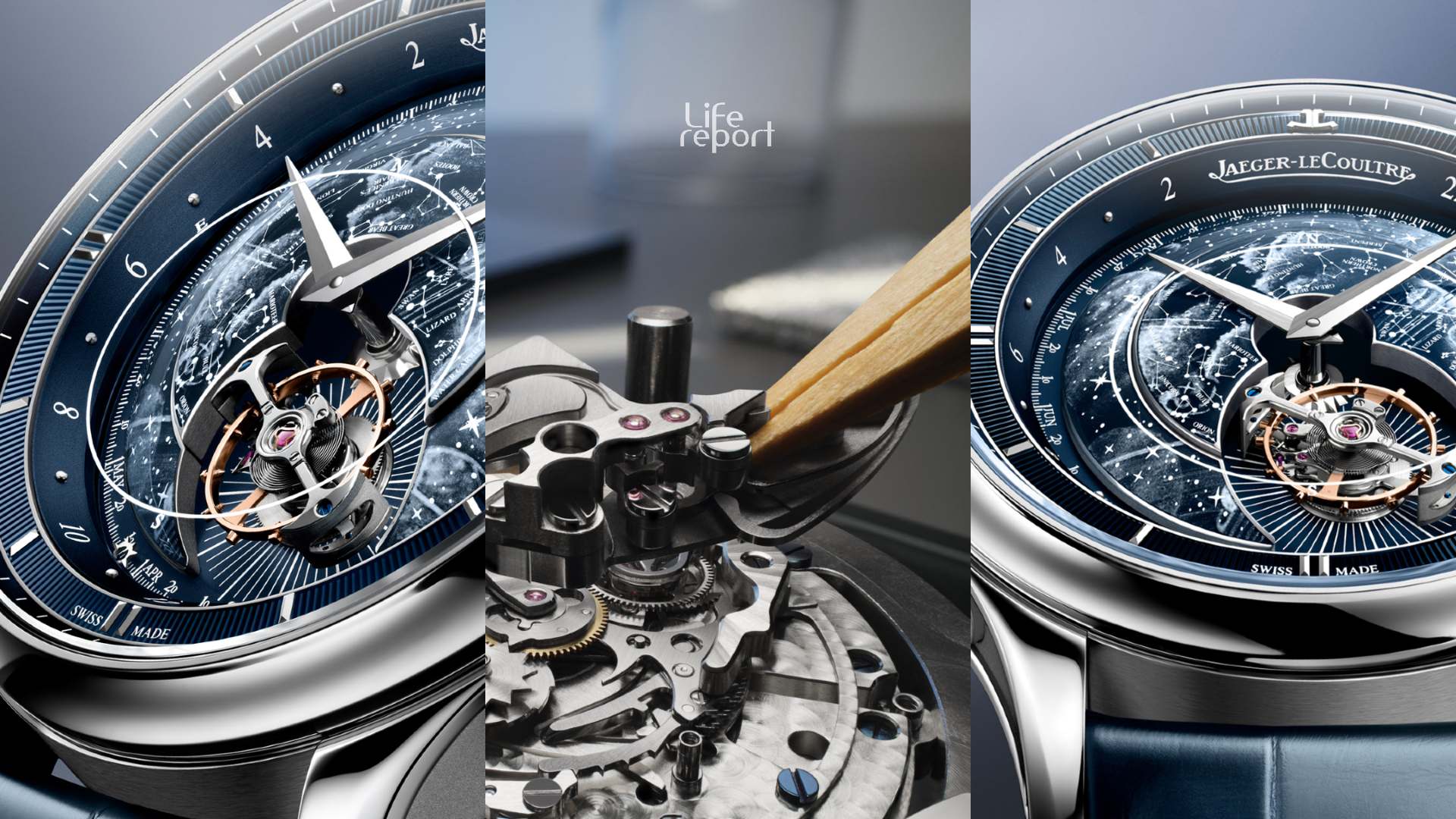
Jaeger-LeCoultre has long been the horological equivalent of a whisper in a room full of shouting. The Vallée de Joux maison, based at the same Manufacture since its founding in 1833, has a habit of producing timepieces that reveal their genius slowly, almost reluctantly, to those who bother to look. Its latest offering, the Master Hybris Artistica Calibre 945, is a case in point: a watch that does not shout its credentials but arranges them with the quiet confidence of someone who has nothing left to prove. Limited to five pieces. Eighteen-karat white gold. A dial depicting the night sky above the Swiss valley in grisaille enamel, a rare technique requiring extraordinary patience and painstaking handcraft. It is, by any reasonable measure, absurd. It is also, by any measure that matters, magnificent.
The watch’s technical narrative begins with Calibre 945, originally created in 2010 and now reinterpreted in a new white-gold case. Within its architecture lives a minute repeater, one of the most challenging complications a watchmaker can master, alongside a flying Cosmotourbillon that performs a circuit of the dial once every sidereal day – 23 hours, 56 minutes and 4 seconds, the time it takes the Earth to complete one rotation relative to the fixed stars rather than the Sun. The distinction may sound like astronomical pedantry until you consider what it means: the watch keeps time with the universe itself, not merely with our convenient civil approximation of it. A star chart for the Northern Hemisphere, calibrated to the view from the Vallée de Joux, rotates in real time, while a golden sun-shaped pointer indicates the familiar 24-hour cycle. The tourbillon, its 73 components held within a lightweight titanium carriage, is secured on the movement side only, allowing its kinetic beauty to remain unobstructed. Mounted on lubricant-free ceramic ball bearings, its 10-millimetre monometallic balance wheel beats at 4 Hz, a steady pulse beneath the celestial theatre above. And then there is the sound.
View this post on Instagram
The minute repeater, a mechanism designed to translate the precise time into a series of perfectly programmed strikes, has been refined by Jaeger-LeCoultre through decades of innovation. Cathedral crystal gongs, fixed to the rear sapphire crystal for maximum resonance, combine with trébuchet hammers to enhance the acoustic performance. A patented silent governor ensures that nothing distracts from the purity of the chime. The result is not merely a complication but a sensory experience – a sound that belongs, as the maison suggests, to those who venture deep into the mountains for stargazing beneath a pitch-black sky. In Dubai, where light pollution renders many constellations difficult to see and the sonic landscape is dominated by the hum of air conditioning and the occasional Lamborghini, the romance of such a mechanism becomes almost defiant. To own this watch is to carry a private observatory and a private concert hall on the wrist, accessible only to the wearer.
The artistry of the dial deserves its own paragraph, not least because it represents a particularly refined expression of the maison’s Métiers Rares craftsmanship. Jaeger-LeCoultre introduced grisaille enamel to its repertoire in 2022, drawing on a pictorial technique that originated in sixteenth-century France. The technique creates delicate chiaroscuro effects through successive layers of enamel and painstaking firing, producing an illusion of depth that makes the celestial scene appear almost three-dimensional. The deep blue background is built gradually, before the celestial motif is rendered by hand in white enamel. The result is an optical illusion so convincing that the dial seems to recede into actual depth, echoing the dome of the night sky itself.
A midnight-blue disc forms the deepest layer, carrying the months and tourbillon seconds. Above it, the domed dial holds the star chart and constellation names, while an intricate golden-coloured structure evokes the lines connecting the stars in a celestial map. The tourbillon seconds scale radiates outward like beams of light from a distant star.

It is worth pausing here to consider what this watch represents in the context of contemporary luxury. The GCC luxury goods market was estimated at $15.02 billion in 2025 and is projected to reach approximately $24.36 billion by 2030, reflecting the region’s continued appetite for high-end goods. Yet the most interesting development is not simply the scale of that spending, but the increasingly sophisticated language in which luxury is expressed. Consumers are moving towards pieces that carry cultural meaning, storytelling and a sense of personal resonance. The rise of “quiet luxury” – a term so thoroughly co-opted by marketing departments that it now signifies almost nothing – finds a more authentic expression in an object like this watch, which neither announces its price nor apologises for its complexity. It simply exists, beautifully, for those equipped to understand it.
The case measures 45 millimetres in diameter and 16.05 millimetres in thickness, comprising more than 80 parts. Its convex bezel is complemented by broad bevels on the lugs, while micro-blasted finishes inside the lugs add dynamic tension. The repeater slide is tapered to harmonise with the curving case sides, and the various surfaces – micro-blasted, polished and satin-brushed – are treated to maximise the play of light. There are no recessed buttons in the case for setting; the functions and displays are set via the crown, a design decision that speaks to an almost architectural commitment to purity. The minute repeater is activated by a slide on the left side of the case, a gesture that feels less like operating a machine and more like drawing a bow across a string.
The watch is presented on a blue alligator strap with small-scale alligator lining, matched meticulously to the colour and texture of the dial, and secured by an 18-karat white-gold folding clasp with an adjustment mechanism allowing precision in half-millimetre increments. It is, in every detail, a study in considered excess – the kind of excess that does not call attention to itself but simply refuses to compromise. One might ask, reasonably, whether any of this matters. A watch that tells sidereal time is, functionally speaking, useless for catching a meeting in DIFC or making a dinner reservation at Ossiano. Its star chart is calibrated to the skies above a Swiss valley that most of its owners will never visit. Its minute repeater, however exquisite, is rendered largely redundant by the smartphone in one’s pocket. And yet, the persistence of such objects suggests that they answer to a need deeper than mere utility.
View this post on Instagram
In a city like Dubai, where the future arrives with almost aggressive speed and the past is frequently demolished to make room for it, there is something almost subversive about a watch that measures time according to the fixed stars. It is a reminder that some things – the rotation of the Earth, the positions of constellations, the patience required to paint enamel in successive layers – operate on timescales that pay no heed to quarterly earnings or skyline developments.
The Master Hybris Artistica Calibre 945 is not, in the end, a watch for telling time. It is a watch for contemplating it. It belongs to the collector who understands that the most meaningful acquisitions are not those that generate the most Instagram engagement but those that reward solitary attention, preferably in the quiet of a penthouse overlooking the Gulf, with the lights dimmed and the city’s relentless glow momentarily forgotten. It belongs to the Millennial or Gen Z connoisseur who has graduated beyond the flex and arrived at something closer to reverence. And it belongs, in a sense, to Dubai itself – a city that has built its identity on ambition and spectacle but whose most sophisticated residents are quietly discovering the pleasures of restraint, of craftsmanship and of objects that whisper rather than roar. Five pieces. Five owners. A cosmos on the wrist. The rest of us can only look up and wonder.
ALSO READ: The Last Manual V12: Why Aston Martin Valiant Could Be the End of an Era


