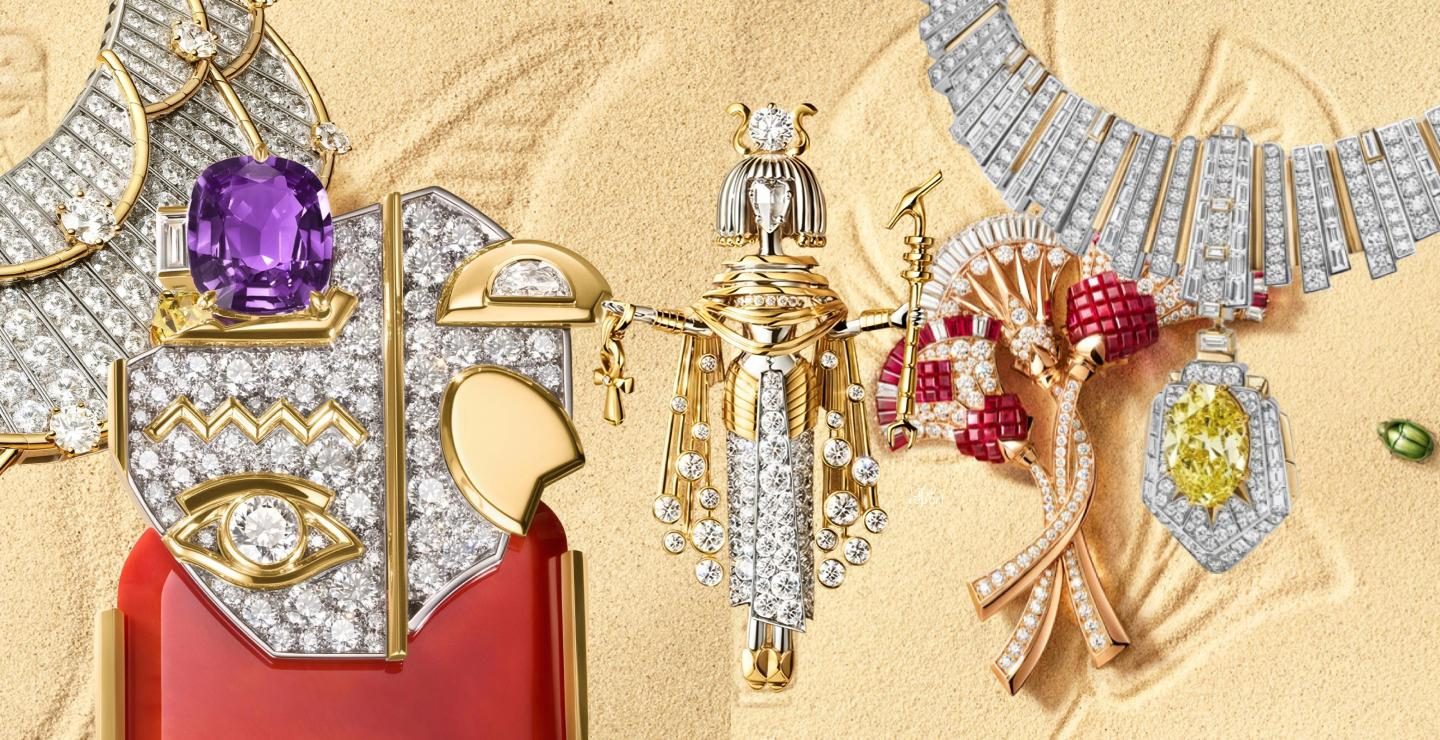
In a city like Dubai, where architectural ambition routinely defies physics and the concept of ‘more’ is a cultural baseline, the challenge for any maison is not merely to dazzle, but to disturb the senses into silence. Van Cleef & Arpels has achieved precisely this with Fascinating Egypt, a high jewellery magnum opus comprising around 180 creations and developed over four years. Unveiled in Paris before making its way to the Middle East, the collection arrives with the gravity of a lost chapter of history.
To describe this 180-piece collection as a mere tribute to Egyptology would be an act of journalistic laziness. We are drowning in a sea of cultural pastiche; luxury houses recycle mythology with the same automated efficiency as an algorithm curating a mood board. What separates Van Cleef & Arpels from the fray is an almost academic refusal to reproduce. Here, the ancient world is not a surface decoration; it is a syntax. The maison speaks fluent Memphis, but the vocabulary is strictly 21st-century haute joaillerie.
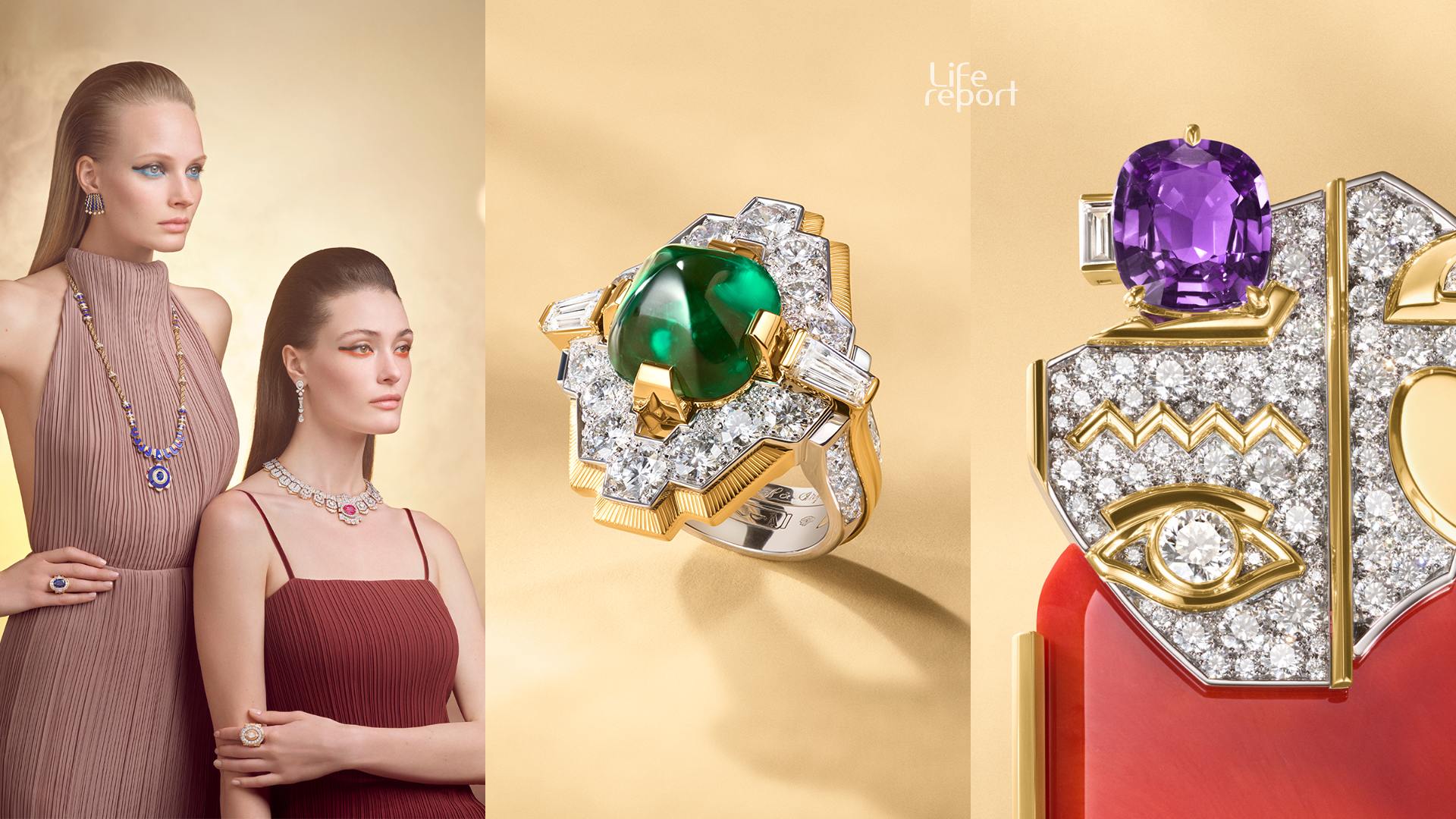
The dialogue between past and present begins with the archive. The Paysage royal bracelet revisits Egyptian-style cuff bracelets the house created in the 1920s, when the discovery of Tutankhamun’s tomb in 1922 sent European culture into a frenzy of Egyptomania. Van Cleef & Arpels itself began creating Egyptian-inspired jewels between 1923 and 1925. Yet where the Jazz Age embraced the exotic with varying degrees of theatricality, the modern iteration employs a quiet, architectural rigour. Sculpted gold undulates across the wrist in a topographical dance, juxtaposing textures that capture the hard, unyielding light of the desert. It is Art Deco filtered through the lens of speculative fiction – a horizon line of gold that feels less like jewellery and more like an artefact from a future-past that never quite happened.
This is the central paradox of Fascinating Egypt: it feels simultaneously sacred and cinematic. The Paysage merveilleux bracelet, for instance, presents a pyramid landscape rendered not in literal engraving, but in an astonishing composition of faceted gems. The gradient of stones moves with the subtle, chromatic intensity of a desert dusk, shifting from the burnished terracotta of the dunes to the deep lapis of the encroaching night. It is, in essence, a wearable tableau vivant – a narrative moving across the skin.
The intellectual weight of the collection is perhaps most visible where it is most delicate. The Vénus égyptienne clip is a masterclass in lapidary restraint. By employing the marquetry technique, the artisans have married turquoise and lapis lazuli with such precision that the materials appear to breathe. The piece evokes the goddess Hathor, with the solar disk and cow horns of her crown reduced to a graphic, almost abstract emblem. There is no gaudy idolatry here; instead, there is a refined irony. The wearer is not invoking a deity for protection; they are engaging in a sophisticated game of cultural semiotics, one that requires the observer to be literate in the history of ornamentation.
View this post on Instagram
The house saves its most visceral theatricality for the neck. The Rivage égyptien necklace is an exercise in liquidity, pairing 37 pear-shaped Zambian emeralds, totalling 41.58 carats, that cascade like a sybarite’s version of the Nile. These are not simply stones; they are engineered rivulets, capturing the vivid green of papyrus and water. The sensory ambition is staggering. It conjures the humidity of a delta breeze, the acoustic hush of reeds, and the cool weight of a civilisation built on irrigation and immortality.
And then there is the sun. For all the conceptual sophistication elsewhere, nothing quite prepares the eye for the Beauté légendaire necklace. At its centre sits a 10.02-carat Fancy Vivid Yellow cushion-cut diamond. It is a stone that does not merely sparkle; it smoulders. Suspended within a flexible, diamond-set breastplate inspired by the ceremonial adornments of Egyptian royalty, the gem seems to emerge from a skeletal framework, as if the scaffolding of history has been stripped away to reveal a core of pure, unadulterated light. In a market flooded with ‘investment pieces’ that look like corporate banking, this necklace is a liquidity event of pure desire. It is the closest most of us will ever get to owning a piece of solidified solar deity.

One might ask, in an era of smartwatches and algorithmic curation, who exactly is the audience for a 10-carat tribute to a goddess? The answer lies precisely in the psychology of the new luxury consumer in the UAE. Millennials and Gen Z cohorts driving the region’s high-end market are no longer seduced by the logo-heavy flotsam of the 2010s. They are academically curious, culturally omnivorous and deeply suspicious of the disposable. They have spent their formative years on digital archaeology, unearthing subcultures and histories with a swipe. For them, Fascinating Egypt offers the ultimate flex: not the price tag, but the story. It is provenance you can wear. It is cultural capital translated directly into carats.
Van Cleef & Arpels has always understood that the most compelling luxury is the ability to transform history into contemporary desire. It is a skill that feels increasingly rare in an industry often content to play it safe. Fascinating Egypt is not merely a collection; it is a correction. In a world accelerating towards the synthetic, where artificial intelligence renders the visual world into a blur of sameness, here is a body of work that insists on the human hand, the geological anomaly and the ancient myth.
To look at these pieces is to be reminded that elegance is not about being of the moment. It is about being out of time. It is the quiet, devastating confidence of wearing a 3,000-year-old symbol on a dinner jacket on a Dubai terrace, not because you need to prove you know history, but because you have no intention of being forgotten by it.
ALSO READ: The Guggenheim Finally Comes to Abu Dhabi: Inside Its $1Bn Art-World Debut