Sofia City Art Gallery is staging the most compelling exhibition of the summer: 200 works, one forgotten artist, and a question that has been waiting 130 years to be properly asked. The exhibition runs until 30 August 2026 at Sofia City Art Gallery. A catalogue accompanies the exhibition.
There is a particular cruelty in the way art history forgets people. It does not do so all at once – that would be too honest, too absolute. Instead, it performs a slow, bureaucratic erasure: a name begins appearing in footnotes rather than headlines; a retrospective is postponed, then cancelled; works migrate to regional storage facilities, out of reach of the curators and critics who might have rescued them. By the time anyone notices, an entire creative life has been effectively quarantined from the cultural conversation.
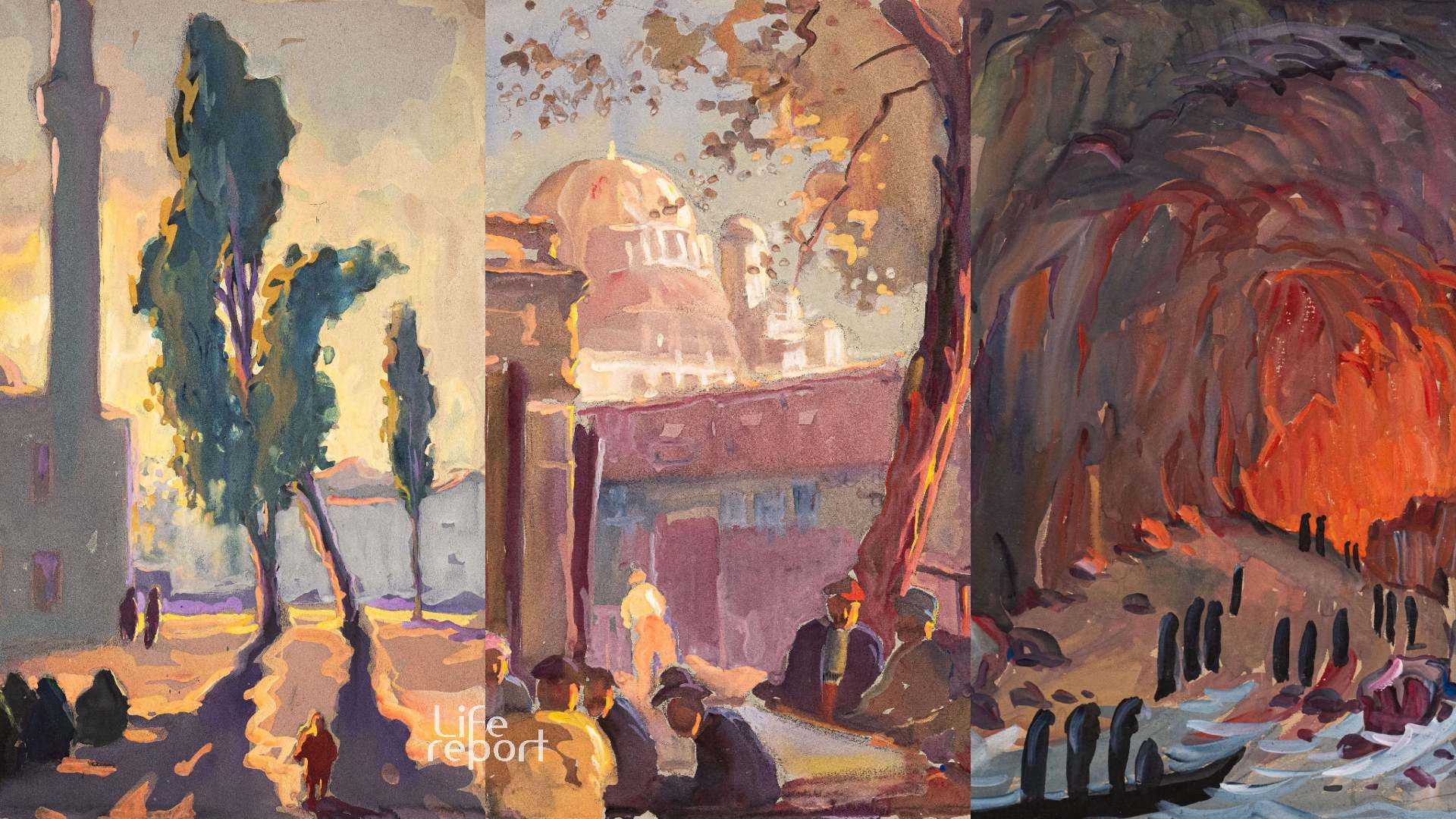
1. Constantinople motif, late 1920s – 1930s gouache, paper.
2. Constantinople motif, late 1920s – 1930s gouache, paper.
3. Composition, 1920s up to 1924 gouache, paper.
Petar Dachev – born in Kotel in 1898 and deceased in Sofia in 1968 – was, until recently, remembered by almost nobody outside the archival corridors of the Regional History Museum of Dobrich. Sofia City Art Gallery’s exhibition The Petar Dachev Case, which opened on 23 June and runs until 30 August 2026, is curated by Lyuben Domozetski and Ivo Milev. With more than 200 works assembled under one roof, it represents the most comprehensive presentation of Dachev’s practice ever mounted and, implicitly, a gentle yet pointed indictment of how the Bulgarian art establishment allowed one of its more intriguing modernists to slip through the cracks.
The Case, as Presented
The exhibition’s title – The Petar Dachev Case – deliberately borrows from the vocabulary of legal and forensic inquiry, as though culture were a crime scene requiring reconstruction rather than a gallery requiring illumination. The framing is apt. What Domozetski and Milev have undertaken is less a retrospective in the conventional sense than an act of institutional archaeology: excavating, cross-referencing and presenting the evidence of a life’s work that was, for reasons both political and aesthetic, kept just below the threshold of canonical recognition.
View this post on Instagram
Dachev studied under Professor Tseno Todorov at Sofia’s School of Arts and Industry before pursuing further education at the Academy of Fine Arts in Constantinople – present-day Istanbul – between 1924 and 1926. He worked across painting, drawing, lithography and book illustration, and published critical texts on art at a time when such dual practice – the artist functioning simultaneously as intellectual and commentator – was considerably less common than it later became. In 1957, he visited Paris, spending several months absorbing the cultural life of a city that, in the mid-twentieth century, remained the closest thing the art world had to a gravitational centre. He died in Sofia eleven years later at the age of seventy.
1924: The Exhibition That Announced a Sensibility
The first structural axis of the exhibition centres on Dachev’s solo exhibition of 1924 – an event that, contemporaries noted at the time, revealed an artist with a clearly articulated relationship to modernity. Dachev moved within the circles of Geo Milev alongside Ivan Milev, Ivan Boyadjiev and Sirak Skitnik – a cohort of artists who, in the early 1920s, were processing the influence of European avant-garde movements through the specific anxieties and aspirations of interwar Bulgarian culture. This was not a provincial echo of Western modernism; it was a genuinely parallel development, shaped by its own political climate and its own unresolved questions concerning national identity and visual modernity.
The 1924 exhibition positioned Dachev within this milieu with particular clarity, demonstrating what the curators describe as an interest in “the new plastic solutions entering European art during the first decades of the century”. The phrase is deliberately measured: the works do not proclaim stylistic allegiance so much as they reveal perceptual intelligence, a sensitivity to the ways in which the pictorial field was being reconceived across Europe from Cézanne onwards, and a willingness to engage with those developments on his own terms.
Istanbul: A Decade of Looking
The second, and arguably more distinctive, body of work in the exhibition consists of paintings, drawings and prints produced during Dachev’s extended residence in Istanbul – nearly a decade of sustained engagement with a city that has always resisted simple categorisation. Streets, harbours, markets, architectural panoramas and figures observed within the texture of everyday life: the Istanbul works constitute what the curators describe as “one of the largest thematic groups” in his oeuvre and are, by any measure, his most formally ambitious.
Istanbul in the early-to-mid twentieth century was a city undergoing a transformation as radical and disorientating as any in Europe, caught between Ottoman inheritance and Kemalist modernity, between its own Mediterranean-Levantine cosmopolitanism and the pressures of nation-state consolidation. For a Bulgarian artist attuned to questions of cultural translation and visual modernism, the encounter with such a city proved generative in precisely the ways one might expect. It offered a subject inexhaustible enough to sustain a decade of observation and a context sufficiently layered to reward the attentive, iterative approach that Dachev appears to have practised.
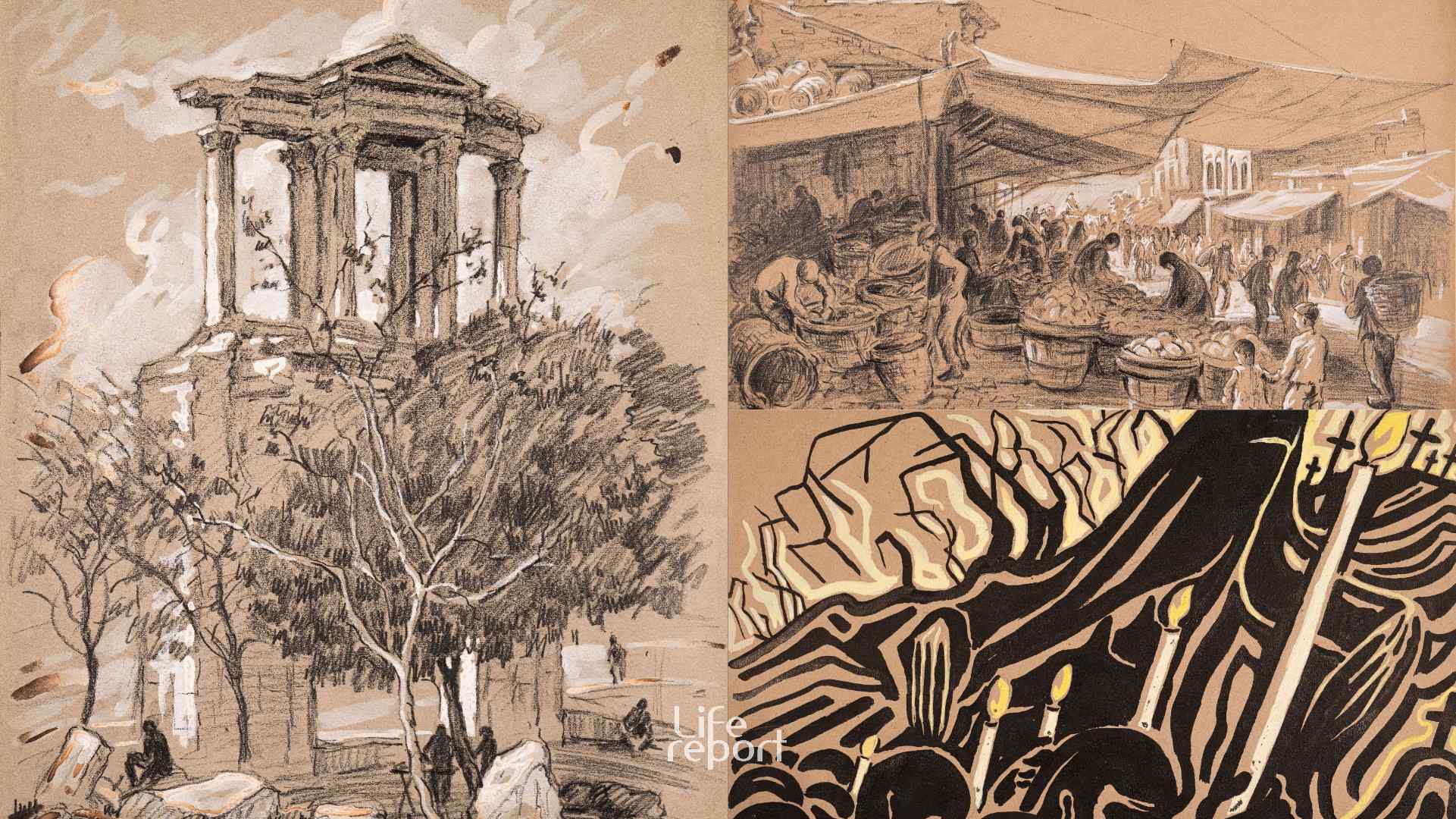
1. Hadrian’s Arch, 1930s chalk, gouache, paper.
2. Istanbul Market, late 1920s – 1930s chalk, gouache, paper.
3. Composition, 1920s up to 1924 ink, gouache, paper.
The Istanbul works invite comparison, at least in spirit, with those of European artists who found in the city an inexhaustible chromatic and compositional challenge – from the nineteenth-century Orientalists, whose representations the next generation of modernists would be obliged to critique and dismantle, to later twentieth-century figures who sought in Istanbul not exoticism but complexity. Trained between Sofia and Constantinople, Dachev positioned himself somewhere within that transition, bringing to his cityscapes a quality of sustained attention that seems less interested in the picturesque than in the structural.
The Question of Forgetting
Sofia City Art Gallery houses more than 8,000 works, ranging from classical Bulgarian painting to contemporary art and photography, and organises around 30 exhibitions each year. Within that programme, the gallery has developed a distinct research strand dedicated to re-examining the established narrative of Bulgarian art between the wars – a period of genuine artistic vitality that was subsequently subjected to considerable historical distortion. Dachev’s partial disappearance from that history is, in this light, not an accident but a symptom.
The exhibition catalogue – featuring research by the curators alongside essays by Ani Venkova on Dachev’s biography and Kremena Miteva on his archival legacy, with design by Todor Manolov – reflects a scholarly commitment that extends beyond the temporary illumination of a gallery visit. It is an attempt to provide Dachev with the documentary apparatus that serious historical consideration requires: to make his case, as the title suggests, not merely visible but genuinely arguable.
View this post on Instagram
The largest single source of works in the exhibition is the Regional History Museum of Dobrich, which holds the most substantial collection of Dachev’s art. The museum’s participation is both logistically essential and symbolically resonant. The works that might, in a differently organised cultural landscape, have anchored a national museum collection instead found their way to a regional institution, where they were carefully preserved but remained largely invisible to the audiences that might have shaped their reception.
Why This Matters Now
The rehabilitation of overlooked modernists has become a well-established institutional endeavour. Over the past two decades, the art world has devoted considerable attention to recovering artists marginalised by the canonical gatekeeping of the twentieth century, particularly women, artists working beyond the Western European mainstream and those whose work was suppressed or distorted by political regimes. Dachev fits several of these categories simultaneously, making Sofia City Art Gallery’s project timely in ways that extend beyond the local context.
There is also something particularly valuable about an exhibition that focuses not on a rediscovered genius – the “lost masterpiece” narrative preferred by the market – but on an artist of genuine seriousness and historical significance whose relative obscurity reveals something important about the mechanisms through which art history is constructed and dismantled. The Petar Dachev Case takes its title seriously: this is a case to be examined, debated and, ultimately, judged by audiences willing to engage with the evidence.
Also Read: The Most Unexpected Art Show in Dubai Will Make You Distrust Your GPS