At Jameel Arts Centre, more than 40 artists dismantle the fiction of seamless movement – from hand-carried Mercedes-Benz cars to cosmic highways – revealing why the luxury of getting lost is the ultimate status symbol of 2026.
Before 1956, the Kathmandu Valley existed in a kind of self-imposed isolation, a kingdom untouched by the combustion engine not through dogmatic resistance, but through sheer geographical defiance. When the Rana aristocracy desired a Mercedes-Benz, the vehicle was shipped to Calcutta, driven to the Himalayan foothills, then meticulously dismantled and carried on the shoulders of as many as 96 porters along mountain trails. These porters did not classify the cars by marque or horsepower, but by a more human metric: the number of men required to carry them – 32, 64 or 96. A Mercedes, at that altitude and in that context, was not a machine of propulsion but a dead weight, a disassembled idol of progress ferried by a network of muscle and bamboo.
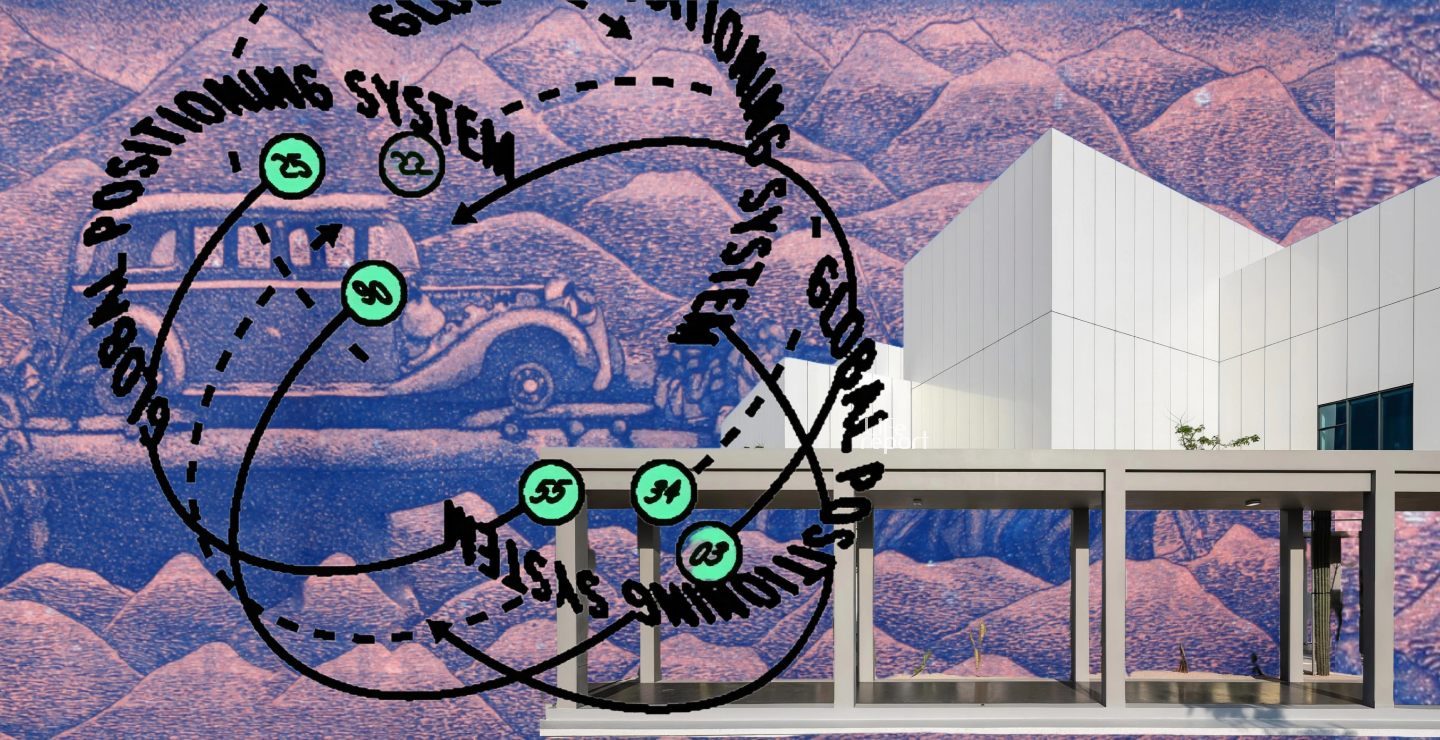
This image – a spectral premonition of today’s luxury SUV’s journey from factory to valet stand – hangs in the air at Jameel Arts Centre, a low-slung masterpiece of floating concrete and courtyard tranquillity perched on Dubai Creek. Here, until October 2026, the two-part exhibition Global Positioning System unfolds with the kind of intellectual swagger that does not need to raise its voice. Curated by Lucas Morin and Indranjan Banerjee, and bringing together more than 40 artists from over 20 countries across Art Jameel’s twin venues in Dubai and Jeddah, the exhibition is a patient, witty and, at times, quietly devastating audit of the infrastructures that promise frictionless mobility while silently calibrating who gets to move, how quickly and at whose expense.
To walk through the galleries is to enter a cartographic fever dream in which maps shed their pretence of objectivity. The exhibition treats the map not as a benign tool but as what it has always been: an instrument of power, a “proposition” about space that ossifies borders, inscribes ownership and renders certain trajectories invisible. Yet, as the exhibition deftly reminds us, the age of the paper map is over. In its place, the glowing blue dot on a smartphone has reduced navigation to a Pavlovian obedience test. Turn right. In 300 metres, your destination is on the left. The journey itself – the messy, serendipitous and sensory act of moving through space – has been stripped of friction, texture and chance. What remains, the exhibition’s central provocation asks, when we stop knowing how to read the world?
View this post on Instagram
The answer arrives in a polyphony of media and sensibilities. Subas Tamang’s photographic reinterpretation of a 1948 image by Volkmar Wentzel – the very scene of a Mercedes-Benz being carried by sixty porters – re-centres the narrative on the Tamsaling community, the invisible bodies behind the weight of modernity. Nearby, Colombian artist Tatyana Zambrano turns her lens on a different kind of burden: the Mercedes G-Class as it prowls the streets of Medellín and Cali, a hulking totem of aspirational excess and the informal economy. In the Gulf, where the G-Class is less a vehicle than a rolling declaration of arrival – often, it must be said, in precisely the same valet queue as everyone else – Zambrano’s critique lands with an irony so elegant it practically emits a discreet chime.
Then there is the traffic jam of broken promises. Harun Farocki’s forensic cinema, Mohammed Kazem’s disorientating video loops and the CGI-sculpted dystopias of Lawrence Lek all probe what happens when navigation systems collapse – not into chaos, but into something more unsettling: a digital purgatory in which the destination is perpetually recalculated. The works spill into orbit as well. Recurring circular movements, endless spirals and repetitive gestures populate the exhibition, serving as a wry visual metaphor for the way algorithmic routing keeps us tracing the same grooves of convenience, mistaking efficiency for freedom.
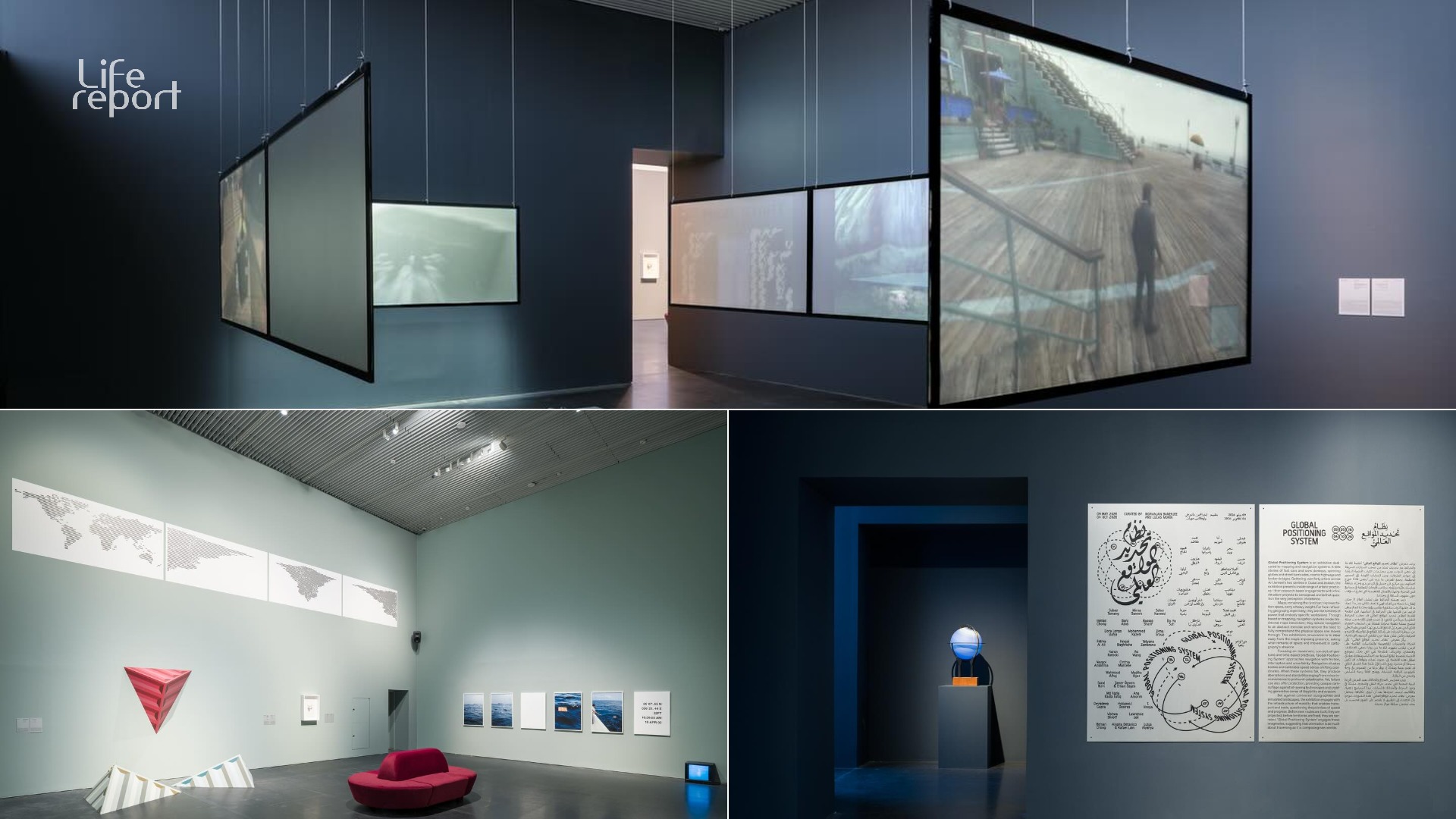
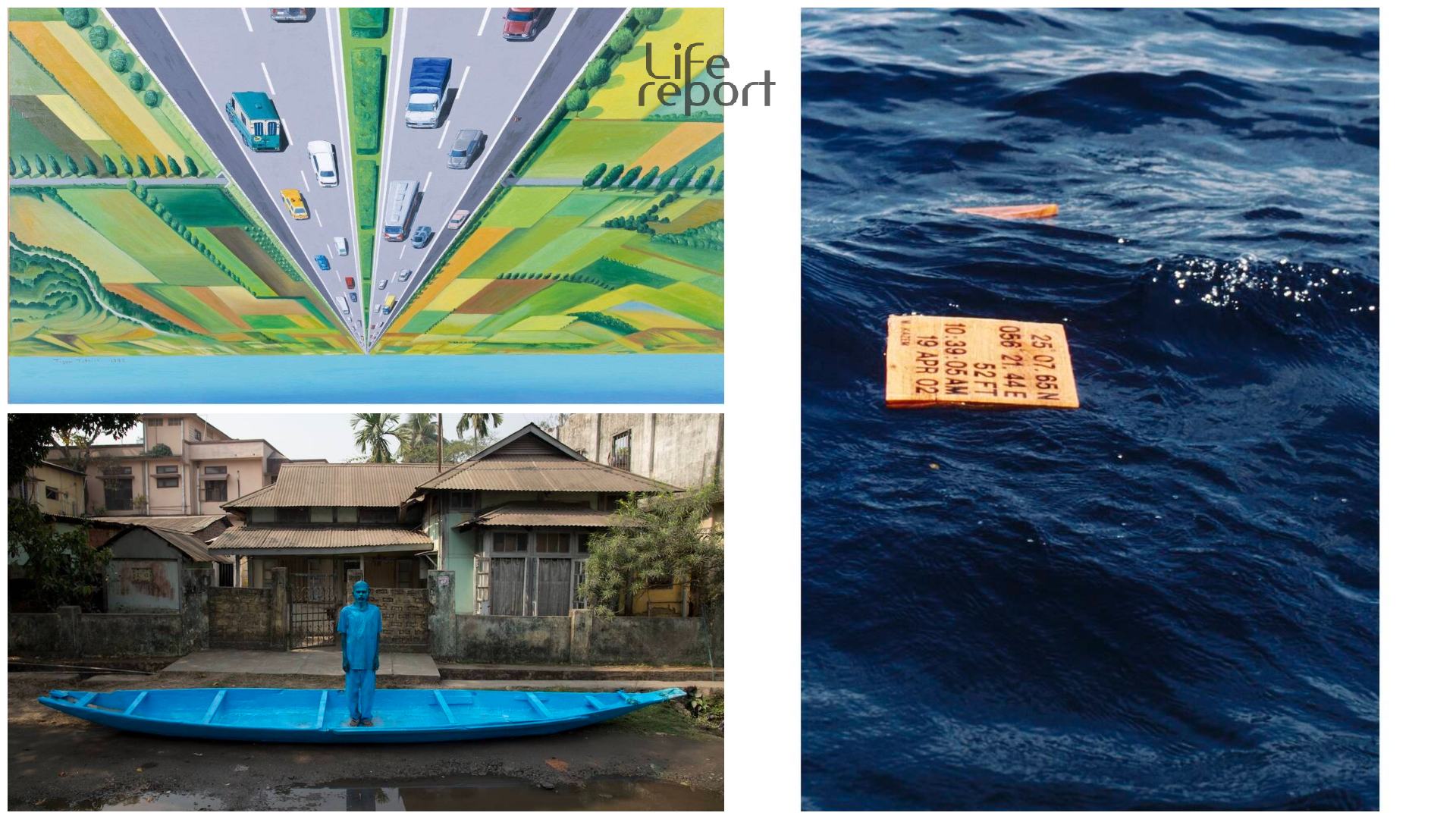
What elevates Global Positioning System beyond a well-articulated seminar is its refusal to forget that the infrastructures it interrogates are also sensory, intimate and occasionally absurd. The exhibition juxtaposes donkeys and fast cars, spinning globes and street barricades, cosmic highways and broken bridges. It reminds us that before a route is built, it is projected; before a territory is fixed, it is narrated. In the hands of artists such as Bani Abidi, Dima Srouji and the collaborative duo Hylozoic/Desires, navigation becomes less about arrival than imagination – a composition of possible worlds rather than the consumption of coordinates.
This is, of course, a deliciously inconvenient idea to entertain in Dubai, a city whose identity is inscribed in superlative velocity and the cult of the direct route. It is a place where the latest connected chronograph from Patek Philippe or a car’s augmented-reality head-up display promises ever more granular control over one’s trajectory. Yet the most urbane pleasures – the unmarked backstreet café, the perfume souk discovered through sensory drift rather than GPS, the accidental conversation – depend entirely on a willingness to suspend the tyranny of the optimal path. The exhibition suggests, with a certain sibylline smile, that the luxury of getting lost may be the last true scarcity in a hyper-mapped world.
View this post on Instagram
The Jeddah chapter at Hayy Jameel extends this cartographic meditation across the Arabian Peninsula, reinforcing Art Jameel’s dual-city choreography. Together, the two venues demonstrate that infrastructure is not a neutral backdrop but a narrative technology, shaping how bodies relate to time, borders and one another. By the time visitors step back onto the corniche, the evening air thick with oud and salt, the blue dot on the phone feels slightly more dubious, more advisory than divine.
Running until October 2026, Global Positioning System is that rarest of phenomena: a group exhibition with the intellectual rigour of a thesis and the sensorial charm of a finely edited playlist. It invites a generation raised on on-demand everything to consider that the most radical cartography might be drawn not on silicon, but in the willingness to pause, to deviate and to shoulder the weight of a journey – even one measured in men rather than miles.
Also Read: This Dubai Bar Turned Cocktails Into Food – And Somehow Made It Taste Better