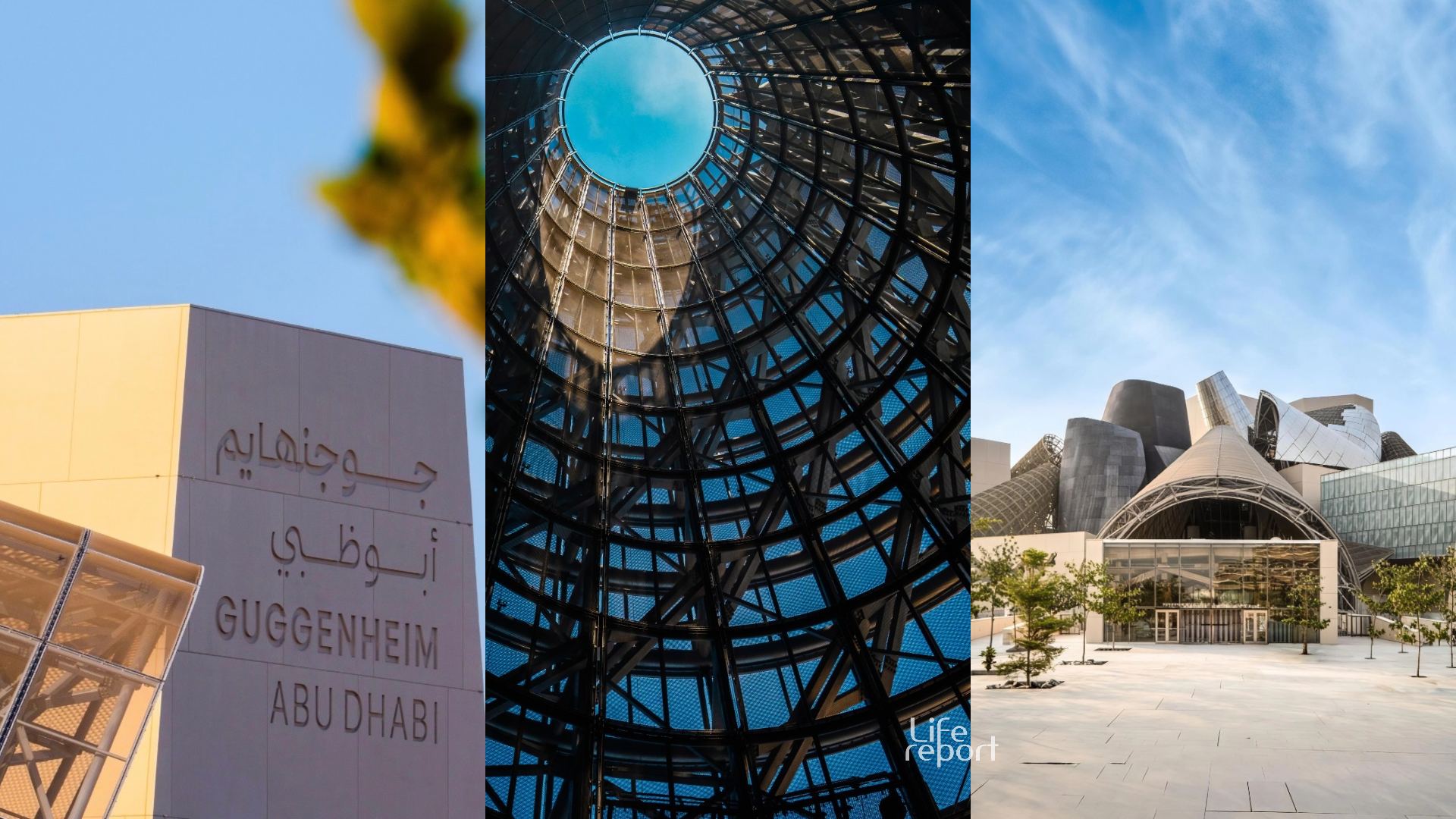
What happens when a museum takes twenty years to arrive? It becomes more than a building. It becomes a rumour, a promise, a test of patience – and, eventually, a cultural event too large to ignore. On December 11, 2026, the Guggenheim Abu Dhabi will finally emerge from that long intermission on Saadiyat Island, as Frank Gehry’s extraordinary constellation of ten sculptural cones opens to the public. Wrapped in stainless-steel mesh, onyx and glass and rising as high as 88 metres, the 80,000-square-metre museum is set to become the largest Guggenheim in the world. But the real story is not the building. It is what happens when one of the art world’s most recognisable names arrives in Abu Dhabi – and potentially redraws the cultural map in the process.
To call the journey protracted would be to mistake a marathon for a stumble. First announced in 2006, the project survived the financial crisis, an era of halted cranes and the slow, sand-dusted churn of reviews and construction delays that became as emblematic of the Gulf building boom as its skyline. Site and structural work began in 2011 before construction was suspended; the project re-emerged in 2019, with the main construction contract ultimately awarded in 2021. The $1 billion construction contract, awarded to BESIX Group subsidiary Six Construct and Trojan Contracting, now seems less a line item than a testament to the sheer gravitational force required to bring a Gehry to life in the desert.

The delays, while widely tut-tutted in Western art circles, allowed the collection to mature with a focus that almost seems planned: a transcultural harvest of modern and contemporary art from the 1960s onwards, with particular attention to West Asia, North Africa and South Asia, acquired through a collaboration between Abu Dhabi’s Department of Culture and Tourism and the Solomon R. Guggenheim Foundation.
Gehry’s design resists the urge to mimic the regional vernacular with overt mashrabiya cut-outs or literal sand-dune metaphors. Instead, it erupts from the shoreline like a postmodern volcanic field. Nine of the cones are wrapped in stainless-steel mesh, while the tenth is clad in onyx and glass. Rising as high as 88 metres, the cones are not merely sculptural bravado: they are designed to provide natural ventilation and shade, improving the building’s energy efficiency while giving the museum its unmistakable silhouette.
Inside, a central atrium pulls the gaze upward, while 30 galleries – comprising 11,600 square metres of interior gallery space – unfold without dictating a linear march through art history. The promise is a curatorial Wunderkammer organised not by chronology but by resonance: Abstractions, Popular Culture, Land, Language and Storytelling. It’s a playlist, not a textbook. For a generation raised on algorithmic discovery, this non-linear promenade will feel instinctive: a museum built for the Spotify-adjacent mind.
View this post on Instagram
The Guggenheim Abu Dhabi lands not in isolation but within a cultural district that has, almost surreptitiously, become one of the world’s most concentrated showcases of architectural star power. Saadiyat Cultural District brings together Jean Nouvel’s filigreed dome at Louvre Abu Dhabi, the falcon-inspired towers of Foster + Partners’ Zayed National Museum and the forthcoming Dar al Funoon Abu Dhabi, a performing-arts venue also designed by Gehry and scheduled to open in 2030. Together, they form a kind of architectural Voltron of late-capitalist enlightenment.
For the Gen Z and millennial traveller who itinerises via Instagram geotag, Saadiyat Island has long been a backdrop for the luxury slow-travel aesthetic: the polished calm of the St. Regis Saadiyat Island Resort, the hushed reverence of the Mamsha promenade and the improbable ritual of a sunset aperitif beside an ancient landscape. Now, it adds a definitive gravitational centre.
What of the art? The collection has been quietly assembling since 2009, under the custodianship of the Guggenheim Foundation and Abu Dhabi. While Bilbao’s museum is renowned for its relationship with the post-war Western canon, this new institution promises substantial holdings from West Asia, North Africa and South Asia – an art history that deliberately looks beyond the familiar New York–London–Paris axis. Expect to encounter artists and practices from across these regions alongside international figures, with the collection designed to reveal connections across geographies, generations and artistic practices rather than placing works inside the familiar confines of “regional representation”.
Mariët Westermann, Director and CEO of the Solomon R. Guggenheim Foundation, has described the collection as uniquely local and global, centred in the region while encompassing works from every continent. It is a proposition that sounds almost suspiciously straightforward until one considers how long the art world has spent drawing its maps along rather narrower lines.
The museum will also support research, commissions and a multilingual public programme, extending its ambitions beyond the conventional museum experience. The broader project has previously been associated with facilities dedicated to art and technology, education, archives, research and conservation, underscoring Abu Dhabi’s desire to build not merely a museum but an ecosystem around contemporary cultural production.
Yet no cultural ribbon-cutting in this part of the world escapes the shadow of geopolitics. The opening arrives amid a region still navigating profound tremors. It’s an irony that feels almost Gehry-esque in its contortions: a temple of transcultural dialogue rising on an island whose very name means “happiness”, while the wider neighbourhood continues to debate the texture of borders and belonging. The museum’s boosters will recite the mantra of art as a bridge, and one might roll one’s eyes – except that bridges, unlike press releases, are built to hold weight. The collection’s thematic spine, with its emphasis on Land and Language, cannot help but read as a quiet curatorial reply to the headlines. This is not a museum designed to shout; it’s a space engineered for the long, slow look.
For the global luxury traveller – the same creature who times their December calendar around Art Basel Miami Beach and Frieze Seoul – the 2026 season has just acquired a new anchor. Frieze Abu Dhabi, the evolution of Abu Dhabi Art, is scheduled to make its debut at Manarat Al Saadiyat from November 19 to 22, meaning the art pilgrimage can now begin with a fair, linger through the Louvre and culminate with a pre-booked slot in Gehry’s atrium.
View this post on Instagram
The logistics are already aligning: Etihad’s first-class cabin, a suite at the Park Hyatt Abu Dhabi Hotel and Villas on Saadiyat Island, a bespoke fragrance fitting at the Oo La Lab apothecary in Alserkal Avenue before the drive down to Saadiyat. The museum will feature 23,000 square metres of outdoor exhibition space, which translates, pragmatically, to a rather more photogenic alternative for the culturally inclined visitor who finds the Burj Khalifa’s selfie density exhausting.
There remains the faint, elegant whiff of scepticism that clings to all mega-museums born of state ambition. It’s a scent as familiar to the Gulf as oud and sea salt, and not without reason. But to dismiss the Guggenheim Abu Dhabi as a mere exercise in cultural soft power would require ignoring the profound shift in curatorial gravity it represents. When the doors slide open on December 11, what will stir isn’t just the satisfaction of a long-delayed architectural handshake. It will be the quiet, unsettling and thoroughly welcome recognition that the map of contemporary art has been subtly, perhaps permanently, redrawn – not with a manifesto, but with a mesh-clad cone catching the last light of an Arabian afternoon.
ALSO READ: Forget Venice: The Art World’s Next Obsession Is Hiding on the Silk Road