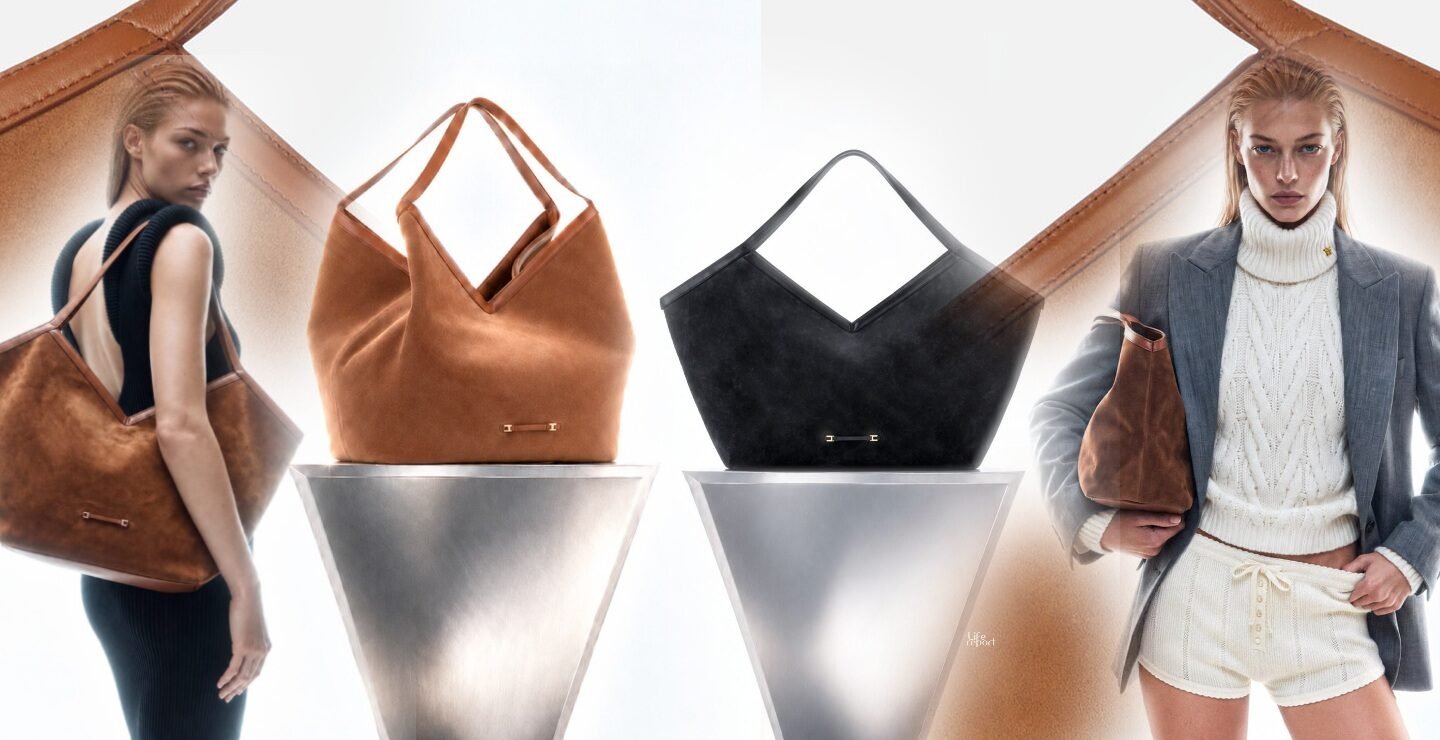
Luxury has learnt to lower its voice – and the handbag has become its most articulate whisper. In a majlis, where a room can be read before a single word is exchanged, the true flex is now counterintuitive: a silhouette so considered, so deliberately understated, that it rewards only the gaze patient enough to linger. The new TRIA bag from Elisabetta Franchi enters this territory not as a declaration but as a proposition. It asks whether a tote can be both a geometric argument and a tactile pleasure, whether structure and softness can coexist without one colonising the other. The answer, mercifully, is yes.
The TRIA is a suede tote measuring 30 × 35 × 17 centimetres – an eminently civilised set of proportions that accommodates a day’s essentials without suggesting you might be moving house. Its defining gesture is the generous opening, which gives the upper volume a sculptural curve, almost architectural in its execution, as if the bag had been drafted by someone who understands that the most elegant line is often the one that knows when to stop. The handles follow that geometry, creating a clean, balanced design that resists the current vogue for ornamental excess. At the base, a metal logo clasp sits like a discreet signature on a canvas – present, precious, but never insistent. In an era when certain houses have turned their monograms into a form of visual tinnitus, this restraint feels almost radical.
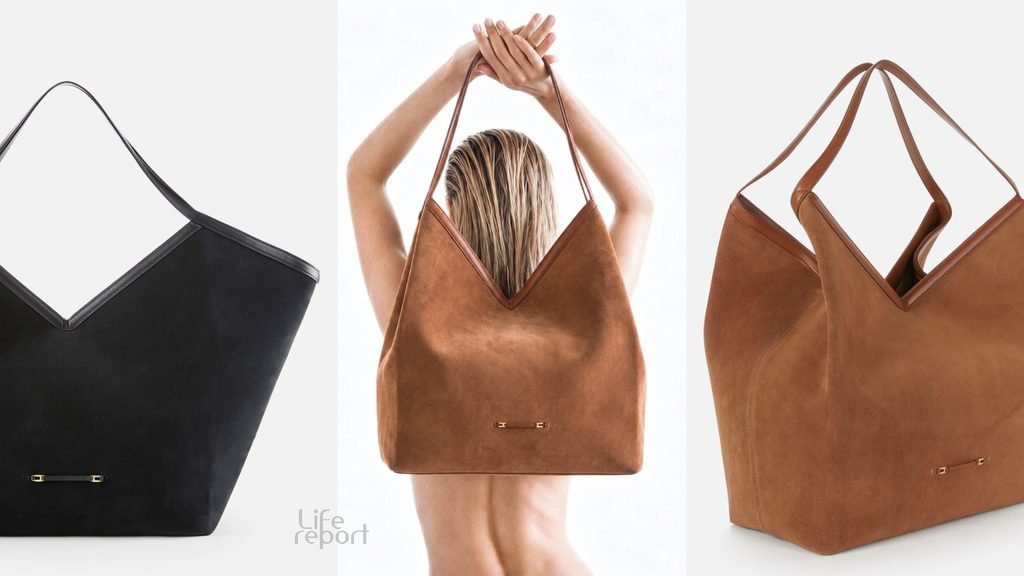
Suede, of course, is one of the season’s defining materials, although one approaches it with a certain wry awareness of its practical demands. The autumn/winter 2026 collections have given it renewed prominence: Chanel, under Matthieu Blazy, has offered a particularly persuasive interpretation in beige suede, while designers elsewhere have explored its tactile appeal across clothing and accessories. Where some interpretations lean into bohemian softness, however, Franchi’s suede is chosen for the way it absorbs light; its nap lends the structured silhouette a natural, contemporary feel, preventing the geometry from hardening into severity. It is a material that ages and records the friction of a life well lived – a quality likely to resonate with a generation increasingly allergic to the disposable.
That generational instinct is worth pausing over. The Middle East’s luxury market is increasingly shaped by millennials and Gen Z consumers: PwC’s 2024 regional survey found that 47 per cent of Gen Z respondents and 55 per cent of millennials planned to increase their spending on luxury goods over the following six months. For many younger buyers, a handbag is less a trophy than an extension of personal style – an object that must justify its place through versatility, craftsmanship and a degree of ethical coherence. The company behind Elisabetta Franchi, Betty Blue, was established in Bologna in 1998. The label has built its identity around a femininity that is confident rather than performative, combining sartorial precision with a sensuality that never tips into caricature. Its collections went fur-free between 2012 and 2013. Franchi’s Spring/Summer 2026 show at Milan’s seventeenth-century Palazzo Acerbi – known as the ‘House of the Devil’ because of a plague-era legend, and still bearing a cannonball from the 1848 Five Days of Milan uprising against Austrian rule – set tailored power against fluid jersey and tulle. That tension between softness and structure is something the TRIA distils into accessory form.
For a Dubai audience fluent in the language of investment dressing, the TRIA’s appeal lies precisely in this tension. It is a bag that suits the rhythm of the city – from a morning at the office in DIFC to a late lunch at Alserkal Avenue, from a gallery opening to the kind of dinner where the seating plan is a contact sport. Franchi’s own framing of the piece is telling. The brand describes TRIA through a neat conceit: ‘Two shapes. The third is you.’ The wearer completes the idea through one of three attitudes – Power, Off Duty or Icon – allowing the bag to move between registers with ease. It is, in its way, a commentary on the modern luxury consumer’s refusal to be just one thing: serious and soft, structured and spontaneous, rooted in Italian design and entirely at home in the Gulf.
Elisabetta Franchi’s presence in the UAE has expanded accordingly. In Dubai, the brand continues to grow its retail footprint, with a fourth boutique opening at Nakheel Mall on Palm Jumeirah in August 2026, joining its established locations at Galeries Lafayette and Dubai Mall. The TRIA, arriving in this context, does not need to shout. It has the confidence of a piece that understands the difference between being seen and being noticed – and the even rarer confidence to choose the latter. In a market saturated with statement bags, the most stylish gesture may be the one that leaves a little to the imagination.