Dubai does not do subtlety by halves. It has turned scent into architecture: oud in the lobby, amber in the lift, a trail of something expensive lingering by the valet stand like a diplomatic credential. To walk through a mall here is to move through a series of olfactory installations, each one competing for the same square inch of attention. And yet the most interesting thing happening in luxury fragrance right now is not louder. It is quieter, older and considerably more sure of itself. It comes from a former Dominican convent in Florence, smells of smoked leather and pomegranate, and has a history stretching back more than eight centuries.
Officina Profumo-Farmaceutica di Santa Maria Novella is often described as the oldest pharmacy in the world. Its roots date to 1221, when twelve Dominican friars were granted formal use of the site known as Santa Maria inter Vineas, just outside Florence’s city walls, and established a botanical garden to supply their infirmary. The first documented sale of aromatic waters dates to 1381; the public pharmacy itself opened in 1612. Eight centuries later, the historic rooms on Via della Scala remain the house’s spiritual and commercial heart. Its range still includes soaps, candles and colognes shaped by Florentine traditions that have proved remarkably resistant to the logic of scale. In 2025, the house recorded turnover of €74.4 million, up 6.3 per cent year on year, which is the kind of growth that makes heritage brands interesting to people who otherwise use the word “heritage” as a polite synonym for “stagnant”.
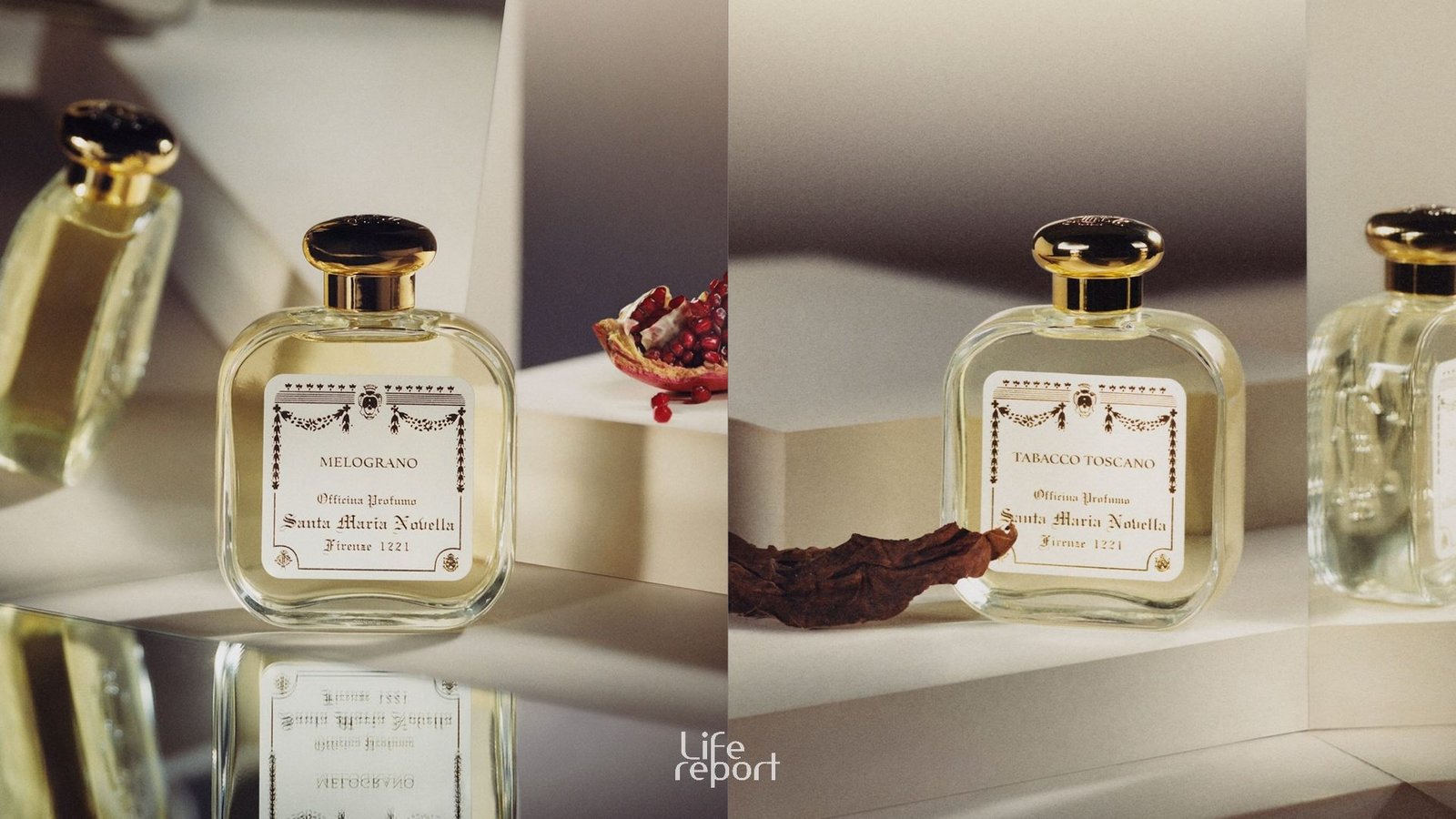
A defining format in the house’s fragrance portfolio has always been the Eau de Cologne – a genre that the fragrance industry tends to treat with the indulgence one reserves for an elderly relative at a wedding. Pleasant, well-mannered and gone by the first dance. Colognes are the linen suits of perfumery: elegant in theory, negligible in practice. Which is precisely why the two Santa Maria Novella compositions now available in the UAE deserve a closer look. They are not trying to be eau de parfum. They are not trying to project across a room. They are trying to do something far more difficult: smell like a place, a century and a point of view, all at once.
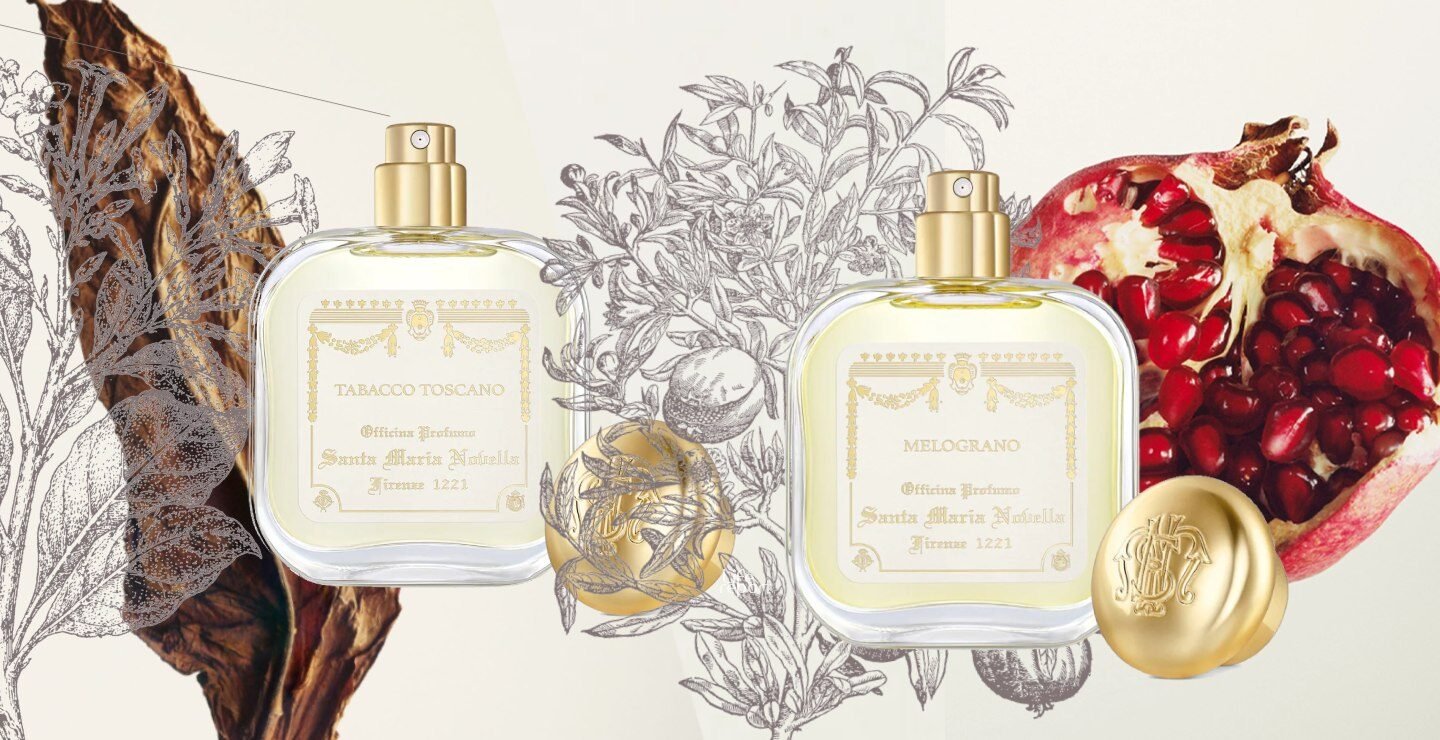
Tabacco Toscano is the one that tends to ambush people. The name promises a tobacco barn; the reality is closer to a library after hours – soft leather, dry leaves and a faint sweetness of vanilla and resin curling through the shelves. Bergamot and tobacco leaf open the composition; birch, leather and amber form its heart; and cedarwood, guaiac wood, sandalwood, musk and vanilla settle into a base that feels less like smoke than the memory of it. According to the house, the tobacco leaf entered apothecary practice under the name Herba catharinaria, associated with Catherine de’ Medici’s use of tobacco as a remedy for migraines. It is either a charming piece of house lore or an early example of self-medication by tobacco. Either way, a leaf once associated with a headache remedy has become one of the most quietly addictive things one can wear in a city that already has enough to say.
Melograno is the more extroverted of the pair, though “extroverted” here is relative. It opens with bergamot, bitter orange and fresh spices, moves through a pomegranate accord with rose and ylang-ylang, and settles into a base of oakmoss, labdanum, patchouli and musk. The composition dates from the 1960s, when the house created an accord inspired by the pomegranate, a fruit long associated with abundance across Mediterranean and Eastern cultures. It is the sort of scent that smells expensive without smelling new, which is a distinction that becomes more valuable the longer one lives in a city where everything is designed to look as though it was bought yesterday.
View this post on Instagram
Then there is the terracotta pomegranate, which is the most decadent object in the entire story and also the least useful. In the early 2000s, the Melograno composition found a new form as a hand-modelled terracotta pomegranate. The unglazed clay is infused with the scent, which is released slowly through its porous surface over several months. It does nothing. It diffuses. It sits on a console and makes a room feel like a Renaissance studiolo with better lighting. At a listed price of AED 332, it is the kind of purchase that resists rational justification, which is exactly what makes it a luxury object rather than a home-fragrance solution. The pomegranate is also the reason the collection feels alive rather than archival: a fruit that appears in Egyptian, Persian and Mediterranean iconography as a symbol of abundance has been translated into a piece of clay that will outlast most of the trends currently competing for shelf space.
The UAE is, improbably, the perfect market for this kind of restraint. The old assumption was that Gulf consumers wanted projection above all else – the bigger the trail, the bigger the statement. The data tells a more interesting story. According to Mordor Intelligence, luxury fragrances accounted for 80.78 per cent of GCC fragrance-market revenue in 2025, while the unisex segment is forecast to grow at a compound annual growth rate of 4.21 per cent through 2031. Younger consumers, particularly Gen Z and millennials, are helping to drive that shift towards versatile compositions that move beyond the traditional “his and hers” binary. The report also identifies Eau de Toilette as the fastest-growing fragrance format, linking its projected growth to younger buyers’ appetite for lighter, more versatile scents suited to daily wear and layering. Eau de Cologne, meanwhile, continues to occupy a more niche position.
This is where Santa Maria Novella’s apparent disadvantages become its selling points. A cologne that invites reapplication is not necessarily a failure of performance; it is an invitation to turn fragrance into a ritual, to treat it as something one does rather than something one inflicts. A scent that sits close to the skin is not weak; it is intimate, which is the only register that still carries any real social currency in a city where everyone is already performing. The brand’s Middle Eastern presence – Harvey Nichols at Mall of the Emirates, Bloomingdale’s at Dubai Mall and THAT Concept Store – places it within reach of consumers who are fluent in the language of niche perfumery but bored by the clichés of exclusivity. At Bloomingdale’s, a 50ml bottle of either cologne is listed at AED 419, while the 100ml Melograno is AED 596. These are prices that do not announce desperation. They announce a house that knows what it is.
The Firenze 1221 collection, launched in 2021 to mark the house’s 800th anniversary, frames all of this as a narrative rather than simply a product line. It brings together eight Eau de Colognes, each connected to a particular story: Acqua della Regina, associated with Catherine de’ Medici’s journey from Florence to France in 1533; Angeli di Firenze, created in 2006 in tribute to the “mud angels” who helped save the city’s cultural heritage after the 1966 Arno flood; and Melograno, Tabacco Toscano, Fresia, Pot Pourri, Rosa Gardenia and Rosa Novella. The collection is also presented in a discovery set of eight two-millilitre spray vials, which is perhaps the most sensible way to approach a house this old: try everything, then commit to the one that feels least like a costume.
View this post on Instagram
There is a gentle irony in all of this. Santa Maria Novella is now wholly owned by Italmobiliare, the Italian investment holding company that acquired an 80 per cent stake in 2020 and completed its acquisition of the remaining 20 per cent in 2021. In 2025, the house recorded turnover of €74.4 million, with double-digit growth in both retail and online channels. The oldest pharmacy in the world is, in the most contemporary sense, a scale-up. Its colognes are sold alongside wax tablets and terracotta diffusers, in a product ecosystem that would make a direct-to-consumer founder weep with envy. And yet the products themselves remain stubbornly analogue: the scent of tobacco and leather, the scent of pomegranate and moss, created by a Florentine house whose traditions long predate most countries.
Which is, perhaps, the real luxury. Not the price, not the packaging, not the story of the Medici migraines – though the story helps. The luxury is the refusal to panic. In a market that rewards novelty with alarming speed, Santa Maria Novella offers something that cannot be launched, only inherited. Eight centuries of practice, bottled at a concentration that asks you to lean in rather than stand back.
Dubai will keep shouting. It is a city built on the sound of its own ambition. But the smartest people in the room are increasingly the ones who have learned to whisper – and to smell as though they have been somewhere the rest of us have only read about.
ALSO READ: Why Dubai Men Are Ditching Designer Logos for Bespoke Tailoring