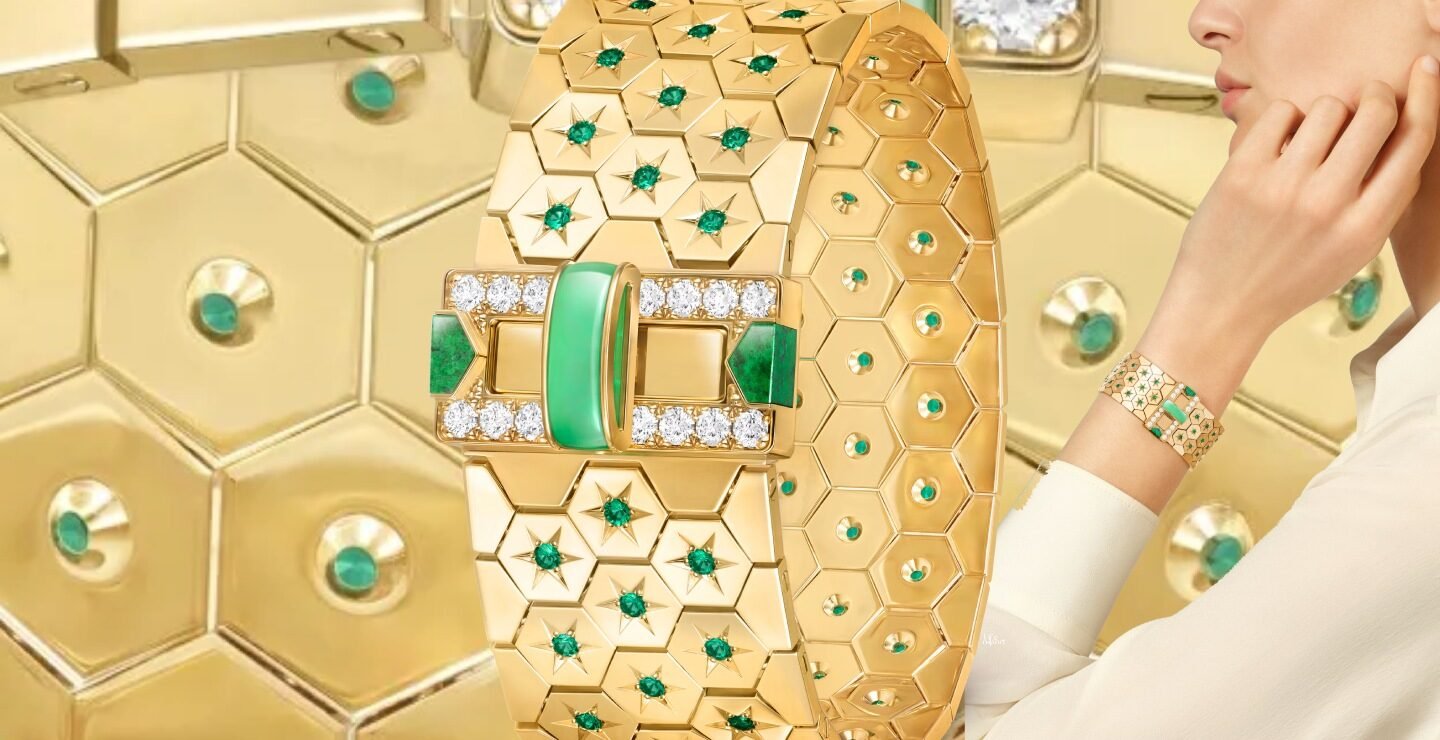
In a city that has made an art of the grand gesture, the most subversive thing you can wear this season is a belt. Not around the waist – that would be too literal – but wrapped around the wrist, rendered in 18-karat gold and fastened with a buckle that clicks shut with the quiet finality of a vault door. The Ludo bracelet, Van Cleef & Arpels’ most deliciously ironic contribution to the high jewellery canon, remains as relevant as ever. And it feels particularly at home in Dubai, precisely when the city’s younger collectors are beginning to tire of logos loud enough to be heard from the valet queue at Atlantis The Royal.
The Ludo is not new. It was born in 1934, when waists were cinched and women were discovering that a belt could be both a constraint and a declaration. The Parisian maison, then under the artistic direction of Renée Puissant, took the humble couture accessory and transformed it into a bracelet: a ribbon of gold that hugged the wrist as supplely as a length of silk, but with considerably more bite. Named after the childhood nickname of Louis Arpels, the youngest of the founding Arpels brothers, the piece was less a jewel than a feat of engineering: articulated, flexible and fastened with a gem-set buckle that made no secret of its sartorial DNA.
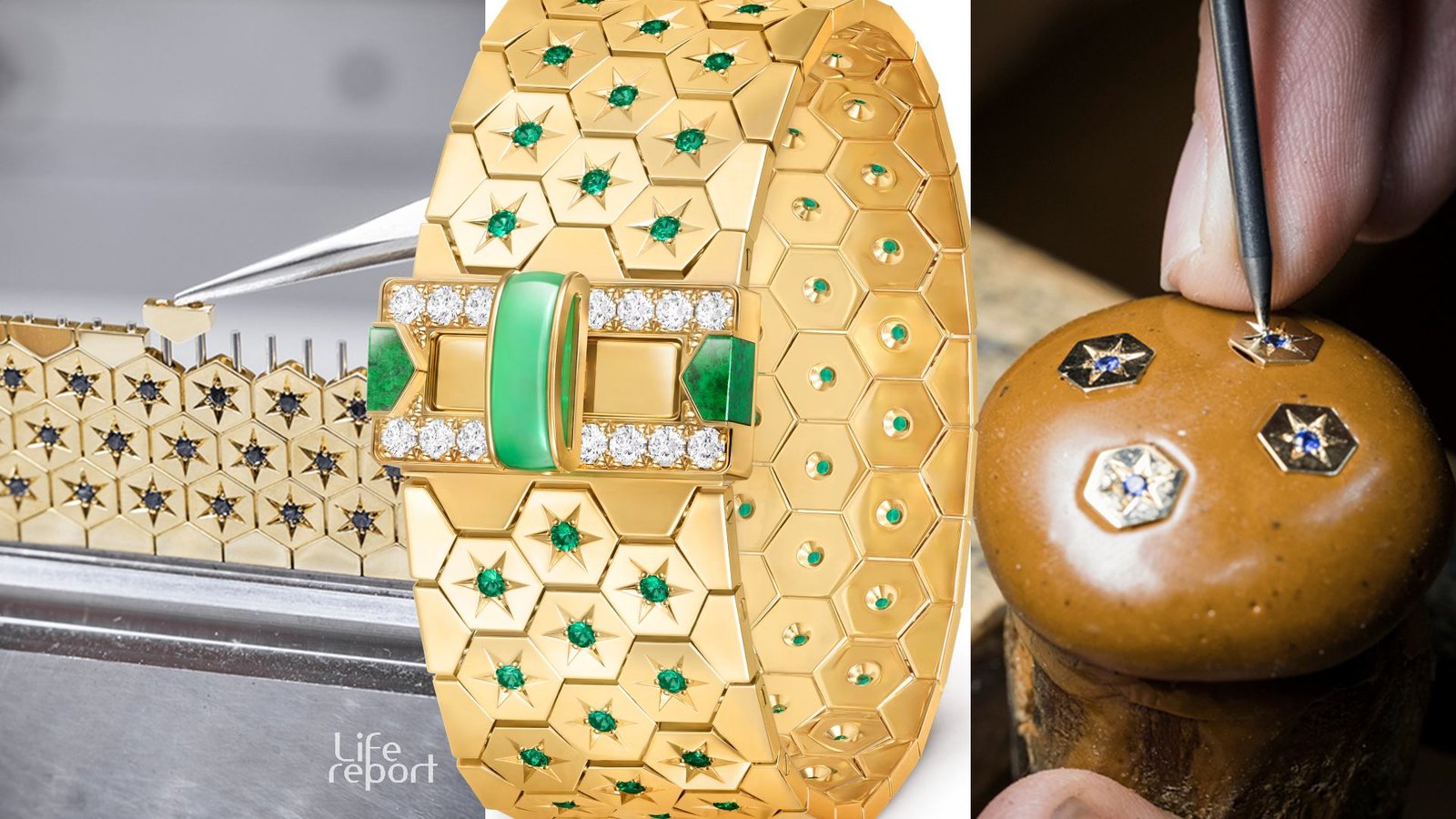
Van Cleef & Arpels new Ludo bracelet in yellow gold, emeralds and diamonds
One of the bracelet’s earliest champions was Hélène Arpels, Louis’s wife. She wore her Ludo over gloves or long sleeves, drawing attention to its modern silhouette and turning it into a piece of punctuation rather than mere decoration. It was an assured styling gesture that emphasised the bracelet’s unusual construction and its relationship with couture. Hélène understood that the Ludo was never simply an accessory to be admired in isolation. It was designed to become part of the silhouette.
Over the decades, the Ludo has evolved through numerous interpretations, while retaining the defining characteristics of its original design. The maison’s archives trace its development from the first brick-link version to the hexagonal mesh introduced in 1935, as well as subsequent jewellery watches that translated the same distinctive aesthetic into horology. Today, the collection continues to be reinterpreted, demonstrating how a design conceived almost a century ago can remain remarkably contemporary.
The contemporary Ludo bracelets are a study in controlled contradiction. The mesh is woven in the maison’s signature briquette and hexagon motifs: tiny polished gold rectangles and honeycomb links that catch the light with the restlessness of a disco ball, if a disco ball had been raised on couture and restraint. Their articulated construction allows the bracelets to move naturally with the wrist, creating the impression of a supple ribbon rather than a rigid piece of metal. The buckle clasp completes the illusion of a miniature belt, while precious and ornamental stones introduce colour and contrast to different interpretations of the design.
View this post on Instagram
The current UAE selection illustrates the breadth of the collection. Creations in yellow, white and rose gold, as well as mixed-metal combinations, are adorned with diamonds, sapphires, lapis lazuli, turquoise, chrysoprase, emeralds, coral and onyx. In one particularly striking yellow-gold hexagon-mesh version, star-set emeralds punctuate the links, while the central motif brings together chrysoprase, sannan skarn and diamonds. Other interpretations explore the interplay of blue sapphires, lapis lazuli and turquoise. The effect is not unlike looking at a piece of Art Deco architecture through a jeweller’s loupe: geometric, precise and unexpectedly warm.
The Ludo has always been a piece about tension. A belt is, after all, a tool of discipline – something that holds, shapes and occasionally confines. The Ludo takes that utilitarian object and turns it into an ornament of pure pleasure, a gilded handcuff that fastens around the wrist with a conspiratorial click. It is a belt that serves no function except to remind you, and everyone else, that function is not the only measure of value. In an era of quiet luxury and stealth wealth, when the most expensive things in the room are often those that refuse to announce themselves, the Ludo is a delicious anomaly. It is discreet in logo but not in presence. It does not shout, but it does catch the light. And it carries with it the spirit of a woman who understood that a jewel should never be merely decorative.
This is precisely why the Ludo has particular appeal for collectors in the Gulf who are drawn to pieces with a story as well as a recognisable name. Its attraction lies in its narrative, provenance and craftsmanship: jewellery that can be worn regularly and still feel like a private discovery. It belongs just as naturally with denim as it does with eveningwear, and can be layered with contemporary designs or worn as a singular statement. The Ludo is the thinking woman’s status symbol: a piece that rewards knowledge rather than income, though the latter certainly helps. At the time of writing, the UAE website lists Ludo bracelets from AED 316,000 to AED 366,000, depending on the design and gemstone configuration. This is not a bracelet for the impulsive. It is a bracelet for the convinced.
The Ludo’s enduring appeal also coincides with a broader cultural reappraisal of the 1930s – a decade whose aesthetic language of belted waists, Art Deco geometry and liberated silhouettes feels unusually resonant in a moment obsessed with structure and softness in equal measure. The bracelet’s lines pay tribute to the classics of couture: much as a belt accentuates a graceful silhouette, the Ludo outlines the curve of a wrist, tracing the architecture of the body with the same precision a couturier might bring to a seam. Van Cleef & Arpels has always understood that the relationship between jewellery and fashion is not one of ornamentation but of syntax. The Ludo is a sentence in that ongoing conversation, and it is spoken with perfect grammar.
For Dubai’s collectors, the piece is available at the maison’s Les Salons Dubai Opera, a boutique that pays homage to the house’s historic relationship with dance and has become something of a pilgrimage site for those who prefer their luxury with a side of cultural memory. The Ludo Secret watches extend the same design language into watchmaking, concealing their dials until a discreet gesture reveals them. At the 2025 edition of Dubai Watch Week, the maison’s Poetry of Time exhibition presented its horological artistry alongside archival documents and heritage pieces, including a Ludo Secret watch. The exhibition drew visitors into a world where craftsmanship and imagination take precedence over conventional timekeeping. This is a city that has learned to read jewellery the way it reads architecture: for structure, for proportion and for the story embedded in the material.
And yet, for all its cerebral pleasures, the Ludo is not a solemn object. It is, at heart, a little bit funny. A belt for the wrist. A couture accessory shrunk to the scale of a secret. A piece of hardware elevated to the status of an heirloom. There is a gentle irony in wearing a symbol of constraint as a token of liberation, and the Ludo wears that irony lightly, with the self-awareness of a maison that has been exploring the same idea for nearly a century and still finds it amusing. In a market saturated with newness, the Ludo offers something rarer: a piece that feels both inevitable and surprising, like a conversation you did not know you needed until it began.
So, the next time you fasten a belt around your waist and feel the satisfying certainty of a silhouette coming into focus, spare a thought for your wrist. It has been waiting for its own buckle. The Ludo is not simply a bracelet. It is a reminder that the most enduring luxuries are those that make you think – and then make you smile, quietly, into your cuff.
ALSO READ: Salmon Guru Dubai Broke the Rules in the Most Unexpected Way