

It usually happens after the second round of iced coffees and just before someone pulls out their phone to show you a Reel of a villa on Palm Jumeirah that they’re definitely going to tour this weekend. It’s the moment we start asking the bigger questions. Like: what do we actually want? Not in the vague, self-help, manifestation sense, but in the tactile, I-want-to-put-it-on-my-body-and-feel-different sense. Last week, I found my answer in a serpent. Or rather, in a room full of them.
I’d been invited to see Bvlgari’s new Eclettica High Jewellery collection, which had just made its way through the usual capitals of the Old World – Rome, Milan – and landed, as everything interesting eventually does, in the crosshairs of our city’s particular brand of magic. And here’s the thing about walking into a Bvlgari high jewellery presentation in Dubai: you expect to be dazzled. You expect the wattage, the carat counts that sound like postcodes, the kind of diamonds that make you instinctively check whether your rent is paid.

What I didn’t expect was to feel seen. Not by the jewels exactly – though the emeralds in the Emerald Strata necklace have a way of locking eyes with you that feels almost flirtatious – but by the idea behind them. The word “eclecticism” gets thrown around in fashion the way “vibes” gets tossed around on Hinge profiles: generously, vaguely, often as a placeholder for “I like a bit of everything but haven’t quite figured out the thread”.
For Bvlgari, eclecticism isn’t a placeholder. It’s the thread. It’s the whole tapestry. Let me step back. Because to understand why a collection called Eclettica – over 150 one-of-a-kind pieces, 15 transformable creations, and nine Capolavori that take my breath away just typing the word – feels less like a product launch and more like a declaration of creative independence, you have to understand where it comes from.
Bvlgari is Roman. Not in the way that a hotel in Rome is Roman, or a pasta recipe passed down through generations is Roman. It is Roman in the way the city itself is: layered, contradictory, unapologetically itself. When Sotirio Bulgari – a Greek silversmith who effectively said, “you know what, I’ll just start over in a new country and reinvent everything” – opened his first shop in 1884, the jewellery world was speaking French. Platinum. Geometry. Restraint. Very très chic, very “we don’t make mistakes”.
View this post on Instagram
For a while, Bvlgari played along. But by the 1950s, Sotirio’s grandsons looked at the Colosseum, the churches, and the Baths of Caracalla and thought: why are we making jewellery that looks like it belongs in a Parisian salon when we live in a city that invented the dome?
They abandoned platinum for yellow gold. They swapped diamonds for cabochon cuts – those smooth, rounded stones that catch the light like a Roman afternoon. They paired precious stones with semi-precious ones as if introducing guests at a dinner party, trusting the conversation would be electric. Elizabeth Taylor wore them. Sophia Loren wore them. La dolce vita wore them. And eclecticism – the audacity to draw from Mughal carvings, ancient coins, Japanese lacquer, the mosaics of a third-century bathhouse – became not a style but a method.
A way of making things that said: I contain multitudes. And I am not going to apologise for it. The Eclettica collection is this philosophy turned up to eleven. It is divided into three chapters – painting, sculpture, architecture – which sounds like an art history syllabus until you see it in the flesh. Then it feels like the syllabus you wish you had taken, the one where the only assignment is: describe the moment you fell in love.
Painting arrives in the Seres Scarf necklace, which does something I didn’t know jewellery could do: it drapes. Over 1,800 hours of handwork, more than 1,180 individually modelled elements – and the piece flows around the collarbone like woven silk. Sapphires and emeralds intertwine in a pattern that immediately calls to mind Tamara de Lempicka’s women: all sharp angles and soft skin, Art Deco geometry worn by bodies that refuse to be contained.
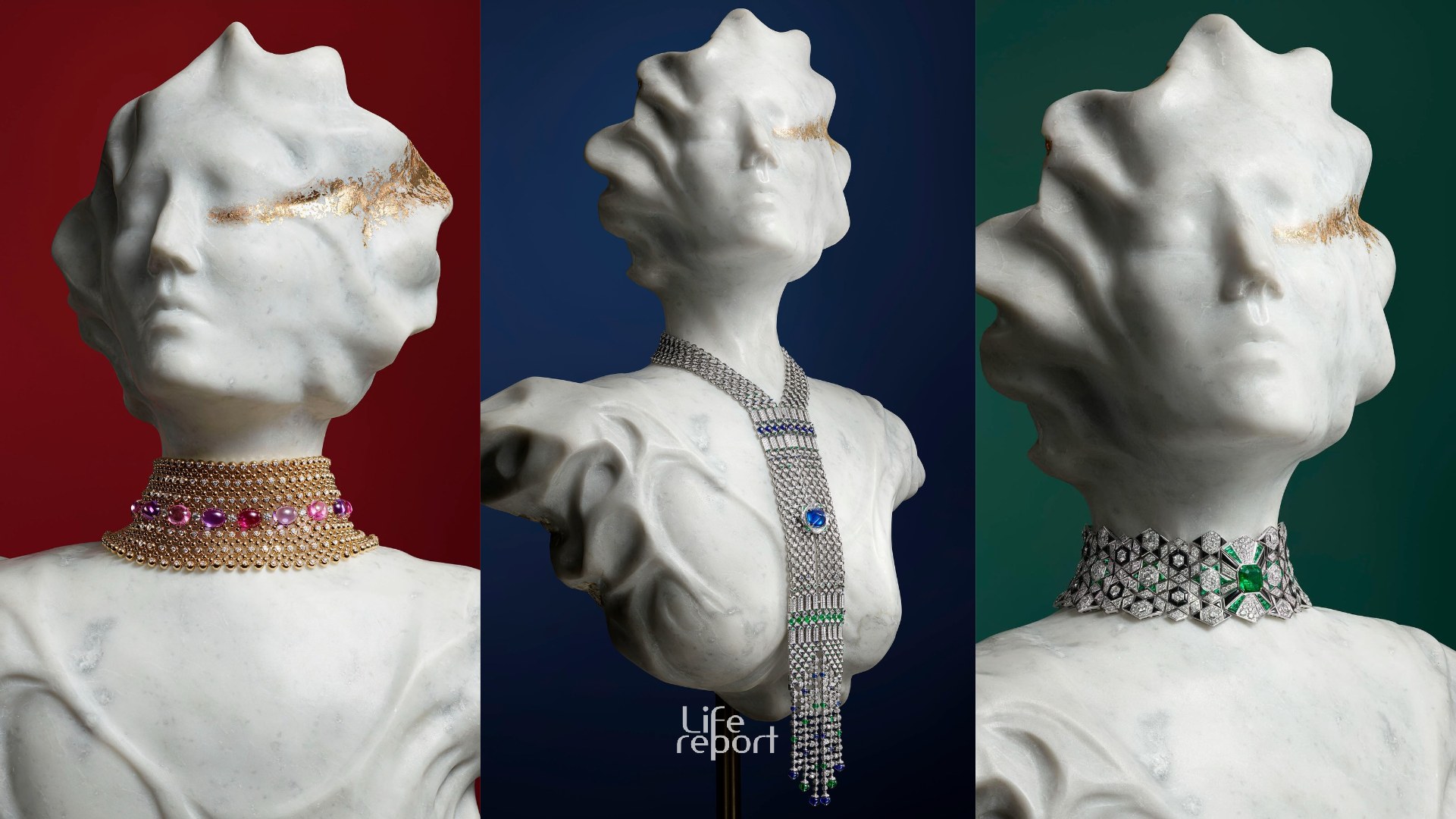
There is a removable brooch at its centre – a 31.90-carat sugarloaf sapphire from Sri Lanka that can be repositioned anywhere along the necklace. And I had a moment, standing there, when I realised: this is jewellery that understands we want to be in control of how we are seen. It is not a look. It is a conversation you get to lead.
The painting chapter also presents a ring inspired by Francesco Hayez’s The Kiss. If you do not know it, look it up – it is the one where two lovers are locked in an embrace, their garments in the blue, red, and green of the Italian and French flags, a subtle political statement embedded within a romantic gesture. Bvlgari’s interpretation uses the toi et moi motif – two stones, each with its own history, drawn together like figures in a painting. A 7.85-carat antique pear-shaped diamond sits beside a 5.42-carat Colombian emerald. It is the kind of ring that makes you believe in soulmates – or at least in stones that find each other across centuries.
Sculpture is where the serpent comes in. And if you know Bvlgari, you know the serpent is its signature: the first Serpenti watches appeared in the 1940s, and they have been coiling, shedding, and reinventing themselves ever since.
The Serpenti Infinito bracelet is a study in precision. A rough crystal has been sculpted into a 7.49-carat diamond, cut specifically to follow the anatomy of the serpent’s head. The setting – each scale individually incised, with 1,385 hours devoted to diamond cutting alone – gives the piece a sense of movement. When I saw it, I instinctively leaned closer, half-convinced it was breathing.
View this post on Instagram
Then there is the Serpenti Illusione necklace, which plays with negative space in a way that feels almost mischievous. The serpent is not fully rendered; it is suggested through the gaps between diamonds, a visual game of concealment and revelation. A 14.01-carat antique cushion-cut sapphire from Madagascar anchors the piece, set on a diagonal – because why place anything straight when you can tilt it and let the light behave differently?
But the piece that brought the room to a standstill – the kind of silence where even the air conditioning becomes audible – was the Serpenti Imperial Heart necklace. At its centre: a 30.75-carat Golconda diamond. Golconda.
For those who do not spend their free time exploring gemstone history, Golconda diamonds are the stuff of legend. Mined in what is now Andhra Pradesh in India, they were the world’s only source of fine diamonds for nearly two millennia. They are Type IIa – composed of exceptionally pure carbon, virtually free of nitrogen – and account for less than two per cent of all diamonds ever discovered. The Koh-i-Noor. The Hope Diamond. The Regent. All Golconda.
The mines were exhausted by the early nineteenth century. Every Golconda diamond in existence today is centuries old. They once adorned Mughal courts and the treasuries of maharajas. They are, quite literally, relics of a world that no longer exists.
And here it is, set into the head of a Bvlgari serpent, mounted in a star-shaped setting designed to amplify its internal glow. The necklace comprises 180 articulated elements and required over 1,400 hours of handwork. Its design evokes the Venus de Milo – beauty that transcends time – and, for once, that is not marketing hyperbole. It is simply accurate.
Architecture completes the trilogy with pieces that feel like wearing a building – but never in a heavy-handed way. More in a I’ve-been-to-Florence-and-I’m-not-afraid-to-show-it kind of way.
The Eclectic Embrace collier draws inspiration from the Castello di Sammezzano, a nineteenth-century Tuscan palace renowned for its exuberant Moorish revival style – intricate arches, kaleidoscopic mosaics, and richly ornamented domes. Bvlgari translates this into a white gold necklace centred on a 10.12-carat octagonal Colombian emerald, surrounded by pavé diamonds and black onyx, each stone cut like a mosaic tile. With 180 modular elements and over 1,000 hours of craftsmanship, the piece moves with remarkable fluidity, a reminder that architecture, at its best, is simply jewellery for the city.
View this post on Instagram
The Emerald Strata necklace is more architectural still: vertical, structured, deliberate. Five sugarloaf emeralds from Zambia are stacked like columns, while rows of buff-top emeralds unfold in symmetrical precision. It reportedly took nearly a year to source stones of matching quality – a detail that is both extravagant and oddly romantic.
There are watches, too – three of them, each blurring the line between timepiece and artwork.
The Notte Stellata Divas’ Dream watch features a dial crafted from a “flying saucer”–cut black opal, shifting in depth like a twilight sky. Sapphires and diamonds form a constellation, while yellow gold lines trace an astral map. It is powered by the Piccolissimo movement – Italian for “very small”.
The Pavone bracelet watch evokes a peacock: diamonds, rubellites, and emeralds cascade along the wrist like feathers. The peacock, sacred to Juno and a recurring motif in Roman art, lends the piece both symbolism and theatricality.
And the Serpenti Dea Secret watch offers a final, playful gesture: the serpent’s head, set with marquise-cut emeralds, opens to reveal a hidden dial paved with diamonds. Time is there if you want it – but it does not insist.
Here is what stayed with me as I left the presentation, my phone filled with images I will no doubt revisit for weeks.
We live in a city – Dubai, but also the digital city, the scrolling city, the curated city – that constantly asks us to be one thing. A wellness enthusiast, a fashion devotee, a corporate climber, a gastronome, a traveller. Choose a lane, the algorithm insists. Choose a niche. Choose an aesthetic and commit.
View this post on Instagram
But what if your aesthetic is all of them? What if you want to be sharp and soft, structured and fluid, ancient and entirely new? What if you want to wear a necklace inspired by a nineteenth-century Florentine palace, set with a diamond that once belonged to a maharaja, shaped into a serpent that has wound its way through art history for millennia?
That is eclecticism. Not as a style, but as a method. A way of saying: I contain multitudes. I contain contradictions. Bvlgari has been doing this since 1884. They have simply, at last, given it a name.
The collection will be on public display at the Bvlgari boutique on Via Montenapoleone in Milan until 19 April – a privilege for Milan, certainly, though I am already asking when it will return here. Because if there is one city that understands what it means to be a little bit of everything – a little bit desert, a little bit sea, a little bit everywhere all at once – it is this one.
So the next time you are at brunch and someone asks what you want – what you really want – you will know what to say. Not a style. A method. And perhaps a serpent. Definitely a serpent.
Also read: This Perfume Collection Isn’t Meant to Smell Good – It’s Meant to Haunt You


