

There are collaborations that feel engineered in a boardroom, and then there are those that seem to unfold like a sentence you didn’t know you were waiting to finish. The Boss Summer Club – a two-week pop-up that commandeered Soho House’s Miami Pool House from 1 May – belongs decisively to the latter category. It is, on paper, a celebration of the German house’s Summer Resort 2026 selection. In practice, it is something more intriguing: a carefully staged argument that a brand born in Metzingen in 1924 can teach America’s most sybaritic city something about the art of leisure.
I arrived in Miami in the thick of Grand Prix weekend, that peculiar annual ritual during which the 305 briefly rewires its circulatory system around a three-day festival of speed, engineered noise and corporate hospitality. The Miami International Autodrome had drawn its usual pilgrimage of racing royalty – Mikaela Shiffrin and Aleksander Aamodt Kilde, skiing’s reigning power couple and both Boss brand ambassadors, were spotted in the paddock with Aston Martin – while the race itself unfolded under a theatrically grey sky, an 88 per cent chance of rain threatening to turn the Hard Rock Stadium circuit into something more Monaco than Miami. At the Pool House, however, the mood was conspicuously dry, sun-drenched and soundtracked by the low-frequency thrum of a city that understands pleasure as a professional discipline.

The Geography of Cool
To appreciate what Boss and Soho House have achieved, one must first understand the geography. Miami Pool House occupies nearly an acre at the seam of Wynwood and Edgewater, a site that was once a 1940s printing factory, later a private residence, and is now a members’ club arranged – with near-literary symmetry – around a rectangular swimming pool. Wynwood remains Miami’s most legible argument for the transformative power of art: its eponymous Walls have consumed over 75,000 gallons of paint across 35,000 square feet of murals since 2009. Edgewater, by contrast, regards the whole affair with the quiet equanimity of old money. To situate a pop-up between the two is to stake a claim on both credibility and capital, and the Boss Summer Club wastes no time in pressing its advantage.
The activation is, in the argot of the industry, a “360-degree brand immersion”. Translated from marketing Esperanto, this means that every surface, every moment and every cocktail (one imagines a Boss Bottled-inspired spritz, faintly redolent of apple and sandalwood, though the bar menu kept its secrets admirably close) has been considered through the lens of the brand’s Summer Resort 2026 narrative. A shoppable pop-up boutique, curated with the sort of editorial precision one might expect from a concept store in Aoyama or the Palais-Royal, sits adjacent to the pool deck. An experience space unfurls the collection’s story in tactile, photogenic vignettes – the kind of design thinking that acknowledges, correctly, that today’s luxury consumer is as likely to purchase via Instagram mood as through a traditional fitting room.
Precision Tailoring, Deconstructed
The collection itself is a study in chromatics for the climate-conscious. Menswear arrives in a palette of white, lavender blue, sandstone glow, grey mélange and grisaille – a spectrum that sounds like the index of a Farrow & Ball catalogue and wears like a second skin in humidity. Womenswear answers with mocha, lavender, rose and brown: sun-drenched shades that seem to have been distilled directly from a Miami sunset. The silhouettes are what one has come to expect from a house that cut its teeth on precision suiting: linen separates that hold their architecture without stiffness, swimwear that manages to look equally plausible on a sun lounger and at a rooftop bar, and accessories calibrated to the exact frequency of “holiday-ready” – a phrase that, in lesser hands, can curdle into cliché, but here feels earned.
View this post on Instagram
This is, after all, the brand that returned to Milan Fashion Week for Spring/Summer 2026 under Marco Falconi’s creative direction with a collection titled “BOSS Paradox”, a meditation on the tension between structured tailoring and fluid sportswear. It is also the brand that has entrusted David Beckham – a man whose relationship with clothing has evolved from the merely experimental to the genuinely authoritative – as creative style director for his eponymous capsule, which champions linen-blend double-breasted suits and butter-yellow polo shirts with the quiet assurance of someone who no longer needs to prove anything. The Summer Resort selection extends this vocabulary into the realm of off-duty dressing with a coherence that suggests Boss understands something its competitors sometimes forget: the most difficult look to get right is the one that appears to require no effort at all.
Fête Accompli
The cultural calendar unfurled with an almost baroque density. On 3 May, a kick-off party featuring Ja Rule – a man who, it should be remembered, was named GQ’s Solo Musician of the Year in 2002, a piece of archival symmetry too pleasing to ignore – launched the collaboration in earnest. Race weekend screenings followed, drawing a crowd that understood the Grand Prix less as a sporting event than as a sartorial obligation. Chloé Caillet, the Paris-based DJ, producer and multi-instrumentalist whose kaleidoscopic sets have made her a fixture at CircoLoco and beyond, closed the festivities with a finale party. Walshy Fire of Major Lazer – a man who has done more to collapse the distance between Caribbean dancehall and global pop than almost anyone this century – delivered DJ sets that transformed the pool deck into something approaching a reverie.
The gastronomic programme, meanwhile, offered a study in quiet excellence. Deborah De Corral, the Argentine former model and singer who reinvented herself as one of Miami’s most compelling chefs – her restaurant Tigre earned a Michelin Guide nod in 2022 – hosted a “one-night-only” dinner. Her presence at the Boss Summer Club was both a coup and a curatorial wink: a woman who walked away from one kind of visibility to master another, now cooking for a room full of people navigating the same tension between public performance and private pleasure.
Wellness activations, too, were on the docket, with Case Kenny – the Chicago-based mindfulness author whose New Mindset, Who Dis? podcast has become a quiet phenomenon among the sort of people who journal in Moleskines but would never admit to it – leading workshops. He was joined by Brittany Berger, a nutritionist whose approach to food is refreshingly free of dogma and whose presence served as a gentle corrective to the notion that a pop-up built around swimwear and cocktails might neglect the interior life.
The guest list for the 3 May dinner was, predictably, a composite portrait of Boss’s current cultural ambitions. Aleksander Aamodt Kilde and Mikaela Shiffrin – he a downhill specialist with a philosopher’s gaze, she the most decorated alpine skier in World Cup history – represented the brand’s deepening investment in elite sport. Chase Stokes, the Outer Banks star and longtime Zenni Optical ambassador, brought the generational ease of someone who understands that acting is only half the job in 2026. Emilia Mernes, the Argentine pop singer who has been quietly consolidating her position as Boss’s Latin American muse, wore a pearl-grey oversized blazer that read as both précis and provocation. Antoni Porowski, the Queer Eye gastronome and cookbook author whose relationship with a certain black polo shirt has been exhaustively documented, was there. Delilah Belle Hamlin, the model and daughter of Lisa Rinna and Harry Hamlin, reminded the room that California nepotism, when executed with taste, can look remarkably like merit. And Matthew Broome, the British actor who has been generating a low-decibel hum of anticipation since his breakout in The Buccaneers, attended in a Boss look that suggested he had read the brief and understood it implicitly. Robbie G.K., Greta Onieogou, June Diane Raphael and Eva Ruíz filled out the tableau with the sort of eclectic magnetism that keeps a party from tipping into monoculture.
The Long Game: From Poolside to Brand Philosophy
Boss has been methodically repositioning itself for the better part of five years. The brand’s “Be Your Own Boss” campaign, which launched with a desert takeover in Dubai in 2022, signalled a pivot towards a younger, more globally minded consumer. The subsequent opening of a revamped flagship at Fashion Avenue in Dubai Mall, followed by a takeover of AURA Skypool – the world’s highest 360-degree infinity pool, suspended 210 metres above Palm Jumeirah – demonstrated that the brand understood the Gulf’s particular appetite for luxury that is experiential, immersive and eminently Instagrammable.
The Soho House collaboration extends this logic into the Western Hemisphere with an elegance that feels, in its best moments, almost inevitable. Soho House has long understood that its members – whose median age skews younger than one might imagine – are less interested in velvet ropes than in vérité: the sense that they have stumbled into a moment that is simultaneously curated and unrepeatable. Boss, for its part, has been incubating a parallel thesis: that tailored clothing need not be the enemy of spontaneity, and that a brand born in a Swabian factory town can speak the language of Miami with an accent that sounds, against all odds, like native fluency.
This is not, it must be said, an entirely frictionless moment for the parent company. Hugo Boss AG reported a 6 per cent decline in first-quarter 2026 sales as it implements its “Claim 5” strategic realignment, a programme that prioritises quality over volume and has involved the closure of 15 freestanding stores. The Boss brand itself fared better than its sibling Hugo – down 3 per cent versus 21 per cent – but the numbers tell a story of a house in deliberate transition, trading short-term velocity for long-term brand equity. In this context, the Soho House activation is not merely a marketing expense; it is a thesis statement. Boss is wagering that immersive, culturally intelligent experiences will do what traditional advertising cannot: build a constituency of consumers who buy into the brand’s worldview before they buy into its product.
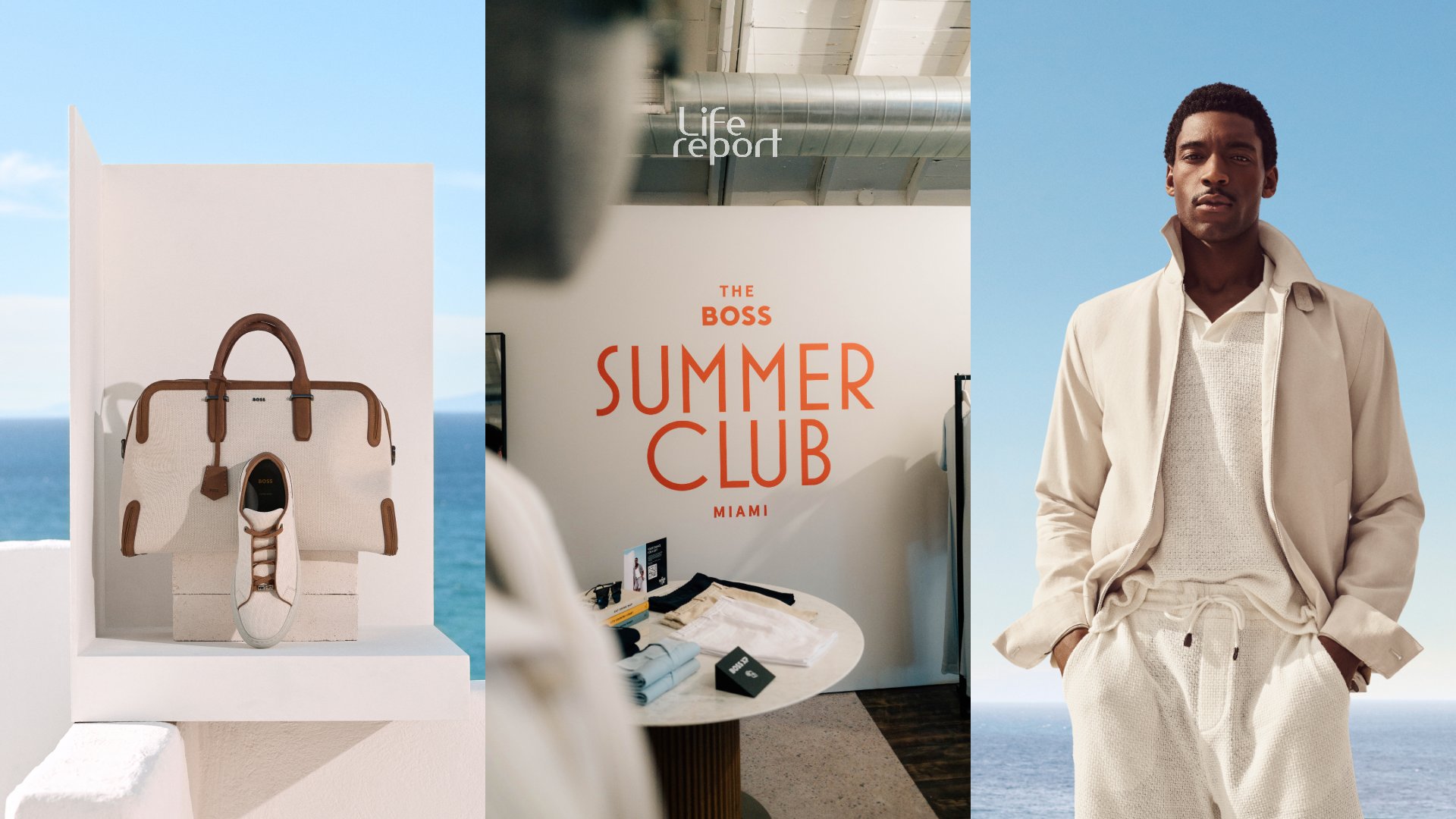
The collaboration will continue later in the year, with further “only-at-Soho House” moments planned around key cultural events – tennis tournaments were name-checked – suggesting that this is less a dalliance than a courtship with ambition.
What We Talk About When We Talk About Summer
The Boss Summer Resort 2026 collection is available now at Boss stores worldwide, on boss.com and through wholesale partners. But to reduce the story to a shopping list would be to miss the point, which is that Boss is no longer merely a fashion authority. It is, with increasing conviction, positioning itself as a lifestyle brand in the truest sense – one that understands that the modern luxury consumer’s loyalty is not won by product alone, but by the texture of the world a brand builds around it.
In Miami, that world smelled faintly of sunscreen and vetiver, sounded like Walshy Fire dropping a dancehall riddim across a pool deck at dusk, and looked like a palette of lavender blue and sandstone glow melting into the humidity. It was, in other words, exactly what it intended to be: a dress rehearsal for summer, conducted with German precision and Floridian soul. Whether the formula translates to the remaining cultural moments Boss has promised – the tennis events, the further Soho House activations – remains to be seen. But for two weeks in May, at the edge of Wynwood and Edgewater, the argument felt persuasive enough.
One left with the sense that Boss had accomplished something genuinely difficult: making a pop-up feel permanent, and making a marketing activation feel – if only for a moment – like a memory worth keeping.
Also Read: The Art of Stillness. Bulgaria’s New Luxury Escape


