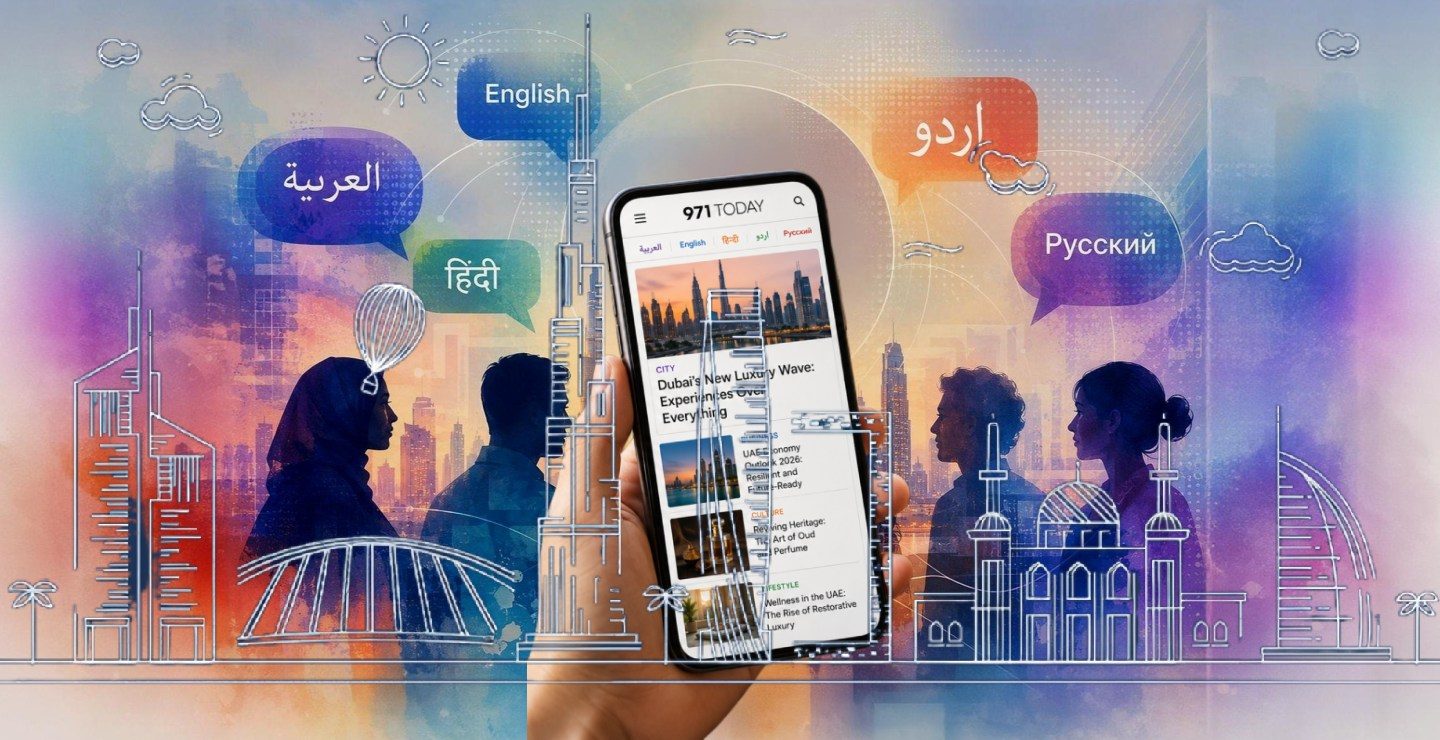
A particular kind of fatigue attends today’s media landscape: a churn of algorithmically flattened headlines, hot takes that expire within minutes, and a wearying sameness that suggests a single, invisible editorial room. Nowhere is this felt more keenly than in Dubai – a city that presents itself as a global crossroads yet is too often narrated in a narrow, monophonic voice: English-first or Arabic-only, with its polyglot reality sidelined. Into this gap steps 971-today.com, a multilingual digital platform built around the United Arab Emirates’ lived diversity rather than merely acknowledging it.
971 Today will be publishing in Arabic, English, Hindi, Urdu and Russian – languages that map the country’s everyday soundscape. From Deira’s markets to DIFC boardrooms and Jumeirah cafés, this is the chorus one hears. The platform’s multilingualism is not cosmetic; it rejects the long-standing broadcast model that treated diversity as a complication rather than an asset.
Scepticism is reasonable: does the world need another digital outlet? Yet recent data suggests a shift. The UAE National Reading Index 2025 shows English still dominant at 48.7 per cent, but Arabic rising to 27.2 per cent, while digital and audio formats now surpass print. A Forbes Middle East analysis (2021–2025) also points to growing, linguistically diverse consumption. Audiences are fragmenting – and seeking content that reflects that plurality. In this context, 971 Today looks less idealistic than well-timed.
The UAE’s media ecosystem has matured. English-language stalwarts such as Gulf News, Khaleej Times and The National have evolved into multimedia platforms, while Arabic titles like Al Khaleej and Al Bayan have strengthened their digital presence. Niche outlets serve specific communities with loyalty and precision. Yet as others narrow their focus, 971 Today bets on breadth – aiming to maintain a coherent editorial voice across five languages without diluting substance.
Crucially, its multilingualism is foundational. Content is created for each linguistic audience from the outset, not retrofitted through translation. The ambition is simple but significant: to make every reader feel directly addressed. Whether this holds under newsroom pressures remains to be seen, but the intent is notable.
This approach aligns with broader cultural shifts among the UAE’s younger, affluent consumers. A 2025 Kantar study indicates luxury has become experiential: dining, travel and wellness now outweigh display. These audiences are digitally fluent, culturally aware and linguistically fluid; they expect media to match that complexity.
971 Today positions itself as a cultural mirror as much as a news outlet, blending storytelling, community and branded content. For partners, its multilingual model offers direct access to audiences often treated as secondary. In a market where consumption increasingly follows language lines, the logic is compelling.
Ultimately, the platform advances a modest but meaningful proposition: that a country’s stories should be available to all who live in it, in the language they understand best. In the UAE, that feels less like innovation – and more like overdue recognition.
Also Read: This New Smartphone Might Be the Only One That Sees Dubai the Way You Do