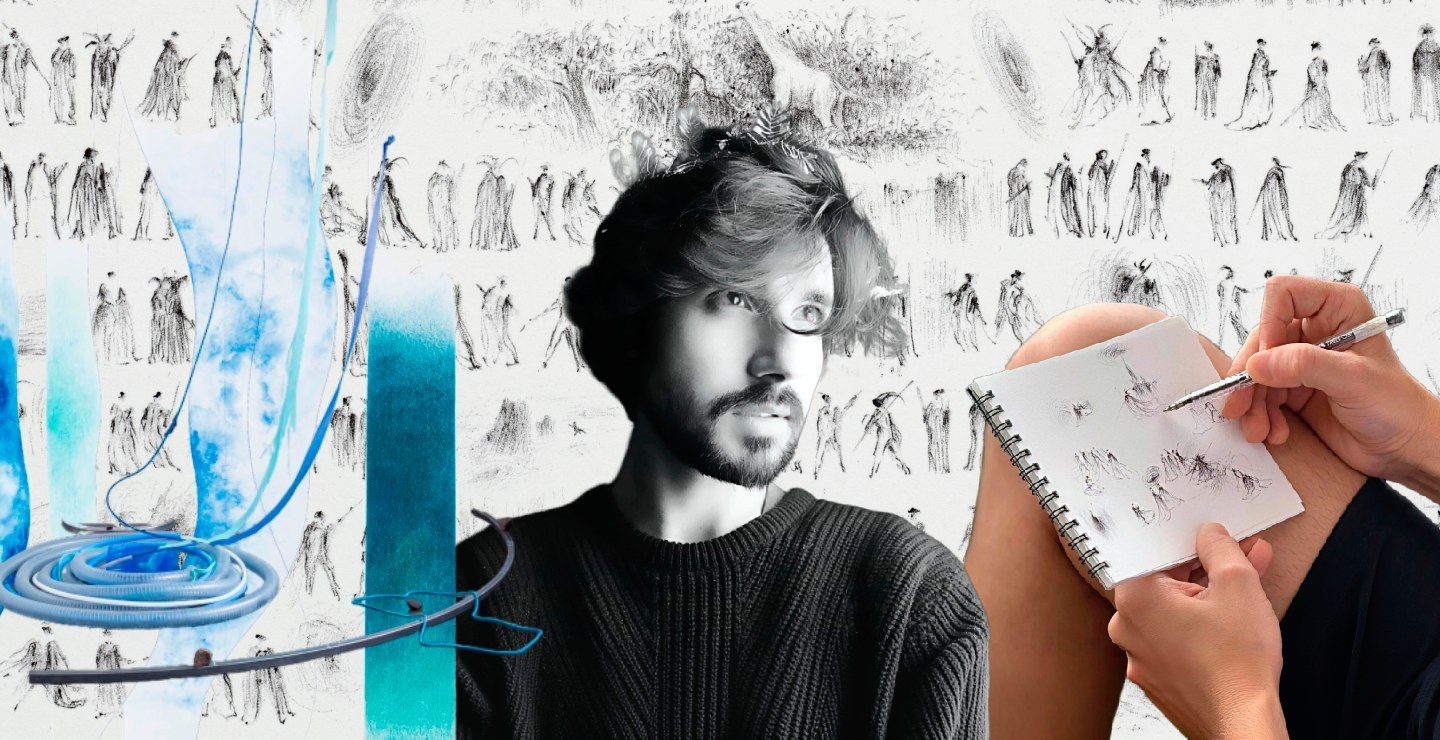
It is a quiet afternoon in Dubai’s Alserkal Avenue, that industrial-chic agora where the city’s cultural pulse now beats most convincingly. Outside, the late sun casts geometric shadows across the concrete. Inside, a visitor stands before a large-scale work on paper, arms crossed, head tilted. From a respectful distance, the piece reads as an elegant abstract text – a manuscript for a language that never existed, or perhaps the seismographic transcription of a distant tremor. The lines weave, tilt and breathe in what appear to be varying italics.
Step closer, however, and the illusion shatters into something far stranger. The “lines” are, in fact, processions of figures. Thousands of them. Tiny, volumetric, three-dimensional characters standing shoulder to shoulder, their gestures and postures creating the very rhythm that once read as a pen stroke. Zoom in with a smartphone camera – the inevitable modern reflex – and a deeper layer still emerges: these miniature beings are communicating. Mimes, poses and the silent tilt of a head create ripples of interaction. The work, you realise with a jolt of pre-digital wonder, does not simply reward prolonged attention. It demands it as its primary medium.
This is the paradoxical universe of Yüksel Dal, a Turkish contemporary artist whose work with the humblest of instruments – the ballpoint pen – has become a form of experiential luxury for a generation suffering from acute image fatigue. In an era when artificial intelligence can conjure a hyper-detailed fantasy landscape in the time it takes to order a flat white, Dal sits for months with a single sheet of paper, guiding ink into configurations so dense and delicate that the resulting object seems to possess its own internal temporality. It is art as a deliberate anachronism, a quiet rebellion against what the philosopher Byung-Chul Han might call the “smooth” consumption of the digital scroll. And for the discerning collector, the millennial who knows her way around both a Bottega Veneta intrecciato weave and a Zaha Hadid cantilever, Dal’s practice offers something increasingly rare: a genuine encounter with slowness that feels less like nostalgia than a survival strategy.
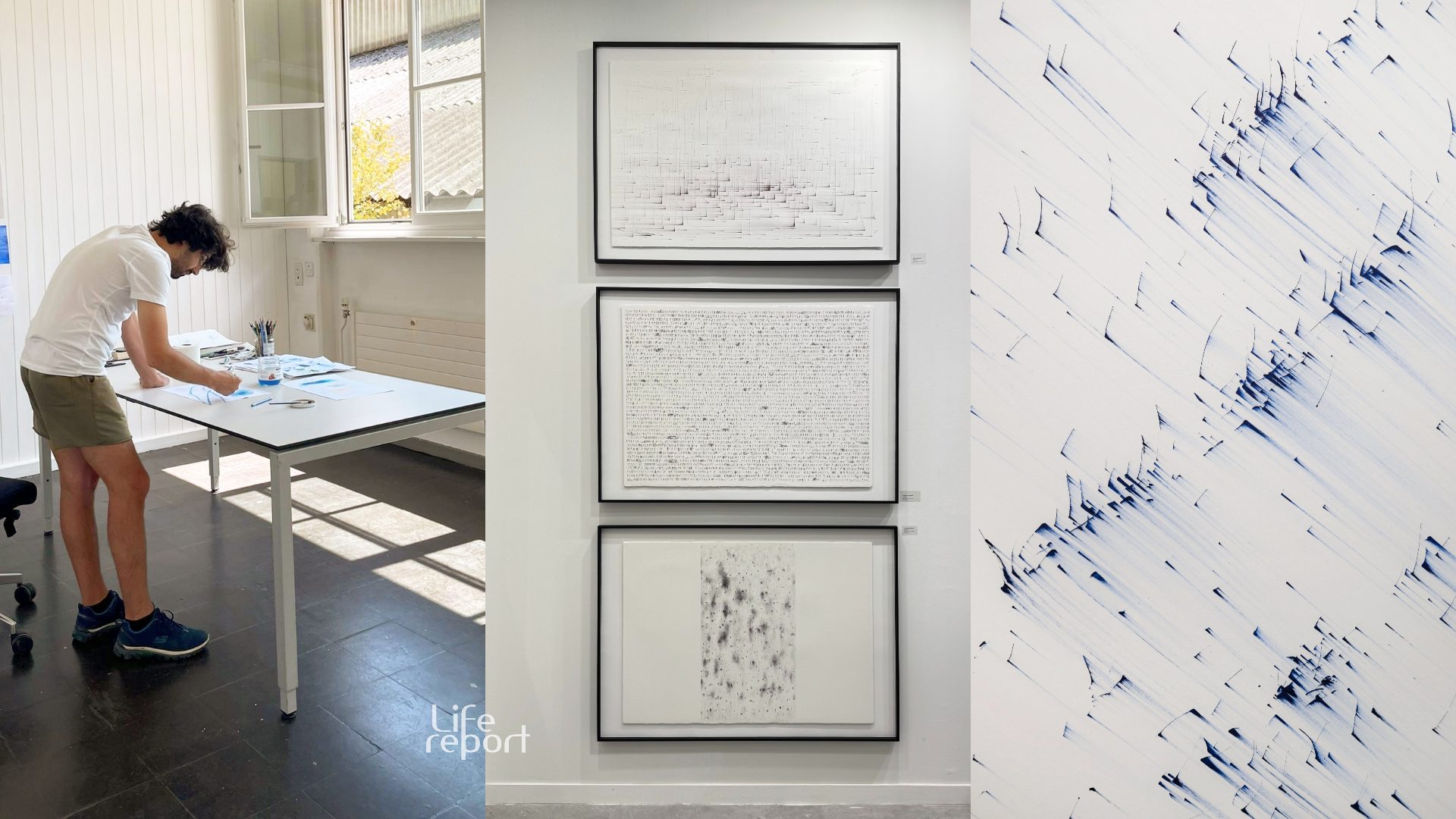
We met the artist during the whirl of Dubai Design Week, where his intensely tactile works generated the kind of hushed, lingering attention that gallerists dream of. He is not an artist of soundbites. “What continues to fascinate me about ink,” he says, in a tone that suggests we are picking up a conversation begun years ago, “is that, despite being such a primitive material, it remains remarkably capable of responding to contemporary needs.” That primitive material is, almost unbelievably, the standard ballpoint pen. Yet in Dal’s practice, the pen is never simply a drawing instrument. He files, cuts and sands the nibs; removes the ink reservoir to let the ink bleed with controlled abandon; and deploys chisels and sandpaper as though the pen were a piece of marble waiting to release a sculptural form. The result is a line that is never merely a line. It carries “movement, rhythm, tension, and sensation”, a sensuous physicality that makes a mockery of the vector-crisp perfection of digital rendering. This is not drawing as depiction. It is drawing as a field of experience, a phrase Dal uses with the exactness of a vintner describing terroir.
View this post on Instagram
The works from his ‘As It Is!’ series, or the hypnotic Antinomy compositions, seem to exist on the cusp of abstraction and obsessive figuration. The longer you look, the more these binaries dissolve. What appears to be a geological cross-section becomes a crowd of ancient figures; a swirling galaxy resolves into a dance of contemporary bodies. This is not surrealism but something closer to a form of deep-time consciousness, a visual equivalent of the block universe theory in which past, present and future coexist. Dal articulates this with a refreshing absence of mystical airs: “A single image may evoke a body, a ruin, a geological formation, or a topography at once. The boundaries between the living and the inanimate, the remembered and the imagined, or the personal and the collective often become indistinct.” It is a sensation familiar to anyone who has wandered through the archaeological layers of Istanbul, where a Roman column might support a Byzantine arch beneath an Ottoman foundation – a city Dal calls home, and whose palimpsestic nature permeates his every gesture.
This permeability between scales – the infinitesimal and the cosmic – has recently propelled his work beyond the intimate confines of paper. In his three-dimensional installations, industrial materials such as curved metal, mirrored surfaces and plastics, each carrying its own deep-time history through hydrocarbon transformations that predate human existence, begin to construct immersive spatial fields. The shift, he explains, was never about simply “building” his drawings in space. It was about testing whether the relationships between the lines – the tensions and resonances – could continue to exist beyond the page. “The greatest challenge was never technical,” he notes. “It was relational. The question was not how to assemble materials, but how to allow the meanings and associations they carry to coexist within a coherent structure.” For a generation of patrons who have watched installation art become an Instagram staple, this is the antidote: works that do not clamour for the camera but instead slowly recalibrate the atmosphere of a room over years of cohabitation. Think of a Richard Serra torqued ellipse crossed with a Cartier high jewellery vitrine, where the object’s presence deepens rather than diminishes with time.
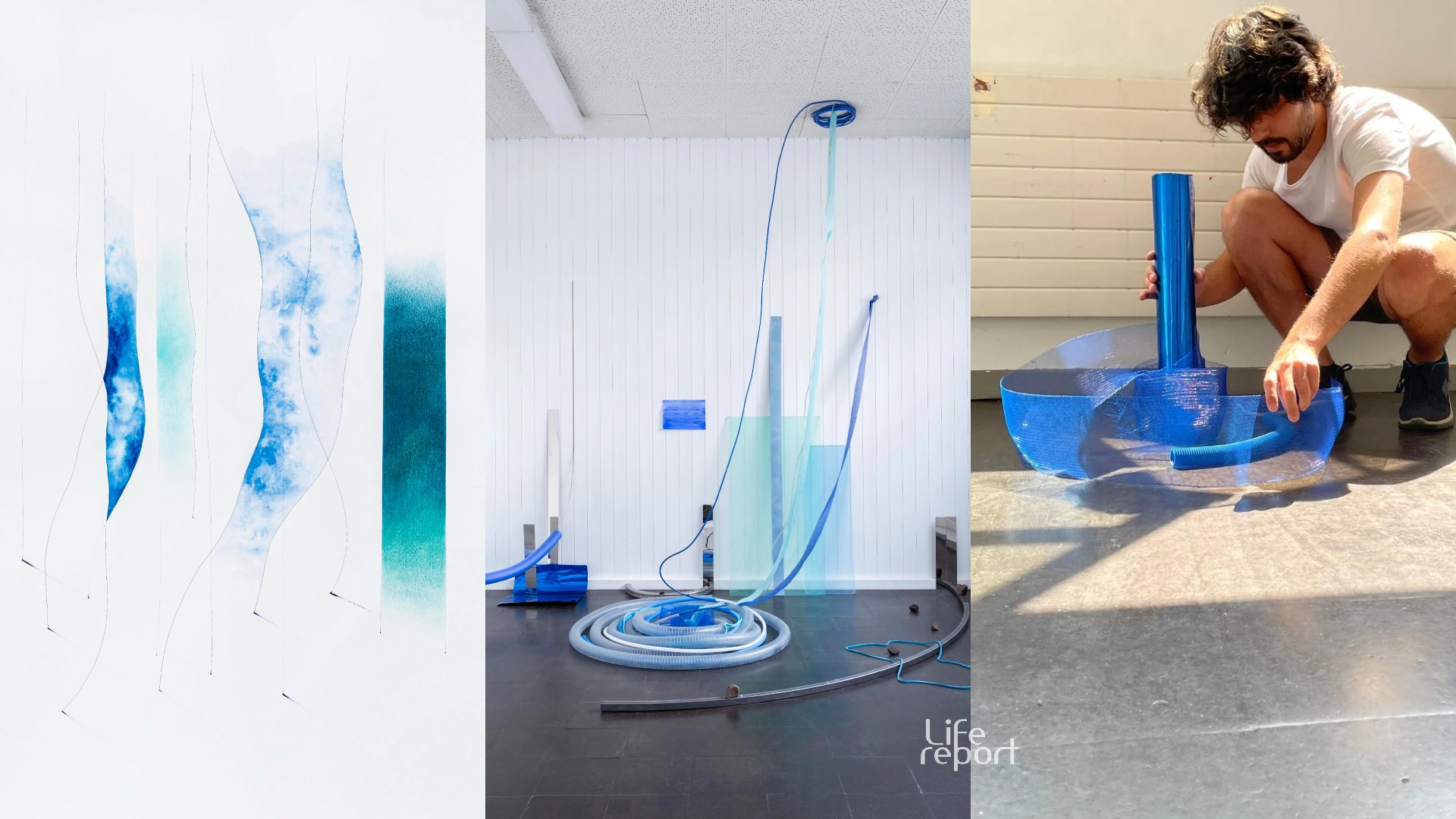
Inevitably, the conversation drifts to the elephant in the studio: artificial intelligence. How does a man who can spend three months drawing a single square inch of figures, and who describes his process as “accompanying the emergence of an idea”, coexist with tools capable of generating infinite complexity in seconds? Dal’s answer is so disarmingly reasonable that it stops you short. “I do not see artificial intelligence and physical making as opposing forces,” he says. “Within my practice, they answer different kinds of questions.” He uses AI as a research tool – to test how a sculpture might behave in anodised aluminium rather than patinated bronze, or to imagine an A4 composition at the scale of a façade – collapsing weeks of prototyping into minutes. Yet the act of making, the “lived experience” of the line, remains non-negotiable. He offers an analogy that resonates with the quiet hedonism of a luxury readership: “I often think of the difference as being similar to attending a live concert at the Elbphilharmonie or travelling to a place in person rather than experiencing it through recordings or photographs. Images and digital tools can inform us, remind us, and reveal remarkable things, but they cannot fully contain the atmosphere, the encounters, or the passing of time.” It is the difference between ordering a Noma fermentation kit online and actually sitting in Copenhagen as René Redzepi’s team presents a dish of reindeer moss. Both nourish. Only one becomes a memory that changes you.
Dal’s relationship with time is, in fact, the secret architecture underpinning everything he produces. During the long hours of drawing – meditative, certainly, but also “demanding patience, precision, and persistence” – his perception of scale begins to warp. A figure only a few millimetres tall comes to embody “an entire period of experience, a particular state of mind, or months of accumulated thoughts and sensations”. When he completes a work, what he misses is not the drawing itself but the time he spent living alongside it. It is a confession that speaks directly to the emerging mentality of a new generation of collectors from Dubai to Doha: a shift away from art as a trophy asset towards art as a vessel for sustained, life-enhancing contemplation. To live with a Yüksel Dal is to invite a temporal parasite into your home, one that feeds not on attention but on its absence, revealing new physiognomies and dialogues each time you return. It is the polar opposite of the buy-and-forget cycle that has made so much contemporary art feel as interchangeable as a fast-fashion drop.
View this post on Instagram
The cultural references that pulse through his practice provide a rich cartography for the intellectually inclined. He draws nourishment from Jorge Luis Borges’s infinite libraries and Italo Calvino’s invisible cities; from the Object-Oriented Ontology of Graham Harman and Timothy Morton’s concept of “hyperobjects”; and from the visual grammars of Blade Runner and Hayao Miyazaki. When he quotes T. S. Eliot, via John Fowles’s The Magus – “We shall not cease from exploration, and the end of all our exploring will be to arrive where we started and know the place for the first time” – it is not a decorative flourish. It is an operating principle. His drawings are machines for returning, for seeing anew. The viewer who first saw a swarming abstraction and then, with a start, discovered a narrative of miniature human connection will, on the third or fourth visit, encounter an entirely different work. That delayed moment of revelation is not a cheap trick; it is a form of hospitality. The work remains open, “allowing new layers, meanings, and associations to emerge over the years.”
Such an ethos feels almost absurdly contrarian in a culture calibrated for the infinite scroll. Yet it is precisely this contrarianism that has elevated Dal’s reputation among discerning collectors across Europe and the Middle East. At a recent exhibition, a young Emirati collector, impeccably dressed in a Roksanda silhouette, told me that acquiring a Dal drawing felt like “buying a private library – not just the books, but the silence around them”. The observation is astute. In a region where the luxury market is increasingly defined by experiences rather than possessions, by Aman resorts rather than simply American Express Platinum invitations, Dal’s work functions as a portal to a rare form of interiority. It is the horological equivalent of a Grand Seiko Spring Drive: quiet, handcrafted, mechanically obsessive and entirely unconcerned with the vulgarity of flamboyance.
View this post on Instagram
Looking ahead, Dal is refreshingly candid about the work that continues to elude him. He searches, he says, for “a new artistic language capable of holding these relationships together in a meaningful way” – a language that might bridge human experience, the objects that shape us and the new forms of being that technology is beginning to produce. He does not yet know whether it will manifest itself as a drawing, a space, a system or something for which we do not yet have a name. In a world of artists eager to declare themselves pioneers of the future, this honest uncertainty is as elegant as a perfectly cut De Petrillo blazer. It suggests that the point is not to arrive but to keep searching. For a generation that has learned to question the myth of the definitive, the final and the fully resolved, a Yüksel Dal work is not merely a beautiful object. It is a companion in uncertainty – a small, vast and endlessly unfolding universe held together by nothing more than ink, pressure and the stubborn, near-extinct magic of a hand moving across a page.
ALSO READ: The Wildflower That Conquered High Jewellery: Inside Harry Winston’s Forget-Me-Not Collection