
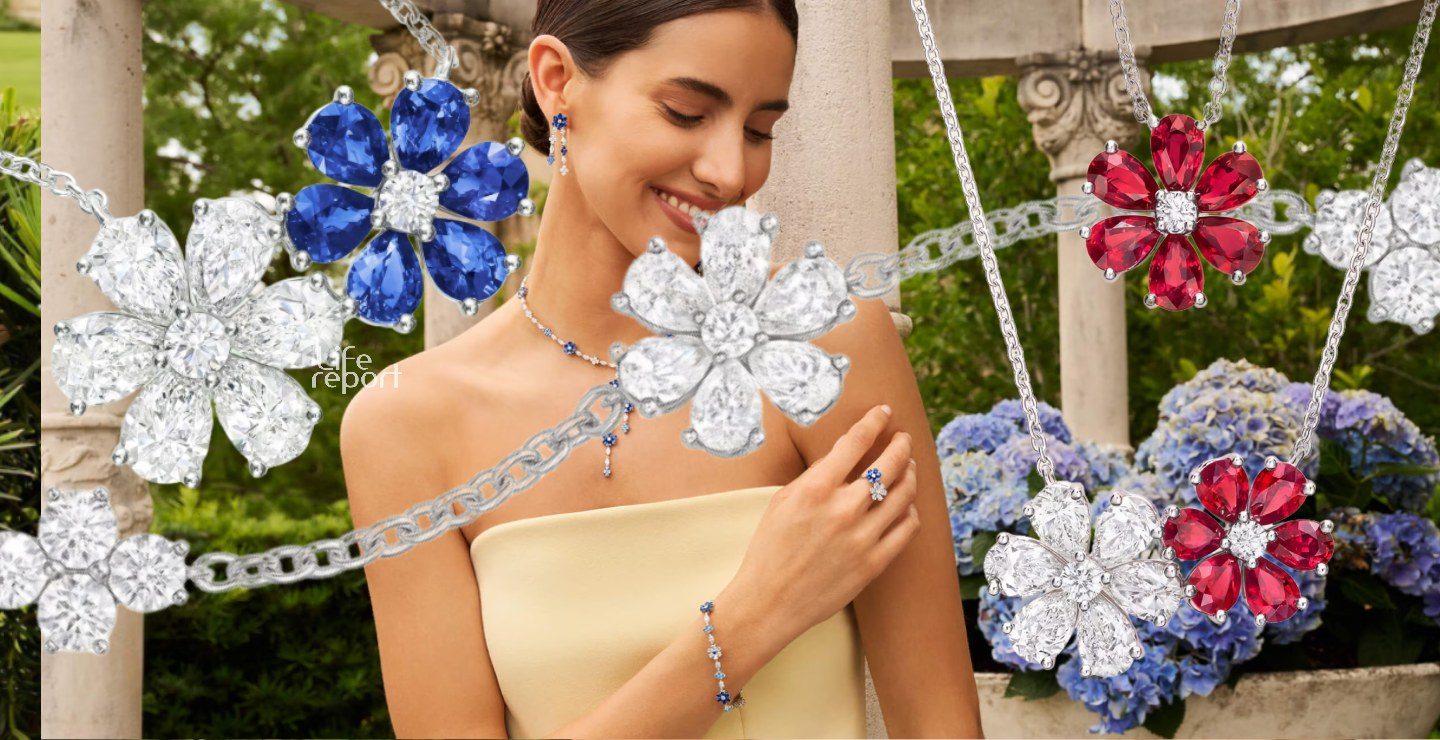
In a city that treats the ephemeral as a virtue – where pop-up dinners vanish before the last course settles and relationships often expire with the lease – there is something quietly radical about a jewel designed to memorialise permanence. Not the shouty, logo-emblazoned kind of permanence that announces itself before you have crossed the threshold of a Dubai majlis.
Rather, the kind that whispers from a lapel or an earlobe, a coded message for those who understand that true luxury does not require a megaphone. The Harry Winston Forget-Me-Not collection, newly expanded for the season of renewal, arrives not as a trend to be discarded but as a counterpoint: a keepsake pressed in brilliance for an age suffering from acute memory loss.
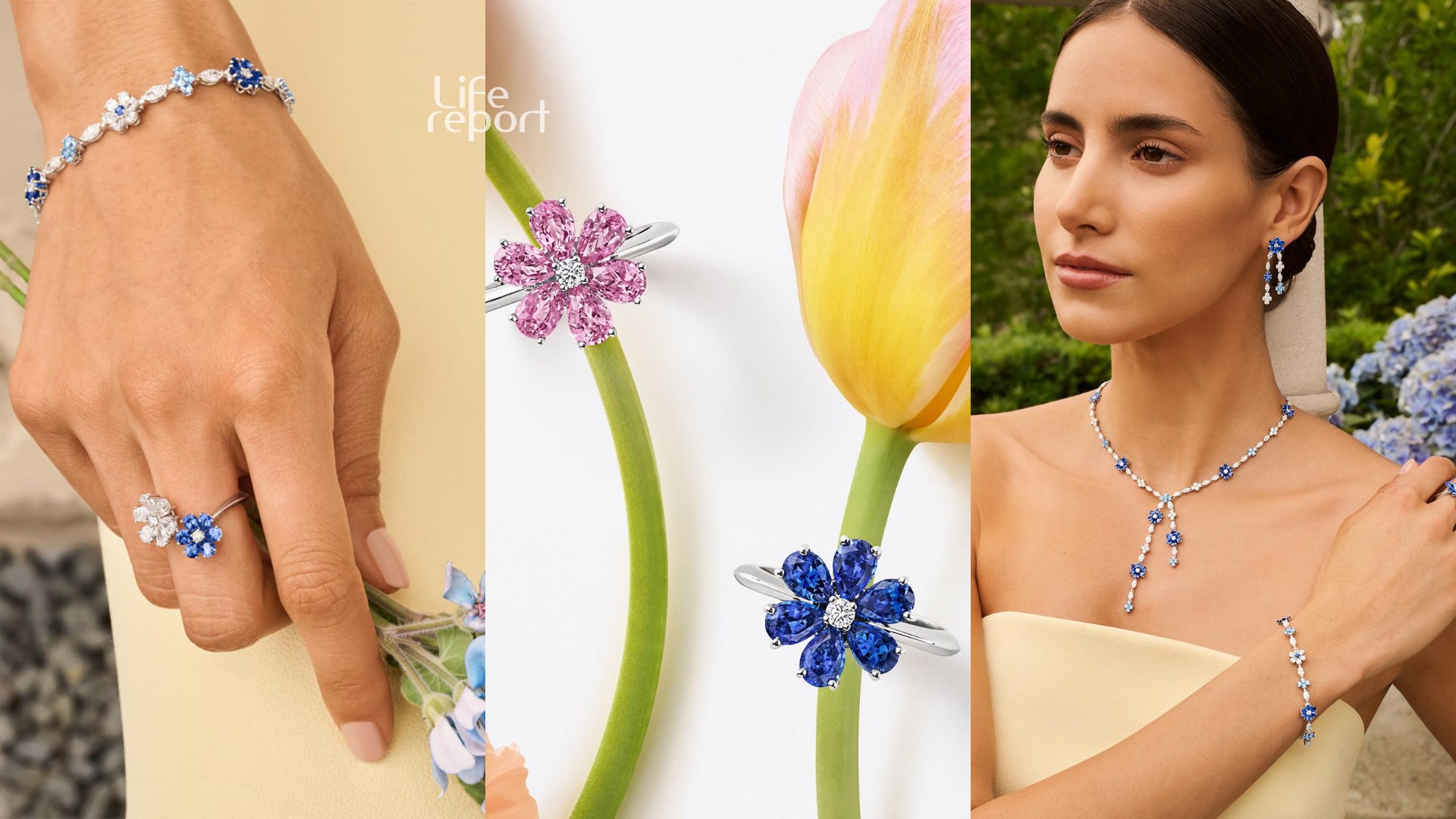
The premise is deceptively simple. Take one of nature’s most sentimentally loaded wildflowers – the myosotis, whose very name in German, Vergissmeinnicht, sounds like a line from a Rilke poem – and render it in the language of the world’s most meticulously sourced gemstones. To glance at an Instagram carousel of these twin blooms, as the House recently teased to its digital audience from its Fifth Avenue flagship, is to experience a fleeting pang of something almost old-fashioned. It is the visual equivalent of discovering a handwritten letter in a pile of utility bills. Yet to hold the object, to feel the weight of a new Twin Pendant where two blossoms sit side by side in a silent, symbiotic dialogue, is to understand the profound gulf between decoration and artistry. This is not merely floral jewellery for a Dubai brunch; it is a counter-narrative to the culture of the disposable.
The intellectual architecture of the collection rests on a resurrection. Deep within the House’s New York archives, a sketch from the early 1960s – an era when Mr Winston himself was redefining the very physics of gem-setting – depicts a delicate spray of wildflowers. It was a time when the jet set actually dressed for dinner and a jewel was not an asset class but a token of devotion. To reinterpret this archival piece for a Gen Z and millennial audience in the UAE – a demographic that can spot a disingenuous heritage play from a mile away – requires a particular kind of wit. The House’s craftsmen, dedicating more than twenty weeks of labour to a single Sapphire and Diamond Lariat Necklace, engage in a form of slow work that feels almost subversive. While algorithms accelerate desire into one-click purchases, these artisans in Midtown Manhattan are calibrating the hue and saturation of pink sapphires, rubies and blue sapphires with extraordinary precision. The angled petals of a Forget-Me-Not earring become a masterclass in optical engineering, capturing light not as a flash of insolence but as a sustained, ethereal glow.
View this post on Instagram
What distinguishes this collection from the perennial garden of floral high jewellery is its intelligent asymmetry. The introduction of the twin motif – two blossoms side by side in rings, pendants and earrings – displays a structural modernity that avoids the saccharine. A classic straight-line necklace in all-diamond variations drapes the collarbone with the minimalist discipline of a Sol LeWitt wall drawing, while the new Twin Ring sets six pear-shaped pink sapphires, weighing approximately 1.26 carats in total, in a minimal platinum setting that allows the negative space to breathe. It is a piece that understands the contemporary wardrobe; it pairs as seamlessly with the fluid tailoring of a The Row suit at Dubai Opera as it does with the nonchalant slouch of a vintage band T-shirt. The all-diamond versions, meanwhile, serve as a blank canvas for personal narrative – a luminous token for oneself, as the House elegantly phrases it – sidestepping the tired trope that diamonds must arrive only via a suitor’s hand.
There is a gentle, self-aware irony in promoting such deeply romantic symbolism in a region that is already a global epicentre of the sentimental grand gesture. The House of Harry Winston, after all, is no stranger to the audacious romance of the Gulf; it understands that in a landscape of Superleggera hypercars and limited-edition Richard Mille timepieces, intimacy is the ultimate luxury. The Forget-Me-Not collection succeeds by inverting the scale. These are not grand statements for momentous occasions demanding a ballroom’s worth of space. They are delicate, calibrated for everyday wear. The marquise and pear-shaped diamonds are not merely set; they are composed, arranged into a silhouette that echoes the soft curve of a petal caught in a spring breeze. It is the kind of piece you wear not to be photographed for a society page, but to be remembered by a single person across a quiet dinner table at Il Borro Tuscan Bistro.
View this post on Instagram
From a tactile perspective, the collection taps into the sensory nuance that today’s culturally hyper-literate luxury consumer craves. The late Maurice Galli, who long led the Winston design atelier, understood that translating nature’s bouquet requires a perfumer’s instinct. Just as a master perfumer balances top notes of neroli with base notes of oud, these jewels layer the fiery warmth of rubies against the icy precision of round brilliant diamonds. The result is almost synaesthetic; one can practically sense the effervescence of the wildflower in the sway of a lariat. It is a dialogue between the eternal brilliance of the stone and the fleeting beauty of the bloom – a tension that feels particularly poignant in a city like Dubai, where everything blooms rapidly, lavishly and often briefly against the arid expanse of the desert. The collection captures that fleeting moment of petal-soft colour and fixes it in one of the hardest substances known to geology. That paradox is the very essence of the House’s poetic logic.
In an era where fine jewellery is often treated as a wearable balance sheet, Forget-Me-Not serves as a corrective. It is an edited, aesthetically sophisticated rebuttal to the vulgarity of pure carat weight. The modern collector – that urbane Gen Z aesthete with a taste for rare Murakami prints and vintage Patek Philippe Calatravas – is looking for cultural intelligence in their gems. They want the story of the 1960s archive, the twenty weeks of Manhattan craftsmanship, the meticulous calibration of light. They want the quiet irony of wearing a wildflower – a symbol of fidelity and remembrance – in a world hooked on the dopamine hit of the new. To slip on a twin-bloom bracelet is to engage in a refined mockery of the digital age’s obsession with the fleeting. It says: I remember, therefore I am. And in that luminous token, Harry Winston reminds us that perhaps the most radical act in modern life is simply refusing to forget.
Also Read: The Great Omani Reset: Where Silence Is the New Six Senses


