At this year’s Art Dubai – downsized, delayed and defiantly reborn on the cusp of a sweltering May – the air inside Madinat Jumeirah seems to have acquired a texture all its own: the faint friction of palm fronds against floor-to-ceiling glass, the susurration of tailored abayas across polished stone, the held breath of a collector deciding that a work is not merely a purchase but a proposition.
Marking its 20th anniversary with a curated intimacy that borders on the clandestine, the fair feels less like a trade floor than a séance for the region’s creative subconscious: smaller, freer and quietly electric. Rising from that calibrated hush is a new, stitched-together visual language, one that demands you lean in rather than scroll past. The work of Lana Khayat, presented in a solo booth by Hafez Gallery, arrives not as a debut but as an unspooling thread that would be foolish to ignore.
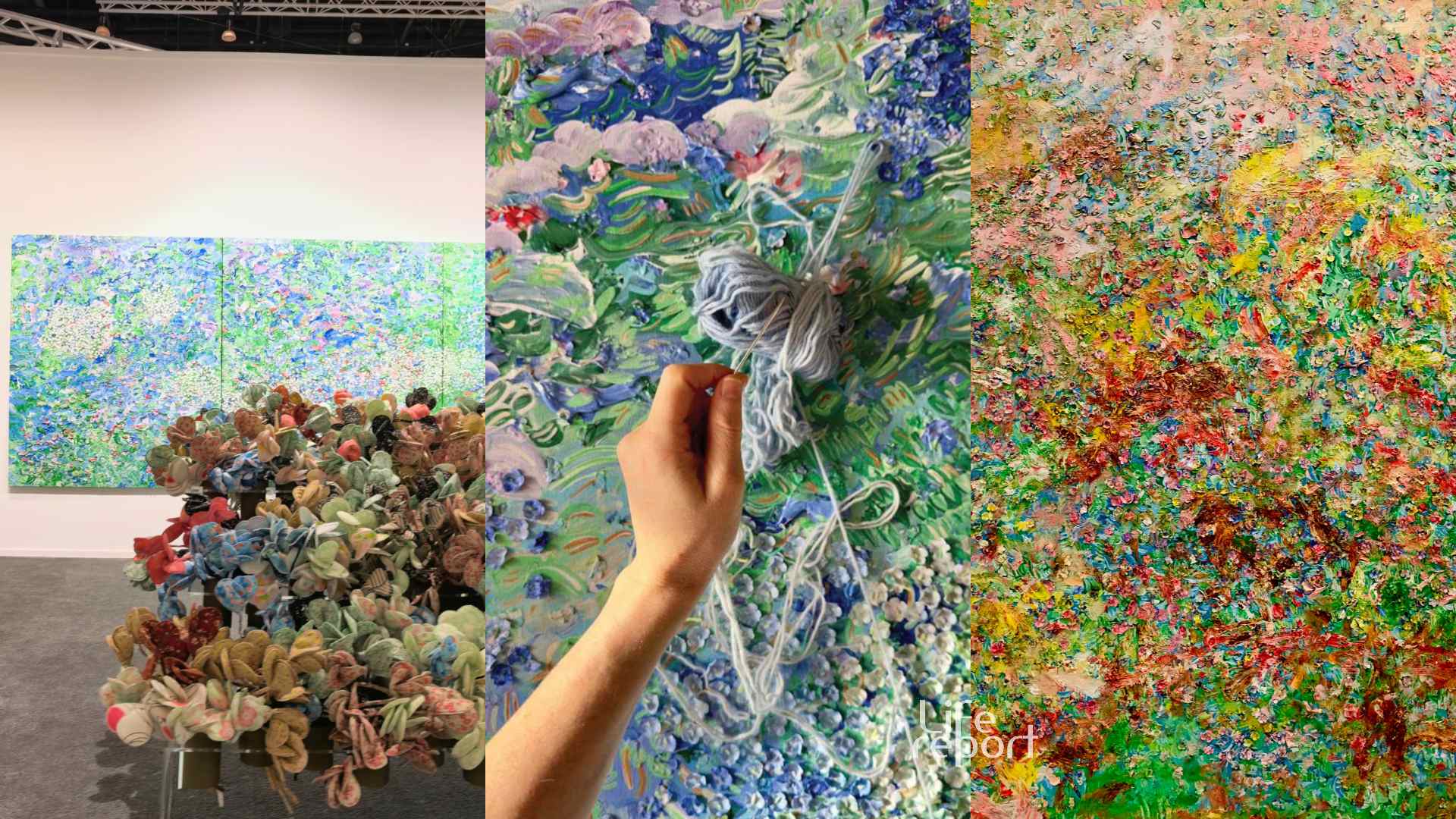
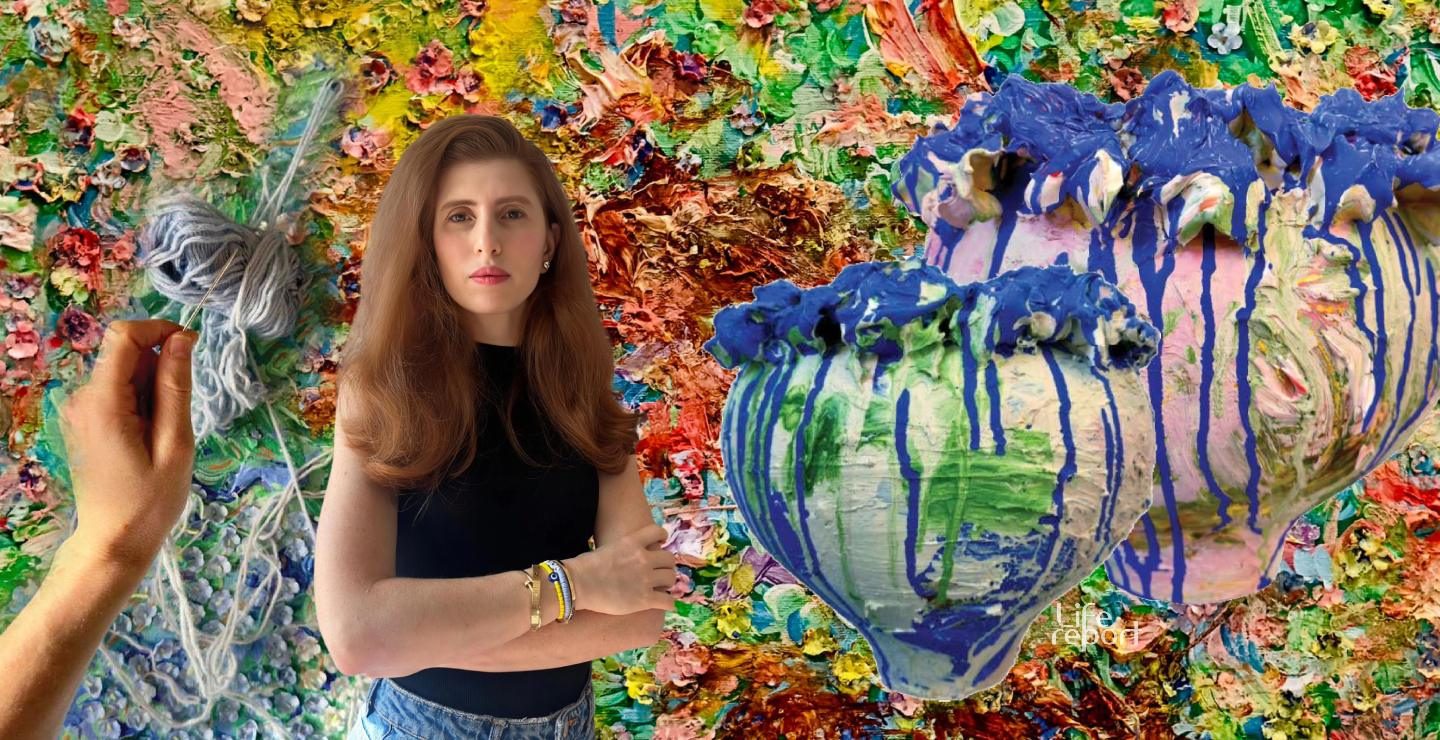
Khayat’s presence at the fair is less an exhibition than an invocation. Her new body of work, The Labor of Repair, unfurls across the booth like an inherited manuscript – one the artist seems to have been translating her entire life. Working at the intersection of textile, calligraphy, nature and abstraction, Khayat produces canvases – though the word feels inadequate – that are layered, stitched and botanically haunted. These surfaces appear to breathe between the Arabian desert and the Mediterranean coast, the two landscapes that shape her imagination. To stand before them is to witness a conversation between Tifinagh and Arabic script, between the geometry of healing and the organic disorder of petals: a lexicon that belongs as much to the Phoenician past as to a distinctly millennial present.
The lily, Khayat’s recurring motif, is no mere decorative flourish. It is a symbol of resilience that has accompanied her from the centenary celebrations of Jardin Majorelle – where her 2025 solo exhibition The White Lilies of Marrakech filled Hafez Gallery’s space in Riyadh with one hundred paintings and a thousand fresh blooms – to this latest iteration in Dubai. The flower functions as a structural ghost, a reminder that beauty, when intelligently deployed, is not an escape from difficulty but a negotiation with it. This is not the facile ‘empowerment’ of a motivational poster, but the more exacting and enigmatic work of making fragility endure.\
View this post on Instagram
There is an alchemical lineage at work here, one that Khayat wears with equal measures of reverence and reinvention. She is the first woman in her family to pursue a professional career in the arts, yet the artistic DNA extends back generations. Her great-grandfather, Mohamad Suleiman Khayat, was a master craftsman who restored traditional Syrian Ajami rooms – intricate, polychrome wooden interiors that once adorned the homes of Ottoman-era Damascus. His work is now held in the permanent collections of The Metropolitan Museum of Art and Shangri La Museum of Islamic Art, Culture & Design. To grow up in the shadow of such a figure is to understand, early and viscerally, that craft is a form of memory and that surfaces can carry entire civilisations. It is no accident that Khayat’s own practice has migrated from paint to fibre, from image to texture. In her own words, she is engaged in a ‘dialogue between worlds’, creating a bridge where heritage and abstraction converge. One suspects that bridge is also a loom.
The timing of this presentation is, to borrow a phrase from the fair’s own rhetoric, deeply resonant. Art Dubai’s 20th-anniversary edition follows a postponement prompted by regional conflict, transforming what might have been a sprawling commercial enterprise into a more concentrated cultural gathering. Exhibitors were offered a risk-sharing model, paying a percentage of sales in lieu of upfront booth fees – a gesture that reads less as desperation than as a shrewd recalibration of incentives. The result is an atmosphere of surprising buoyancy: a form of cosmopolitan defiance dressed in linen and artisanal eyewear. When Sheikha Latifa bint Mohammed bin Rashid Al Maktoum inaugurated the event, she effectively endorsed a version of Dubai the city has long aspired to become: not a melting pot, but a fruit salad – distinct elements held together by a shared dressing of ambition and tax-free living.
Hafez Gallery, founded by Qaswra Hafez, has established itself as one of the central forces in Saudi Arabia’s contemporary art scene – a description that, for once, does not feel like publicist hyperbole. The gallery’s programme moves fluently between established figures such as Ahmed Nawar and emerging voices like Lina Gazzaz, whose recent exhibition Tracing Line of Growth transformed palm leaves into meditations on time and memory. Yet it is Khayat who, at this moment, most clearly crystallises the gallery’s curatorial thesis: art as a laboratory of repair, where the fractures of identity and geography are not concealed but meticulously and visibly mended.
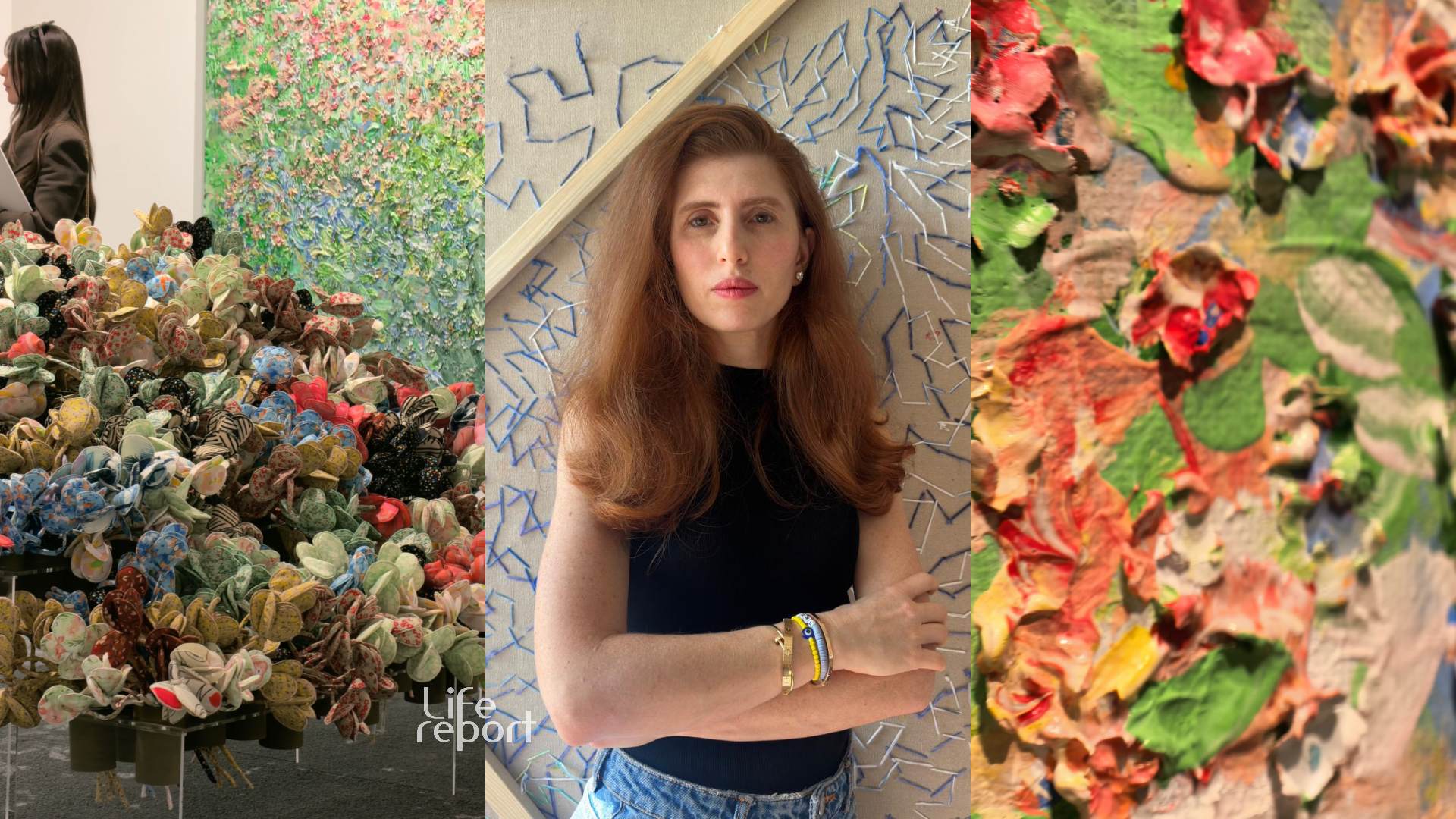
To understand Khayat’s project, one must appreciate the peculiar semiotic density of her materials. The Tifinagh script she incorporates is the ancient writing system of the Amazigh people, predating Arabic in North Africa and carrying considerable political and cultural weight. The Ajami rooms her great-grandfather restored belong to a Syrian tradition of domestic ornamentation that, for centuries, signified mercantile sophistication. In Christian iconography, the lily is associated with the Virgin Mary; in Islamic garden traditions, it embodies beauty that is fleeting and therefore sacred. Khayat does not explain these references so much as braid them, trusting the viewer to sense the texture even if every symbol cannot be fully deciphered. This is the quiet audacity of her work: it does not demand cultural translation. Instead, it offers a form of visual multilingualism that treats heritage not as a suitcase to be unpacked, but as a bloodstream.
The fair itself provides a backdrop of striking synchronicities. At the Barjeel Art Foundation’s Pulse exhibition, modern Arab masterpieces by Mahmoud سعيد, Samia Halaby and Safeya Binzagr remind visitors that the region’s artistic modernity is not a recent invention but a century-long negotiation between tradition and rupture. At Ayyam Gallery, Safwaan Dahoul’s The Eye: An Aperture Into The Soul extends his long-running Dream series, a monochromatic meditation on enclosure and longing that feels uncannily timely. Elsewhere in the Johara Foyer, a moving-image programme curated in collaboration with Alserkal Avenue offers fragments of gesture and rhythm, a cinematic counterpoint to the stillness of the paintings. In such company, Khayat’s work does not compete; it converses.
What elevates The Labor of Repair beyond a merely accomplished solo presentation is the way it resists the clichés of both ‘regional art’ and ‘feminine art’. It is neither Orientalist fantasy nor Instagram-friendly empowerment. Khayat’s stitching is too deliberate to be merely decorative, her calligraphy too fractured to be purely ornamental. When she speaks of ‘the strength and resilience of women’, she is not trading in slogans but invoking an archetype: the woman who mends, who tends, who transforms damage into design. In an era in which luxury has become increasingly indistinguishable from noise, there is something radically elegant about this proposition: that the most sophisticated response to a tear is not to conceal it, but to embroider it.
View this post on Instagram
For the culturally itinerant audience of millennials and Gen Z who orbit fairs such as Art Dubai – the same generation that collects vintage Cartier as avidly as it streams niche perfume reviews – Khayat offers a particular form of recognition. Her work understands that identity in the 21st century is a composite material, that diaspora is not a condition of loss but of layering, and that the most compelling luxury arrives with a provenance too complex for a single label. One can imagine her paintings hanging in a Jeddah apartment designed by Hiba Bensalek, who conceived the temporary centenary pavilion at Jardin Majorelle, or in The Lana, where Foad Hamzeh’s sculptural exhibition currently blurs the boundaries between hospitality and installation art. These are the nodes of a new cultural geography, and Khayat is mapping them in thread and pigment.
As the fair enters its final days – free to the public, a gesture of democratic access that feels almost radical in a city built on velvet ropes – the question that lingers is not whether Khayat’s work will sell (it almost certainly will), but what it suggests about the direction of a region that has spent two decades building museums, biennials and auction houses at a pace that would exhaust even the most caffeinated urban planner. If this booth is any indication, the answer lies in a turn towards the intimate, the hand-stitched and the genealogically profound. In a world addicted to spectacle, Khayat offers substance with a seam. And that, perhaps, is the most luxurious thing of all.
Also Read: Ariana Grande’s Swarovski Drop Is a Full-Blown Escape From Reality