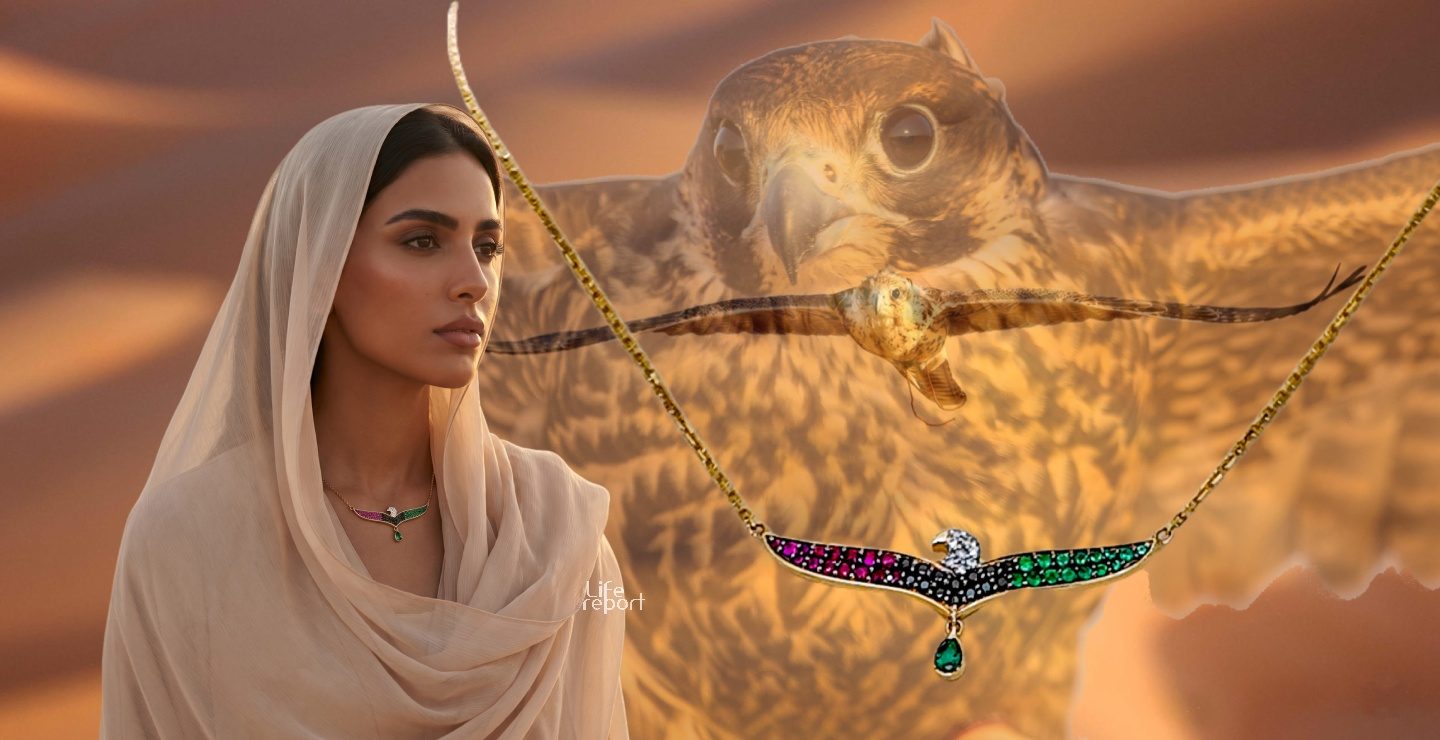
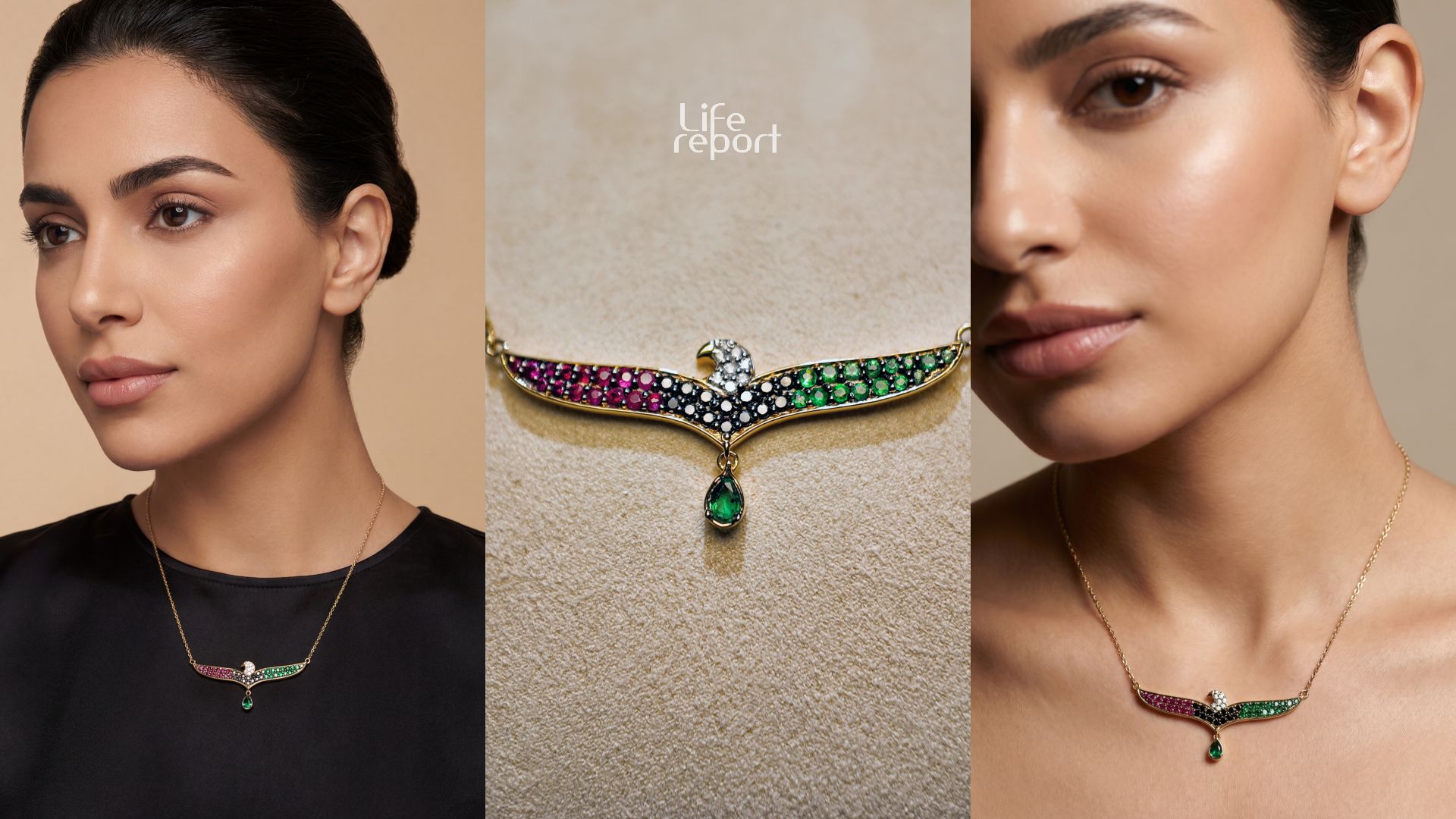
It was in this precise quality of stillness, the kind that seems to hold its breath between the desert and the sea, that I first held The Unique Falcon of the Emirates. Not the bracelet, nor the necklace, but the object in its entirety – an idea rendered in 18-karat gold, black diamonds, rubies and emeralds, resting in its case with the quiet assurance of something that has no need to announce itself.
Let us dispense, immediately, with the vocabulary of mere ornament. The Unique Gallery, that polished new arrival perched within Dubai’s ever-expanding constellation of luxury, has not simply launched another jewellery collection. Dalila Daffara and Alberto Enrico Federico Ferrario – the Italian duo whose curatorial instincts were honed across Monte Carlo, St Moritz and Lake Como before they decided Dubai was the only city worthy of a permanent foothold – have produced something closer to a diplomatic gesture rendered in precious stones. Their falcon, unveiled in both bracelet and necklace forms, arrives at a moment when the region’s luxury market is not merely growing but metamorphosing. The GCC luxury goods sector, valued at a staggering $15.02 billion in 2025, is projected to climb to $26.66 billion by 2031 – a compound annual growth rate of 10.03% that has every maison from Place Vendôme to Ginza recalibrating its compass towards the Gulf.
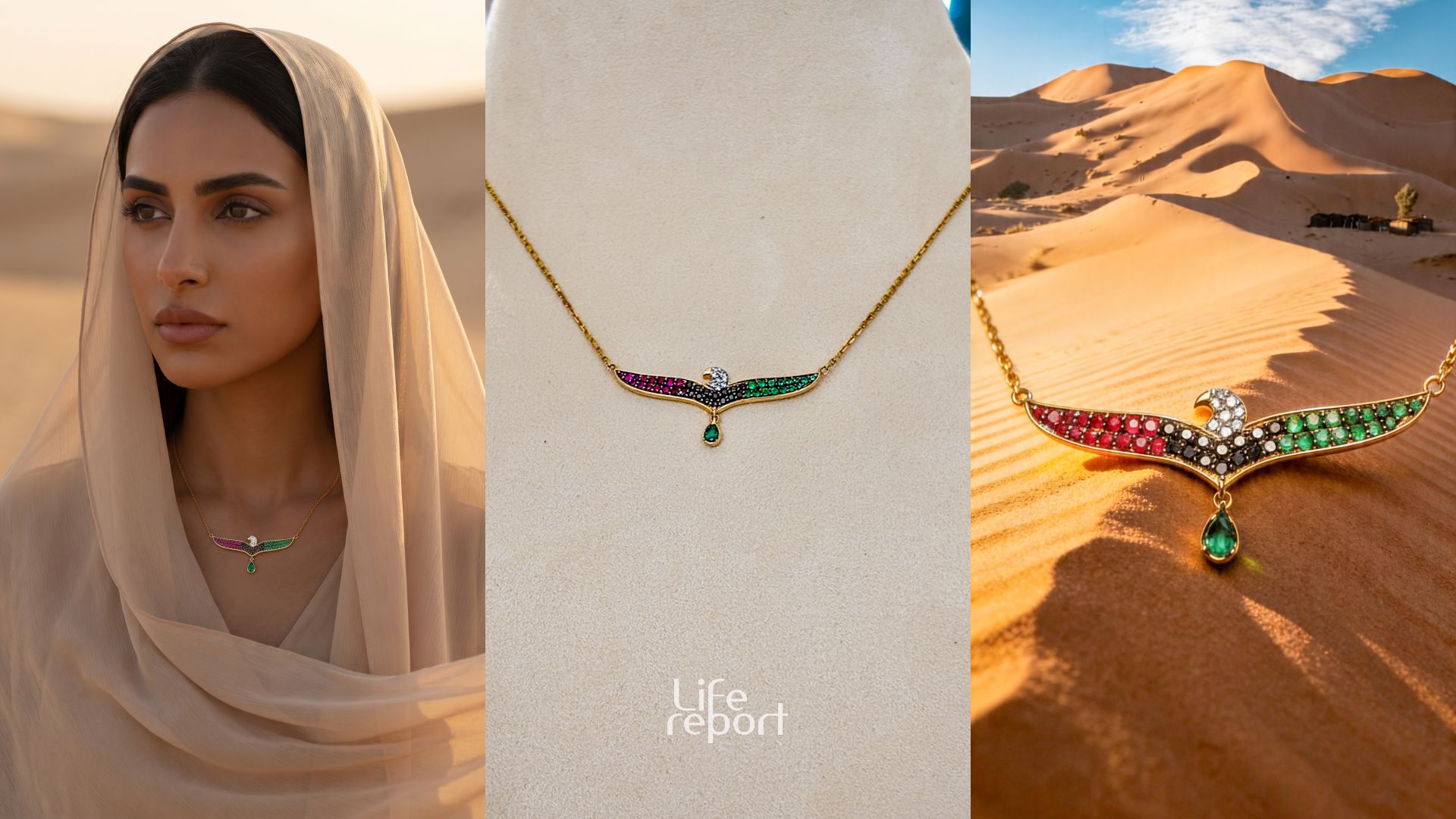
Why a falcon? The question answers itself if you have spent any meaningful time in this part of the world. The bird is omnipresent – stamped on currency, embroidered on military uniforms, etched onto the tail fins of Etihad Airways jets – yet rarely examined beyond its function as national shorthand. The falcon is the UAE’s emblem, yes, but it is also something more nuanced: a creature that, as heritage expert Dr Sleiman Najm Khalaf notes, “stands for valour and chivalry; a bird that fights for itself, that hunts for its food with elegance and ferocity”. In a region that has transformed survival into spectacle – where Bedouin ancestors once depended on these birds to catch dinner and now their descendants issue them biometric passports and first-class airline seats – the falcon occupies a symbolic register that oscillates between the ancient and the absurdly luxurious.
Daffara and Ferrario understand this duality intuitively. Their interpretation of the falcon silhouette is delicate without being fragile, powerful without being aggressive – a balance that, as any student of Gulf diplomacy will recognise, is rather the point. “The Unique Falcon of the Emirates was born from a very sincere emotion: gratitude,” Daffara explains, her phrasing calibrated with the precision of someone who has spent years navigating the intersection of European craftsmanship and Middle Eastern connoisseurship. “Gratitude towards a nation that has welcomed people from around the world, created opportunity, inspired ambition and demonstrated what thoughtful leadership truly means.”
This is not, it must be said, the standard boilerplate of a luxury press release. There is something disarmingly earnest about the sentiment, a quality that feels almost subversive in an industry where sincerity is often the first casualty of marketing. Ferrario, the strategic architect behind the Gallery’s expansion, brings the numbers into focus with the same clarity: the GCC jewellery market, already commanding over $14 billion, is forecast to reach nearly $24 billion by 2033, with the UAE alone welcoming more than 12,000 new millionaires across 2023 and 2024. These are not abstract statistics; they are the coordinates of a cultural shift that has turned Dubai into a global jewellery capital with the velocity of a peregrine falcon in a stoop – those 320-kilometre-per-hour dives that make the bird the fastest creature on earth.
View this post on Instagram
The collection itself is a study in controlled opulence, the kind that whispers rather than shouts – though, admittedly, a whisper made of black diamonds tends to carry. The UAE edition places rubies, emeralds, natural diamonds and black diamonds in a composition that evokes the national palette without descending into literal flag-waving. The black diamonds are an especially intelligent choice: moody, architectonic, they lend the piece a contemporary edge that distinguishes it from the more predictable rubies-and-gold vernacular of regional heritage jewellery. This is a falcon designed not for a museum case but for a wrist or a collarbone – for the woman who might wear it to dinner at Il Borro Tuscan Bistro and then to a Desert Sound session in AlUla without feeling the slightest sartorial dissonance.
What elevates the collection beyond the merely beautiful is its quiet embrace of philanthropy – a portion of proceeds directed towards charitable initiatives across the region. In an era when Gen Z accounts for 60% of luxury consumers and increasingly demands that their purchases carry ethical weight, this is not altruism so much as fluency in the contemporary luxury lexicon. The younger cohort of Gulf buyers, after all, is reshaping the market with a pronounced appetite for pieces that tell stories, that carry identity, that refuse to be reduced to mere carat counts. As one industry report noted, more than 70% of Gen Z consumers now factor sustainability into their luxury purchasing decisions – a statistic that would have seemed unimaginable in the Dubai of a decade ago, when bigger was invariably assumed to be better.
The regional editions deserve more than a passing mention, if only because they demonstrate a curatorial intelligence that avoids the common pitfall of treating the Gulf as a monolithic market. The Saudi Arabia edition leans into emeralds and diamonds to evoke heritage and prosperity; the Bahrain iteration marshals rubies and diamonds in a nod to courage and historical legacy; the Kuwait, Oman and Qatar editions each deploy their own chromatic vocabularies with a sensitivity to local identity that feels researched rather than assumed. This is not the lazy Orientalism that occasionally plagues Western luxury brands when they attempt to court Middle Eastern clientele – a sin that usually manifests as an excess of gold and a deficit of imagination. The Unique Gallery’s approach suggests they have done their homework, or perhaps simply spent enough time in the region to understand that cultural fluency cannot be faked.
There is, of course, a broader context against which this collection unfolds – one that the founders allude to with characteristic discretion. “We are confident that the skies will soon return to being admired only for their stars, symbols of light, hope and possibility,” they note, a line that manages to be simultaneously opaque and eloquent, personal and universal. In a region where geopolitical currents shift as rapidly as desert sands, the falcon’s symbolism acquires an almost talismanic quality: strength guided by wisdom, power tempered by balance, vision unclouded by short-term turbulence.
The Unique Gallery itself, housed at the Kempinski Palm Jumeirah, has rapidly established itself as something more interesting than a mere boutique. It operates, in effect, as a cultural institution – a rotating gallery where the work of designers such as Alessio Boschi, Qannati Objet d’Art and Zahira Fine Jewellery is presented with the curatorial seriousness of a museum exhibition. The space borrows more from the white-cube grammar of contemporary art than from the velvet-roped theatrics of traditional high jewellery salons. This is entirely deliberate: Daffara has described Dubai as “a city that embodies vision and cultural ambition,” and her Gallery is designed to meet that ambition at its own level.
For the collector who already possesses the requisite Van Cleef Alhambra pendants and Cartier Love bracelets – those elegant but increasingly ubiquitous markers of a certain kind of global luxury citizenship – The Unique Falcon offers something genuinely distinct. It is a piece that locates its wearer in a specific geography and a specific moment, that carries the weight of tradition without being crushed by it, that manages to be both a declaration of identity and an object of genuine beauty. This is no small achievement in an industry where novelty and meaning are too often assumed to be synonymous.
As I left the Gallery that evening, the falcon resting once more in its case, the Kempinski’s corridors had begun to fill with the soft murmur of the evening’s first guests – collectors, designers, the usual Dubai alchemy of nationalities and ambitions. Outside, the Palm’s fronds stretched into the darkening Gulf, and somewhere in the distance, though I could not see it, a bird of prey might have been circling the desert’s edge, looking down at a city that has made a habit of turning symbols into skylines. The Unique Gallery, with this collection, has done something similar: taken a creature that has long embodied the region’s values and rendered it wearable, collectible and quietly, unmistakably profound. In a market awash with embellishment, that constitutes a form of elegance that needs no further adornment.
Also Read: In a World of Diamond Watches, This Rose Dial Whispered – and Won