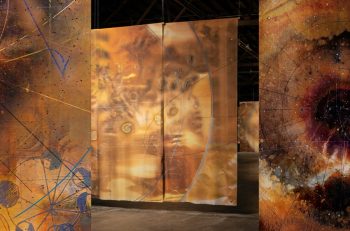
Alserkal Art Month 2026 is the Gulf’s most ambitious cultural programme yet. Here’s why it matters – and why the timing couldn’t be more loaded. Alserkal Art Month runs from April 18 to May 18, 2026, across Alserkal Avenue, Al Quoz, Dubai. All exhibitions and public programming are free to attend. Art Dubai 2026 takes place May 14–17 at Madinat Jumeirah.
There is a particular breed of cultural optimism that only survives under pressure – the kind that does not announce itself with a press release, but with a quietly extended hand: the decision to build something larger precisely when everything around it is contracting. Dubai in April 2026 is a city navigating the tectonic friction of a region under geopolitical strain, its skyline unchanged but its cultural pulse noticeably more deliberate, more purposeful, more human. And in the middle of it all, tucked into the repurposed industrial warehouses of Al Quoz, Alserkal Avenue has done something quietly radical: it has turned one week into one month.

Alserkal Art Month stretches what was once a tightly packed week of openings into a more distributed model – 16 gallery exhibitions, public art commissions, and more than 100 talks, performances, and events unfolding across five weekends, from 18 April to 18 May. The mathematics alone is impressive. The reasoning behind it, however, is where the story becomes interesting.
Art Dubai – the Gulf’s most visible art fair and one of the more glamorous fixtures on the global circuit – was pushed to mid-May, a scheduling adjustment framed in measured diplomatic language but understood within the industry as a direct response to regional disruption linked to ongoing conflict. The UAE has a direct economic stake in keeping the Strait of Hormuz open, a narrow but vital corridor through which approximately 20 per cent of the world’s oil shipments pass. These disruptions have led to increased gas and energy prices, changes to airline routes, and, by extension, interruptions to the movement of artworks and people that sustain the art market’s Gulf ambitions. The logistics of moving a Koons across contested airspace are, as one might imagine, far from trivial. Into this vacuum, Alserkal stepped – not with a survival strategy, but with expansion.
The Avenue itself deserves context. What began as a modest cluster of galleries in a light-industrial district has, over the past decade, evolved into something far more structurally significant. It now houses around 90 creative businesses across repurposed industrial spaces, making it less a gallery district and more an urban organism – the kind of place that feels alive on a Tuesday afternoon, not just during opening weekends. Think of it as Dubai’s answer to London’s Southwark or New York’s Meatpacking District circa 2005, albeit with considerably better air conditioning and an institutional seriousness that those neighbourhoods took decades to acquire.
The thematic anchor of Art Month is a newly commissioned public artwork by Mumbai-born conceptual artist Shilpa Gupta. Titled Still A Sky We Hold and installed in The Yard, the piece serves as the guiding premise for the entire month, underpinning its focus on shared experience and resilience. Gupta, whose practice has long orbited language, silence, and the limits of what can be expressed or suppressed, is a particularly apt choice for a programme that is, at its core, about persistence. Her work does not shout. It endures. And in a moment when much of the cultural conversation revolves around what might be lost, there is something quietly formidable about a work of art that insists on holding the sky.
View this post on Instagram
Among the opening exhibitions, Green Art Gallery presents All the Lands from Sunrise to Sunset, a group show examining the persistence of imperial power through works by artists including Michael Rakowitz – the Chicago-based Iraqi-American artist whose practice has spent two decades reconstructing what empire destroys and what forgetting fails to preserve. His presence here feels less like programming and more like a statement. Meanwhile, Efie Gallery debuts a public-facing viewing room featuring work by El Anatsui and Aïda Muluneh – a pairing that places Ghanaian monumental textile practice alongside Ethiopian photographic portraiture, and manages to make the dialogue feel essential rather than merely curatorial.
At The Third Line, Sara Naim’s solo exhibition features paintings that oscillate between figuration and abstraction, paired with a video work that dissolves language into gesture and sound. Naim, who has developed a quietly distinctive practice around the intersections of the corporeal and the digital, produces work that feels genuinely uncomfortable in the best possible way – the kind of discomfort that lingers beyond the exhibition and into the drive home. At Leila Heller Gallery, Douglas White’s The Great Wave translates Hokusai’s iconic 1831 woodblock print into a monumental sculpture constructed entirely from discarded tyres, capturing a moment of suspended force that mirrors, almost uncomfortably precisely, the current climate of ecological and geopolitical strain. Notably, Hokusai completed the original during a period of national isolation and external pressure. The parallel is either deliberate or inevitable – possibly both.
The centrepiece arrives on 25 April with Déjà Vu – a curated group exhibition at Concrete, bringing together more than 50 artists represented by 20 of the UAE’s leading contemporary galleries and running through 8 May. Inspired by Raed Yassin’s 2016 neon work of the same name, the exhibition interrogates the absurdity of repeated cycles, historical mismatching, memory glitches, and linguistic slippage. The concept – that uncanny sensation of experiencing something for the first time that nonetheless feels already lived – resonates deeply in a city that has been perpetually reinventing itself for three decades, and in a region where political scripts often replay with only minimal variation. The accompanying Majlis Talks series, curated by critic Nadine Khalil, transforms the traditional Arabic gathering format into an extended intellectual exchange – a sequence of dialogues designed not to conclude, but to deepen. It is worth noting that the majlis, as a cultural form, predates the conference panel by several centuries and arguably produces more meaningful conversations. Khalil’s curatorial instinct here is sound.
Beyond the headline exhibitions, Art Month operates with the intelligence of a programme that understands attention spans are finite and curiosity requires cultivation. Slow Art Walks, guided by researcher Faris Shomali, offer a focused alternative to the exhausting impulse to see everything – choosing instead to see a few things properly, which is, arguably, the entire premise of serious looking. Creative workshops led by Dirwaza Curatorial Lab, Chafa Ghaddar, Nora Zeid, and Al Reem Al Beshr run alongside open studios with Alla Abdunabi and Maryam Ahli, as well as a performance by Asareh Ebrahimpour – together forming a programme that positions the artist not as a distant producer of finished objects, but as a present, accessible, and occasionally unpredictable participant in public life.
The Alserkal Arts Foundation has also established a grants fund of up to AED 10,000 for research-led projects within its network – a modest sum by institutional standards, yet a meaningful one at studio level. In a cultural ecosystem where the gap between ambition and resources is rarely discussed openly, the decision to state the figure explicitly is itself a form of candour.
The closing act, running from 12 to 17 May in parallel with Art Dubai, is Moving – a four-day programme of moving-image works presented in partnership with the fair and screened simultaneously in The Yard and at Madinat Jumeirah. Now in its second year, the programme extends the month’s reach from the industrial pocket of Al Quoz into the broader geography of the city, transforming a district-level initiative into something that briefly, and convincingly, belongs to Dubai at large. “For almost 20 years, Alserkal has helped shape the region’s cultural landscape into the vibrant scene it is today,” said Vilma Jurkute, Executive Director of Alserkal. “Alserkal Art Month is a tribute to the resilience and fortitude of the UAE’s arts ecosystem, and to the people who sustain it.”

Resilience is, admittedly, one of the more overused words in contemporary institutional communication. Here, however, it earns its place. The decision to expand – to add rather than retreat, to extend rather than consolidate – in a moment of genuine regional difficulty is not a marketing gesture. It is an argument, made through programming rather than prose, about what cultural infrastructure is actually for.
The art world has a complicated relationship with the Gulf. It has spent years debating whether the region’s cultural ambitions are genuine or merely architectural; whether galleries exist for the city or for the international press; whether collectors are cultivating taste or accumulating status. These conversations have their place. They also tend to be conducted by those who have not spent an unhurried Saturday afternoon moving from a Naim painting to a White sculpture to a Gupta installation, and finding themselves, unexpectedly, moved by all three.
Alserkal Art Month is not a rebuttal to those conversations. It is, more usefully, a reason to continue having them – on better terms, in a space that, for all its contradictions, continues to exist, continues to commission, and continues, against rather formidable odds, to hold the sky.
Also Read: In a City of Trends, This Café Stayed Real – And That Changed Everything