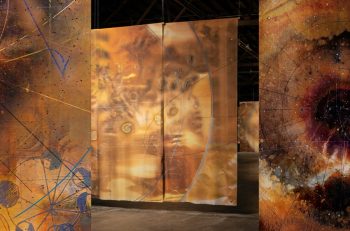
Step off the sun-blasted pavements of Al Quoz and into the cavernous, cool quiet of Ayyam Gallery this season, and you are not merely entering an exhibition. You are stepping into a meticulously curated ruin. Kais Salman: Remnants runs from 17 January to 18 March 2026 at Ayyam Gallery, B11, Alserkal Avenue.
Here, amid the industrial-chic concrete of Alserkal Avenue – a district as devoted to contemporary cultural production as the Louvre Abu Dhabi is to canonical grandeur – Syrian artist Kais Salman is not building monuments. He is sifting through their aftermath. His latest solo exhibition, Remnants, is a masterclass in elegant disintegration: a body of work that feels less like painting and more like psychic archaeology, speaking directly to a generation fluent in the aesthetics of fragmentation.

Salman, a painter whose name carries the weight of Damascus and the dynamism of Dubai, presents works that are viscerally arresting. Take Face 10, a commanding expanse of acrylic in which form and oblivion engage in a taut, compelling struggle. His brushwork does not so much depict a face as perform its emergence – energetic, raw strokes briefly coalesce into recognisable features, only to dissolve back into the materiality of paint, like a face glimpsed and lost in a crowd. The experience carries the same unsettling allure as a Rick Owens deconstructed blazer or the deliberate, haunting decay of a Maison Margiela Artisanal piece. This is abstraction not as retreat, but as confrontation.
The exhibition text, penned by critic Malsam Mallisho, positions the canvas as a “space for reclaiming memory”. Salman achieves this not through nostalgic reverie, but via a process akin to intellectual carpentry, assembling meaning from collected fragments. With a sensitivity that would resonate with any student of Walter Benjamin, he understands that history – and the history of painting – is written in “cracks, interruptions, and gaps”. His surfaces operate as palimpsests, layered with what he terms “acts of erasure”. The resulting chromatic weight feels accumulated and earned. It evokes not the pristine emptiness of a minimalist luxury penthouse, but the charged silence of a revered space – the trace of oud lingering in a room after its wearer has departed, or the perfectly worn patina of a vintage Patek Philippe.
View this post on Instagram
At the core of Salman’s inquiry lies a question that is deceptively simple yet endlessly complex: what is a face once it is stripped of its obligation to remain a “readable form”? In an era shaped by curated Instagram identities and AI-generated avatars, his work feels urgently relevant. He dismantles the portrait’s traditional aura – that sacred halo of fixed identity and narrative clarity – leaving behind what he describes as its “ethical aspect”: a commitment to ambiguity. It is a quietly rebellious stance in a culture driven by the rapid consumption of easily categorised imagery. To stand before these paintings is to feel the soft tyranny of the algorithm recede, replaced by something older, slower, and profoundly human.
His practice, forged in the displacement wrought by Syria’s war and refined within Dubai’s hyper-modern crucible, engages with the defining themes of our time – corruption, fanaticism, digital voyeurism – not through literal depiction, but through a saturated, gestural language that impresses unease onto the very skin of the canvas. The work shares a lineage with the visceral intensity of Francis Bacon, yet remains filtered through a distinctly contemporary Middle Eastern sensibility. Salman’s figures, frequently merging with abstracted landscapes, echo the region’s layered realities, where ancient ruins exist in the shadow of soaring glass towers.

For the culturally attuned resident of Dubai – the one who debates the merits of a Gaia Gaja Barbaresco over dinner at Trèsind Studio and notices the acoustic precision of Dubai Opera as keenly as the performance itself – Salman’s work offers a different register of luxury. It is the luxury of sustained contemplation. The intellectual equivalent of nursing a complex, peaty whisky in a discreet speakeasy, far removed from the neon insistence of the mainstream. It asks the viewer to slow down, to wander, to wonder.
Remnants is more than an exhibition; it is an event in the truest sense of the word. It prepares a ground for encounter without promise or prefigured image. In a city celebrated for its mastery of the future, Kais Salman offers a poignant, powerful, and beautifully unresolved conversation with the past and the fractured present. It is a necessary pilgrimage for anyone who believes that true sophistication lies not in possessing all the answers, but in embracing the profound beauty of the questions.