As Australia prepares to unveil its largest cultural project since the Sydney Opera House, a monumental bronze by the London-born, New Delhi-based artist reframes public sculpture for a generation that worships at the altar of Instagram – and, perhaps, something far older.
I first encountered Bharti Kher’s work in the most incongruous of settings: a sun-bleached afternoon at the Hayward Gallery, where an elephant lay recumbent, its hide shimmering with thousands of tiny, sperm-shaped bindis. The piece, The Skin Speaks a Language Not Its Own, radiated a disquieting tenderness – a creature both monumental and fragile, collapsed under the weight of infinite feminine markings. It was 2022, and the queue to photograph it snaked past the brutalist concrete, every visitor desperate to capture a moment of numinous oddity on an iPhone 14 Pro. Kher, I suspect, would have appreciated the irony. She has always dealt in chimeras, in the tension between the sacred and the profane, the ancient and the algorithmically new.
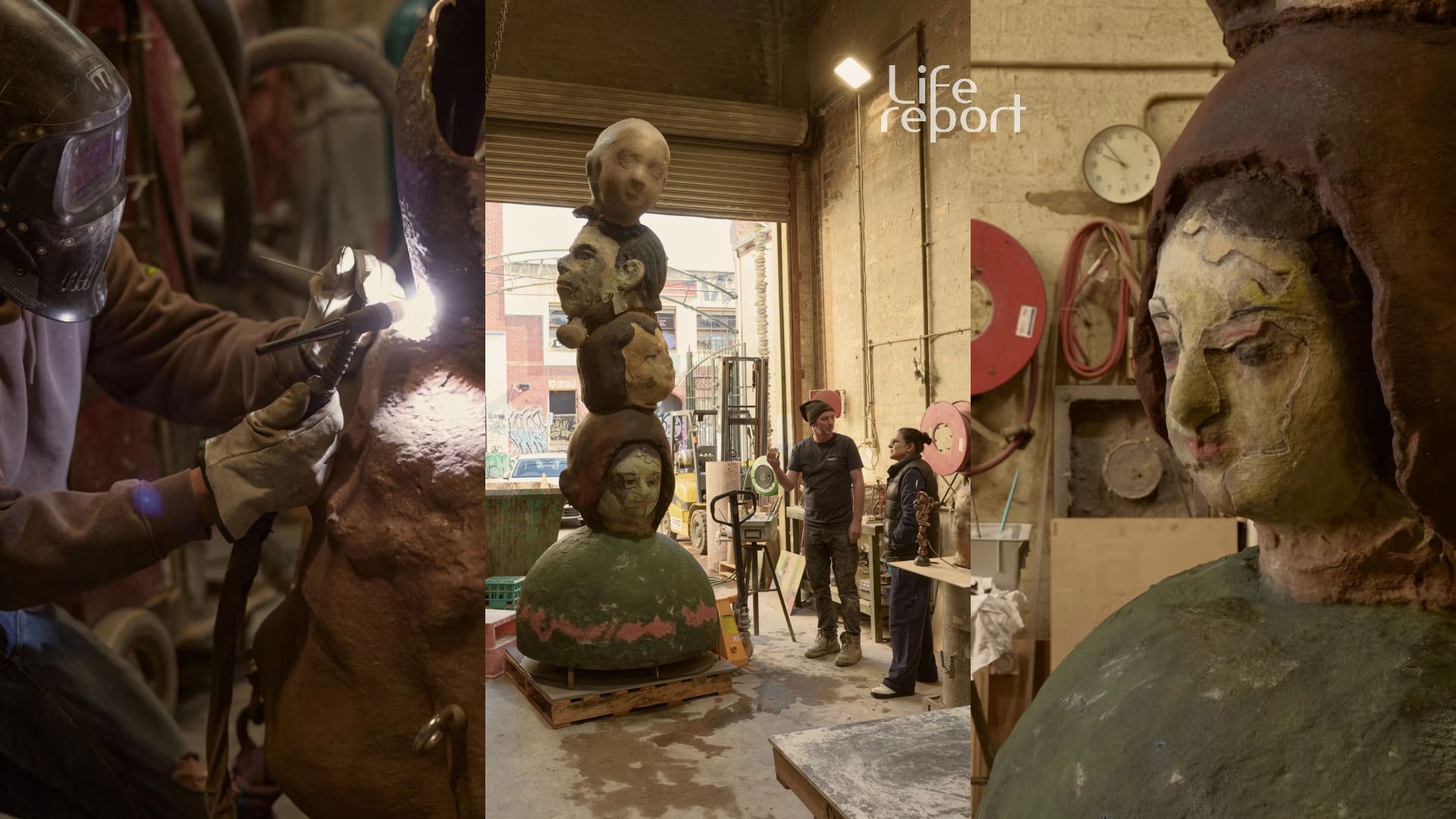
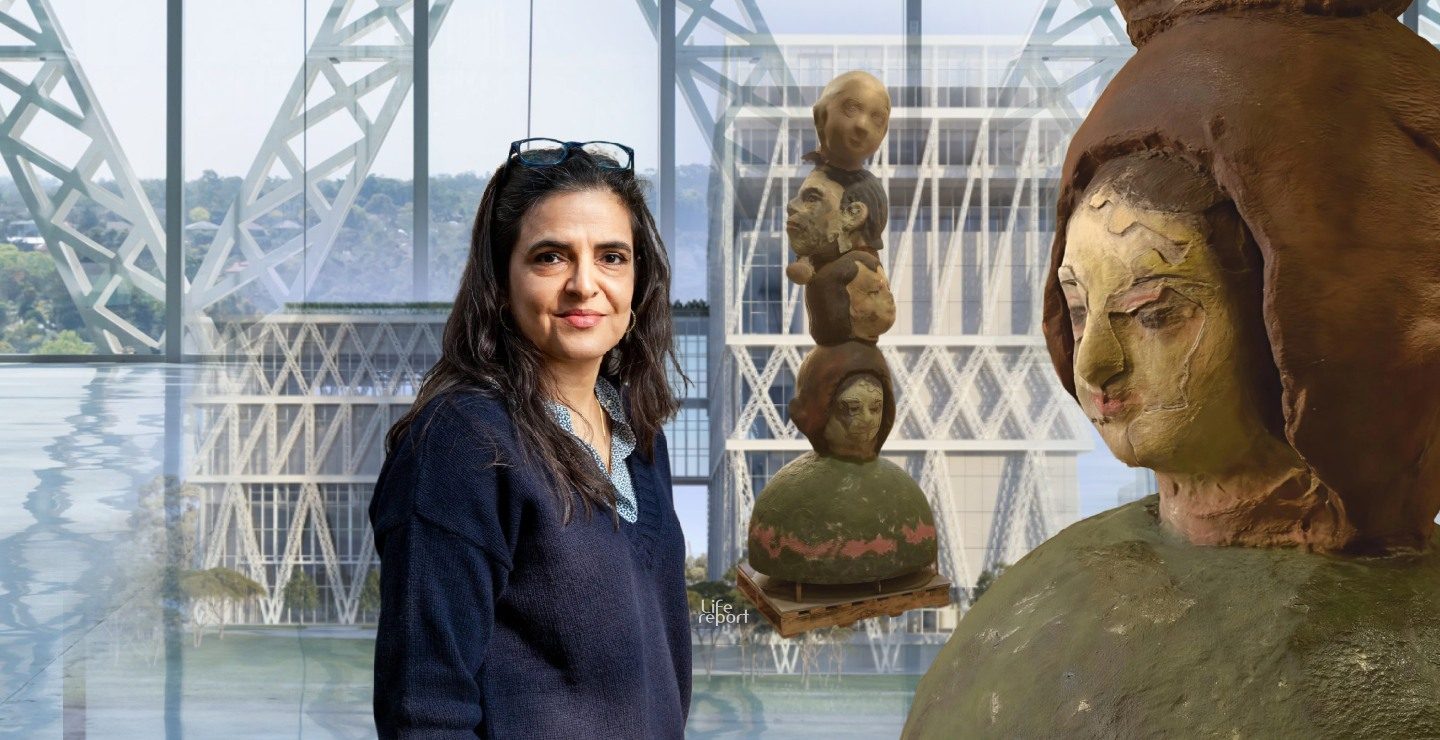
Now the artist is preparing to scale that tension to seven metres. In late 2026 – delayed, as all genuinely ambitious civic dreams are, by the friction between vision and concrete – Powerhouse Parramatta will fling open its doors on the banks of the Parramatta River in Western Sydney. Designed by the Franco-Japanese practice Moreau Kusunoki, with Genton serving as executive architect, the museum is a low-slung, latticed exclamation mark on Dharug land, a shimmering expression of the applied arts and sciences that aspires to do for the city’s second CBD what Frank Gehry’s Guggenheim did for Bilbao. At its entrance plaza, anchoring the entire composition like a vertical mantra, will stand Tree of Life, Kher’s first permanent public commission in Australia.
The work is, in the artist’s own words, “a spirit work”. Conceived as a totem of layered ancestral heads, it interprets one of the most ancient images from Indian mythology: the sacred tree that connects the living and the spiritual worlds. The sculpture’s seven metres of bronze will rise from the ground with quiet, implacable authority, its stacked faces neither entirely human nor wholly divine, their expressions suspended somewhere between benediction and appraisal. It is, in other words, the anti-selfie. And yet one can already imagine the sea of hands holding phones aloft, the endless carousel of #PublicArt posts, the influencer captions about “finding your roots”. Kher, ever the dialectician, would likely call that a meeting place as well.
View this post on Instagram
To understand why Tree of Life matters beyond Sydney’s increasingly crowded cultural calendar, one must first appreciate the alchemy of Parramatta itself. The district is a pâtisserie of diasporas, with more than a third of its residents tracing their heritage to the Indian subcontinent. The commission did not emerge from a curatorial whim; it was a direct outcome of the museum’s Heritage Interpretation Plan, which identified a public artwork celebrating the Indian community as an essential gesture of belonging. One can almost hear the community consultation sessions, the PowerPoint presentations, the earnest municipal language of “engagement” and “outcomes”. Yet from that bureaucratic crucible has emerged something genuinely transgressive: a work that refuses the easy tropes of multicultural kitsch in favour of a sophisticated, deeply esoteric visual language.
Kher, the daughter of Punjabi immigrants to the United Kingdom, has built a three-decade career on such refusals. Her oeuvre – spanning painting, sculpture, and installation – swims in animism, Surrealism, and a kind of tantric materiality. She employs readymades – bindis, saris, plaster casts – not as Duchampian jokes but as vessels of transformation, objects that carry the residue of the feminine, the domestic, and the overlooked. When she exhibited at the Freud Museum in 2016, her interventions in the house of psychoanalysis felt less like artistic commentary and more like a séance. At Tate St Ives in 2025, her chimerical beings conversed with the Cornish light as though they had been conjured from the sea mist. Now, with Tree of Life, she moves from the intimate gallery to the civic plaza, from the bindi’s delicate adhesive to the permanence of bronze. The shift is not merely one of scale; it is philosophical.
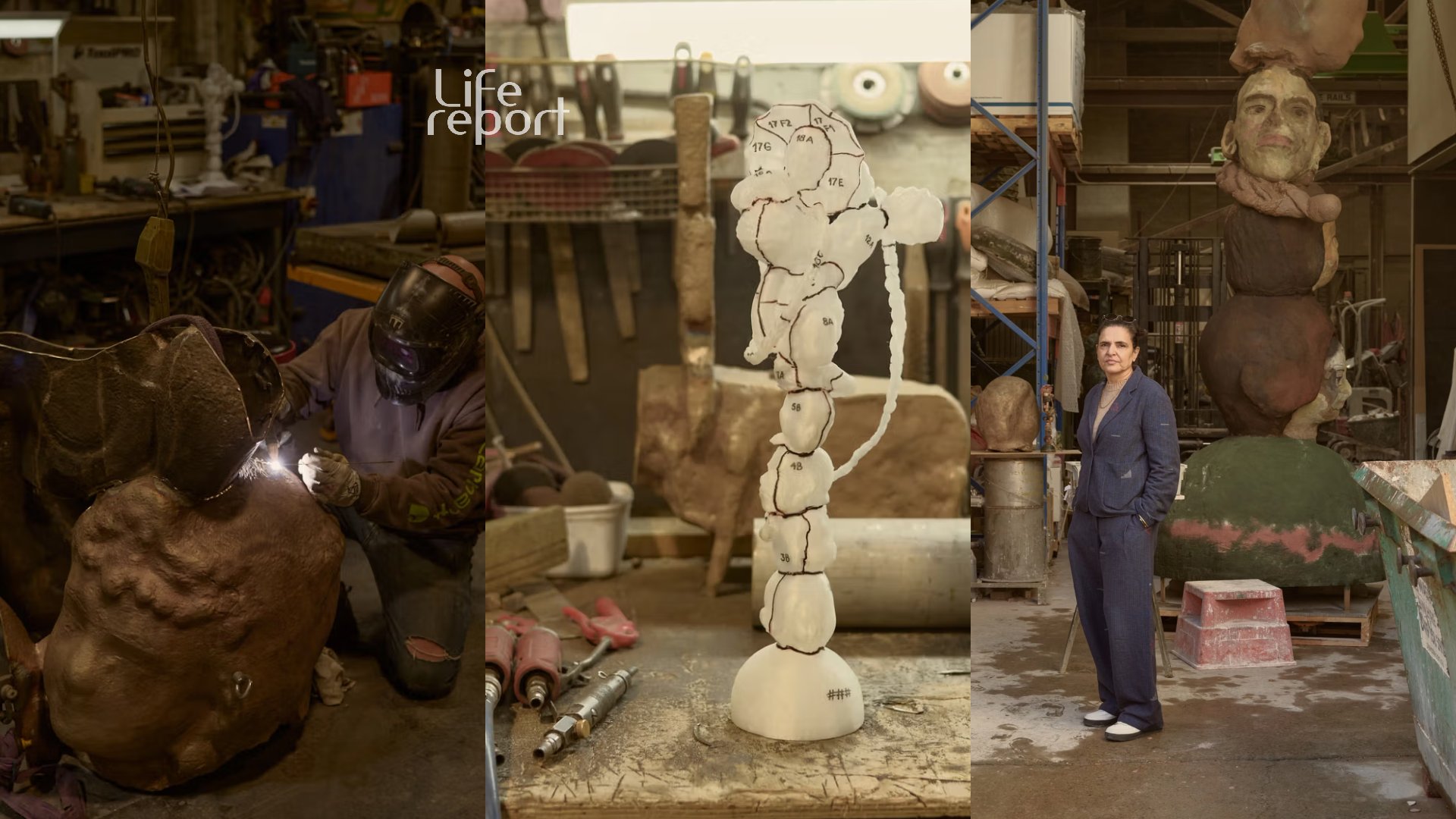
One cannot help but think of the great public totems of the modern era – Louise Bourgeois’s spiders, Anish Kapoor’s reflective bean – and how they have become secular pilgrimage sites, backdrops for the performance of cultured leisure. Kher’s sculpture, with its emphatic verticality and its refusal to become merely decorative, seems designed to resist being reduced to a photogenic prop. The layered heads demand slower looking, an unravelling of their palimpsest of features. They evoke the Yakshi figures of ancient India, the guardian spirits of trees and water, while also whispering of Brancusi’s endless columns and the modernist search for essence. It is a work that could sit comfortably in the courtyard of a luxury resort in Udaipur or the sculpture park of a Swiss watch manufacture – Audemars Piguet, perhaps, might covet its blend of craftsmanship and metaphysics – yet it is destined for a suburb populated by accountants, engineers, and technology professionals, a place that has consistently favoured political centrism in recent Australian elections. There is a quiet audacity in that.
View this post on Instagram
For the UAE’s culturally omnivorous Gen Z and millennial audience – those who chart their year around Art Dubai, the Sharjah Biennial, and openings at Alserkal Avenue – *Tree of Life* offers a new node on the global art map, a reason to route the next long-haul journey via Sydney. It joins a constellation of recent commissions that understand public sculpture as both urban anchor and content generator: think of Es Devlin’s Forest of Us at Expo 2020 Dubai or the mirrored labyrinth of the Museum of the Future, where architecture itself performs for the lens. Yet Kher’s work possesses something those crowd-pleasers often lack: genuine numinosity. It does not merely ask to be looked at; it seeks to become a meeting place “between the mountain and coastal people”, as the artist has said, harking back to the site’s pre-colonial history as a gathering ground for the Dharug people. In an era when luxury brands scramble to attach themselves to “purpose” and “heritage” – Loewe’s Craft Prize, Dior’s artist collaborations, the watch industry’s revival of métiers d’art – here is a piece of public infrastructure that embodies those values without a branded hashtag in sight.
Naturally, there will be detractors. The sculpture’s scale and uncompromising verticality will inevitably be labelled “phallic” by someone on X. Its cost – undisclosed but surely considerable – will become fodder for the kind of tabloid outrage that mistakes any investment in beauty for elitism. And the selfie-snapping masses, bless their ring-lighted faces, will reduce its intricate iconography to a backdrop for their pre-brunch content. Kher, one imagines, will observe all this with the same equanimity with which she once placed bindis on elephant hides, accepting the profane transaction as part of the sacred economy. “Just as Powerhouse Parramatta serves as a meeting place,” she has said, “Tree of Life embodies an artistic message of commonality and an ode to nature.” Out of context, the line could sound platitudinous; spoken by an artist who has spent three decades creating chimeras from the mundane, it carries the weight of genuine conviction.
View this post on Instagram
What does it mean, finally, for a public artwork to succeed in the age of the infinite scroll? Perhaps success is no longer measured by quiet contemplation but by the number of times a work is transmitted, pixelated, hashtagged, and geotagged into the collective consciousness. If so, Kher’s Tree of Life will almost certainly thrive. Yet its deeper achievement may prove more elusive: to offer, in the middle of a city that is perpetually becoming, a still point where the ancestors can be felt to murmur, even if the only person listening is a Gen Z visitor from Dubai who has wandered there between a flat white and a sample sale and discovers, if only for a fleeting moment, that their phone remains in their pocket.
Also Read: In a City of Trends, This Café Stayed Real – And That Changed Everything