In Dubai, even the sea has learned to follow the money. For four decades, the city has dredged, reshaped and repackaged its coastline, turning water into one of its most persuasive luxury assets. Now, the next chapter is taking shape on Dubai Islands. On 28 October, Casa Vista Development will unveil Aquora, a AED 350 million waterfront address whose 105 residences are already attracting buyers before the launch evening’s first canapé has been served. According to the developer, 40 per cent of the homes have already sold. In a city where ambition is measured in square feet and scepticism is treated as a character flaw, the question is no longer whether waterfront living sells. It is what the next generation of luxury buyers really wants – and whether Aquora has found the answer.
Aquora’s governing conceit is a phrase that sounds as though it was born in a design studio and polished in a boardroom: ‘Form Follows Flow’. It is a pleasing riff on Louis Sullivan’s famous dictum, and it does the heavy lifting for an architectural approach that promises to translate ‘the natural rhythm of water’ into ‘flowing architectural forms, light-filled interiors and carefully planned lifestyle spaces’. Whether the result resembles one of Koichi Takada’s meditations on Sydney Harbour’s sandstone ridges or simply another well-appointed mid-rise with a decent infinity pool is a question that will be settled by the building itself, not the press release. But the ambition is instructive. The era of the trophy tower is yielding to something quieter and more tactile – a luxury defined less by altitude than by atmosphere.
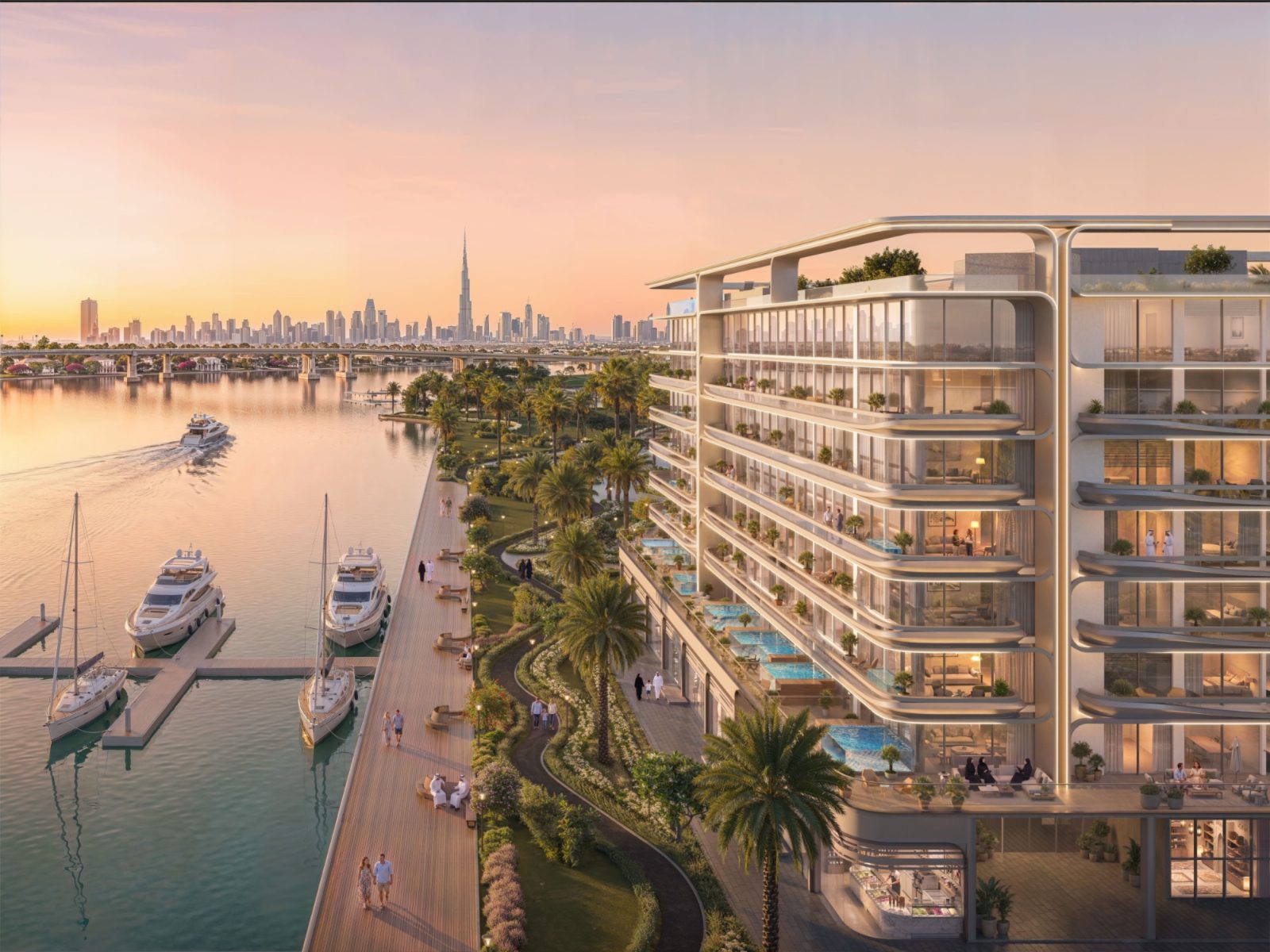
The numbers behind Aquora are modest by Dubai’s current fever-dream standards, which is precisely what makes them interesting. The project occupies a 50,000 sq ft plot, with a built-up area of approximately 240,000 sq ft, and contains 105 residences in one-, two- and three-bedroom simplex and duplex formats. Initial prices were advertised from AED 1.9 million. This is not a Palm Jumeirah fantasy of private beaches and staff quarters; it is a calibrated bet on a buyer who wants waterfront living without the theatrical scale that once defined it. The transaction data tells a story of its own: recent registered sales of one-bedroom residences at Aquora have ranged from AED 2 million to approximately AED 2.8 million, at roughly AED 2,400 to AED 3,100 per sq ft. For context, Bayut’s September 2026 index put the average price for one-bedroom apartments on Dubai Islands at AED 2,547 per sq ft. The figures are not perfectly like-for-like, but they place Aquora’s pricing near or above the prevailing area benchmark rather than establishing it as an obvious bargain. The archipelago is nevertheless being pitched as an alternative to the established glamour of Palm Jumeirah and Dubai Marina.
Casa Vista is a new name in a city that eats new names for breakfast, but its lineage is not the usual developer boilerplate. The founding family’s experience spans trading, commodities, logistics, construction and real estate, dating back to 2012, with strategic property investments beginning in 2015. There is something almost old-world about this trajectory – a commodity trader’s instinct for timing and margin applied to the business of building homes. Chairman Abdul Basit speaks of ‘genuine quality and lasting value’ with the measured cadence of someone who has watched a few cycles and does not need to shout about this one. The subtext is a quiet rebuke to the more breathless corners of the off-plan market: we are not here to flip; we are here to finish.
The amenity schedule reads like a syllabus for the contemporary wellness-minded resident. A 22-metre rooftop infinity pool. A Technogym-equipped fitness centre. A yoga studio. A Zen Garden. A pickleball court. The pickleball court is the tell. It is the sport of the moment for a generation that has monetised optimisation and turned leisure into a form of personal branding. Its presence here is less an architectural flourish than a demographic thesis. The brands follow suit: Minotti furniture in the lobby, Terzani chandeliers, Ergon tiles, Fondovalle marble and Teka kitchen appliances. These are not the loudest names in the luxury universe; they are the ones that signal fluency. They suggest a buyer who knows the difference between expensive and considered, and who would rather be caught dead than caught trying.
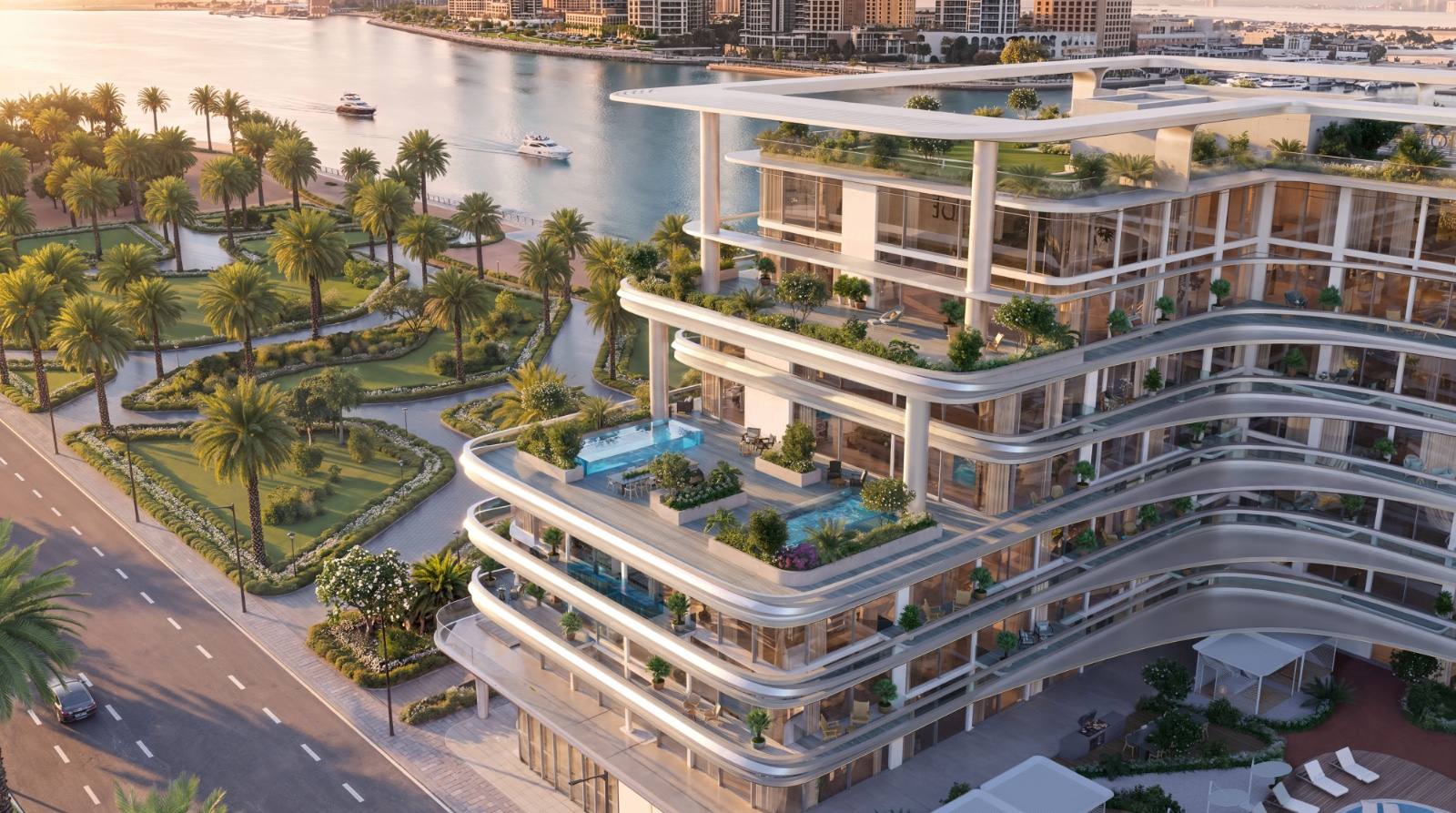
Dubai Islands itself provides the larger canvas, and it is a canvas worth taking seriously. Nakheel’s five-island masterplan spans 18.6 sq km and is set to add approximately 57 km of coastline to the city, including 21 km of beachfront, alongside two 18-hole championship golf courses, eight marinas and more than 11,000 hotel keys. The tourism arithmetic is straightforward: Dubai welcomed 19.59 million international overnight visitors in 2025, according to official figures. The established beachfront clusters – JBR, Dubai Marina and Palm Jumeirah – already absorb a substantial share of that demand. The gap in family-oriented beachfront living is another challenge: many coastal areas are either heavily geared towards tourists or lack the schools, walkable retail and community infrastructure that permanent residents require. Dubai Islands is designed to address both demands, aligning the often-competing interests of the resort economy and the residential market. Aquora’s position on Island A, at the heart of the archipelago, places it at the confluence of those two ambitions.
The buyer profile for this segment is evolving with an alacrity that the old guard of Dubai real estate occasionally struggles to process. The crypto-wealthy millennial – typically aged between 30 and 42, with a technology or Web3 background and liquidity from the 2021 or 2024 crypto cycles – is becoming a more visible force in the market, favouring architect-driven projects and branded residences over generic developer product. European second-home seekers from Italy, France, Germany and the UK form another important cohort, equally sensitive to brand and price. Gen Z buyers are present but cautious, often entering through smaller-ticket purchases and shared-ownership models rather than making a grand gesture. The common thread is a preference for narrative over noise. A building that can explain itself – philosophically, aesthetically, even morally – clears a higher bar than one that simply promises a view.
This is where ‘Form Follows Flow’ earns its keep, or fails to. The philosophy is not new; fluid architecture has been part of luxury waterfront design since at least the yalı mansions of the Bosphorus, and contemporary practitioners from Koichi Takada to SAOTA have made careers of dissolving the boundary between interior and water. What is new is the audience. A generation that has grown up with infinite scroll and algorithmic feeds does not want a fortress; it wants a filter. It wants light that behaves, air that moves and spaces that flow into one another with the effortlessness of a well-curated feed. Whether Aquora delivers that is a matter of execution, but the intent is legible.
The timing of the unveiling is not accidental. Dubai’s off-plan luxury segment has proved resilient even as activity in the wider resale market has cooled. Luxury transactions above AED 15 million fell 59 per cent year on year in the second quarter of 2026, while off-plan luxury sales rose 27 per cent. Across the residential market, off-plan properties accounted for approximately 71 per cent of sales in Dubai in the first half of 2026, a structural shift that favours developers with credible delivery records and punishes those with little more than a rendering and a payment plan. Casa Vista’s decision to break ground before unveiling the project in full is a deliberate signal: the foundation is real, not metaphorical. The developer currently advertises handover for the first quarter of 2028, although the Dubai Land Department’s project register lists a completion date of 11 October 2028. The company says it has additional UAE projects in the pipeline. This is not a one-act performance.
The broader cultural context is worth a moment’s reflection. Dubai has always sold the future as a product, but the terms of that sale are changing. The buyers arriving now are not merely seeking a tax-efficient bolt-hole or a status address; they are seeking a version of life that feels coherent – wellness without sanctimony, design without ostentation, water without the circus. Aquora’s promise of a ‘signature arrival experience’ and a ‘Zen Garden’ is easy to mock, and one should never entirely resist the temptation. But beneath the marketing language is a real question: can a city built on superlatives learn to luxuriate in subtler registers? The developer’s claim that 40 per cent of residences have sold before the unveiling suggests that a sufficient number of people are willing to bet that it can.
On 28 October, under the lights of Madinat Jumeirah Arena, the answer will be presented as an evening ‘inspired by the elegance, movement and tranquillity of water’. The guest list will include dignitaries, investors and media representatives, with the usual choreography of confidence. But the more interesting audience is the one that will arrive later – the millennial with a design habit, the European with a tax problem, the crypto-native with a taste for architecture. They will not be seduced by the word ‘flow’. They will ask whether the light falls correctly in the afternoon, whether the pickleball court is shaded, whether the Minotti sofa is the right one. The water always wins, but only if the details hold.
ALSO READ: Rana Begum’s ‘Taking Form’ in Dubai: The Art Exhibition Changing How We See Light