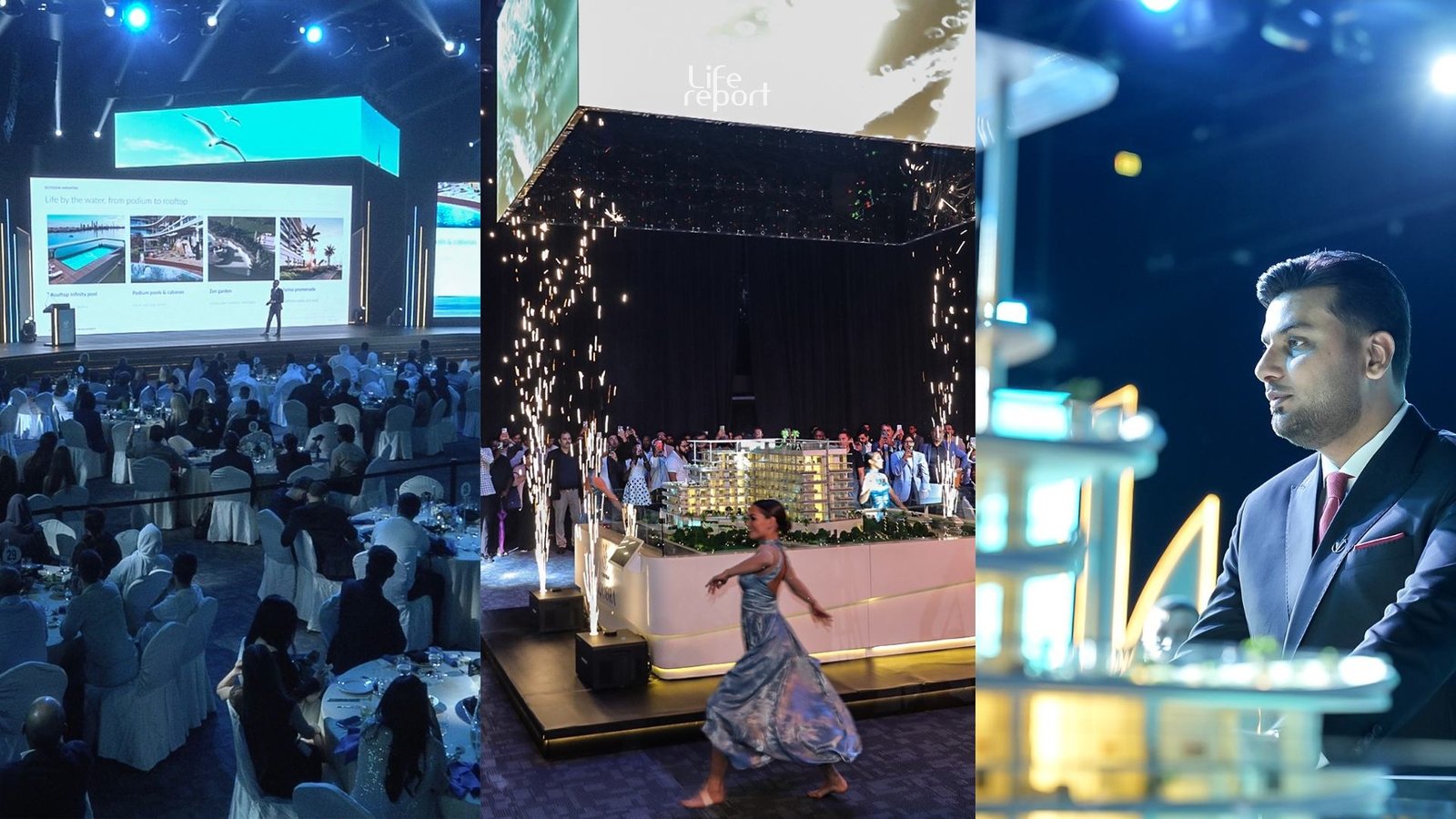
Only in Dubai could a faux Venetian canal feel like the understatement of the evening – particularly when the genuinely waterfront development being unveiled had already sold out its first sales phase. Outside the arena, the lagoon did its best impression of spontaneity; inside, more than 800 guests were about to celebrate a building whose market had already spoken. The canapés were photographed rather than eaten, the lobby perfume did its discreet work, and somewhere between the gondoliers and the infinity-pool renderings, a quiet inversion of the city’s usual choreography took place: the party had become a victory lap for a product that had already proved its appeal. In a market where the launch event is often the main event, Aquora simply let the water whisper – and the buyers had already listened.
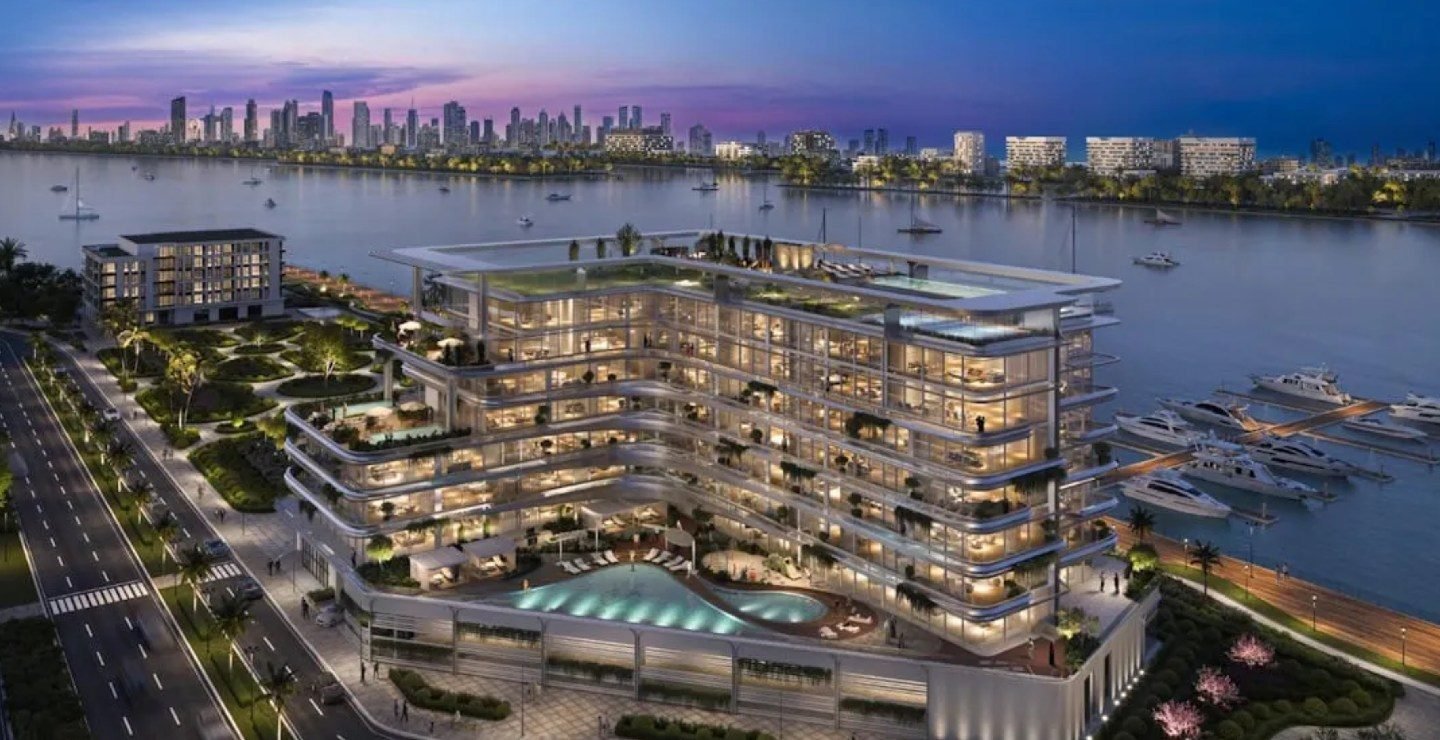
The project at the centre of this liquid theatre is the debut residential venture of Casa Vista Development, an AED 350 million address on Dubai Islands. Occupying a 50,000-square-foot plot, it offers approximately 240,000 square feet of built-up area, comprising 105 residences and six waterfront retail spaces. The architecture is organised around a philosophy the developer calls ‘Form Follows Flow’, a phrase that borrows the cadence of modernism’s ‘form follows function’ while gently suggesting that, in the third decade of the twenty-first century, function has been superseded by something more atmospheric. Water, here, is not a backdrop. It is the organising intelligence – the source of light, the logic of the plan, the reason the rooftop infinity pool measures twenty-two metres and the reason the Zen Garden, yoga studio and Technogym fitness centre feel less like amenities than stations along an aqueous pilgrimage. Handover is scheduled for the first quarter of 2028.
The design language is legible to anyone who has spent time in the quieter corners of Milanese or Florentine craftsmanship. The lobby furniture is by Minotti – that most discreetly confident of Italian houses, whose sofas have furnished the penthouses of people who prefer not to be named. The chandeliers are by Terzani, sculptural and slightly theatrical, the kind of lighting that makes a room feel like a held breath. The tiles are by Ergon, the marble by Fondovalle, and the kitchen accessories by Teka. These are not the bombastic signatures of a brand-conscious developer ticking boxes; they are quiet signals of a particular kind of taste – the sort that understands luxury as a matter of texture and proportion rather than logos and scale. The same intelligence extends to the amenity programme: a pickleball court, a dog park, an open-air cinema and a signature arrival experience. Pickleball, it should be noted, is the democratic court sport of the moment, the pastime of tech founders and wellness pilgrims alike. Its presence here is a small admission that the target buyer is younger, more active and less interested in the traditional gilded lobbies of Dubai’s first luxury wave.
That buyer profile is, in fact, the subtext of the entire enterprise. The Gulf’s luxury property market is increasingly shaped by a generation that came of age after the 2008 financial crisis, with wealth often linked to technology, Web3 and an increasingly mobile global economy. The archetypal Dubai trophy buyer is no longer necessarily an older investor seeking a conventional status address. Developers are increasingly courting millennials and older members of Gen Z, including affluent buyers from India. A report published in December 2025 cited a 40 per cent rise in enquiries from affluent Gen Z Indians exploring property investment opportunities in Dubai, although enquiries should not be confused with completed purchases. These buyers do not necessarily inherit taste; they acquire it, rapidly and voraciously, and expect their buildings to deliver wellness, community and aesthetic intelligence in equal measure. With entry prices starting at AED 1.9 million and one-to-three-bedroom simplex and duplex formats, Aquora appears calibrated for precisely this constituency: the younger professional or internationally mobile investor for whom a waterfront address is both a considered allocation of capital and a daily sensory upgrade. The infinity pool, in this reading, is not merely a leisure amenity. It is a liquidity event with a view.
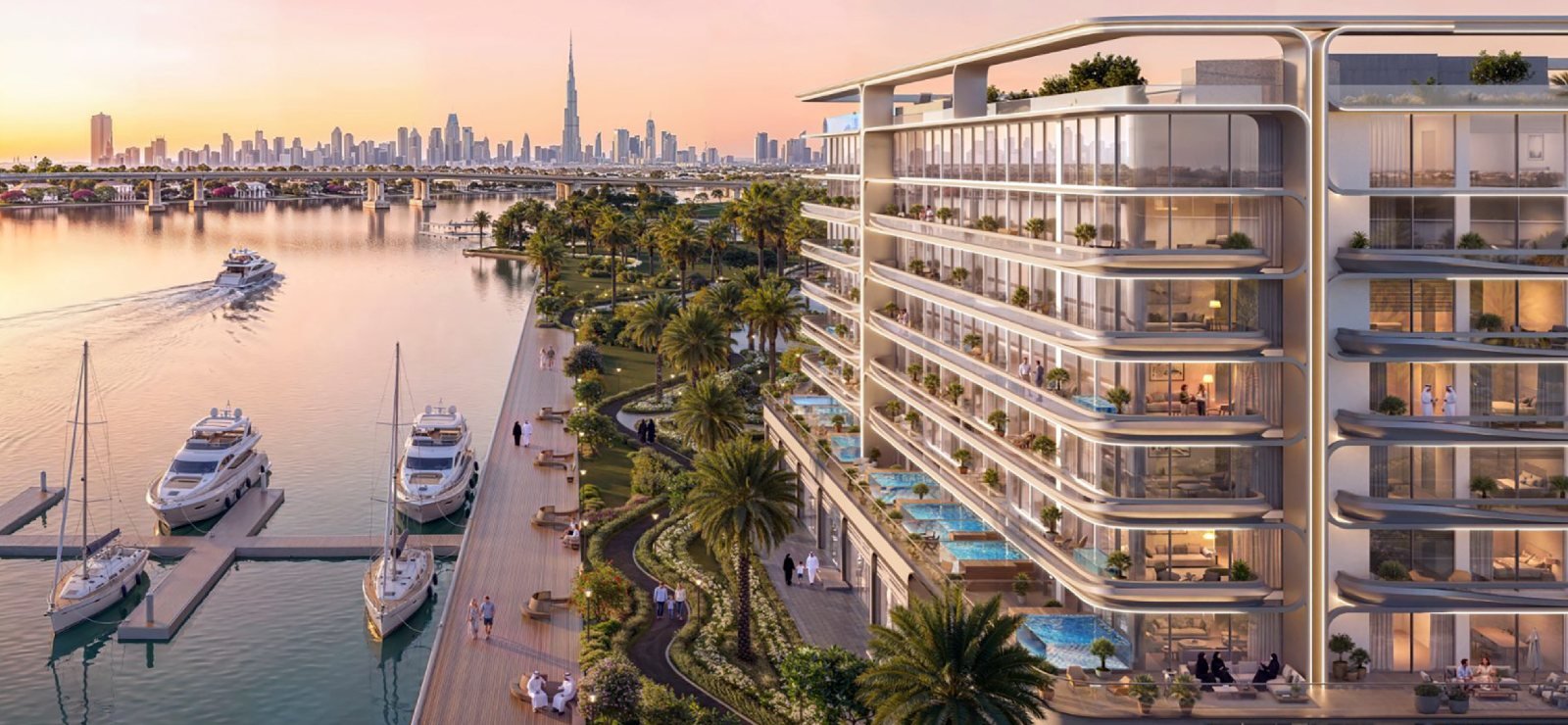
None of this would matter if the ground beneath it were not equally considered. Dubai Islands, the five-island archipelago off the Deira coastline, is one of the more ambitious pieces of urban engineering in the emirate’s current development cycle. The 18.6-square-kilometre masterplan is designed to accommodate more than 230,000 residents across approximately 62,000 homes, alongside more than 11,000 hotel keys, two 18-hole championship golf courses, eight marinas and some 57 kilometres of coastline, including 21 kilometres of beaches. Nakheel has already launched Bay Estate, a gated waterfront community within the archipelago, while the pipeline of branded residences and hospitality-led projects continues to lengthen. The irony, of course, is that Dubai has spent decades perfecting the art of manufacturing waterfront where nature provided desert, and Dubai Islands represents the most refined iteration of that impulse: an engineered coastal landscape built with the confidence of a place that has stopped apologising for its own artifice. Aquora sits on Island A, the mixed-use core where residential calm meets retail, leisure and waterfront commerce, and its ‘Form Follows Flow’ concept reads as a quiet rebuttal to the more bombastic towers that have defined the skyline. It is waterfront living as a form of curatorial restraint.
Casa Vista itself arrives with the kind of backstory that Dubai’s merchant families understand intimately. The founding family’s business history stretches back to 2012, spanning trading, commodities, logistics, construction and real estate, with strategic property investments beginning in 2015. This is not a developer born in a marketing deck. It is a family that learned the value of things by moving them, building them and holding them, and that lineage is legible in the language of ‘quality, trust and long-term commitment’ that Abdul Basit, the chairman, deploys with a sincerity that feels almost old-fashioned. ‘The response to Aquora is an important endorsement of the values we are building Casa Vista Development around,’ he said, and one suspects that, in a market crowded with promises, the phrase ‘long-term commitment’ is the one that will matter most. The company has confirmed that further residential projects are in preparation, and the Aquora unveiling was as much a statement of intent as a celebration of a single building.
The evening at Madinat Jumeirah, then, was a carefully composed piece of theatre with a genuinely interesting script. The water features outside were decorative; the water logic inside the building is structural, philosophical and commercial. More than 800 guests were treated to a presentation of a development whose first phase had already proven its market, while the subsequent release of Phase 2 was less a second act than a widening of the aperture. What lingers, beyond the canapés and the lighting, is the quiet proposition at the heart of Aquora: that luxury in the UAE is no longer a matter of marble quantity or lobby height, but of flow – of how light moves through a room, how a building meets its water, and how a brand calibrates itself to a generation that reads texture the way its parents read floor plans. Form follows flow. The money, it seems, has already followed.
ALSO READ: Bentley Torcal First Edition: The Future of Electric Luxury