
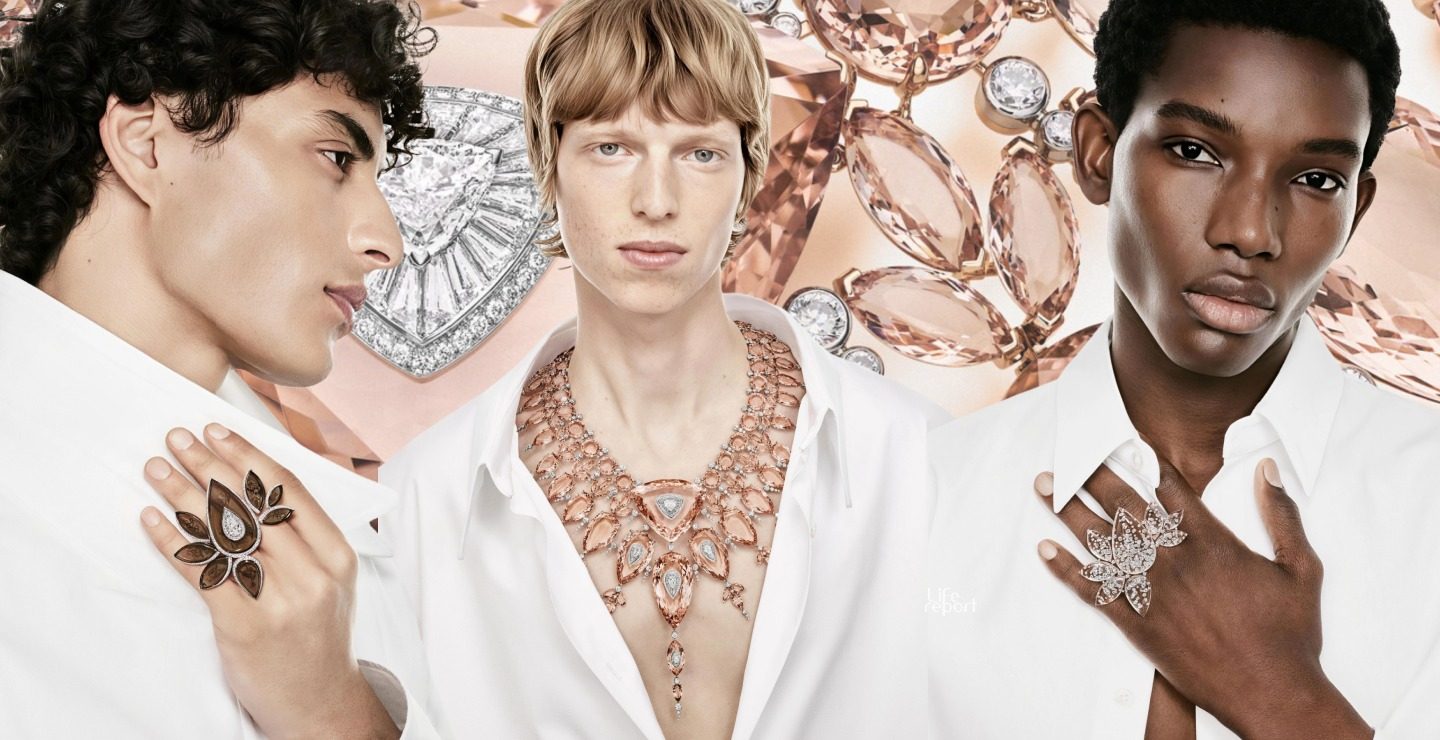
In a top-floor salon on the Place Vendôme, where the light falls with the soft precision of a Vermeer interior, a white-gloved hand lifts a necklace from a suede tray. The piece is a collar of blinding geometry – a perfect oval lattice that seems to float an inch above the collarbone, held together by invisible engineering. Next to it, on an identical bust, lies what appears to be the exact same necklace.
Yet, as you lean in, the first reveals a skin of frost: thousands of microscopic diamond granules scattered across rock crystal like a sudden winter in the desert. The second burns with a low, volcanic fire: black spinels and deep orange fire opals set into titanium that has been heat-treated to a shade of bruised twilight. This is the opening act of Boucheron’s Carte Blanche, Human Being, a collection that arrives not so much as a luxury launch but as a philosophical provocation dressed in precious stones.
At a cultural moment when we are earnestly debating whether a machine can write a screenplay, diagnose melancholy or generate an influencer with better cheekbones than any human ever born, Claire Choisne, Boucheron’s Creative Director, has chosen to reply in the language she knows best: high jewellery that champions the quivering, irreplaceable imperfection of the human hand. The statement is glamorous, deeply subversive and just a touch ironic. After all, what could be more anachronistic in the age of the digital avatar than dedicating 14,000 hours of artisan labour to five objects designed to adorn a physical body? But that, precisely, is the point. Human Being is not about seeming. It is about being.
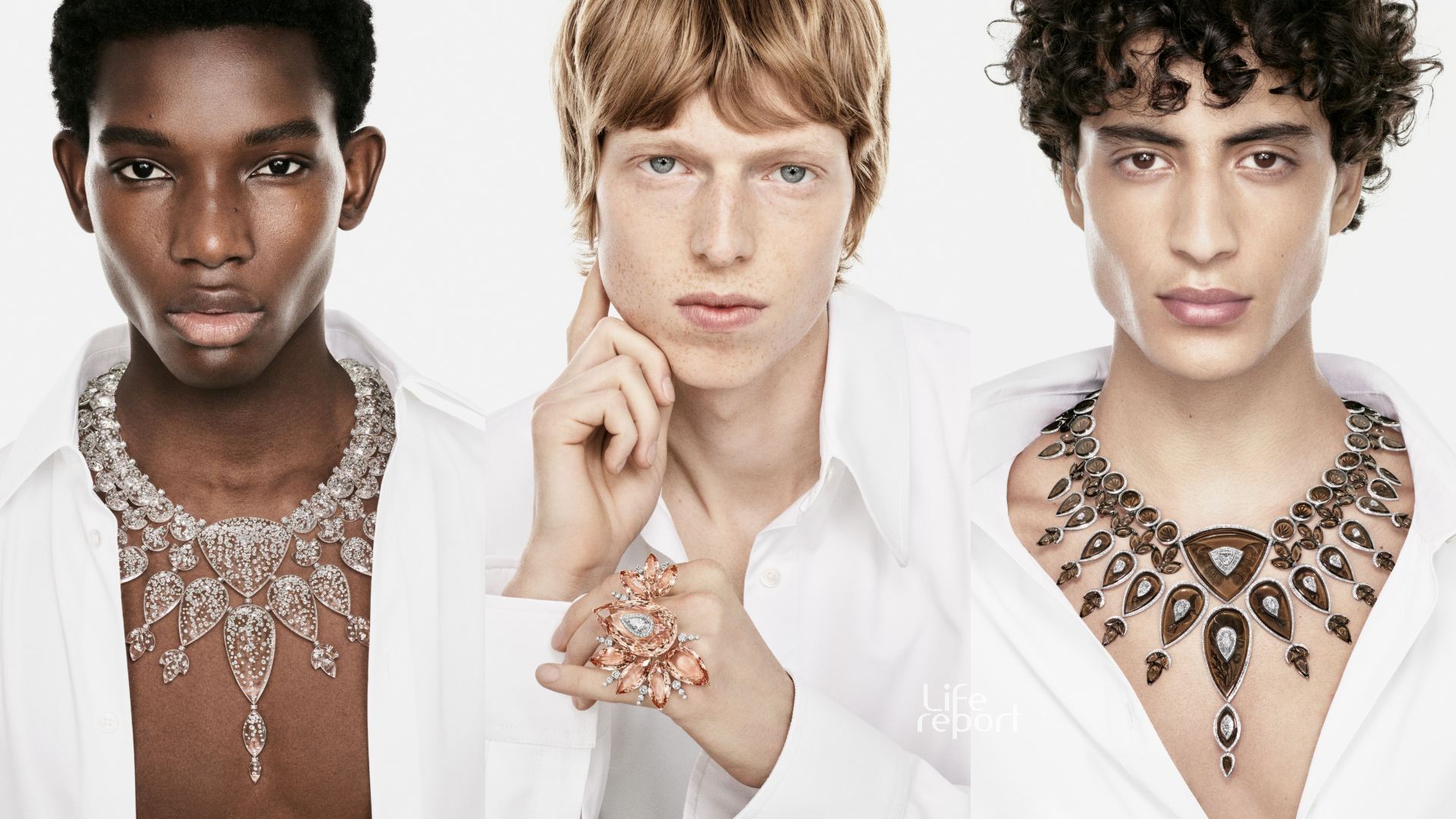
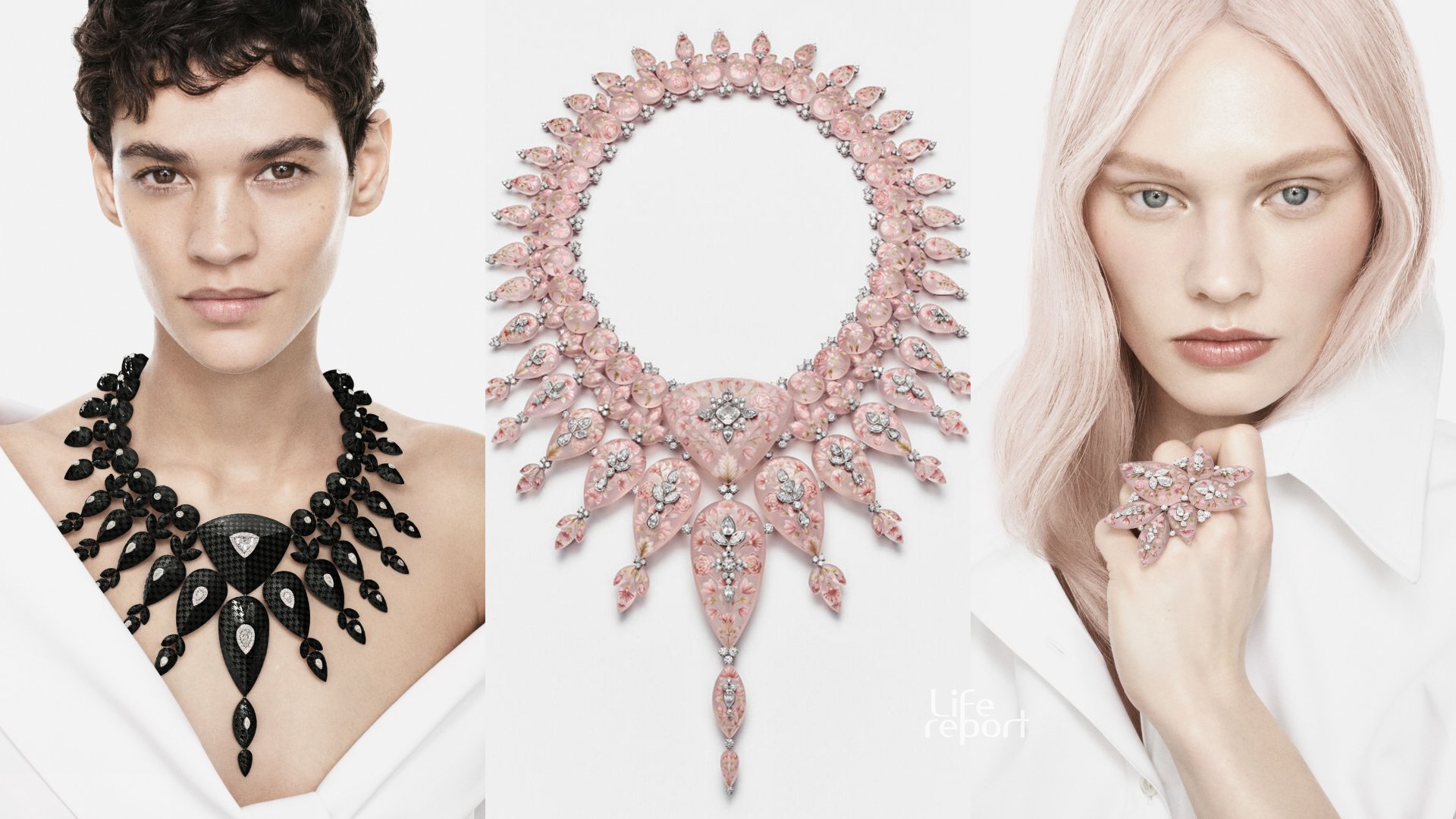
The collection’s conceptual scaffold is deceptively simple, with a subtle wink to structuralism. Five necklaces, each accompanied by a ring, share an identical archetypal form: a high-collar silhouette that nods to the majestic rigidity of ancient Egyptian pectorals and the futuristic austerity of a Zaha Hadid contour line. They are the same size, the same weight and the same skeletal arrangement of stones and metal. This common denominator, the Maison explains, represents the shared architecture of humanity – the bones beneath the skin. What makes each piece entirely distinct is the frenzy of divergence unfolding across the surface: the colours, the lapidary techniques and the quiet narratives embedded in every chased groove and hand-polished bezel. “The closer you look, the more you discover,” Boucheron’s accompanying notes read, “as in each of us, those details that define who we are.” It is, essentially, a meditation on sameness and individuality, rendered in carats.
Choisne, who has spent the past few years building a body of work that treats high jewellery as a form of ecological and existential reflection, arrives at Human Being after Or Bleu (2024), a meditation on water scarcity, and Impermanence (2025), an exploration of nature’s fragility. This time, her focus is the rise of artificial intelligence and the accompanying anxiety that human creativity might one day be outsourced to the cloud. She is not a Luddite, but she is a romantic pragmatist. The collection argues, with the quiet confidence of a house that has refined its craft on the same square of Parisian real estate since 1858, that no neural network will ever replicate the micro-decisions made by a master lapidary upon discovering a single rogue inclusion in a Paraíba tourmaline, or the instinctive pressure adjustment of a polisher’s fingertip across a cabochon of ammolite.
View this post on Instagram
Walk through the five sets and the metaphor unfolds with cinematic clarity. One necklace is an exercise in glacial restraint: a lattice of frosted rock crystal and diamonds that whispers of modernist architecture, as though Le Corbusier’s Ronchamp chapel had been sculpted in ice. Another combusts with colour – rubellites, pink gold and mandarin garnets arranged in a gradient reminiscent of the moment a Dubai sunset dissolves into the Arabian Gulf, a palette any connoisseur of magic hour at the Burj Al Arab will instantly recognise. A third explores darkness through obsidian and black lacquer, its surface so deep and mute that it appears to swallow the light around it – a subtle reminder that not all luxury needs to announce itself loudly. One imagines it worn with a white dinner jacket at a private supper in the AlUla desert, the only sound the whisper of sand against canvas. Each ring, a concentrated echo of its corresponding necklace, rests on the finger like a miniature manifesto.
The technical mastery on display is the sort that makes even the most seasoned observer of Place Vendôme pause mid-sentence. Boucheron has long been known for reviving forgotten techniques, and here its ateliers have employed en tremblant springs that allow central stones to quiver with the wearer’s pulse; gold pierced and carved to resemble the finest Calais lace; and titanium anodised in electric violets and moss greens that would not look out of place in a work by James Turrell. There are gemstones cut into half-moons so impossibly thin that they become translucent, holding light like water cupped in the palm of a hand. In an era when most luxury goods are designed to be consumed instantly – in a social media thumbnail or on a passing wrist – Human Being demands precisely the opposite. It asks for time. It asks, almost defiantly, for stillness.
It is here that the collection’s gentle critique of contemporary life truly comes into focus. We inhabit a culture that has confused authenticity with a perfectly lit, meticulously captioned version of itself. We purchase “slow living” accessories through dropshipping platforms and attend digital detox retreats whose itineraries arrive via push notification. Boucheron’s answer is to create objects that resist reduction to a screen. They cannot be fully appreciated in a static image; they require movement, shifting light and the living gaze of the observer. Anyone who has watched a collector lift a piece of high jewellery towards daylight, turning it over and over with the quiet absorption usually reserved for a Rothko canvas, will understand the point. These necklaces challenge the scroll-past economy simply by existing within it, refusing to resolve into a perfect JPEG.
There is also a subtle acknowledgement of the shifting centre of gravity in global luxury. Although the collection debuted in Paris, its themes – the tension between heritage and hyper-modernity, the pursuit of meaning over logos and the celebration of individuality over mass production – resonate particularly strongly in the UAE. Dubai, after all, is a city built upon the dialogue between immediacy and endurance: a place where a skyscraper can rise within a few years while the carpet of the Sheikh Zayed Grand Mosque required years of painstaking hand-knotting. The young Emirati and expatriate collectors who move between exhibitions at the Louvre Abu Dhabi and private viewings at Alserkal Avenue are fluent in this dialogue. They are as comfortable discussing the biomorphic forms of Neri Oxman as the mechanics of a Vacheron Constantin tourbillon. For them, a piece of jewellery requiring more than a year to create – one necklace alone can demand well over 2,000 hours of craftsmanship – is not merely an indulgence. It is a statement of values.
The total figure of 14,000 hours lingers over the collection like an invisible signature. It represents a temporal commitment that feels almost radical in a world where artificial intelligence can generate an entire fashion campaign in less time than it takes to drink an oat-milk latte. Yet that vast, irretrievable investment of time is perhaps the collection’s most precious material. It speaks of almost monastic devotion to craftsmanship: the polisher who spends weeks refining the reverse of a single component that no wearer will ever see; the gem-setter who calibrates a honeycomb of stones to within a fraction of a millimetre, guided by instinct and muscle memory that no algorithm can replicate. Claire Choisne’s wager is that this human investment will be felt rather than merely understood – that its presence will register on the skin of the wearer as a subtle warmth absent from even the most flawlessly manufactured object.
To wear a piece from Human Being is to carry a small yet elegant act of defiance around the neck. It is a refusal to surrender to the cult of speed, a quiet insistence that some things – a watercolour wash of sapphires, a hinge that closes with the reassuring precision of a Bentley door, a clasp shaped like an invisible heartbeat – remain worth creating slowly, patiently and by hand, with no justification beyond that enduring impulse we call beauty. In a city of towers that seem to rise almost overnight, that may be the most radical luxury of all.
ALSO READ: Feathered Polar Bears & Beaded Ice Cream: This DIFC Gallery Is the UAE’s Most Surreal Summer Refuge


