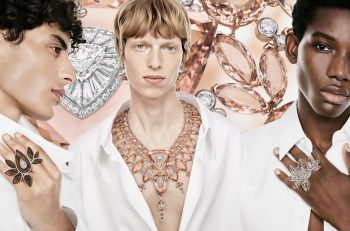
Let me paint you a picture of my morning. I’m halfway through my flat white, doomscrolling through the usual cacophony of Doha flights and dinner plans, when my editor sends me a brief on the new Boucheron collection – ‘Nom: Boucheron Prénom: Frédéric’. Normally, my millennial brain would glaze over at the words “high jewellery”. I’d conjure images of stuffy gala matrons and tiara emergencies – things that feel about as relevant to my life in Dubai as a snowblower.
But then I saw the name of the collection: Frédéric. Not Boucheron, the brand. Frédéric, the man. And suddenly we’re not talking about rocks; we’re talking about a 19th-century disruptor who was basically the Steve Jobs of the jewellery world – if Steve Jobs had a thing for ivy and really hated corsets. Claire Choisne, the creative director and resident genius at the helm, has cracked the code. For the 2026 Histoire de Style collection, she has moved away from conventional archival deep dives and instead painted what the maison calls a “sensitive portrait” of its founder. And honestly? Frédéric Boucheron sounds like the kind of person you’d want to split a bottle of natural wine with at Soho Garden.

The Real Estate Glow-Up
Let’s start with the fact that this man had vision. We’re talking about late-19th-century Paris. Place Vendôme was essentially a refined but quiet square. Elegant, certainly, but not yet the epicentre of jewellery culture. The leading jewellers were established on Rue de la Paix – the original luxury high street. But Frédéric was observing. He noticed that the city’s most fashionable women passed through the square daily on their way to the Tuileries Gardens. While everyone else saw a tranquil plaza, he saw a runway. He also recognised something deeply practical: the light at No. 26 illuminated the corner building throughout the day, allowing diamonds to sparkle at their best.
So, in 1893, he made a bold move and opened his boutique at 26 Place Vendôme – becoming the first jeweller to do so. Within years, other maisons followed. In many ways, he created what would become the world’s most famous jewellery address. Choisne references this moment with a necklace that reinterprets the geometry of the square itself. Sharp lines of white gold and diamonds contrast with deep black lacquer, forming the iconic octagonal shape of Place Vendôme. At its centre sits a 10.01-carat emerald-cut diamond – a striking focal point that anchors the composition with architectural precision.
View this post on Instagram
The ‘Question Mark’ Era
Here is where Frédéric becomes truly radical. Observing women constrained by corsets, heavy fabrics and rigid jewellery that limited movement, he questioned the conventions of his time. While many contemporaries designed jewellery as symbols of status and rigidity, Frédéric approached design with empathy. In 1879, he asked a revolutionary question: what if jewellery served the woman, rather than the other way around?
The result was the iconic Question Mark necklace – the world’s first claspless necklace. It could be slipped effortlessly over the head, requiring no fastening assistance. A concealed spring mechanism allowed the piece to flex and move naturally with the body. Asymmetrical, fluid and modern, it represented a profound shift in jewellery design. Choisne’s tribute within the new collection takes the form of a cascading composition of eight diamond cuts – marquise, Asscher, oval, hexagonal, pear, emerald, round and a final 5.01-carat kite-shaped diamond – flowing down the neckline like liquid light. The effect feels contemporary and effortless: high jewellery designed not to overpower, but to accompany.
The ‘Quiet Luxury’ Gene
Frédéric was the son of a draper and grew up surrounded by silk and lace. He understood movement, softness and drape. While others thought in terms of metal and stone, he thought in terms of fabric, conceiving jewellery as an extension of couture. This philosophy feels especially relevant today. Modern collectors increasingly seek versatility – pieces that adapt rather than remain locked away. Jewellery that transforms, converts and evolves alongside daily life.

Choisne translates this idea into a sculptural white-gold and diamond creation that moulds to the collarbone and can be worn in six different ways. The piece folds, separates and recomposes itself, integrating more than seven metres of diamond chains into a single design. It is technical virtuosity combined with wearability – luxury conceived as flexibility rather than formality.
Team Ivy
Finally, we arrive at the emotional core of Frédéric Boucheron’s vision: his fascination with the untamed natural world. At a time when jewellers favoured idealised flowers such as roses and lilies, Frédéric turned his attention to ivy – a plant often dismissed as invasive or undesirable. He saw instead its resilience: it climbs, twists and survives. Imperfect, persistent and alive.
Choisne has revived his original 1879 ivy motif – a design so technically complex that it had never been fully realised until now. The resulting piece features pavé-set stems and leaves, rock-crystal fruits and articulated elements that tremble subtly with movement, creating the illusion of a living plant. The creation required 2,600 hours of craftsmanship. And standing before it, one realises that the power of the piece lies not in the diamonds themselves, but in the emotion it conveys – the celebration of authenticity over perfection, nature over ornament.
Frédéric Boucheron was not merely a jeweller. He was an innovator, an observer of society and a designer who understood that true luxury is not defined by weight or status, but by freedom. And perhaps that is why his vision still resonates today. In a world where we are all striving to move more freely and live more authentically, wearing a piece inspired by ivy feels less like adornment and more like a statement of intent.