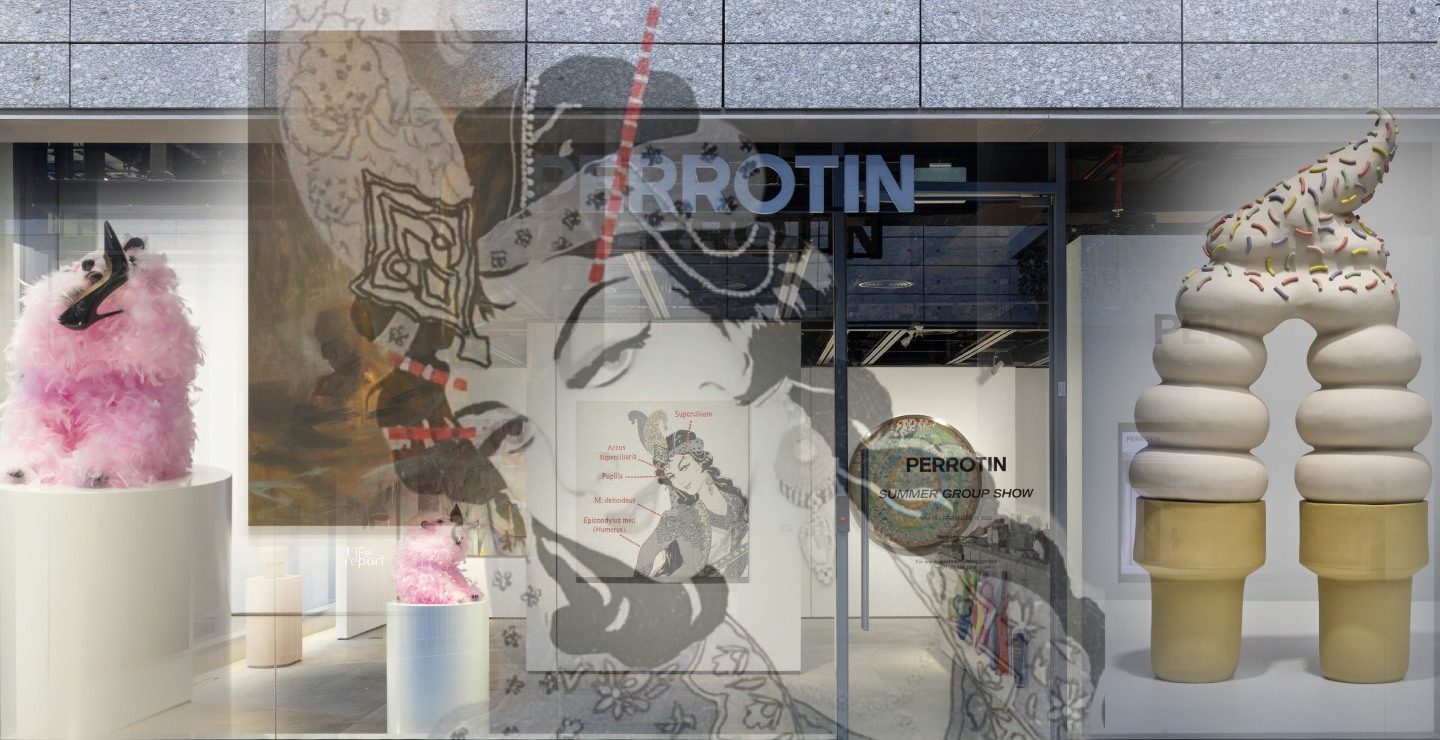
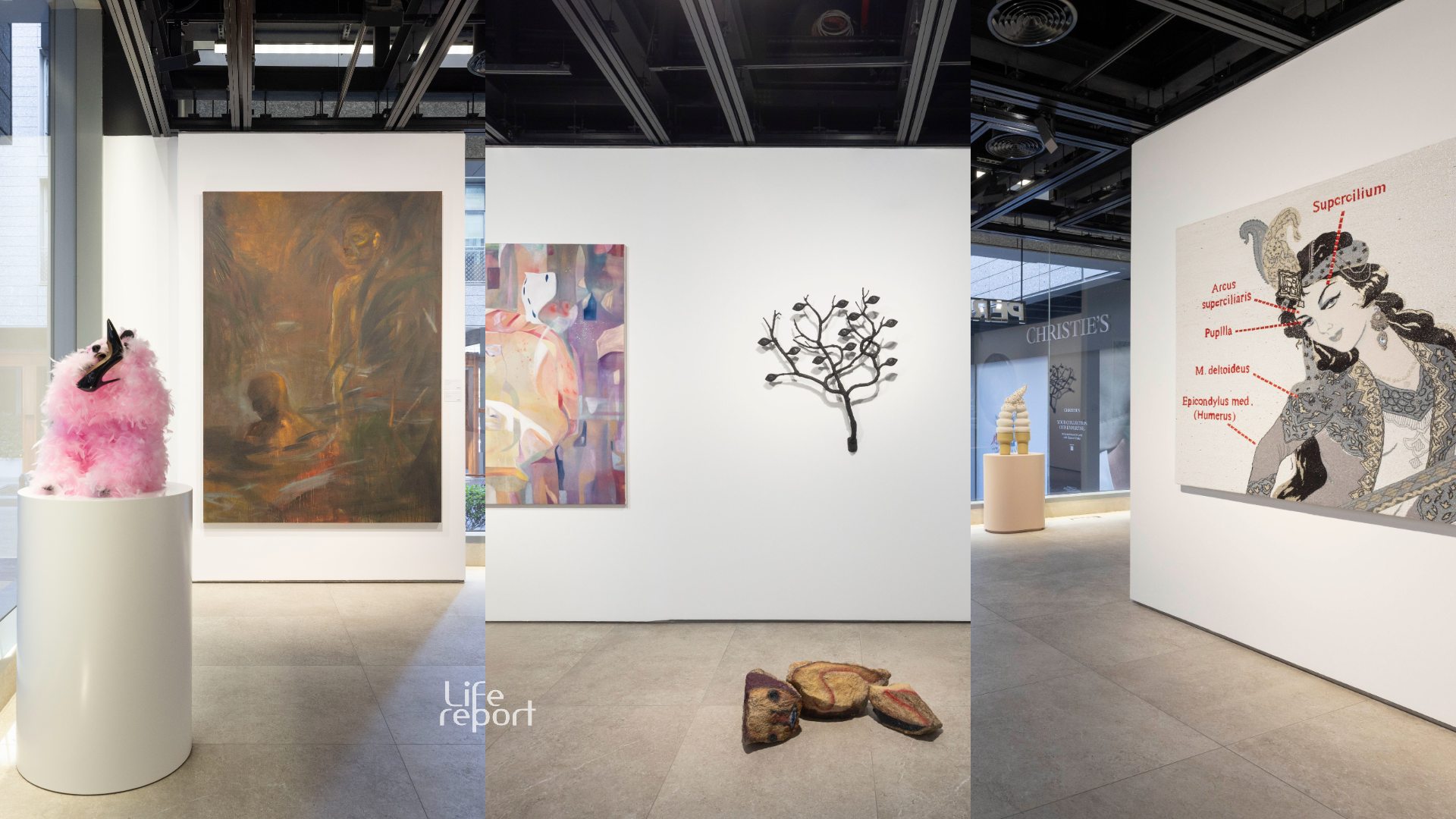
There is a polar bear executing a near-perfect downward dog in the middle of the gallery. Its fur, upon closer inspection, is a meticulous plumage of screaming pink and tangerine feathers – the kind of creature a couturier might conjure after a sleepless night spent binge-watching David Attenborough. It is, in other words, a Paola Pivi, and it refuses to be ignored. One watches visitors instinctively reach for their phones, as though the bear might vanish into the digital ether if not captured immediately. Pivi, one suspects, has long since made peace with this ritual; her work is as much about the act of spectacle as the object itself. The true subversion lies in the fact that, once the Instagram Story fades, the bear remains – silent, feathered and utterly indifferent to its own virality.
This is the opening gambit of Perrotin Dubai’s summer group exhibition, an annual exercise in cool-headed curation that, this year, runs until 11 September in the polished confines of Gate Village, Building 5. In a city where the concept of “summer” is met with a mass exodus to cooler climes, those who remain – out of obligation, existential inertia or a perverse affection for sauna-like conditions – must become connoisseurs of the indoors. Perrotin’s exhibition provides an impeccable justification for staying put. The gallery’s immaculate white cube, scented with a bespoke blend that whispers of bergamot and old paper, feels less like a commercial space and more like a decompression chamber for the culturally parched.
Emmanuel Perrotin, the French gallerist whose eye for the zeitgeist has launched careers from Takashi Murakami to JR, seems to delight in programming his Dubai outpost with a knowing wink at the region’s contradictions. Here, thirteen artists from disparate corners of the globe converse in a language of surreal juxtaposition, mythological gravity and unabashed material seduction. There is no stated theme, yet a distinct mood emerges: an ironic, dreamlike disquiet laced with the kind of luxury that does not shout but instead murmurs in a Savile Row accent.
Monira Al Qadiri’s sculptures shimmer like petrified oil slicks, their iridescent surfaces seductive enough to make one forget they are critiques of the petro-culture that shapes the very ground beneath this city. Glistening and vaguely dangerous, they read as relics from a future in which fossil fuels have become fetish objects, collected by civilisations long since submerged. Nearby, Jean-Marie Appriou’s bronze astronaut astride a prehistoric creature might have wandered out of a fever dream co-written by Jules Verne and H.R. Giger. The craftsmanship is obsessive – patinas recalling the brushed titanium of a Greubel Forsey timepiece – yet the ensemble maintains an unsettling intimacy, as though the figures are merely pausing before galloping into another dimension.
Genesis Belanger’s porcelain mise-en-scènes deliver a different kind of uncanny. A pitcher dissolving into a glazed puddle, titled In the right conditions we are indistinguishable, literalises a state change while taking aim at the liquid logic of desire. Her sculpted handbags spill not cosmetics but painted tears; a stoneware aspirin looms as large as a pouf. These are objects standing in for human emotion in a world where advertising has already colonised the unconscious. It is the kind of critique that lands with the dry fizz of a perfectly shaken martini.
View this post on Instagram
A bronze branch studded with unblinking eyes – Laurent Grasso’s meditation on totemism, informed by research into Saint Lucy and the animist philosophies of Philippe Descola – anchors one wall with the solemnity of a relic unearthed by a future civilisation. The eyes seem to track your movements, and it becomes unclear who is observing whom. Grasso, ever the conjurer of invisible forces, transforms the gallery into a charged field where electromagnetic phenomena and collective fears suddenly feel comfortably close.
Jean-Philippe Delhomme contributes a suite of paintings that skewer the art world’s self-seriousness with the elegance of a New Yorker cartoon. A gallery-goer stares blankly at an abstraction, a speech bubble floating above her head containing something achingly banal. The wryness is so precise that it stings, yet the brushwork is pure pleasure – loose, assured and impeccably dressed.
In a quieter register, Thilo Heinzmann’s abstract panels, in which raw pigment clings to textured surfaces like crushed velvet, provide a formalist interlude. Mathilde Denize weaves fragments of her earlier paintings into new sculptural garments that function simultaneously as armour and déshabillé, channelling the energy of Carolee Schneemann through the lens of a Parisian atelier. Izumi Kato’s primordial creatures – oval heads, fathomless eyes, limbs belonging to neither infant nor elder – hum with an animist frequency that predates language. They seem to have arrived not from a studio but from a cave where the first myths were born.
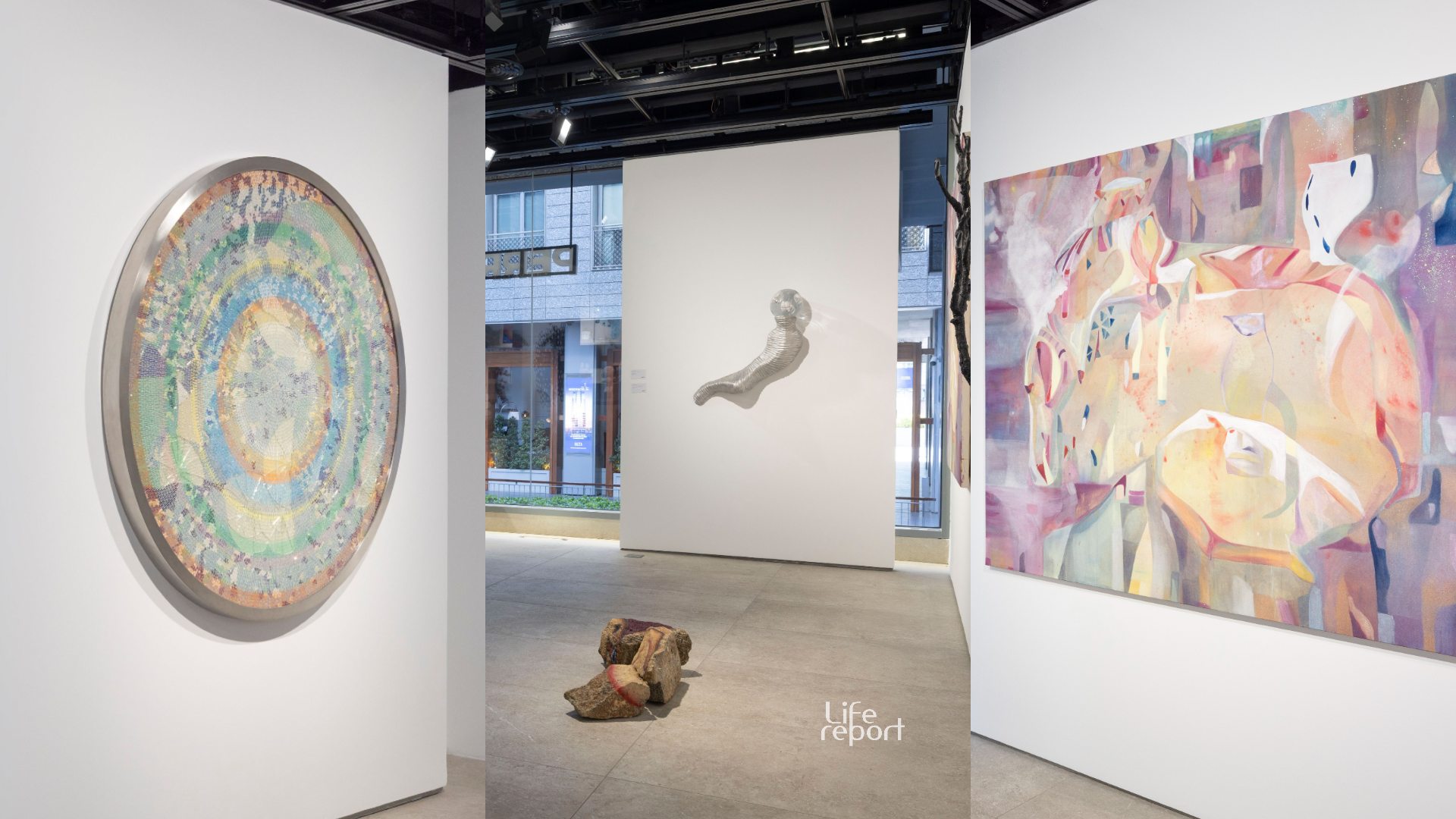
Bharti Kher’s hybrid goddess, her skin a constellation of bindis, presides over the main room with the serene authority of a sci-fi deity. For more than two decades, Kher has used the bindi as both material and metaphor, creating chimeras that dissolve the boundaries between the human, the animal and the divine. Here, her creature feels perfectly at ease among Appriou’s mythological beasts and Kato’s silent spirits – a menagerie of modern totems that might, in another life, decorate the lobby of an Aman resort designed by a mad genius.
Farhad Moshiri’s monumental canvas, embroidered entirely with sequins, beads and glitter, depicts a melting soft-serve ice cream with the intricacy of a Safavid miniature. The collision of pop banality and Persian craftsmanship is so outrageous that it circles back to the sublime. It is simultaneously a love letter to the artisanal traditions of his native Iran and a gentle mockery of a globalised visual culture capable of turning an ice cream cone into an icon. Next to it, Sigrid Sandström’s vast abstract landscapes dissolve the boundary between mountain and mirage, their poured paint and circular discs shifting like heat haze over asphalt. Hugo Toro, the architect-turned-painter, bridges his French and Mexican heritage in diptychs where alebrijes and Louis XVI fauteuils coexist beneath a terracotta sun – a bicultural imaginary as fluid as the boundaries he himself transgresses.
For the UAE’s growing tribe of Gen Z tastemakers and millennial collectors, a visit to this exhibition functions as a quiet declaration of cultural fluency. This is not the art of the algorithm, engineered for a two-second scroll; it demands a slower metabolism. In a district where one is as likely to discuss a Vacheron Constantin Métiers d’Art collaboration over miso black cod at Zuma as to close a private equity deal, Perrotin’s summer programme slots effortlessly into a lifestyle that values the tactile, the rare and the effortlessly arcane. Afterwards, one might descend to L’ETO for a pistachio latte, the conversation turning to whether Moshiri’s beaded canvases or Pivi’s feathered ursine offers the shrewder entry point for a young collection.
The exhibition is, in essence, an oasis of cultivated strangeness – a place where air conditioning becomes a medium and the surreal feels more substantial than the shimmering skyline outside. Stepping back into the wall of heat, the afterimage of a polar bear feathered in fuchsia lingers, a tiny personal mirage far more compelling than the melting tarmac. This summer, that qualifies as essential medicine.
Also Read: This Prada Sneaker Folds in Half – and It Might Be the Smartest Luxury Purchase of the Summer