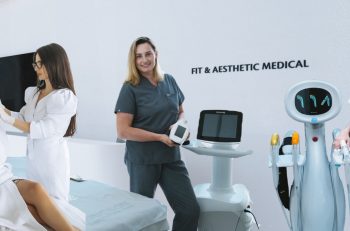
How to maintain radiant skin under the Dubai sun: an interview with Dr Tatiana Simonyan on beauty, strategy and lifestyle in a luxury metropolis.
The light in the Seline Clinic flows softly and diffusely, like a carefully calibrated filter on the set of an arthouse film. Here, amidst living plants and travertine, in an atmosphere that feels more like a private gallery than a medical centre, we meet Dr Tatiana Simonyan – a dermatologist and aesthetic architect of the skin. The question at the heart of our conversation is both simple and fundamental: how can one preserve the delicate, northern nature of the skin in Dubai’s extreme climate?

Northern Porcelain Under the Arabian Sun
“Imagine fifteenth-century silk – incredibly beautiful, but requiring museum conditions: specific humidity and protection from harsh light,” Dr Tatiana begins. Her speech is as precise as a rapier and as vivid as a well-constructed narrative. A light phototype, characteristic of so-called Slavic skin, is not a fashionable label but a biological reality: a thinner dermis, lower collagen reserves and an increased tendency towards dehydration. Without a carefully considered strategy, such skin quickly loses its natural radiance under intense sun exposure and the constant assault of air conditioning. With clinical clarity – and the subtle irony of an intellectual – the doctor systematically outlines the challenges her patients face in Dubai.
Five Daily Challenges of the Scorching Metropolis
Dehydration. This is not merely dryness but chronic stress for the skin barrier. Even oily skin can suffer from moisture deficiency, while heavy creams may clog pores, creating a vicious cycle of irritation.
Pigmentation. Dubai’s high UV index turns light skin into a map marked by uneven “topography”, where every sunbeam leaves its trace – whether a dark spot or post-inflammatory pigmentation.
View this post on Instagram
Loss of Density and Firmness. Aggressive sun exposure and temperature fluctuations accelerate collagen breakdown, causing the face to lose its clear, architectural contours prematurely.
A Compromised Skin Barrier. “It is like breaking the lock on a safe,” explains Dr Tatiana. External aggressors gain direct access, and the skin becomes hypersensitive to everything – from air conditioning to a favourite perfume.
The Philosophy of Skincare: Strategy Over Instant Results
The beauty industry often gravitates towards “cannons and fireworks” – the latest devices and trending procedures. Dr Tatiana, however, advocates a systemic approach, like a strategist planning a long-term campaign.
“We do not need scattered strikes from fashionable devices: lasers today, acid peels tomorrow and hyaluronic acid injections the day after. Slavic skin in Dubai requires strategy, not chaos,” she emphasises.
Key Elements of This Strategy
Deep Hydration – maintaining the skin’s water balance through work with both the dermal matrix and the skin barrier. Hyaluronic acid supports hydration and tissue elasticity, while ceramides reduce transepidermal water loss in conditions of heat and constant air conditioning.
View this post on Instagram
Tissue Reinforcement, Not Volume Addition – a fundamental principle when treating lighter skin types. Priority is given to methods that stimulate the skin’s own collagen production and improve dermal quality, such as biorevitalisation, platelet-rich plasma (PRP) therapy and microneedling radiofrequency (RF) lifting.
Pigment Control – an ongoing strategy rather than a seasonal measure. SPF 50+ protection is essential year-round, while careful management of melanogenesis involves gentle brightening agents and next-generation retinoids that do not compromise the skin barrier.
Supporting the Skin Barrier – a key factor in maintaining resilience in Dubai’s climate. Lipid-replenishing and protective ingredients help the skin adapt to UV radiation, heat stress and sudden temperature shifts.
Aesthetic Technology and Future Trends
By 2026, aesthetic medicine is becoming not only more scientific but also more sensory. In Dr Tatiana’s practice, procedures evolve into a synergy of science, physical sensation and overall wellbeing. Microneedling RF systems and gentle biorevitalisation aim not only to produce visible results but also to strengthen a person’s connection with their own body.
View this post on Instagram
She highlights several trends already integrated into her work: cellular regeneration technologies, including exosomes, which support dermal renewal and accelerate post-procedure recovery; protective molecules such as ectoin, which form a shield against heat stress; and techniques operating at the intersection of medicine and psycho-emotional balance – for example, a “singing bowl facial”, where vibration helps release muscular tension and improve skin tone.
The Cultural Code of Beauty: From Skincare to the Art of Living
For educated millennials, beauty is not an isolated event but a coherent narrative. They choose complex fragrances inspired by unconventional destinations, such as Guerlain’s Tabac Sahara, evoking imagery of pink dunes beneath a star-filled sky, and integrate self-care into thoughtfully designed rituals reminiscent of visits to contemporary art spaces, such as the Reform Athletica studio. They favour professional cosmeceutical brands, approaching them much like collectors of Swiss watches – not for ostentation, but out of respect for craftsmanship, quality and time.

“Beautiful skin in Dubai is neither a given nor a matter of luck,” Dr Tatiana concludes. “It is the result of a well-considered strategy, a partnership with a knowledgeable specialist and consistency. Your skin is the most honest diary of your life in this city. Let its pages tell a story of care, clarity and elegant adaptation.”