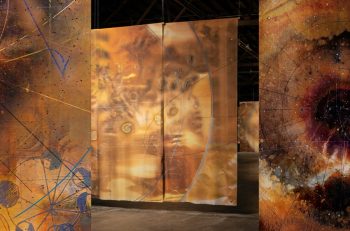
The Ishara Art Foundation, a subtle powerhouse of South Asian contemporary art, is preparing to open a portal to an “Urdu World”. This is not merely an exhibition; it is a deliberate and elegant argument for the power of a single, richly textured language to construct identity, memory, and home. Urdu Worlds runs from 16 January to 31 May 2026 at the Ishara Art Foundation, Alserkal Avenue, Dubai. The foundation is open Monday to Saturday, from 10 am to 7 pm.
In an age where our most profound exchanges are flattened into emojis and declarations of love are abbreviated to “ILY”, have we forgotten how language can shape an entire universe? As our digital tongues grow ever more simplistic, a quiet and profound revolution is unfolding within the minimalist galleries of Dubai’s Alserkal Avenue. It is a celebration not of speed, but of depth; not of globalised slang, but of a specific, poetic soul. Opening in January 2026, Urdu Worlds is a curated dialogue between two artistic titans: the late Zarina and the formidable Ali Kazim. Guided by curator Hammad Nasar, the exhibition makes a bold claim as the UAE’s first major contemporary show dedicated solely to the Urdu language. For the cosmopolitan millennial navigating Dubai’s fusion of futures, this is a poignant invitation to slow down. It asks a deceptively simple question: in a city of transitory lives, what does it mean to carry a world within a word?

Zarina, Tasbih (2011) and Urdu Proverbs (1991)
The Architect of Memory: Zarina’s Cartography of Loss and Longing
Zarina, who passed away in 2020, transformed a life of displacement into a sublime geometry of belonging. Trained initially in mathematics, her art is a testament to structural purity and emotional resonance. She did not merely draw lines; she carved them, gouging surfaces in wood to create prints that feel less like images and more like psychic scars or intimate maps. For her, Urdu was not simply a mother tongue; it was the very mortar with which a sense of home could be built across continents.
The exhibition features her seminal series Home Is a Foreign Place – a collection of 36 woodblock prints in which each piece is a visual translation of a single Urdu word: aasman (sky), barish (rain), khushboo (fragrance). To experience them is to witness a mind assembling a homeland from linguistic fragments. As Sabih Ahmed, Director of Ishara, has articulated in previous programmes, the foundation is deeply committed to voices that explore “mobility, control and acts of resilience”. Zarina’s work epitomises this ethos: a resilient act of world-building. Her Urdu Proverbs series confronts the untranslatable, presenting cultural wisdom that resists easy export. To stand before these works is to understand that some worlds are accessible only through a specific linguistic key – a concept both beautiful and faintly tragic in our globalised era.
View this post on Instagram
The Archaeologist of Presence: Ali Kazim’s Layered Landscapes
If Zarina’s world is one of distilled essence and absence, Ali Kazim’s is one of layered, teeming presence. Based in Lahore and receiving his first comprehensive showcase in the GCC with this exhibition, Kazim is a multimedia chronicler of place. His “Urdu world” is grounded in the soil, water, and archaeology of South Asia. His breathtaking large-scale work Teela is a prime example. Rendered in watercolour pigment on paper across four expansive panels, it depicts undulating mounds of earth strewn with pottery sherds – the remnants of past lives. It is a silent yet powerful reminder that we are perpetual cohabitants with history; the land itself is a palimpsest written in the script of broken artefacts.
His new Alphabets series, debuting at Ishara, functions as a visual dictionary of urban and pastoral landscapes. Developed for an upcoming artist’s book, these etchings depict not letters but forms – a lexicon in which a tree, a well, or a crumbling wall becomes a fundamental unit of meaning. Kazim’s work does not illustrate Urdu; it embodies its composite, layered history, reflecting the language’s evolution through the interweaving of Persian, Arabic, and local dialects.

Ali Kazim_Photography by Khalil Shah
A Sanctuary for the Literary Soul: The Ishara Experience
True to its name – Ishara meaning a gesture or hint in several languages – the foundation cultivates an atmosphere of reflective discovery. The exhibition design promises a cinematic flow: Zarina’s precise, poignant prints will form a central island of contemplation, surrounded by the expansive, evocative sea of Kazim’s paintings, sculptures, and videos. This physical dialogue mirrors the conceptual one – a choreography between the intimate and the epic, the exiled and the rooted.
Ascending to the mezzanine, visitors will encounter a specially curated reading room – a quiet rebellion against the rapid scroll. Here, one can explore volumes of Urdu poetry, the forthcoming Ali Kazim: Alphabet Book, and perhaps lose oneself in the 12th-century Sufi epic The Conference of the Birds by Farid-ud-Din Attar. It is a space that acknowledges that to grasp an “Urdu world”, one must be willing to sit with its literary heartbeat.

Ali Kazim, Untitled (Mara’s Army II, 2022) and Untitled (The Bird Hunter series, II, 2020)
Why This Matters in Dubai, Now
For Dubai’s discerning millennials and Gen Z – a demographic fluent in the languages of luxury fashion, speciality coffee, and digital nomadism – Urdu Worlds offers a different kind of currency: cultural depth. In a city synonymous with towering ambition and futuristic spectacle, this exhibition acts as a grounding force. It speaks to anyone who has ever felt the gentle ache of diaspora, the complexity of a multilingual identity, or the desire for meaning beyond the superficial.
The exhibition is supported by leading institutions from the region’s luxury and financial landscape, including J. Safra Sarasin and Emirates Insurance, underscoring its significance. Its staging also coincides with Ishara’s own ambitious expansion, marked by the recent launch of Ishara House in Kochi, India – an initiative supported by Alserkal Avenue. This development signals a vibrant cross-cultural dialogue that Dubai is uniquely positioned to facilitate, reinforcing its role not only as a hub of commerce, but as a centre of consequential artistic exchange.
Urdu Worlds is more than an art exhibition. It is a timely meditation for a generation navigating hybrid identities. It proposes that in the quiet space between a word and its meaning, between a memory and its expression, we construct the worlds we truly inhabit. In the elegant, understated galleries of Ishara, visitors are invited to step into one of those worlds – just remember to leave your emojis at the door.