Under the marina’s hammered-platinum glare – that precise late-April light just before summer clamps down on the city like a magnifying glass – I rolled the new Vacheron Constantin Overseas Dual Time Cardinal Points over my wrist and watched its smoke-grey bezel swallow the dazzle rather than compete with it. A call to prayer drifted from the nearby mosque, mingling with the whir of a Vitamix inside the café, and I thought: here is a watch that has stopped trying so hard and, in doing so, has become precisely the object of desire that Dubai’s culture-hungry, perpetually airborne generation has been waiting for.
Unveiled at Watches and Wonders 2026, the Overseas Dual Time Cardinal Points arrives as a quartet of titanium references, each dial colour ostensibly evoking a compass direction. It is, unmistakably, the grown-up sequel to the grail-status Everest prototype that photographer and climber Cory Richards strapped to his wrist during his 2019 summit of the world’s highest peak. But where that watch was a limited-edition fever dream – 150 pieces, gone before most of us had refreshed our browsers – this is a full-production love letter, complete with a tool-free interchangeable titanium bracelet, two rubber straps, and a self-awareness that the true summit for most of us is not the death zone, but a seamless transit from a DIFC boardroom to a beach club in Mykonos.

Vacheron Constantin’s suggestion that the white dial stands for the frozen North, the brown for the fertile South, the green for the West’s forests, and the blue for the East’s horizon may feel as geographically fanciful as a vintage map of Arabia. I smirked slightly when I read the press release: the “fertile lands of the South” rendered in brown sound less like a compass rose and more like a single-origin chocolate tasting note. Yet there is an earnest charm to the conceit, the kind of romantic whimsy that allows a Dubai-based collector – someone who likely measures life in time zones rather than hours – to feel that their wrist is permanently oriented towards adventure. And frankly, in a region that transformed desert into vertiginous urbanity, we appreciate a good narrative.
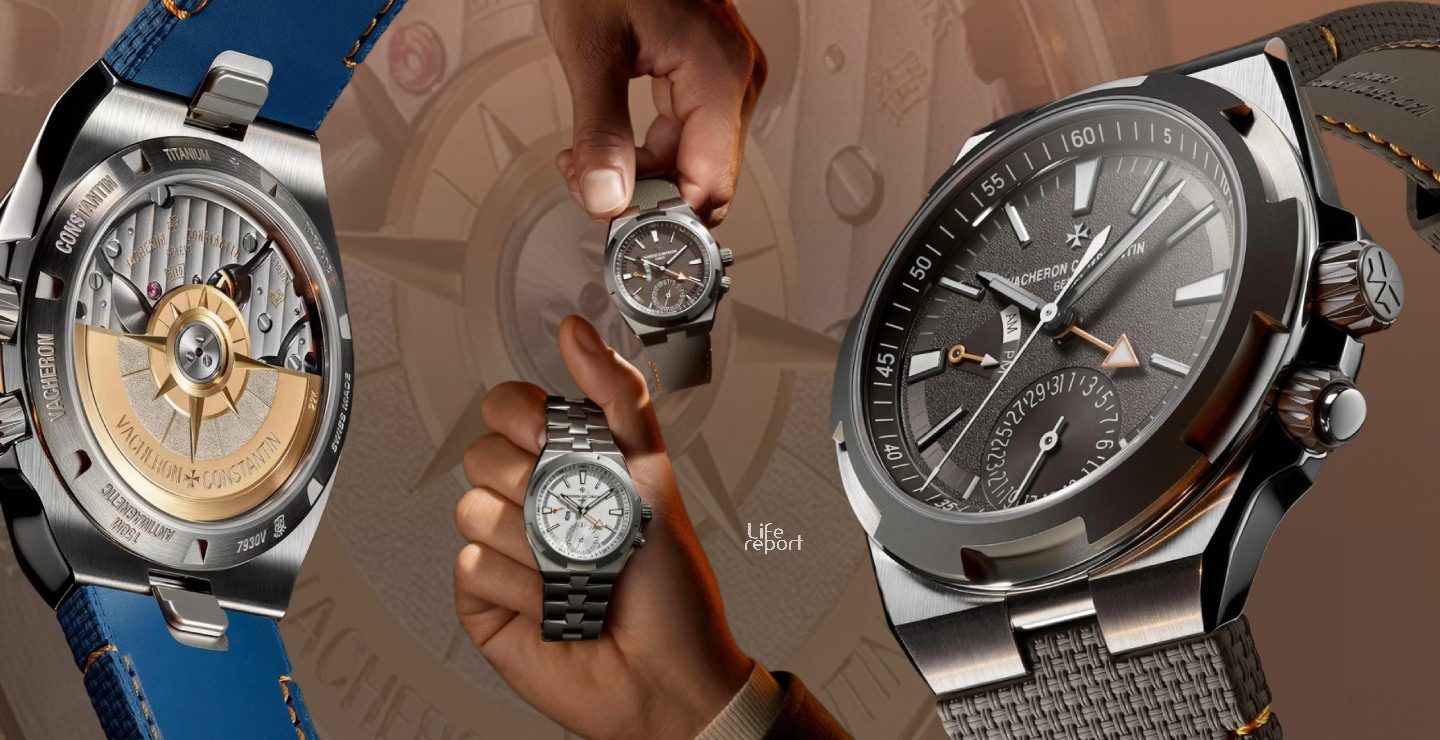
Physically, the watch is 41mm of Grade 5 titanium that sits with a disarming lightness, like a silk shirt you forgot you were wearing. The case is predominantly brushed, with coarse vertical streaks that catch the light in a way that feels engineered rather than decorative. The bezel and crowns wear a Titalyt® coating, an anthracite wash that dials down the shine without ever veering into tactical drabness. It’s the same treatment Vacheron applies to its most sporting references, but here it’s paired with a medium-grey tone – less severe than the Everest’s charcoal, more harmonious. The overall effect is a watch that doesn’t scream for attention, yet communicates a discreet solidity, much like the brushed D-ring on a Rimowa cabin case or the matte carbon-fibre interior of a well-appointed G-Class. Around the dial, a recessed, sunburst-finished minute track acts like a polished frame, catching the light and giving each colourway a cinematic depth that the previous matte-only dials lacked.
View this post on Instagram
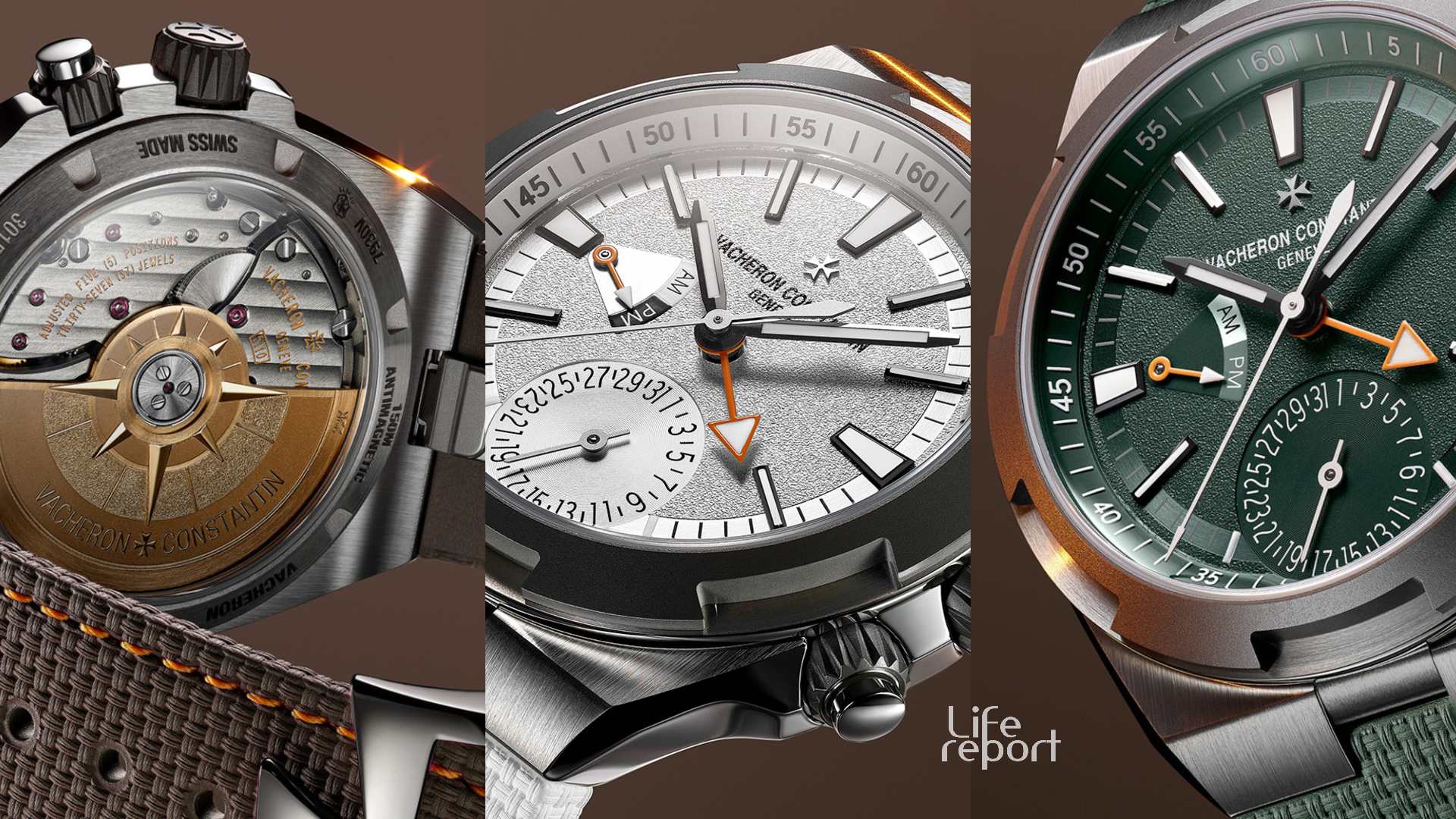
Four chromatic personalities, then: the blue “East” is the heir apparent to the Everest, but now rendered in a deeper, almost Arabian Gulf blue that shifts from cerulean to navy as you tilt it. The white “North” is, for me, the sleeper hit – optically crisp, faintly reminiscent of the blinding plaster walls of a minimalist gallery in Alserkal Avenue, yet the grained centre texture reads like fresh snow, a subtle nod to the mountains many of us flee to during summer. The brown “South” is unexpectedly alluring in person, the colour of a well-worn Bottega Veneta intrecciato card case: warm, robust and quietly luxurious. The olive-green “West” I had only the briefest encounter with, but it carries the outdoorsy appeal of a vintage Land Rover Defender, albeit one retrimmed by Bridge of Weir. All four share the same dial architecture: applied 18K white-gold indices and hands glowing with blue Super-LumiNova® – because locating the light switch in a strange hotel room is a universal luxury problem – and two flashes of orange. The arrow-tipped GMT hand and the day/night indicator at 9 o’clock inject a hit of sports-watch energy that works like a folded pocket square: a small, clever accent that elevates everything.
The author in me wishes that Vacheron had played a little more with the dial textures. Imagine if the West dial had a bark-like grain, the North a crystalline sparkle, the South a striated savannah effect. Instead, we receive the same handsome grained centre across the quartet, as if the design team collectively opted for a capsule wardrobe rather than four bespoke outfits. It’s a forgivable monotony – perhaps even a missed opportunity – but in practice it doesn’t detract from the watch’s visual impact, especially when you factor in the bracelet.
Ah, the bracelet. For the first time on a titanium Overseas Dual Time, we get the integrated bracelet executed in the same featherlight metal. Vacheron Constantin’s ability to translate the steel version’s razor-sharp finishing – mirror-polished chamfers, immaculate brushing – into stubborn titanium is nothing short of alchemy. The darker tone of the titanium makes the polished bevels pop like calligraphic strokes across a Jean Nouvel façade. The concealed EasyFit extension is a quiet revelation: it expands on demand, accommodating a wrist that swells after a long-haul flight or a salty dip in the infinity pool at Atlantis The Royal. Three straps are supplied, each swappable without tools: the bracelet, a colour-matched rubber strap with orange saddle stitching, and a full-orange rubber strap that positively dares you to wear it with a crisp white linen shirt. That orange strap, I suspect, will become the signifier of the wearer who understands that a watch costing as much as a first-class Emirates ticket to Geneva can still possess a sense of humour.
Inside, the in-house Calibre 5110 DT/3 ticks away, a third iteration of a movement first seen in the Everest. The dual-time mechanism places the home time on the orange hand, linked to a day/night indicator, while local time is adjusted via the crown. The date subdial at 6 o’clock, synchronised with local time, adjusts through a discreet pusher at 4 o’clock – a small asymmetry that whispers “I have nothing to prove” rather than shouting for validation. Visible through the sapphire caseback, the bridges receive a NAC treatment, a dark-grey finish that gives the movement the moody, metropolitan aesthetic of an architectural photograph by Hélène Binet. Côtes de Genève and perlage undulate across the surfaces, but the true showstopper is the 22K yellow-gold rotor, shaped like a compass rose and decorated with multiple textures – four distinct finishes layered into a miniature wind rose that spins with each movement of the wrist, a kinetic sculpture for the voyageur. Performance is solid: 4Hz, 60 hours of power reserve, and the Poinçon de Genève hallmark, meaning every component has been meticulously finished and tested. It’s not a technical firework, but it is an engine that will shrug off the magnetic fields of an iPad cover and the minor shocks of an overhead locker, all while keeping time with the serene poise of a majlis conversation.
At CHF 41,000 – roughly AED 150,000 – the Cardinal Points occupies a rarefied tier. The 2021 Everest Limited Edition, priced at CHF 31,300, now seems like a period-piece bargain, much like a pre-blockchain digital artwork. But this is not a limited watch, and the price reflects the addition of the full titanium bracelet and the cachet of a regular-production Overseas that feels genuinely sporty without resorting to carbon-fibre novelty. Comparative shopping becomes an abstract exercise: a steel Overseas Dual Time sits at CHF 34,100; a gold Rolex GMT-Master II nudges CHF 48,400; Patek Philippe’s Nautilus Travel Time resides in another fiscal stratosphere altogether. The closest philosophical counterpart might be the Parmigiani Fleurier Tonda PF GMT Rattrapante, a marvel of understatement, though it lacks the rugged 150-metre water resistance and the three-strap versatility. In the UAE, where zero-tax luxury retail and a deep-rooted watch-collecting culture create a perfect market storm, the Cardinal Points will almost certainly command a waiting list longer than the queue for a matcha latte in City Walk. The Dubai Watch Week circuit has primed a generation of local and expatriate buyers who understand that a true travel watch is both a tool and a talisman, and Vacheron’s status as the world’s oldest continuously operating watch manufacture pairs neatly with a region that venerates heritage.
View this post on Instagram
Wearing the Overseas Dual Time Cardinal Points around Dubai, I felt that rare fusion of pragmatic luxury and poetic narrative. It is a watch for the millennial and Gen-Z striver who measures life in boarding passes and golden hours; who understands that a sapphire caseback reveals not merely a movement, but a compass rose – a reminder that even when you are grounded in a glass tower, the cardinal points are still rotating beneath your cuff. The orange home-time hand, a steady marker of where you came from, is the emotional anchor; the brushed titanium bracelet, with its lightness and concealed extender, is the physical comfort. That Vacheron Constantin managed to pack a subtle critique of modern nomadism into a non-limited collection – the idea that our personal cardinal points are as much emotional as geographical – is the sort of lightly ironic intelligence that makes this watch greater than the sum of its materials.
Will it scratch over years of use? Undoubtedly. There is no ceramic shield protecting this bezel. But as any Dubai resident who has watched pristine sneakers gather desert dust can attest, a little evidence of a life well travelled is no bad thing. The Overseas Dual Time Cardinal Points is, finally, the watch for those of us who prefer our tool watches to be as elegantly flawed and richly storied as we are. Consider it your compass, your conversation piece, and your next object of slightly obsessive affection.
Also Read: Inside the €3 Million Fenomeno: The Art World Meets Lamborghini’s Most Extreme Few-Off