Close your eyes. Actually, don’t – you’re driving. But imagine: 760 Nm of torque feeding through an eight-speed dual-clutch transmission, the flat-plane crank howl bouncing off the guardrail of a coastal road that has no business being this narrow, and above you, nothing. No carbon fibre, no glass, no engineered compromise – just the particular shade of Italian sky that Cinecittà spent decades teaching us to romanticise. The Ferrari Amalfi Spider, unveiled this week, is not the car you buy because you want to feel the wind. It’s the car you buy because you’ve felt everything else.
Unveiled in Maranello, the latest addition to the Prancing Horse stable arrives with the quiet confidence of a seasoned tailor presenting a new seasonal cut. It is not merely a decapitated version of its hardtop sibling; it is a rethinking of what an entry-level Ferrari – if one can utter such a preposterous phrase – should represent in an era where even your barista talks about “investment pieces”. The Amalfi Spider is a $300,000-plus statement that the future of luxury, at least for those who drive rather than merely arrive, belongs to the sensualists.
The Coast Is Not a Place, It’s a Feeling
Let us address the nomenclature, because Ferrari, unlike certain German competitors, does not engage in accidental branding. The Amalfi name is not just tourism-board appropriation; it is a callback to the SS 163, that sinuous ribbon of asphalt that clings to the Tyrrhenian Sea like a lover unwilling to say goodbye. This is a car designed for roads where the destination is irrelevant and the corner is the point. It is a concept that resonates deeply here in the UAE, where the journey from Dubai to Abu Dhabi on Sheikh Zayed Road is less a commute and more a meditation on glass and light.
Under the long, sculpted bonnet lives the latest evolution of the F154 family – a 3.9-litre twin-turbo V8 that has collected more international awards than most film festivals. Here, massaged by Ferrari’s engineers, it produces 640 horsepower and 760 Nm of torque, enough to dispatch 0–100 km/h in 3.3 seconds before you have even found a suitable podcast. But numbers, as any Gulf connoisseur knows, are vulgar when divorced from context. The real magic lies in the calibration: the way the flat-plane crank howls to a 7,600 rpm red line, the independent turbo management that eliminates lag as if it were an embarrassing social faux pas. It is a reminder that Ferrari, for all its recent flirtations with hybrid complexity, remains the high priest of the internal-combustion sermon.
Tailoring, Not Transportation
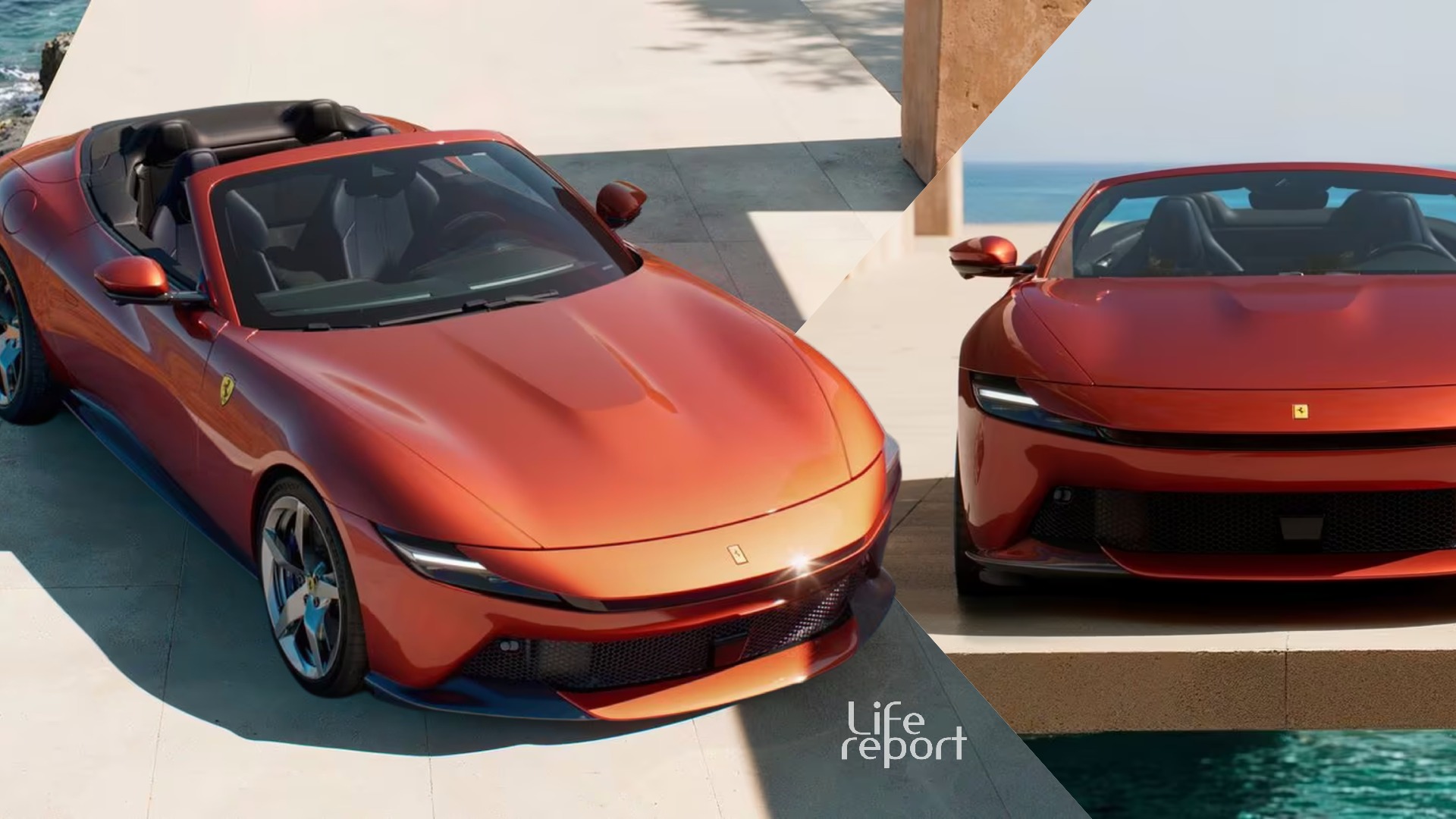
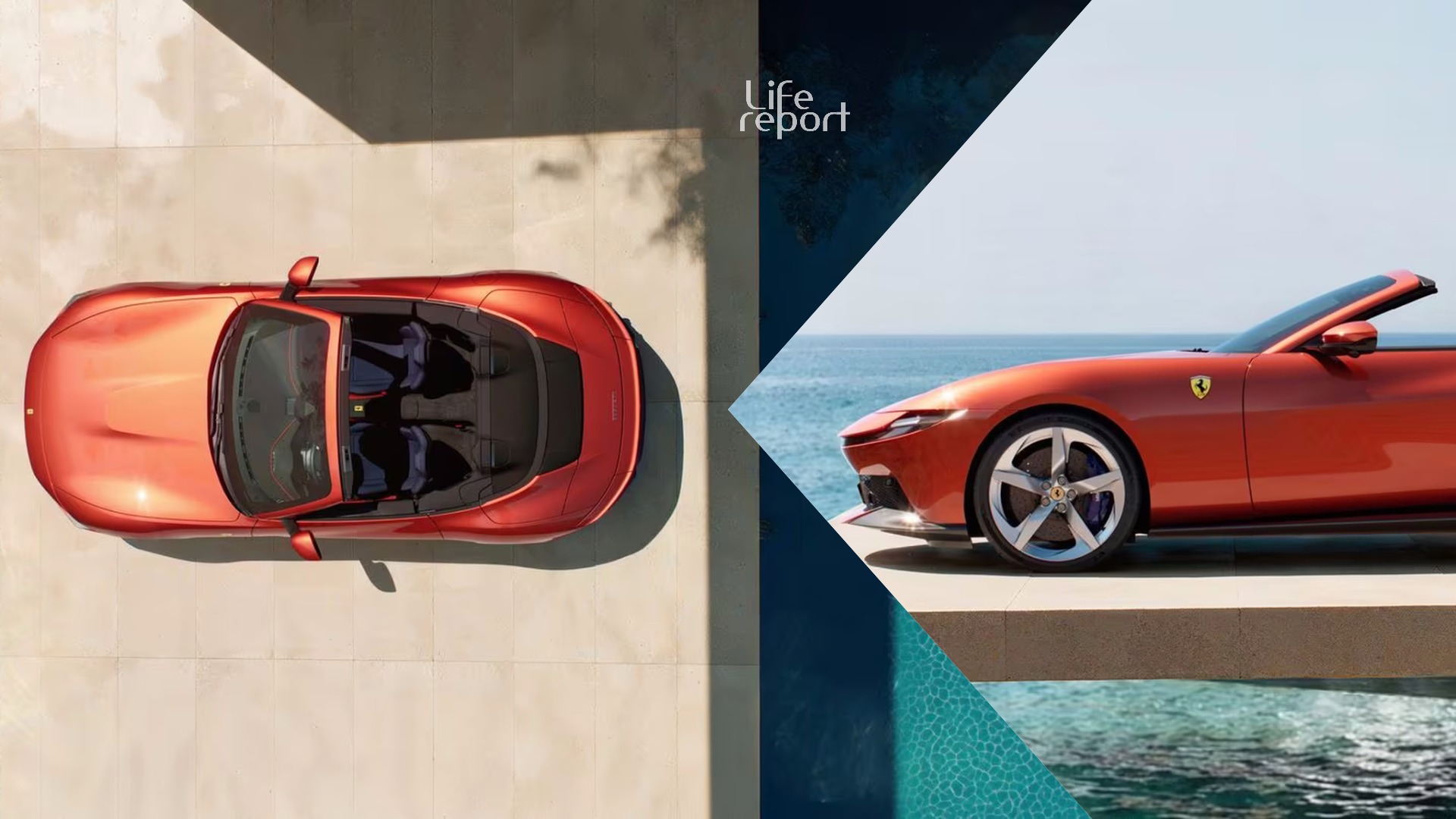
Step back and observe the silhouette. Flavio Manzoni’s Ferrari Design Studio has performed a sleight of hand that would impress even the illusionists at Expo. The fabric soft top, available in six hues including the new “Tecnico Ottanio” technical fabric, folds in a Z-kinematic ballet to just 220 mm in thickness. When stowed, it does not ruin the fastback profile; it enhances it, creating a material continuity across the tonneau that reads more “bespoke suit” than “afterthought convertible”.
View this post on Instagram
This is where the cultural intelligence becomes apparent. We live in a city where branding is worn on the sleeve – or, more accurately, on the wrist with an Audemars Piguet, or draped over the shoulders in a Zegna couture robe. The Amalfi Spider speaks the same language. The five-layer acoustic fabric, which Ferrari claims offers insulation comparable to a retractable hardtop, is not just about comfort; it is about composure. It allows you to arrive at L’Atelier Robuchon or Il Borro with hair unruffled and conversation uninterrupted, the electric life of Dubai Marina gliding past the window like a film you have chosen not to star in.
Inside, the cockpit is an exercise in subtractive luxury. The dual-cockpit layout cocoons driver and passenger in what can only be described as architectural intimacy. Physical buttons have returned to the steering wheel – a move that will elicit sighs of relief from anyone who has attempted to adjust the volume via capacitive touch while negotiating the roundabout by the Dubai Mall Fountain. The anodised aluminium start button, relocated to the left spoke, is a fetish object in its own right: cold to the touch, weighty in gesture, it transforms ignition from a mundane act into a ritual.
The Geometry of Light
Ferrari has introduced a new signature colour for this Spider: Rosso Tramonto. It is, as the press materials breathlessly note, inspired by the boundary between sea and sky at dusk along the Amalfi Coast. In the saturated glow of a Dubai sunset, however, it takes on a different resonance. The subtle orange undertones catch the dust of the desert and the refraction of the Gulf, making the car appear as if it is perpetually backlit by the last ray of a perfect winter day. It is a chromatic reminder that red, in Ferrari’s vocabulary, is never just red; it is emotion, identity and – if you will forgive the marketing jargon – visual performance.
Paired with the optional carbon-fibre details and forged wheels, the Rosso Tramonto finish positions the Amalfi Spider firmly in the camp of the collector who appreciates nuance. This is not the shouty, wide-body aggression of a track-focused speciale; it is the quiet confidence of a Brioni suit worn with bare feet.
Experience as Currency
There is a shift occurring in the UAE’s luxury psyche, one that the Amalfi Spider seems to have anticipated with eerie precision. According to recent market analysis, 75% of UAE residents now actively seek experiences over acquisitions, with the experiential luxury segment projected to grow by 8% annually. We are moving, as a culture, from the accumulation of objects to the curation of moments. The Spider, with its 13.5-second transformation and its rear-seat-integrated wind deflector that deploys at the touch of a button, is less a car than a moment-generating device.
The 2+2 configuration, a nod to practicality that will likely see the rear seats used for Rimowa luggage rather than passengers, offers 255 litres of cargo space with the roof closed. Enough, perhaps, for a weekend in AlUla or a fly-drive to the mountains of Ras Al Khaimah. It is the automotive equivalent of the global nomad lifestyle that Dubai has perfected: seamless, connected and utterly devoid of compromise.
The Verdict
The Ferrari Amalfi Spider arrives at a moment of curious tension. The automotive world holds its breath for electrification, yet here is a V8 so refined, so responsive, so acoustically perfect that it borders on anachronism. The brake-by-wire system, borrowed from the 296 GTB, offers modulation that feels almost telepathic, while the SSC 6.1 side-slip control ensures that even a clumsy foot can channel their inner Schumacher with dignity.
View this post on Instagram
It is, in short, a car for those who understand that true luxury is not about owning the newest thing – it is about owning the right thing. In a city that often mistakes novelty for taste, the Amalfi Spider stands as a quiet rebuke. It suggests that elegance is not a trend, that speed without style is merely velocity, and that sometimes the most profound statement you can make is to arrive with the roof down, the sun setting behind you and absolutely nothing to prove.
Deliveries are expected to commence in late 2026, just in time for the season when Dubai remembers why it fell in love with the outdoors. If you hear the howl of a flat-plane V8 echoing off the façades of Jumeirah at dusk, do not look for the source. You have already missed it. That is the point.