Dubai’s departures hall is a theatre of aspiration, its cast forever rushing toward somewhere else. In Terminal 3, the luggage carousel becomes a runway; in the First Class lounge, a silent contest of carry-ons. TUMI has spent five decades designing for this restlessness. For Fall/Winter 2026, under the banner “Path to Peak,” the brand trades the predictable tropes of alpine fantasy for something altogether more interesting: a collection that treats elevation not as a destination, but as a state of mind.
The alpine ascent is a curious metaphor for the modern traveller. It implies struggle, then reward – a summit reached, a photograph taken, a moment of quiet triumph before the descent. Yet for the discerning set who shuttle between Dubai’s glass towers and Gstaad’s snow-dusted chalets, the climb is perpetual. There is no summit. There is only the next destination, the next meeting, the next Michelin-starred detour. TUMI, a brand that has spent five decades engineering for precisely this restlessness, understands the psychology better than most. For Autumn/Winter 2026, under the banner of “Path to Peak”, the brand trades the predictable tropes of alpine fantasy for something altogether more interesting: a collection that treats elevation not as a destination, but as a state of mind.

The campaign, photographed by Theo Gosselin and directed by Valentin Florian, unfolds across the mist-shrouded Highlands of Scotland rather than the Swiss Alps of postcard cliché. Lando Norris, the McLaren Formula 1 driver and TUMI’s global brand ambassador, navigates jagged stone trails and winding northern roads alongside a travel companion. The two move with the unhurried confidence of people who know exactly where they are going and see no reason to rush the journey. “There is always another peak to reach, another goal to chase,” Norris observes. While it is the kind of line that could easily sound scripted, there is something disarming about hearing it from a man whose professional life is measured in milliseconds. The quiet is the point.
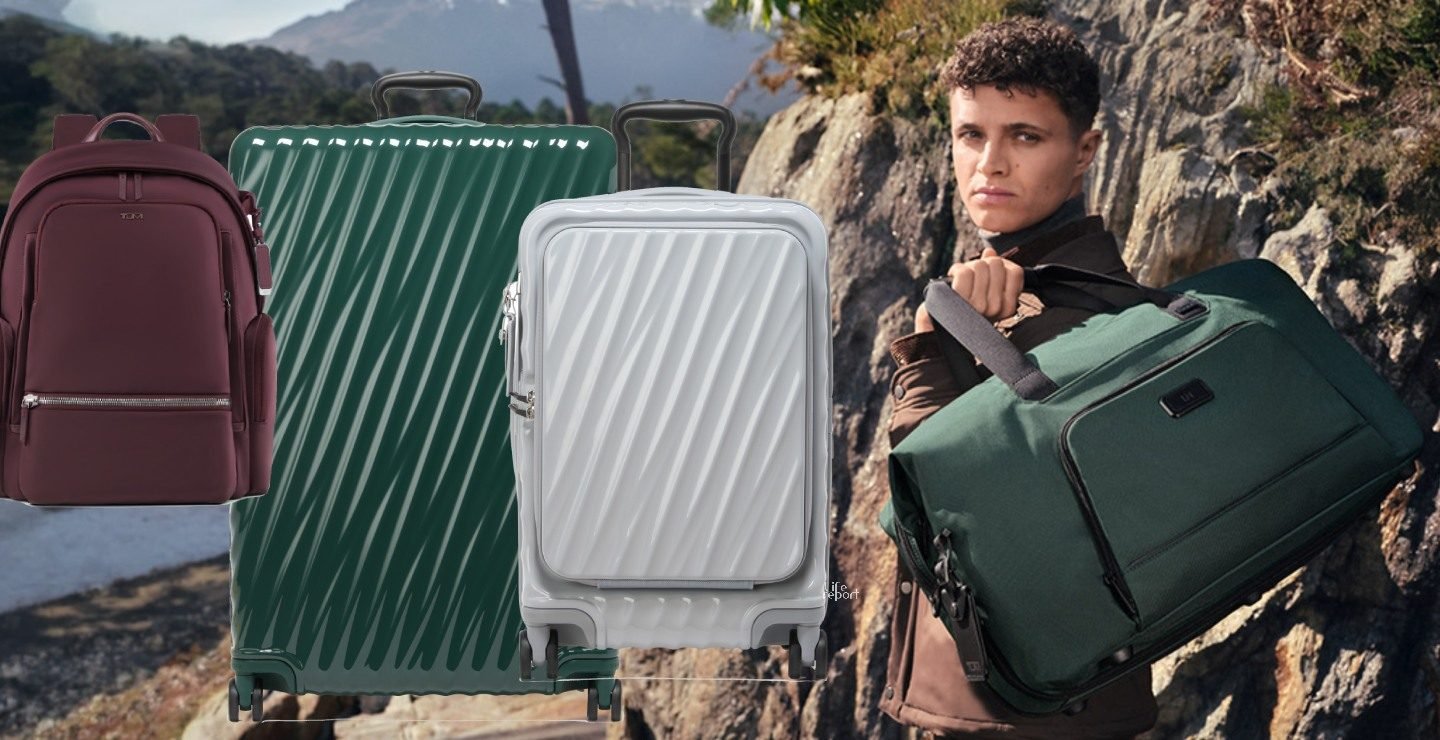
What strikes you first about the FW26 collection is its chromatic restraint. In an era when luxury brands often mistake volume for value, TUMI has opted for a palette that whispers rather than shouts. Deep Pine – a forest green so saturated it feels almost primeval – runs through the 19 Degree, 19 Degree Front Access, Harrison and Alpha collections. Alpine Green and Rosewood introduce warmer, earthier notes to the Voyageur Nylon and Leather collections, while a Forest Camo print lends a tactical edge to Alpha’s expanded range. “This season is inspired by the quiet confidence of the Alps,” says Victor Sanz, TUMI’s Creative Director. “Rather than chasing excess, we wanted to explore the idea of elevation through thoughtful design.” It is a sentiment that feels almost radical in its understatement – a rebuke to the maximalist ethos that has dominated luxury travel accessories for the better part of a decade.
View this post on Instagram
The 19 Degree collection represents perhaps the most compelling expression of this philosophy. Its sculptural hard-shell suitcases combine distinctive design with recycled materials: the outer shell is made from at least 70 per cent recycled polycarbonate, while the interior lining uses 100 per cent recycled PET. TUMI also donates one per cent of sales from its 19 Degree polycarbonate collection to verified environmental non-profits through 1% for the Planet, a global network supporting environmental causes. The suitcases retain their iconic sculptural curves – those fluid, almost architectural lines that have become a signature – but the front-access designs offer a particularly practical solution for travellers who need easy access to their belongings in the cramped quarters of a hotel room. It is a practical consideration that speaks to a deeper truth: true luxury is not about being seen, but about being considered.
For the woman who does not merely chase peaks but sustains the momentum required to reach them, TUMI’s women’s offering includes the Voyageur Leather collection and the Adatto Tote, a piece that feels almost impossibly supple in the hand. Handcrafted in Italy from smooth-grain leather, the Adatto is named for its effortless wearability – a tote that transitions from a morning meeting in DIFC to an afternoon at the Louvre Abu Dhabi without so much as a sartorial second thought. The magnetic snap closure, leather shoulder strap and four-position adjustable buckle are quiet assertions that functionality and beauty are not mutually exclusive propositions.
The Voyageur Q Tote, meanwhile, has received a dressier update in leather, with refined hardware and colour options including Black/Gunmetal, Black/Gold, Rosewood and Sienna. Its silhouette is designed for precisely the type of globe-trotting, goal-setting woman who makes up TUMI’s core clientele. The Add-a-Bag strap allows it to slide effortlessly over the handle of a carry-on, a small but meaningful gesture towards the reality of travel as it actually exists: a series of transitions, not a single grand arrival. The new TUMI Axis collection, a minimalist range of everyday bags, further extends this logic of seamless movement. Clean in design and lightweight in construction, Axis brings an everything-in-place organisation system to four versatile silhouettes, available in Black, Navy, Cement and Black Reflective. It is, in essence, the anti-status bag: no logos paraded, no hardware demanding attention, just a quiet system for moving through the world with grace.

What distinguishes TUMI’s approach from the performative sustainability that has become de rigueur across the luxury sector is the extent to which the brand’s design decisions emerge not from a conference room in Manhattan, but from the real-world experiences of the people who carry its products. “Our women customers come to us and say: Hey, I need something that’s more casual, or more dressy, or something for a cocktail event,” Sanz recounts. It is a compelling portrait of the twenty-first-century woman – simultaneously a boardroom operator, a weekend explorer and a participant in the city’s endless carousel of cultural and social engagements. TUMI has responded with a collection that refuses to force her to choose between these different selves.
The TUMI flagship at Dubai Mall, which opened in late 2024 as the brand’s largest in the Middle East, spans 1,646 square feet and brings this philosophy to life. The space is designed not merely to display products but to allow customers to experience them: to feel the weight of a carry-on, test the glide of a telescopic handle and understand, in their hands, what distinguishes a TUMI from the countless imitators who have sought to replicate its formula.
Sanz, who has spent more than two decades with the brand, has spoken often about the evolution of travel and how design must respond to a world in which the boundaries between work, leisure and transit have become increasingly porous. “Today, travel is faster, more fluid, and more integrated into everyday life,” he notes. “With Alpha, we focused on creating a system that anticipates that rhythm.” The FW26 Alpha line, rendered in Deep Pine, Forest Camo and Grey Reflective, continues this trajectory with its signature FXT® ballistic nylon construction and an organisational architecture designed to guide the hand naturally, without requiring conscious thought. The tuckaway pockets, magnetic zip garages and hidden organisational details are what separate a well-made bag from a truly considered one.
It is worth pausing on the question of what, precisely, we mean when we speak of luxury in the context of travel accessories. The word has been so thoroughly debased by marketing departments that it risks losing all meaning. Yet TUMI, at its best, offers a corrective. The luxury it proposes is not about leather so supple it must be handled with gloved fingers, nor about hardware so polished it reflects light from across the room. It is, rather, the luxury of confidence: the knowledge that the bag you are carrying has been tested across thousands of hours of use, that its zips will not fail you at the gate, and that its organisational logic will hold even when your itinerary collapses into chaos.
View this post on Instagram
The FW26 collection is not, in the end, about the Alps at all. It is about the person who moves through the world with intention, who understands that the journey is not a means to an end but the thing itself. The Deep Pine 19 Degree carry-on, the Adatto Tote and the Axis crossbody are not accessories in the conventional sense. They are tools for a life lived in motion, designed for those who see no contradiction between wanting beautiful things and wanting them to work beautifully.
As the season unfolds across the UAE – where Gen Z and millennial travellers are helping to shape the luxury conversation, with multi-stop itineraries and experience-led travel becoming increasingly prominent – TUMI’s “Path to Peak” feels less like a campaign slogan and more like a description of a generational ethos. The ascent is not a solitary exertion but a continuous, collective rhythm. And the right companion, as anyone who has ever missed a connection in Frankfurt knows, makes all the difference.
Fact-check note (not part of the article): TUMI’s official product pages confirm the recycled materials used in the 19 Degree collection and the one per cent donation commitment. The official FW26 release confirms the Adatto Tote spelling, campaign credits and collection details.
ALSO READ: Less Scent, More Seduction: Molecule 01 + Clary Sage Is Luxury’S New Secret