
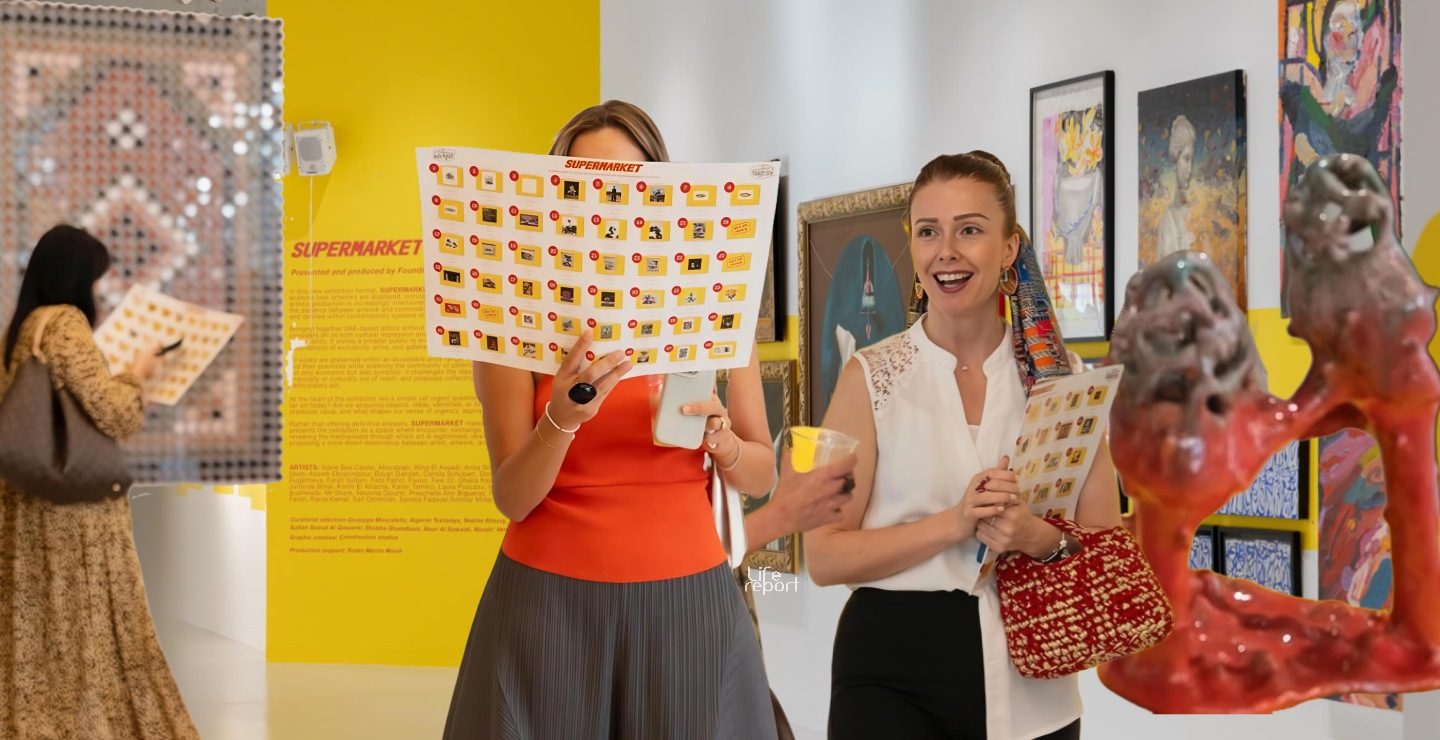
At Foundry Downtown, 35 independent UAE-based artists have staged something quietly radical: an exhibition that asks what we are really doing when we buy art – and whether the entire sacred edifice of the gallery system might simply need a trolley. The exhibition runs until 28 June. Foundry Downtown is located at Boulevard Crescent on Sheikh Mohammed bin Rashid Boulevard in Downtown Dubai. Bring your own trolley, metaphorically speaking. The checkout is the easy part. The looking is what takes time.
There is something almost conceptually perfect about naming an art exhibition Supermarket in a city that has, over the past decade, constructed some of the world’s most spectacular temples to cultural consumption. Dubai, after all, is home to the Louvre Abu Dhabi, which opened in 2017; it is the city where Art Dubai annually transforms Madinat Jumeirah into an international marketplace dressed in the language of ideas; and it is where Foundry Downtown was established as a direct response to the UAE’s evolving cultural landscape – a hybrid venue on Sheikh Mohammed bin Rashid Boulevard combining gallery spaces with a co-working hub, a micro-library, a podcast studio, and a café. The art world, in other words, arrived here already equipped with an espresso machine.

And yet Supermarket – a group exhibition featuring 35 UAE-based artists without gallery representation, now extended until 28 June following what its organisers describe, with restrained satisfaction, as a “wonderful response from visitors” – manages to be genuinely and usefully provocative within that context. Not provocative in the heavy-handed mode of institutional critique that occasionally produces artworks nobody could hang in a living room without extensive explanations over dinner. Rather, it is provocative in the way that a well-posed question is provocative: through precision rather than volume.
The Title Does the Work
To be fair to the exhibition’s curators at Foundry, the title Supermarket is not intended as satire. Or rather, it is not only satire. It deliberately borrows the vocabulary of retail – that lexicon of display, circulation, and assigned value that the contemporary art market has spent decades pretending not to share. By naming the mechanism explicitly, the exhibition collapses a distinction that has always been somewhat artificial. Artworks are objects. They are made, transported, displayed, desired, purchased, and occasionally returned. The fact that the language surrounding their exchange tends towards the reverential – “acquisition”, “collection”, “provenance” – does not fundamentally distinguish the transaction from what happens in a supermarket aisle. It merely makes it more expensive and considerably more difficult to park.
The question posed by the exhibition – What does it mean to shop for art today? – is neither cynical nor naïve. It is the question anyone who has ever stood before a work they wanted and then glanced at the price has quietly asked themselves, usually with a faint sense of guilt, as though desire and economics were somehow incompatible with genuine aesthetic experience. They are not, of course. They never were. Supermarket simply declines to pretend otherwise.
The Artists and the Architecture of Accessibility
The 35 artists gathered here represent a cross-section of the independent creative community that has been quietly establishing itself across the UAE over the past several years – a cohort existing largely outside the traditional gallery representation system and, consequently, outside many of the conversations that system tends to generate. Foundry’s cultural programme supports creative communities across Dubai, the UAE, and the wider region, and this exhibition may well be its clearest act of institutional solidarity: a platform that is simultaneously commercially structured and philosophically generous.
View this post on Instagram
The works are presented within an accessible price range – a phrase that, in the context of a city where secondary auction prices for even moderately established regional artists can reach five figures, carries genuine significance. This is not a concession to the market but a structural argument about whom art is for. By making the experience of acquisition available to a broader public, Supermarket seeks to cultivate what it describes as “a new generation of collectors”, the term shedding its patrician associations and recovering its literal meaning: people who collect things they genuinely care about.
Among the participating artists are Adele Bea Cipste, Afrorabian, Alina El Assadi, Anita Shishani, and Asareh Ebrahimpour – whose work was recently featured during Alserkal Art Month – alongside Bayan Dahdah, Camila Schubert, Ghalia Kalaji, Maitha Bushelaibi, and around thirty others whose practices encompass painting, photography, sculpture, and media that submission forms probably struggle to categorise. The cumulative effect is less a tightly controlled curatorial thesis than a generous survey: this is what independent artistic production in the UAE looks like when nobody is managing the narrative.
Foundry as Infrastructure
It is worth pausing to consider the venue itself, because the choice of Foundry – one of Downtown Dubai’s most dynamic cultural spaces – is far from incidental. The institution regularly hosts events that support the creative community, encouraging collaboration through an open workspace incorporating a micro-library, a podcast studio, and a café surrounded by exhibition galleries. It is, in other words, already a kind of supermarket for creative production: a place where making, thinking, and presenting coexist without the artificial hierarchies that more traditional institutions often impose.
Over the past year, the gallery has also presented exhibitions featuring Hussein Madi, Matt Kane, and Mohammed Kazem – artists representing rather different strands of contemporary artistic practice. That Supermarket sits within this same programme is itself a statement: the independent and the established occupying adjacent rooms, without apology or explanation.
The Question of Legitimacy
The exhibition’s more compelling provocation concerns not price but legitimacy – specifically, who confers it and by what means. The gallery system functions, among other things, as a mechanism of certification. Representation by the right gallery in the right city often provides the institutional endorsement that enables museums to acquire an artist’s work, auction houses to include it in major sales, and collectors to feel secure in their own judgement. It is a closed ecosystem that, like most closed ecosystems, primarily serves those already inside it.
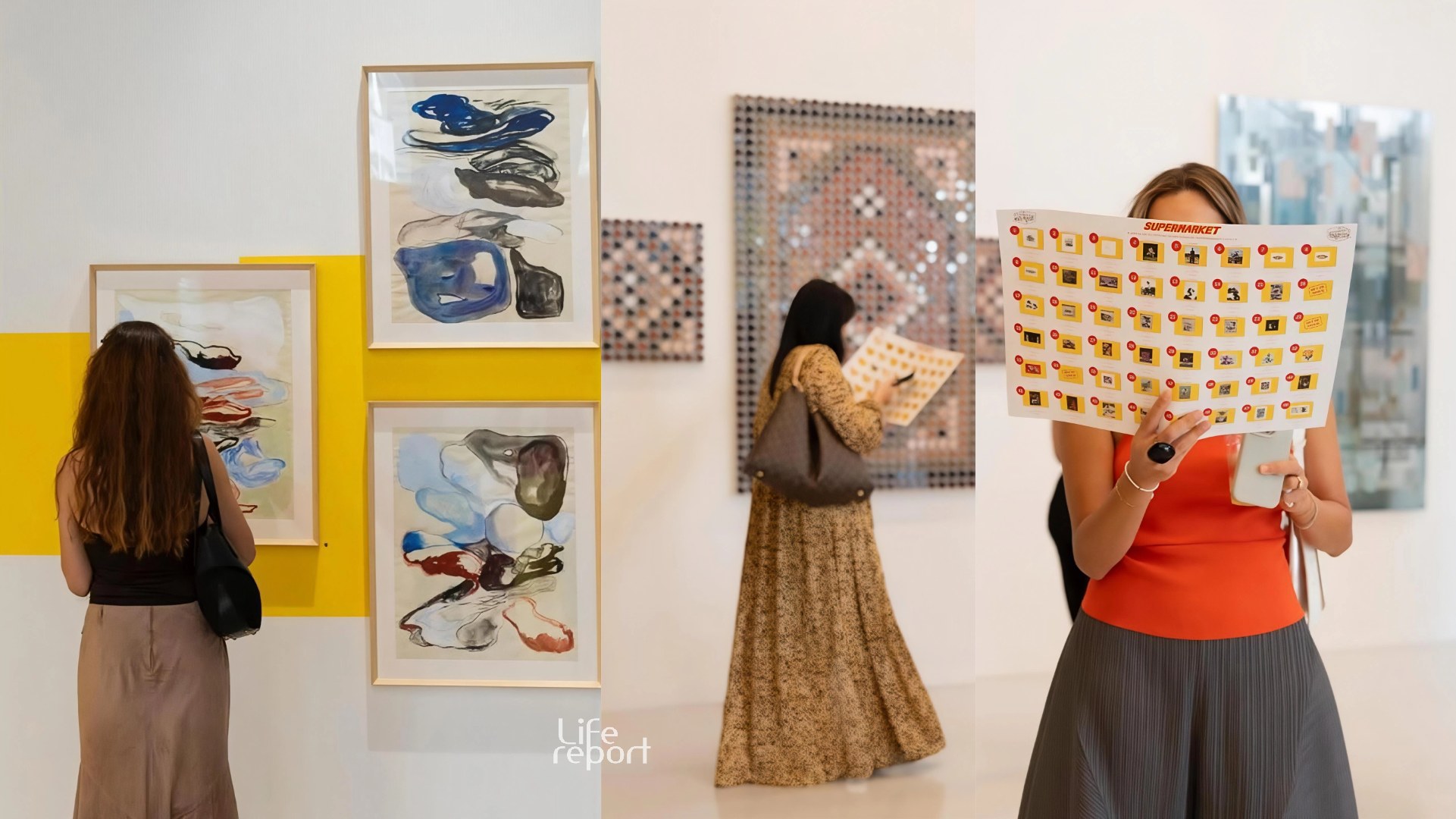
Independent artists in Dubai – as in London, New York, or anywhere else where the gallery economy operates – exist in a more precarious but arguably more direct relationship with their audience. Their work must advocate for itself. There is no institutional authority to soften the encounter in advance. This is simultaneously the most difficult and the most clarifying condition in which to work, and it is precisely what gives Supermarket its underlying tension: these are artists who have not yet been legitimised by conventional mechanisms, presenting work to an audience that must decide, without guidance, what it is worth. The exhibition does not attempt to resolve this tension. It simply presents it. Arguably, that is the most curatorially honest thing it could do.
A Note on Timing
The extension until 28 June arrives at an interesting moment in Dubai’s cultural calendar. Alserkal Art Month concluded in May, Art Dubai took place in its customary spring slot, and the city’s cultural institutions continue to navigate a period of geopolitical and logistical uncertainty that has complicated the movement of artworks and international visitors alike. Against this backdrop, an exhibition of locally produced and locally accessible art – requiring neither international shipping nor elaborate wall texts chronicling a work’s journey from a storage facility in Frankfurt – possesses a certain pragmatic elegance.
It is also, one might observe, considerably more enjoyable. Entering Supermarket with the genuine possibility of taking something home – an object created by someone who lives in the same city, perhaps not far from where you had your morning coffee – produces an encounter fundamentally different from the contemplative distance of the museum experience. It is participatory in the most literal sense: you are invited not merely to look but to decide. And in making that decision, however modest, you become part of the very conversation the exhibition seeks to initiate.
Also Read: When Speed Met Time: The Aston Martin × Breitling Alliance That Was Destined to Happen


