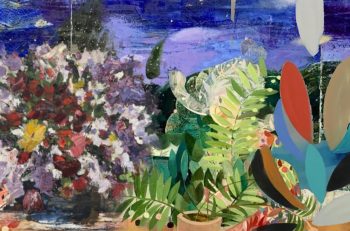
The Andakulova Gallery’s latest exhibition is less a show than a séance. Andrey Krikis doesn’t paint Uzbekistan – he summons it. Fragments of Samarkand runs at Andakulova Gallery, DIFC, from 25 February to 25 April 2026. For those keeping score at home, that is ample time to cancel a lunch and reschedule a meeting. Priorities, darling.
There is a particular flavour of melancholy that clings to cities with too much history. Samarkand wears it like a second skin: a patina of empires, each layer whispering over the next. Andrey Krikis, now in his eighth decade, has spent a lifetime listening to those whispers. His forthcoming exhibition at Andakulova Gallery, Fragments of Samarkand (opening 25 February 2026, should your diary require a dose of transcendence), presents not so much a record of the city as its emotional residue. Think less travelogue, more fever dream.

The gallery, tucked into DIFC’s Damac Park Towers with the understated confidence of an institution that knows exactly what it is about, has carved a singular niche in Dubai’s bloated art ecosystem. While neighbouring spaces chase blue-chip spectacle, Andakulova has quietly become the city’s most vital conduit for Central Asian contemporary art – a cultural bridge between the Stans and the sheikhdoms, if you will. Founder Natalya Andakulova moves through this world with the precision of a curator and the conviction of an evangelist, cultivating dialogue between artists, collectors, and the kind of academics who actually read exhibition catalogues rather than merely displaying them on coffee tables. Krikis, it must be said, is a fitting protagonist for such a project.
Born in Yaroslavl in 1950, he arrived in Uzbekistan as a child when his father – an archaeologist with the sort of romantic profession that guarantees either genius or deep disappointment in one’s offspring – began conducting research in Samarkand. Young Andrey spent summers at the Afrosiab excavations, absorbing the dust of civilisations that had crumbled before anyone thought to invent capitalism. More improbably still, he lived for a formative year within the Sher-Dor Madrasah at the Registan, that hallucinatory ensemble of turquoise tiles and mathematical precision that makes first-time visitors suspect their guidebooks have exaggerated. (They have not. It really is that extraordinary.)
One imagines the adolescent Krikis, surrounded by madrasah walls that had witnessed Timur’s empire and a thousand dawn prayers, developing a relationship with history that was intimate rather than academic. This was not textbook learning. It was atmosphere absorbed through the pores.
View this post on Instagram
His early artistic training under Antonina Vasilyevna Larina at the city art school provided technique, but Samarkand itself provided the obsession. At sixteen, his sketch The Shakhi-Zinda appeared in Yuny Khudozhnik magazine – precocious, certainly, but more tellingly evidence of a young artist already in dialogue with his environment rather than merely rendering it. Later works such as Portrait of a Samarkand Woman (1979) and Sogdian Woman (1982) suggest less a painter approaching a subject than two entities engaged in mutual recognition.
By 1976, Krikis had returned to Yaroslavl for formal training at the School of Art, where the real education began. While his peers dutifully reproduced the sanctioned aesthetics of late Soviet academism, Krikis was discovering Picasso’s fracturing of form, Dalí’s lucrative perversity, and Miró’s playful cosmology. Colour became his rebellion – not the crude defiance of a provocateur, but the subtle insurrection of someone who understands that true freedom lies in the palette.
His contemporaries, never generous with praise, eventually anointed him “the king of colour”. The nickname endured, not because it was flattering, but because it was accurate.
Fragments of Samarkand gathers works spanning this remarkable trajectory, though “gathers” feels too clinical for what the exhibition attempts. Krikis’s paintings do not hang so much as hover – each canvas a membrane between personal memory and collective myth, between the archaeological precision of his father’s profession and the speculative freedom of his own. The Registan appears not as architectural fact but as emotional truth, its geometries softened by nostalgia, its turquoise rendered in tones that suggest longing rather than documentation.

One thinks, standing before these works, of Bruce Chatwin’s observation that travel is not merely about seeing the world, but about seeing how the world sees itself. Krikis, who has exhibited from Tashkent to Moscow and beyond, offers something more disorienting: a vision of how a place sees itself in dreams. His Samarkand is recognisable yet estranged, familiar as a childhood bedroom, mysterious as an overheard language.
The exhibition arrives at a curious moment for Dubai’s cultural ambitions. As the city hurtles towards its hypothetical post-oil future, the appetite for art that offers depth rather than decoration has grown noticeably. The crowd that once queued for immersive Van Gogh spectacles now seeks something with greater resistance – work that does not yield its pleasures immediately, that rewards the patient eye. Krikis, with his layered surfaces and chromatic complexity, will test this new sophistication. Some visitors will find themselves transported. Others, one suspects, will glance, nod, and retreat to the gallery shop, where the merchandise demands less of them.
But for those willing to linger – to submit to Krikis’s vision – Fragments of Samarkand promises the sort of encounter that justifies the entire cumbersome apparatus of gallery-going. It is an opportunity to witness an artist who has spent seventy-five years refining a single obsession, who understands that colour is not applied but released, and who proves, with each canvas, that the most profound landscapes are those we carry within us.