
For its 2025 holiday campaign, the New York jeweller Tiffany & Co. sends its muse on a cinematic global pilgrimage, reminding a generation fluent in digital connection that the most profound exchanges still happen hand to hand.
It begins, as all the best modern fables do, with a ribbon: a slash of white satin, stark against the iconic Tiffany Blue Box, unfurling like a promise. This is not mere packaging; it is a plot device. And our protagonist, the preternaturally poised Anya Taylor-Joy, is both narrator and navigator on a global quest for that most volatile of precious commodities: love. In an age in which our affections are so often digitised, commodified, and broadcast into the ether, Tiffany & Co.’s 2025 holiday campaign, Love Is a Gift, poses a quietly radical question: what if the ultimate luxury – the one that truly appreciates in value – is not an object at all, but the emotion it signifies?
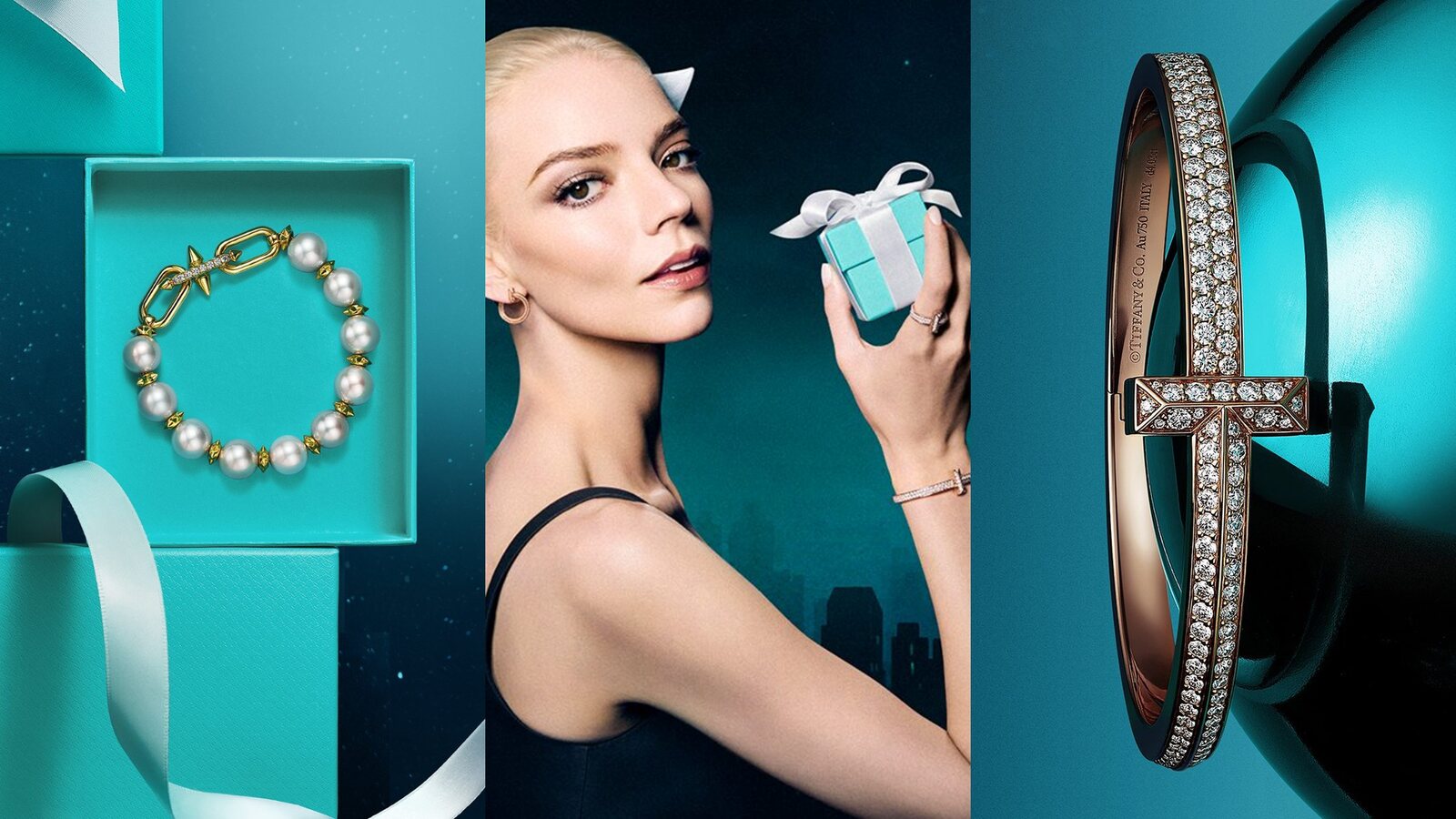
Captured through the discerning lens of Carlijn Jacobs and set to the cinematic rhythm of director Jonas Lindstroem, the campaign is a masterclass in aesthetic seduction. We traverse the globe not as tourists, but as connoisseurs of intimate moments. From the snow-dusted, almost Gatsby-esque grandeur of Fifth Avenue’s Landmark store – a temple of aspiration where dreams still arrive in a specific shade of blue – we are whisked to the neon-drenched serenity of a Tokyo kiss and the familial warmth of a London embrace. Taylor-Joy, a vision in minimalist elegance, is our silent witness, her elfin features a perfect canvas for the brand’s narrative. She does not merely wear the jewellery; she animates it. The industrial-chic links of the HardWear collection become metaphors for unbreakable bonds; the definitive click of the Lock bracelet becomes the sound of commitment.
View this post on Instagram
The true sartorial star, however, may be the new Bird on a Rock collection. A reimagining of Jean Schlumberger’s 1960s fantasia, it is a delicious anachronism – a whimsical, almost baroque confection of gemstones and avian grace. To see it on Taylor-Joy – an actress synonymous with hyper-modernity – is a stroke of genius. It speaks to a generation of luxury consumers who, like the most daring interior designers in Dubai’s Al Barari villas, are fearless in mixing periods, finding harmony between the historic and the avant-garde. It is a reminder that true style, like true love, is timeless but never dated.
This is where the campaign’s intelligence truly gleams. In targeting a cohort of UAE Millennials and Gen Z – demographics fluent in the languages of crypto, NFTs, and the relentless pursuit of “experiences” – Tiffany & Co. offers a counter-narrative. It suggests that the most coveted algorithm cannot curate the frisson of handing someone a perfectly weighted, satin-lined box. In a world of fleeting DMs, the physicality of the gift, the ritual of the exchange, becomes the last word in radical authenticity. It is the analogue answer to a digital dilemma.

And so the ribbon pulls us full circle – back to New York, back to the beginning. As Taylor-Joy’s voice-over, smoky and resonant, concludes that love is “the most precious gift of all,” one cannot help but acknowledge the elegant circularity of the proposition. The jewellery – be it the architectural T, the sinuous Knot, or the fantastical Bird on a Rock – is sublime. It is a testament to craftsmanship, a wearable asset. But the campaign, with its winking self-awareness, understands that we are not merely buying a piece. We are investing in a script, acquiring a prop for our own personal epic. The gift is the token, but the love is the story. And in the end, as any collector knows, it is the story that holds the real value.


