Longines, with the poise of a house that has witnessed nearly two centuries of fleeting trends, has not merely released a watch for the 2026 Year of the Horse. It has orchestrated a convergence: where the gallop of Chinese ink meets the silent sweep of a Swiss escapement; where an actor’s dedication to a once-forgotten art form becomes a modern definition of elegance; and where a timepiece becomes a manifesto for a generation seeking substance behind the sheen.
This is the story of the Longines Master Collection Year of the Horse Moonphase – a limited edition of 2,026 pieces that is as much a cultural artefact as it is a chronometric one. It is a narrative stitched from artistic legacy, athletic rigour, and a calculated whisper in a market that too often shouts.
The Canvas: Where Xu Beihong’s Spirit Meets the Rotor’s Spin
To understand the soul of this watch, one must first understand the stroke of the artist it honours. The painter Xu Beihong was not merely an artist; he was a revolutionary synthesist. Born in 1895, he bridged worlds, training in traditional Chinese ink painting before immersing himself in the rigorous disciplines of oil and drawing at Paris’s École Nationale Supérieure des Beaux-Arts. His life’s work became a fusion of Eastern lyricism and Western anatomical precision – a dialogue most powerfully expressed in his iconic depictions of galloping horses.
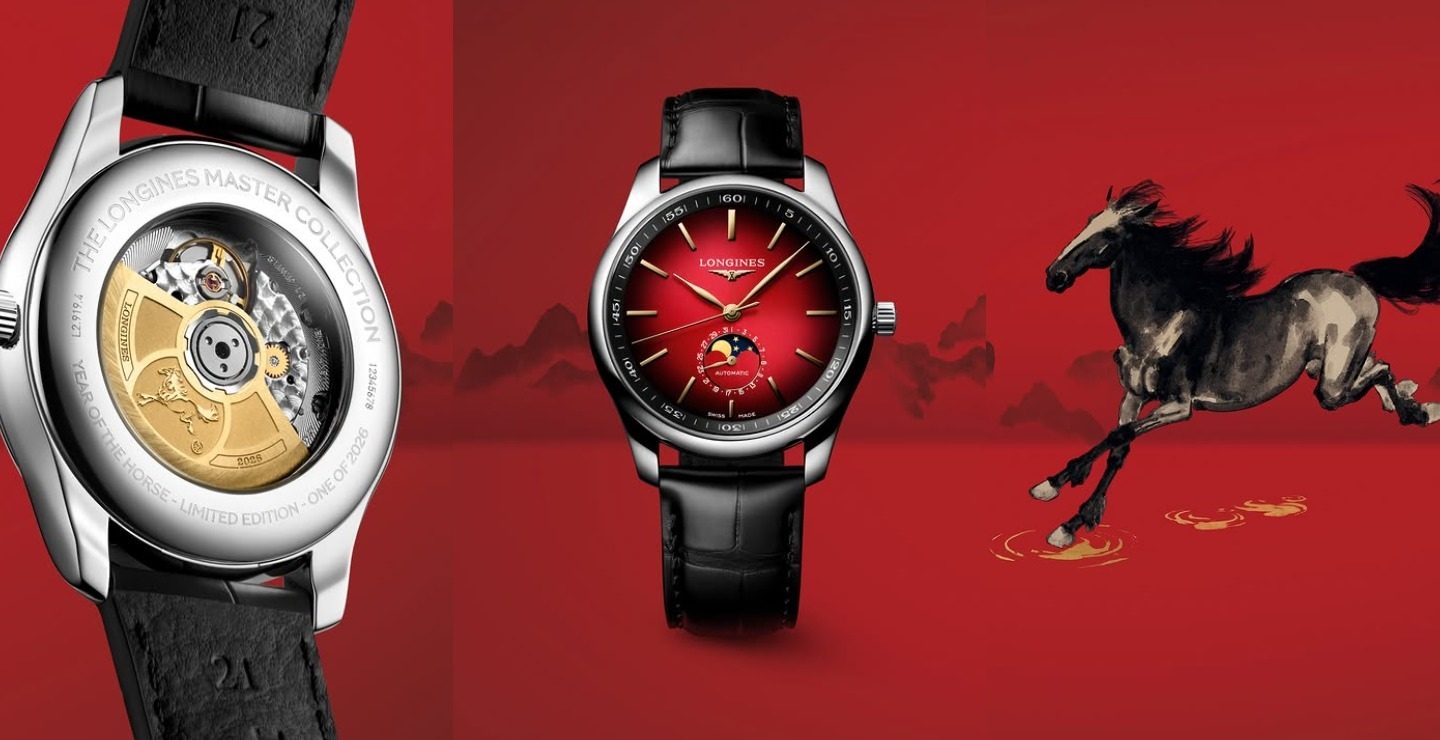
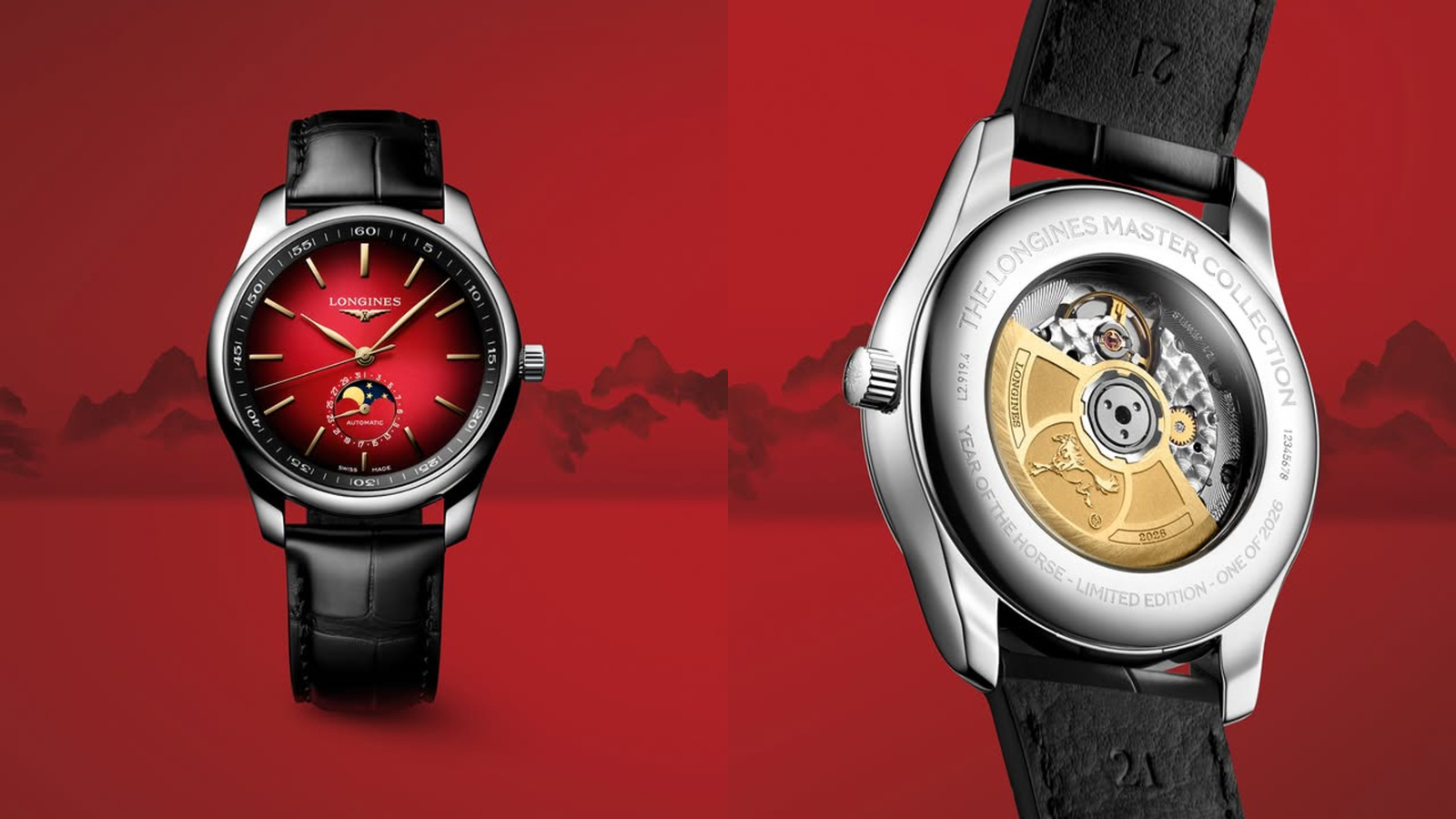
These are not placid, pastoral creatures. They are embodiments of shi – momentum, latent power, an irresistible forward thrust. Longines, in a collaboration overseen by the artist’s son, the calligrapher Qingping Xu, has achieved something quietly extraordinary. It has taken this dynamism and hidden it in plain sight. The watch’s gilt rotor – the pendulum of its heart – is engraved with Xu’s Galloping Horse. The art is not static; it is animated by the very life of the wearer. With each casual movement of the wrist, the horse gallops: a private kinetic sculpture symbolising renewal and courage. It is a beautifully ironic gesture. In an age obsessed with external validation, the most profound symbol is one only the wearer ever sees.
View this post on Instagram
The Dial: A Sunset over Saint-Imier, Forged in Steel and Symbolism
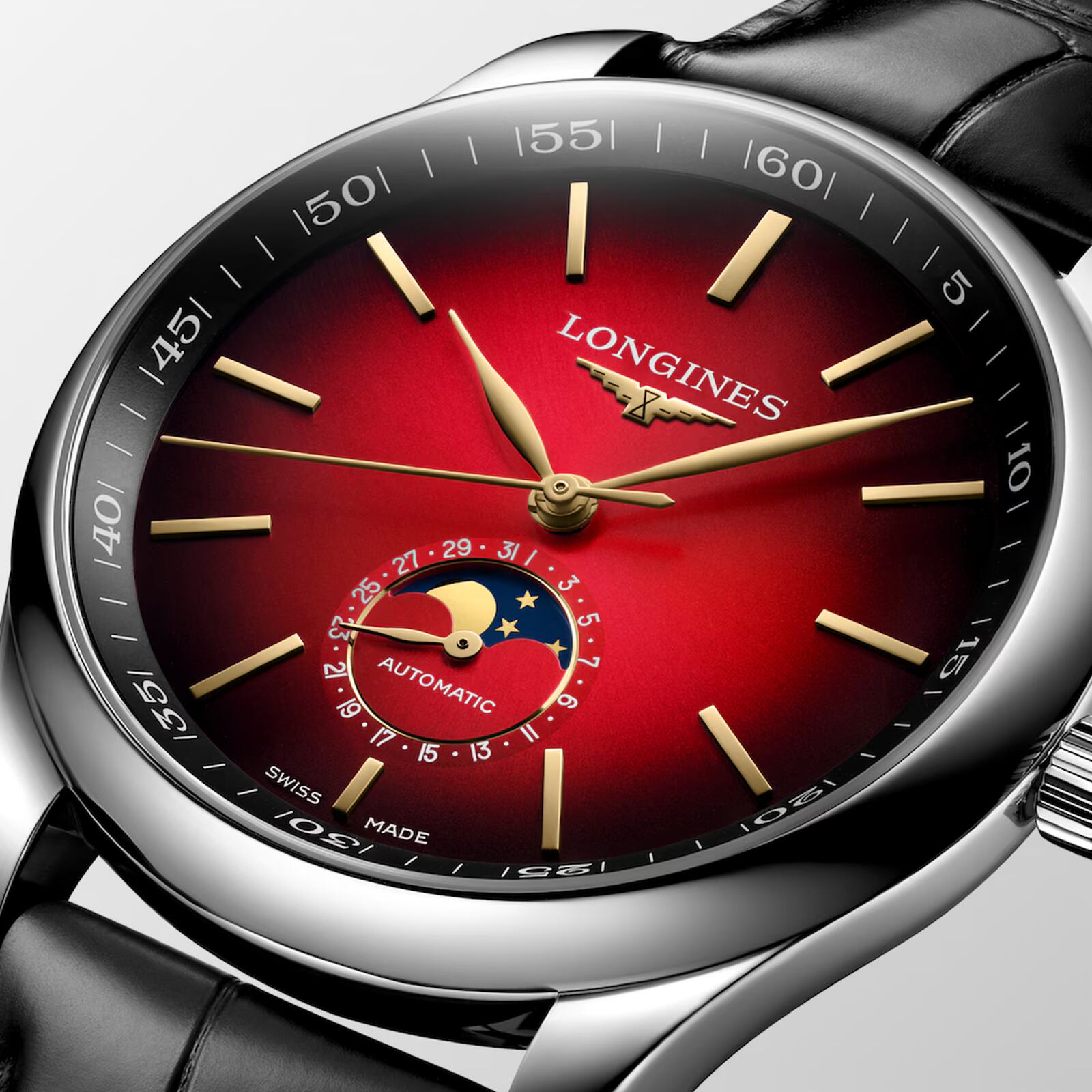
Turn the watch over, and its public face reveals itself as a masterclass in nuanced communication. The 42 mm stainless-steel case frames a dial of deep gradient red, darkening towards its edges like a celestial dusk or the heart of a rare wine. In Chinese culture, red signifies fortune and joy; paired with gold, it becomes doubly auspicious. Longines honours this symbolism with restraint rather than excess. Gilt appliqué indices and leaf-shaped hands catch the light, while at six o’clock the complication that gives the piece its raison d’être quietly breathes: the moonphase.
This is no mere aesthetic flourish. The Chinese calendar is lunisolar, its structure woven from lunar cycles. The golden moon’s passage across a star-studded aperture thus becomes a poetic link to the celestial mechanics governing the Year of the Horse itself. It is a complication that speaks of patience – of rhythms larger than quarterly reports – and of the ancient cycles that still, quietly, underpin modern Asian life. Powering it all is the automatic Calibre L899.5, offering a 72-hour power reserve: a weekend of grace notes, should one choose to let the watch rest.
The Emissary: Yosh Yu and the Anatomy of Modern Elegance
If the watch is the statement, its new ambassador is the living footnote that clarifies its meaning. The appointment of Chinese actor and musician Yosh Yu as Longines’ newest Ambassador of Elegance was a stroke of strategic precision. In a roster that includes global icons such as Jennifer Lawrence, Kate Winslet, and Henry Cavill, Yu represents a different archetype. He is a star forged in blockbuster cinema – notably The Creation of the Gods trilogy – yet his credibility is rooted in what happened when the cameras stopped rolling.
To portray a warrior prince, he did not merely perform; he devoted two years to mastering horse training and the demanding, almost archaic discipline of equestrian archery, eventually competing at a professional level. This is not celebrity dabbling for a campaign shoot. It is commitment – the same kind of discipline one associates with a watchmaker at the bench. As Longines CEO Patrick Aoun observed, Yu’s “determination, talent and multifaceted personality reflect what elegance means today”. In a landscape crowded with influencers, elegance is reframed here as a verb: it is doing, mastering, embodying. Yu’s bond with the equestrian world also echoes Longines’ own historic role as timekeeper for elite show jumping and racing events, making the partnership feel less like a marketing exercise and more like the recognition of a shared ethos.
View this post on Instagram
The Resonance: An Oasis of Meaning in a Desert of Disposability
What, then, does this object signify for the discerning – perhaps slightly jaded – millennial collector in Dubai or Abu Dhabi? In a city that thrives on the ephemeral – the pop-up restaurant, the limited-run exhibition, the seasonal fashion moment – this watch offers an alternative proposition: anchored legacy.
It is a limited-edition mechanical moonphase that understands its audience speaks the global language of luxury while thinking in the native grammar of cultural symbolism. It acknowledges heritage without being constrained by it. For a generation navigating the complexities of global identity, the watch becomes a seamless synthesis: Swiss horology, Chinese artistic heritage, and a universal narrative of momentum.
Priced at approximately $3,400, it occupies that compelling intersection between accessibility and exclusivity. It offers an entry point into serious watch collecting without demanding a king’s ransom, while its 2,026-piece limitation ensures it will never be ubiquitous. For the UAE’s young affluent consumers – those who can distinguish between social-media-driven hype and genuine horological and cultural pedigree – the Master Collection Year of the Horse presents a persuasive case.
Ultimately, the watch succeeds because it operates on multiple levels. It is a technically accomplished moonphase. It is a moving tribute to a master artist. It is a talisman for the equestrian spirit. Yet its greatest achievement lies in its restraint. In an era that too often confuses opulence with elegance and noise with importance, Longines – with Yosh Yu as its envoy – proposes a quieter truth. True elegance, it suggests, is cultivated in private: in the artist’s studio, on the archery field, in the watchmaker’s atelier – and only later, discreetly, revealed to the world. It is not about keeping pace with time, but about understanding what makes it precious. And as the Horse gallops into 2026, bearing its promise of freedom and momentum, there are far worse companions for the journey than a timepiece that has already mastered the art of the graceful leap.