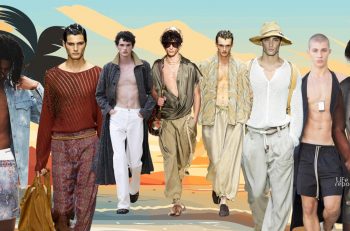
The mood for Winter 2025/26 is one of serene conviction. As the light fades to a slate grey, the discerning man’s wardrobe doesn’t shout for attention; it commands it through the whisper of exquisite cashmere, the decisive drape of a coat, and the quiet confidence of a colour chosen for feeling rather than flash.
This is not a retreat from expression, but a deeper, more personal engagement with it. Eight houses – Zegna, Brunello Cucinelli, Kiton, Dunhill, Brioni, Canali, Bally and Berluti – lead a conversation that speaks fluently to both the millennial seeker of substance and the Gen Z curator of self, proving that true luxury is not defined by the volume of a logo, but by the depth of a narrative.

The New Architecture of Ease: Silhouettes Reimagined
The rigid, power-shouldered uniform of old has been thoughtfully deconstructed. The modern silhouette is softer, more fluid, and profoundly considered – a sartorial exhale. At Zegna, Artistic Director Alessandro Sartori masterfully lowers the collection’s centre of gravity, employing longer jackets, lowered button stances, and generously broken trouser hems that pool luxuriously around the ankle. The effect is one of deliberate, elegant weight. His genius lies in reimagining iconic pieces, such as the shearling-collared raglan-sleeve overcoat, and engineering them anew for modern posture and attitude, with pockets cut at just the right angle for hands slipped casually inside.
View this post on Instagram
This philosophy of intelligent ease resonates elsewhere. Kiton speaks directly to what it calls the “Collector of the Art of Living,” a man for whom elegance is found in details, not declarations. His suit is back, but reborn with relaxed volumes, longer coats and a softer shoulder. Similarly, at Dunhill, Creative Director Simon Holloway practices what he terms “invisible innovation,” revisiting the brand’s archives to rediscover the “English Drape” – a softer, more natural shoulder construction pioneered in the 1930s for the Duke of Windsor. The result is tailoring that feels less like armour and more like a second skin: a “tailored but casual” direction for a world that values both polish and comfort.
View this post on Instagram
The Gospel of Gastronomical Proportions: Layering as a High Art
The art of layering evolves from practical necessity into a central tenet of style. The key is a harmonious interplay of textures and proportions that builds a narrative from the skin outward. Think of it as a culinary composition of flavours: a base of fine-gauge cashmere, a mid-layer of textured corduroy or quilted satin, crowned with a grand, enveloping overcoat. This season, outerwear is the undisputed protagonist. Beyond the timeless peacoat, celebrated for its classic, naval-inspired lines, we see a renewed appreciation for volume and craft. Zegna presents overcoats with detachable shearling liners and amplified lapels, while Kiton showcases the ultimate in luxurious insulation: a shearling bomber jacket lined in a blend of vicuña and cashmere. The knitwear beneath these layers has been promoted from supporting actor to leading role. Chunky, textured knits – including sophisticated knit hoodies that marry the comfort of sportswear with the refinement of a cable stitch – become essential armour against winter’s bite.
View this post on Instagram
Where Material Is the Message: A Tactile Revolution
In an era of digital noise, FW 2025–2026 invites us to reconnect through touch. The season is a symphony of tactility, where value is felt literally in the fabric. This is a world beyond superficial branding: the label is in the loom, the heritage in the hand-feel. Zegna’s entire Winter 2025 showcase was a testament to material obsession, staged within a breathtaking, grass-covered landscape that echoed the pastoral origins of its fibres. The star is the Vellus Aureum line, crafted from lambswool so fine (12–13 microns) that it surpasses the typical fineness of cashmere. Sartori’s claim that it is “better than cashmere” is substantiated by a sublime, durable softness that defines the collection’s luxurious blousons and coats. Kiton engages in a similar pursuit of the rare and exceptional, building jackets from pure vicuña, cashmere and linen, and offering a “private” made-to-measure service centred on these peerless materials. At Dunhill, the narrative is woven through heritage British cloths – robust Melton, nubby Donegal tweed and fine wool whipcord – each cut with a newfound lightness.
View this post on Instagram
A Richer Vocabulary: Colour and Pattern with Intent
The palette of quiet luxury deepens from safe neutrals into a spectrum of emotion and intellect. While walnut, charcoal and camel remain foundational, they are now accented with shades that tell a richer story. We see flashes of romantic red breaking through – a shot of passionate intensity in otherwise subdued collections. Kiton explores an expansive, confident palette ranging from burgundy and pumpkin to azure. Pattern, too, returns with a scholar’s discretion. It is not about loud proclamation, but about inherited codes subtly reinterpreted. Dunhill draws inspiration from the flamboyant tartans of the Duke of Windsor, rendering them with a modern, mismatched flair. Elsewhere, Prince of Wales checks and houndstooth are enlarged and recalibrated, as seen at Zegna, making traditional patterns feel newly expansive and contemporary.
View this post on Instagram
Evening’s Quiet Rebellion: The New Formal
Formalwear sheds its stiff, ceremonial past in favour of a romantic, individualistic ease. This is black tie for the connoisseur – for the man who hosts a dinner party rather than merely attends a gala. Dunhill leads this evolution with exquisite smoking jackets in velvet, ancient madder silk or wool twill. Styled with what Holloway describes as the “deliberate mismatched flair of an aristocratic British connoisseur,” the look conveys inherited confidence rather than rented conformity. It is a vision of eveningwear that is intimate, poetic and self-assured – perfectly at home in the gilded salons of a private members’ club. It reflects a broader trend in which extreme formality paradoxically feels fresh, even rebellious, in our casual-centric age.
View this post on Instagram
The Bridge Between Generations: A Wardrobe as Personal Archive
What ultimately unites these collections is a profoundly humanistic vision. This is menswear conceived not as seasonal disposable fashion, but as a curated personal archive. The millennial pursuit of meaning and craft meets the Gen Z instinct for curation and recontextualisation. The new gentleman is the editor of his own legacy. He might pair a deconstructed Zegna blazer with a technical knit, layer a Cucinelli quilted gilet over a tailored shirt, or anchor a Dunhill heritage coat with relaxed wide-leg corduroys. He understands the grammar of classic style but writes his own sentences. As Kiton’s CEO, Antonio De Matteis, observes, the ultimate luxury today is “the ability to set your own pace.” The clothes of FW 2025–2026 are designed for precisely that: a life lived with intention, where elegance is the natural by-product of discernment, intelligence and a deep appreciation for the quiet, enduring things.
View this post on Instagram
In the end, the season’s most powerful statement is its silence – a confidence that needs no announcement, only appreciation. It offers a sanctuary of considered style, building a bridge between generations on the foundation of what truly lasts: impeccable materials, intelligent design, and the silent, steadfast understanding that how one dresses is, ultimately, a testament to how one thinks.