Dubai is a city that thrives on hyperbole – taller, faster, more expensive – but every so often, something emerges that does not shout for attention. It simply sits there, exquisitely, waiting to be discovered. Such is the case with the latest offering from Sexy Fish Dubai: a limited-edition Easter egg that suggests the city’s culinary scene has quietly evolved from conspicuous consumption into something far more interesting – the art of restraint.
Before you roll your eyes at yet another “luxury chocolate collaboration”, consider what is actually happening here. We are not talking about a gold-leaf-dusted bauble designed exclusively for Instagram oblivion. This is a genuinely restrained object – only 150 pieces exist – that brings together Valrhona, the French chocolate house that serious pastry chefs regard with something approaching religious devotion, and David López, a Spanish contemporary artist whose work has found a natural home at Mondoir Gallery. The result is less an Easter novelty than a small, edible manifesto on how Dubai’s luxury landscape is finally learning to whisper.

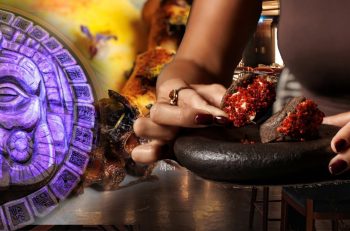
The egg itself is handcrafted by Executive Pastry Chef Jibu Mohan using Valrhona’s Hukambi 53%, a single-origin couverture from southern Bahia that deserves its own paragraph. This is not your standard-issue milk chocolate. Hukambi, which Valrhona describes as the first “cloudy couverture”, walks an unusual line between the familiar comfort of French milk chocolate and the darker, more complex traditions of Brazilian cacao. The beans come from a family-run plantation called M. Libânio, nestled within the Mata Atlântica, a UNESCO Biosphere Reserve where cocoa grows in the shade of rubber trees under a system known locally as cabruca. There is something quietly radical about this: an Easter egg that traces its lineage not to a factory in Switzerland, but to a rainforest in Brazil, where agroforestry and Rainforest Alliance certification are part of the package.
What you taste is the result of that geography. Hukambi 53% offers cocoa-rich notes layered with something slightly biscuity – almost like the memory of a madeleine crumbling on the tongue – and a gentle bitterness that prevents it from sliding into cloying sweetness. Chef Mohan has worked with this chocolate to create a shell that catches the light like polished bronze, with an ombré effect that makes each egg feel less like confectionery and more like something you might find in a gallery vitrine.
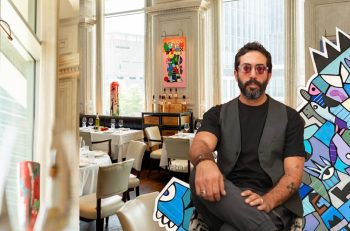
And that, of course, is the point. The egg arrives in a custom collector’s box designed by David López, whose multidisciplinary practice spans painting and design, with a visual language that feels both playful and rigorous. His design for Sexy Fish draws on the restaurant’s underwater fantasy aesthetic – that vibrant, slightly surreal oceanic world shaped by Martin Brudnizki’s interiors and Damien Hirst’s artworks. But López does something clever here: instead of competing with the chocolate inside, his box frames it. The design echoes the movement and texture of the restaurant’s identity while allowing the egg to exist as an object complete unto itself.
View this post on Instagram
At AED 170, this is not the sort of purchase one makes on impulse at the supermarket checkout. It is a pre-order affair, with delivery arranged 48 hours before Easter Sunday on 5 April. The pricing, interestingly, places it in a curious middle ground – more expensive than Lindt’s mass-market offerings, which this year include a “Dubai Style” pistachio-filled egg that capitalises on the region’s culinary moment, but considerably less than the crystal confections from Swarovski, whose annual egg collection currently sits at AED 530 for something you cannot even eat. There is a pleasing irony here: the edible object is the affordable one.
What Sexy Fish understands – and what the rest of Dubai’s luxury sector is slowly beginning to grasp – is that genuine sophistication lies not in size or price tag, but in narrative. This egg has a story that unfolds in layers: the Brazilian cocoa farm operating within a UNESCO reserve; the French chocolate house with B Corporation certification; the Spanish artist whose work bridges contemporary art and commercial design; the Japanese-inspired restaurant that has somehow made all of this feel coherent. It is the kind of layered cultural fluency that Richard Caring’s Caprice Holdings has spent two decades perfecting, from the acquisition of The Ivy to the global expansion of Sexy Fish across London, Miami, and Manchester.
There is also something quietly subversive about an Easter egg that invites collection rather than immediate consumption. The tradition of decorative eggs at Easter is, of course, centuries old – Fabergé built an empire on it. But those were objects for the imperial elite, meant to be displayed in vitrines and passed down through generations. This is something slightly different: a contemporary interpretation that acknowledges our current moment’s obsession with scarcity and collaboration, yet retains enough genuine craftsmanship to avoid feeling cynical. When only 150 people can own something, the question is no longer “Can I afford this?” but “Am I one of the 150?”

For those who answer yes, the reward is a chocolate egg that tastes of Brazil and France, arrives in a box designed by a Spanish artist, and carries the cultural cachet of a restaurant that has established itself as a fixture in three international cities. It is, in other words, precisely the kind of object that Dubai does best when it stops trying to impress and starts trying to mean something.
Pre-orders are now open. Delivery arrives 48 hours before Easter. And if you are wondering whether a chocolate egg priced at AED 170 can possibly be worth it, you have already missed the point. The question is not value – it is whether you understand the story well enough to want a piece of it.