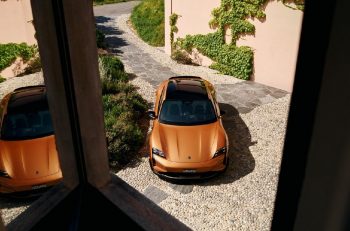
Between a remastered 2002 Cayenne and its all-electric successor, Dubai’s Icons of Porsche festival revealed that true modern luxury is not about the vehicle itself, but about the signature you leave upon it.
The stark, rational angles of the Design District soften when bathed in a glow that turns glass and steel into molten gold. It is the perfect, fleeting hour for an object lesson in desire. At the fifth Icons of Porsche festival, where attendance swelled beyond a record 30,000 visitors, that lesson was not preached but displayed with eloquent simplicity. Side by side, separated by more than two decades of engineering dogma, sat two Cayennes. One, a 2009 GTS, had been summoned back to the factory for a “Factory Re-Commission”, emerging resplendent in Black Olive paint and an interior where English Green leather met the iconic, retro-chic Pasha fabric. The other was the freshly unveiled Cayenne Electric, a digital-native SUV promising up to 1,156 PS.

The dialogue between them was deafening. This was no longer merely an automotive show; it was an exhibition on the evolution of the signature – a masterclass in how the region’s new generation of affluent consumers, from the streetwear-savvy to the wellness-devoted, are redefining luxury not as a badge, but as a bespoke imprint.
The Alchemy of the Archive: When the Past Becomes a Project
To understand the gravity of that 2002 Cayenne’s presence is to appreciate a delicious irony. Upon its launch, purists decried it as heresy: a five-seat SUV from the sacred house of the 911. Today, it is officially a Porsche Classic – a certified artefact. The vehicle displayed in Dubai, belonging to collector Phillip Sarofim, had undergone Porsche’s Sonderwunsch (“Special Wish”) programme, a process in which the customer becomes, in the company’s own words, “part of the team” and the “project manager for their own vehicle”.
This is where modern luxury pivots. It is no longer passive ownership, but active, creative collaboration. The craftspeople in Zuffenhausen did not simply restore the car; they reimagined it, applying heritage fabric to a modern classic and treating the SUV not as a mere machine, but as a canvas for personal history. In a market such as the Gulf, where Emirati HNWIs demonstrate a profound appetite for exclusive collections and deeply personalised experiences, this offering is especially potent. It speaks to a desire for narrative – for an object that contains its own origin story, meticulously tailored through dialogue between client and creator. It transforms a car into a curated heirloom, a piece of moving autobiography.
View this post on Instagram
The Electric Proposition: Performance as a Personal Palette
If the classic Cayenne articulated luxury through curated nostalgia, its electric successor presented it through boundless configuration. The Cayenne Electric arrives as the most customisable iteration ever offered by the marque, with an extensive selection of 13 exterior colours, 12 interior combinations, and new leather hues such as Lavender and Sage Grey.
This breadth of choice is a strategic mirror held up to its primary audience. It caters directly to the nuanced preferences of the Gulf’s diverse luxury consumers: the understated elegance favoured by the Saudi streetwear community, the globally attuned eye of the Emirati HNWI, and the tech-integrated aesthetic embraced by Gen Z buyers. The SUV’s formidable performance – 0–100 km/h in as little as 2.5 seconds for the Turbo variant – is a given, merely the entry requirement in this arena. The true proposition lies in the promise of a vehicle that becomes an aesthetic and functional extension of its owner’s identity before it even turns a wheel. In a cityscape defined by custom-built penthouses and bespoke concierge services, the ability to specify a 1,156-PS machine down to its exact chromatic and tactile details is the logical next step in a hyper-personalised lifestyle.
View this post on Instagram
The Ironic Counterpoint: Whispers from Weissach
Yet the festival’s forward-looking electric enthusiasm was underscored by a whisper of corporate pragmatism drifting in from Germany. Only weeks earlier, Porsche had made headlines for scaling back its ambitious EV roadmap, shelving plans for a future battery-powered luxury SUV and pivoting towards reinforcing its hybrid and combustion-engine line-up. The official rationale cited waning demand for luxury EVs alongside punishing production costs.
The spectacle in Dubai therefore carried a fascinating tension. Here stood the all-electric Cayenne, presented as the vanguard, while back at headquarters strategy was being quietly – yet significantly – recalibrated. For the astute observer, this added a layer of poignant drama to the display, highlighting the high-wire act luxury manufacturers now perform: balancing visionary statements with market realities, a dance as intricate and calculated as the aerodynamic profile of the 911 Turbo S also on show.
View this post on Instagram
The Cultural Confluence: Where Monsters Meet Motorsport
To regard Icons of Porsche solely as a car show is to miss its essence. It is, in truth, a cultural bazaar, and one of its most compelling showcases belonged to artist Kasing Lung. In a stroke of cross-generational genius, Porsche collaborated with Lung to place “Labubu”, the most recognisable character from his The Monsters series, behind the wheel of a 911 Targa Art Car. In addition, a strictly limited 40-centimetre-tall metal sculpture – King Mon in Porsche 911 Targa – was unveiled, limited to just 60 units worldwide.
This move is strategic alchemy. It bridges the legacy of the 60-year-old Targa with the potent, collectible energy of contemporary art toys – a universe revered by the same Gen Z and millennial audiences reshaping luxury consumption across categories from skincare to streetwear. The message is clear: Porsche understands that its icons are not static relics. They are active participants in contemporary visual culture, capable of sharing the spotlight with a mischievous, furry monster – and leaving both richer for the association.
The Technical Sublime: The 911 Turbo S and the Ghost in the Machine
Amid this celebration of past and future, the present roared into focus in the form of the new 911 Turbo S. Its defining innovation is the T-Hybrid system, technology derived directly from the unforgiving laboratories of motorsport. At its core are electric exhaust turbochargers (e-turbos) that spool instantly, banishing the spectral lag of old, alongside a compact electric motor integrated into the PDK gearbox. The result is a combined output of 711 PS and a 0–100 km/h time of 2.5 seconds.

Yet the true luxury here is experiential. It is the seamless, linear surge of power that feels less like mechanical combustion and more like a silent digital command executed by the physical world. This is engineering so advanced it becomes intuitive – a fitting metaphor for the effortless, controlled power that the Dubai luxury scene itself aspires to project.
The Signature, Final
As golden hour faded over the Design District, the lesson of the two Cayennes crystallised. The future of luxury, in Dubai and beyond, is diverging into two powerful, parallel streams. One flows towards deep, authentic personalisation – the Sonderwunsch path – where history is remastered and the owner’s voice is embedded into the object’s very soul. The other flows towards expansive, tech-forward self-expression, where performance becomes a platform for infinite customisation.
Porsche, with one foot planted firmly in its hallowed archive and the other testing the voltage of the future, is uniquely positioned to serve both. For the new generation shaping the Gulf’s luxury landscape – a cohort responsible for nearly 40 per cent of Dubai’s property purchases and defined by an optimistic, experience-driven relationship with wealth – the question is no longer, “What do you drive?”
The more revealing inquiry has become: “What did you have them build for you?”
In the end, the most profound status symbol is not the crest on the bonnet, but the indelible signature left upon the masterpiece.