Scepticism arrives before the valet does. Anyone who has endured one too many “experiential” showrooms – the fern in the corner, the cold-pressed juice, the salesperson in trainers and a blazer performing sincerity beside a compact SUV – knows the choreography by heart. So when Porsche announced it was turning its Sharjah outpost into something called a “Destination”, the eye-roll was instinctive and, frankly, well-earned. It was also premature.
On the evening of 18 October, beneath a sky that had mercifully abandoned its summer belligerence, Porsche Centre Sharjah did something unexpected. It opened its doors not with a drumroll of horsepower figures, but with bakhoor and gahwa, the bitter little cup of welcome that remains the most eloquent sentence in the Gulf’s hospitality vocabulary. It was a small gesture, almost incidental. It was also the tell. This was not a showroom launch. It was a seduction – and a rather sophisticated one at that.
The Showroom That Stopped Selling (For a Night)
The Destination Porsche concept, for the uninitiated, is the brand’s global architectural pivot away from the cathedral of commerce and towards something closer to a members’ club with really excellent parking. The idea is simple enough on paper: fewer desks, more sofas; fewer brochures, more conversation; a flexible floor plan that can accommodate a private dinner, a design talk or a quiet Tuesday afternoon with an espresso and a 911 Carrera in the corner. The Sharjah incarnation, unveiled to the public in conjunction with the local debut of the Cayenne Electric, executes this with a restraint that borders on the architectural equivalent of a well-cut suit: nothing shouts, everything fits.

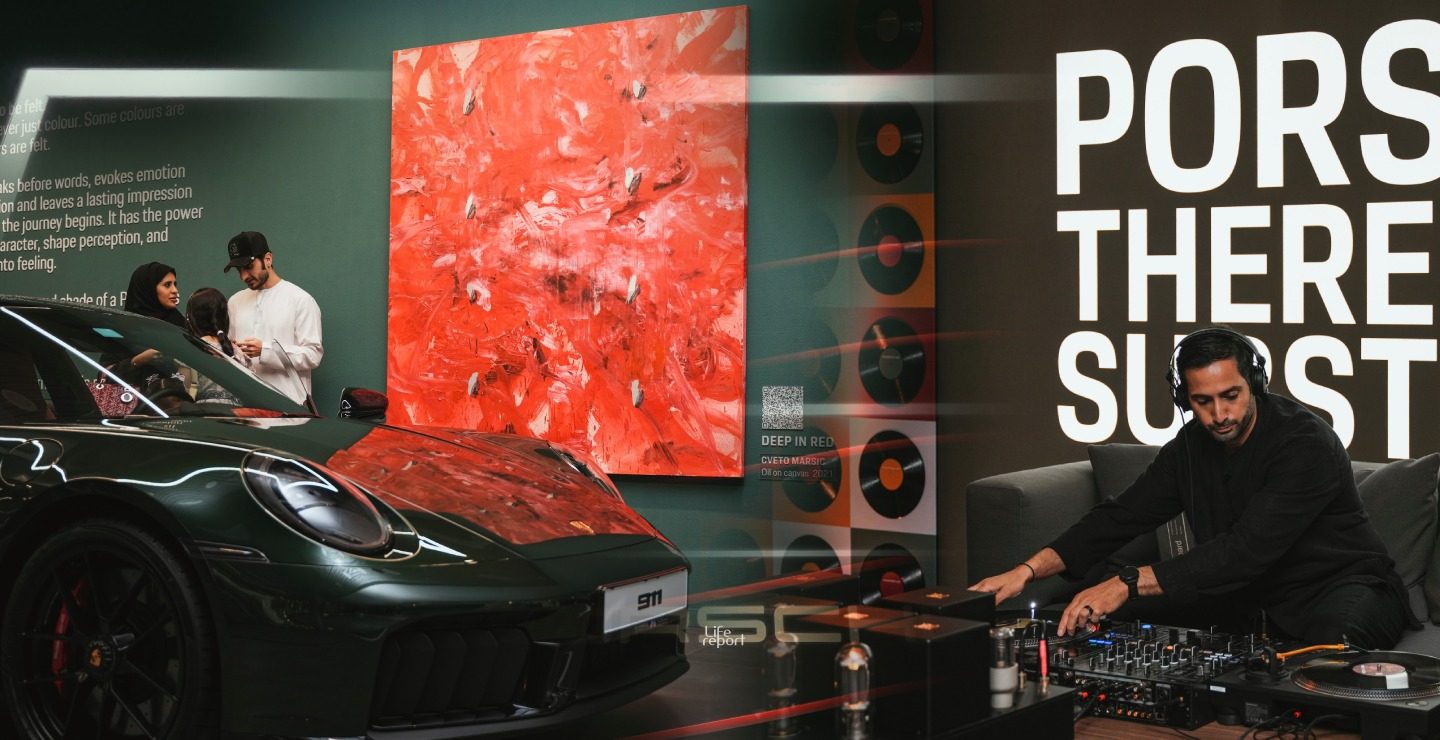
The evening itself was curated with the kind of cross-disciplinary confidence that Dubai’s cultural scene has spent the last decade learning to fake and only occasionally gets right. In partnership with Oblong Contemporary, whose Al Quoz space has become a reliable barometer of the region’s contemporary pulse, works by Hussain Jamil, Cveto Marsič and Giuseppe Maiorana were placed throughout the showroom – not as decoration, but as provocation. Colour fields and material experiments entered into a silent dialogue with the sculpted flanks of the cars, inviting the kind of looking that happens when you stop worrying about the monthly payment.
At the Porscheplatz Café, guests ate and drank. At the Vinyl Lounge, someone had the good sense to programme actual records rather than a Spotify playlist, a small but meaningful distinction in a city where “curated” has become the most abused adjective since “iconic”. There was an illustration corner, which sounds twee until you realise it was populated by adults with the slightly embarrassed concentration of people rediscovering the pleasure of making something with their hands. And then, of course, there was the car.
The Elephant in the Room Is Electric
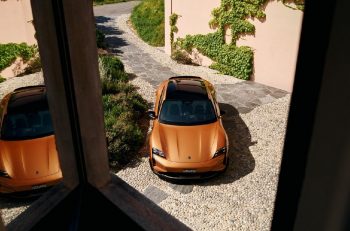
The Cayenne Electric took centre stage, as it was always going to. Porsche’s most powerful production car to date is a machine of genuinely absurd proportions: in Turbo form, it produces up to 850 kW (1,156 PS) and 1,500 Nm of torque under Launch Control, accelerating from 0 to 100 km/h in 2.5 seconds with the sort of violence that makes a mockery of the laws of physics and the patience of tyre manufacturers. Even the base Cayenne Electric, with its 113 kWh battery and 442 PS under Launch Control, accelerates from 0 to 100 km/h in 4.8 seconds and offers a WLTP range of up to 642 kilometres – figures that, a decade ago, would have seemed like the fever dream of an over-caffeinated engineer.
View this post on Instagram
But the real story is not the numbers. It is the placement. By putting the electric Cayenne at the heart of a refurbished facility in Sharjah, Porsche is making a quiet but unmistakable argument: that the electrification of the luxury SUV is not a concession to regulators or a sop to the eco-conscious, but a continuation of the same engineering obsession that gave the world the 959 and the Carrera GT. The Cayenne Electric is not an apology. It is a statement, delivered in the tone of someone who knows they do not need to raise their voice.
Inside, the cabin has undergone its own quiet revolution. The sweeping Flow Display sits at the centre of a cockpit that, with its digital instrument cluster and optional passenger display, offers the largest display area yet seen in a Porsche. It feels less like a traditional dashboard and more like a piece of deliberately restrained industrial design. The wheelbase has been stretched to 3,023 mm, liberating rear legroom in a way that will be appreciated by anyone who has ever attempted to transport a tall adult in the back of a performance SUV. It is all very sensible, very considered and very Porsche – which is to say, it is the kind of sensibility that makes a 1,156 PS family car feel not like an oxymoron, but like an inevitability.
Meanwhile, in the Desert, a Festival Grows Up
If Sharjah was the overture, Icons of Porsche is the main event. The sixth edition of the region’s largest automotive festival returns on 21–22 November, and for the first time, it will take place at The Square Nad Al Sheba, a 21,000-square-metre outdoor lifestyle precinct that has, in the space of two years, become the closest thing Dubai has to a genuinely organic cultural commons. Last year’s gathering drew more than 30,000 fans and featured over 1,000 cars – a figure that suggests the event has long since outgrown its niche enthusiast label and become something closer to a tribal gathering for the region’s car-obsessed, design-literate and, frankly, well-dressed.

Dr Manfred Bräunl, CEO of Porsche Middle East and Africa, has spoken of the move as a “lift to new heights”, which is the kind of corporate phrasing that usually induces a yawn. But in this case, the logic is sound. The Square Nad Al Sheba, with its landscaped gardens, koi pond and rotating roster of homegrown food and beverage concepts, offers something that a conventional exhibition centre cannot: atmosphere. It is a place where you can wander from a concours-condition 356 Speedster to a plate of SLRP ramen without the transition feeling jarring. It is, in other words, exactly the kind of venue that the festival’s increasingly youthful and cosmopolitan audience has been quietly demanding.
Standard tickets are priced at AED 85, although a limited early-bird rate of AED 65 has also been listed on the booking page. Children under twelve can attend free with a ticketed adult, but a complimentary ticket must be registered in advance. Such details suggest that Porsche understands something its competitors often forget: brand loyalty is built not in the showroom, but in the memory of a child standing open-mouthed before a Gulf Blue 911 while their parents argue about whether the ducktail spoiler is “a bit much”.
The Art of Not Trying Too Hard
There is a temptation, when writing about a brand like Porsche in a city like Dubai, to reach for the grand narrative: the triumph of German engineering over the desert heat, the meeting of European heritage and Gulf ambition, the relentless march of electrification across the asphalt of the Emirates. All of that is true, or true enough. But the more interesting story is smaller and harder to pin down.
View this post on Instagram
It is the story of a showroom that decided to open with art rather than a sales target. It is the story of a festival that moved to a venue with a koi pond because someone understood that the future of luxury is not more stuff, but better time. It is the story of a 1,156 PS electric SUV that can be charged wirelessly as an option, but whose most radical feature is the suggestion that you might want to sit in it for a while, in a pleasant room, with a record playing and a coffee going cold, and simply look.
The UAE’s Gen Z and millennial luxury consumer – a creature so relentlessly studied and so frequently misunderstood – is not, despite the prevailing wisdom, allergic to heritage. They are allergic to pretence. They will happily spend an afternoon discussing the finer points of Cveto Marsič’s brushwork or the tonal differences between a flat-six and an electric motor, provided the setting feels earned rather than staged. Porsche, to its credit, seems to have grasped this. The Destination concept is not a showroom with a gallery in it. It is a gallery with some very fast cars in it, and the distinction matters more than it should.
Whether this translates into sales is, of course, someone else’s problem. What remains is the rare spectacle of a luxury brand behaving with a modicum of self-awareness. The Cayenne Electric is impressive. The Sharjah showroom is elegant. The festival will almost certainly be enormous. But the real luxury, as anyone who has spent enough time in this city knows, is the feeling – however fleeting – that someone, somewhere, has actually thought about it.
ALSO READ: Pieter Vermeersch Comes to Dubai: The Exhibition That Asks You to Simply Look