Not long ago, the notion that a post-industrial Basque port could school the world in the economics of desire seemed like magical thinking. Then a titanium-scaled leviathan designed by Frank Gehry rippled into existence on the Nervión’s edge, and the improbable became a formula.
Three decades later – the museum turns thirty in 2027 – the “Bilbao Effect” is the most imitated, Instagrammed and occasionally parodied phenomenon in cultural tourism. Now, as the Guggenheim Abu Dhabi’s long-awaited opening on Saadiyat Island approaches, with another Gehry-designed landmark rising from the desert, the original insists on a return pilgrimage. Before the next wave of hype crests, there has never been a better moment to explore the collection that rewrote the rules. Here, without the digital noise, are ten essential encounters that turn a museum visit into a quiet masterclass in contemporary awe.
Step into the Fog, Then into the Void
Every proper entrance requires a threshold. Outside, Fujiko Nakaya’s Fog Sculpture #08025 (F.O.G.) – an acronym that winks at Frank O. Gehry – cloaks the pond beside the riverfront façade in a ghostly mist released every hour from 1,000 concealed nozzles. It is a piece that dissolves architecture into atmosphere, transforming a morning coffee into a moment of pure Tarkovskian drift. Nakaya has spoken for decades of fog in terms of decomposition and decay, but here it feels less like entropy than a palate cleanser: the city, the bridge, the selfie stick, all erased in white silence.
View this post on Instagram
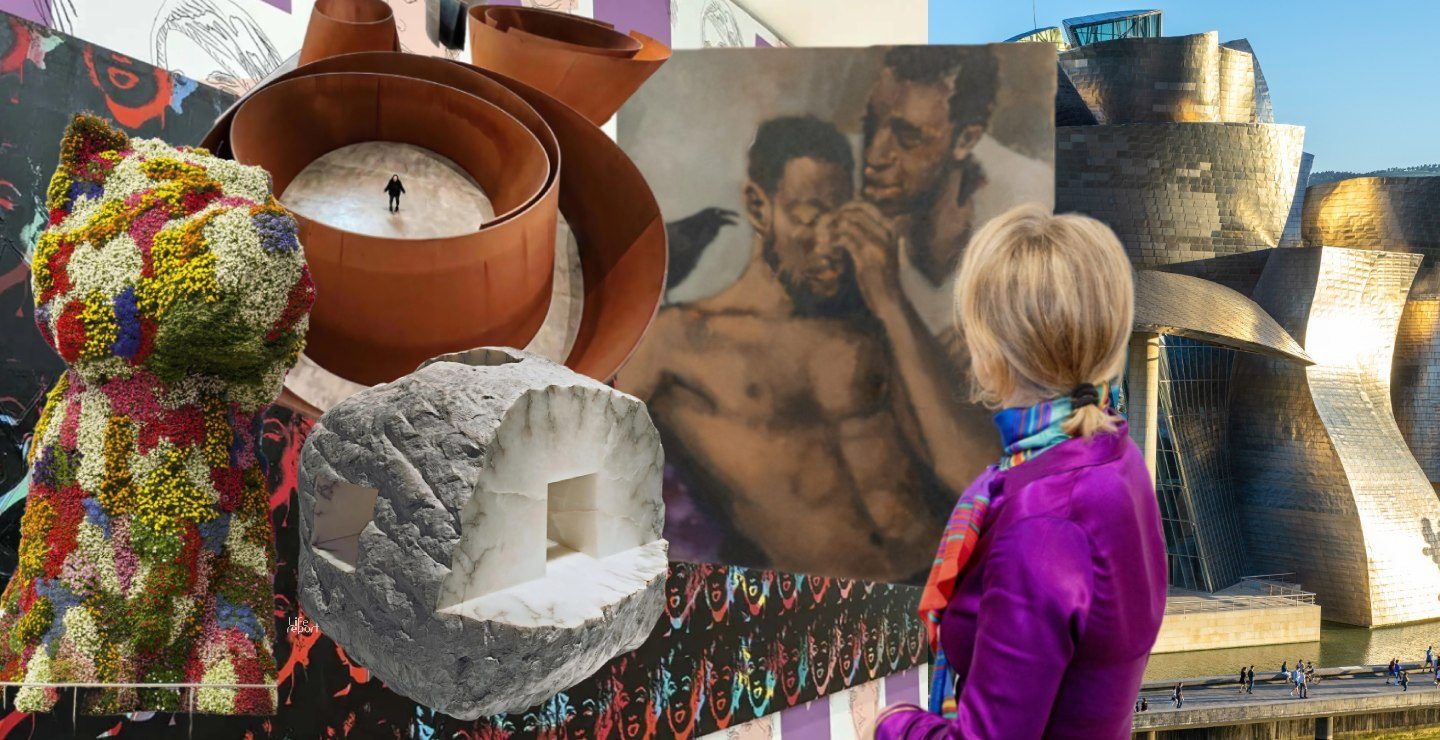
Inside, you descend immediately into the cathedral-scale chamber that houses Richard Serra’s The Matter of Time (1994–2005). This is not a sculpture you observe; it is a sculpture that ingests you. Eight colossal torqued ellipses and spirals of weathering steel, their surfaces the colour of a rusted ocean liner, create corridors that narrow and widen in ways your inner ear refuses to anticipate. Walking through them is to experience space as a mutable substance – at once a three-dimensional exercise in Escher-like disorientation and a strangely meditative surrender to physical sensation. The scent is metallic and mineral, like a vintage car’s patina, and the acoustics turn your footsteps into a distant, reverberant dialogue. Leave your phone on silent. A twenty-minute, unhurried passage here recalibrates the body for everything that follows.
View this post on Instagram
Colour as Theology, Colour as Memory
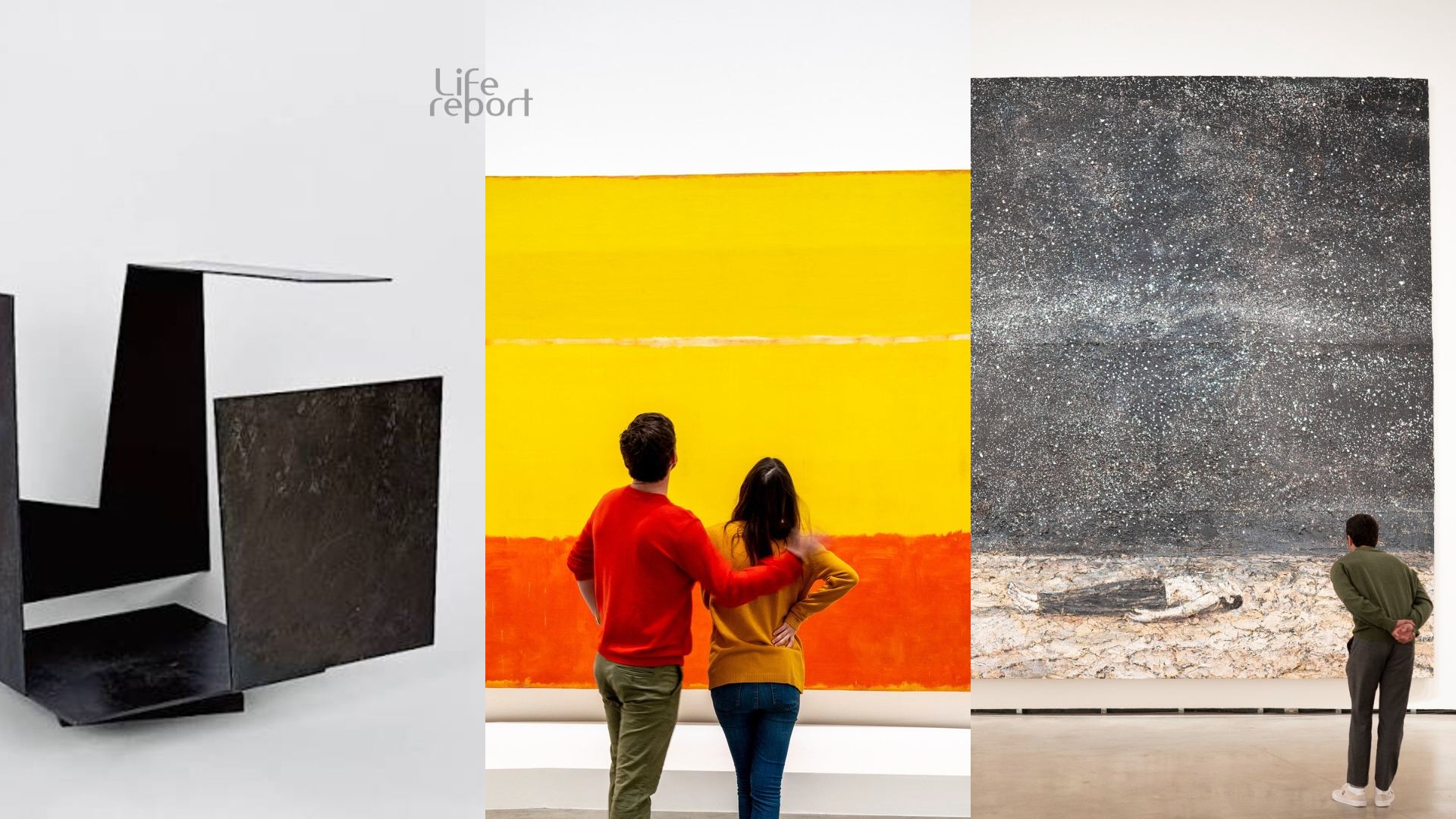
From the visceral weight of steel, ascend towards the luminous. Mark Rothko’s Untitled (1952–53) is a canvas that breathes. Two blurred rectangles of ochre and violet float against a bruised crimson ground, their edges soft as exhalation. Rothko famously rejected purely aesthetic readings, aiming instead for an encounter with the “basic human emotions – tragedy, ecstasy, doom”. In an age of high-definition distraction, surrendering to the subtle, radiating glow of a Rothko feels like an act of cultural defiance. There is no narrative, no focal point, no filter that improves it. The painting simply waits, like a Zen garden, for your nervous system to slow down.
View this post on Instagram
A few galleries away, Yves Klein’s Large Blue Anthropometry (ANT 105) (ca. 1960) delivers a very different kind of transcendence. Klein’s patented International Klein Blue – a shade of ultramarine so saturated it appears to generate its own light – swallows the canvas. The forms were made by nude models serving as “living brushes”, pressing and dragging their bodies across paper under the artist’s tuxedo-clad direction, an event soundtracked by his Monotone Silence Symphony. The result is part performance relic, part abstract sublime. The splatters and ghostly imprints mock the machismo of Abstract Expressionism with an almost camp elegance. Decades later, the colour still haunts the runways of CELINE and the vitrines of every serious design gallery; its spiritual ownership of pure pigment remains absolute.
View this post on Instagram
Basque Soul, Carved and Empty
To understand the museum’s deeper geology, one must engage with its local titans. Jorge Oteiza’s Metaphysical Box by Conjunction of Two Trihedrons. Homage to Leonardo (1958) is a small steel cube that opens into a dark interior void – a “sacred space” in miniature. Oteiza, a Basque sculptor who abandoned sculpture in 1959 to devote himself to cultural, educational and political activism, spent his final creative years emptying geometric forms into light and spirit. The work is proto-Minimalist, almost forbiddingly quiet, but its hermetic intensity feels like a whispered secret about the nature of creation. It’s the kind of object that makes you glance around for a fellow witness before catching yourself in the absurdity of looking for validation in an empty room.
View this post on Instagram
Nearby, Eduardo Chillida’s How Profound Is the Air (1996) performs a similar act of material poetry. Trained in architecture, Chillida carved a rough, mountainous block of alabaster into an interior chamber of polished, luminous precision. The stone conceals and reveals simultaneously, a metaphor for the artist’s fascination with the “dark light” of his homeland. The title, borrowed from a poem by Jorge Guillén, suggests a question that has no answer, only texture. For a moment, the alabaster seems to hum with the same primordial frequency as the fog outside.
The Haunted and the Iconic
Anselm Kiefer’s The Renowned Orders of the Night (1997) transports you into a vast, cracked celestial map where the artist himself lies prone, a tiny figure beneath a field of stars rendered in acrylic, emulsion and sheer existential weight. Kiefer, Germany’s great alchemist of memory, creates palimpsests of myth, history and cosmic loneliness. The painting recalls the occult philosophy of Robert Fludd, who believed every terrestrial plant had a stellar counterpart. Standing before it, the connection between microcosm and macrocosm feels less like arcane lore and more like a diagnosis of our own atomised longing for meaning.
View this post on Instagram
A deft turn of the heel brings you to Gerhard Richter’s Seascape (with Olive Clouds) (1969). Richter’s genius for blurring the boundary between painting and photograph reaches its most melancholic crescendo here. A horizon line of impossible stillness divides a grey sea from a sky of smeared olive clouds, creating an image of deceptive photographic perfection. It is Caspar David Friedrich by way of an analogue holiday slide, a meditation on the nature of visual memory that feels almost scientific in its tenderness. One half expects a Patek Philippe advertising campaign to have commandeered the wall for a seasonal shoot; it possesses that kind of restrained, aching perfection. Unlike the other works discussed here, however, this painting belongs to a private collection rather than the Guggenheim Bilbao’s permanent collection.
View this post on Instagram
Gestural and Grand
The abstract masters of post-war America occupy a generous wing, and their dialogue is electric. Willem de Kooning’s Villa Borghese (1960) channels the memory of a Roman park into explosive Mediterranean light. Yellows, greens and cerulean blues are applied wet-on-wet with a velocity that still feels fresh and briny, a far cry from the moody monochromes of his earlier Women. This is not a landscape; it is the sensation of one, reconstructed after a five-month Italian sojourn and translated into a muscular, airborne calligraphy.
View this post on Instagram
In the same breath, Robert Rauschenberg’s monumental Barge (1962–63) spreads almost ten metres of silkscreened urban cacophony before the eye. It layers images of water towers, satellites, trucks and Velázquez’s Rokeby Venus into a monochrome grid that reads like the central nervous system of a modern city. Rauschenberg, ever the mischievous master of the combine, turned the news cycle into a visual poem. From a distance, it’s a serene, silvery abstraction. Up close, it’s a busy Times Square of the mind, complete with mosquitoes, a rocket and a knowing nod to art history’s gaze.
View this post on Instagram
Pop, Reflection, Departure
Finally, Andy Warhol’s One Hundred and Fifty Multicolored Marilyns (1979) delivers the thesis statement of the entire collection. More than ten metres of silkscreened Marilyn Monroe portraits repeat and reverse in a shimmering grid of acid green, magenta and spectral blue. This is late Warhol, the artist repurposing his own iconography like a luxury brand recycling its archive. The repetition renders the starlet both omnipresent and ghostly, an effect heightened by the negative-image apparitions scattered among the multicoloured visages. It’s a work that predicted our endless algorithmic scroll of celebrity, beauty and erasure. Standing before it, you’re not just a viewer; you’re part of the replication, reflected in the polished marble floor beneath the canvas. A fitting, lightly ironic coda for a building that transformed a city by understanding, long before the rest of us, that image is infrastructure.
View this post on Instagram
Back outside, Jeff Koons’s Puppy – a twelve-metre West Highland white terrier covered in flowering plants – might be the most photographed resident of the Basque Country, and it knows exactly what it’s doing. It’s the final wink in an institution that has never confused populism with a lack of depth. The Bilbao Guggenheim remains the elegant proof that radical art and economic regeneration can coexist without corroding one another. As Abu Dhabi prepares its own seduction, the original sits by its river, weathered and wise, waiting for the next generation to walk through the fog and lose themselves in the steel.
ALSO READ: Bentley’s Most Exclusive Bentayga Yet? Inside the Artenara Edition Inspired by a Mountain