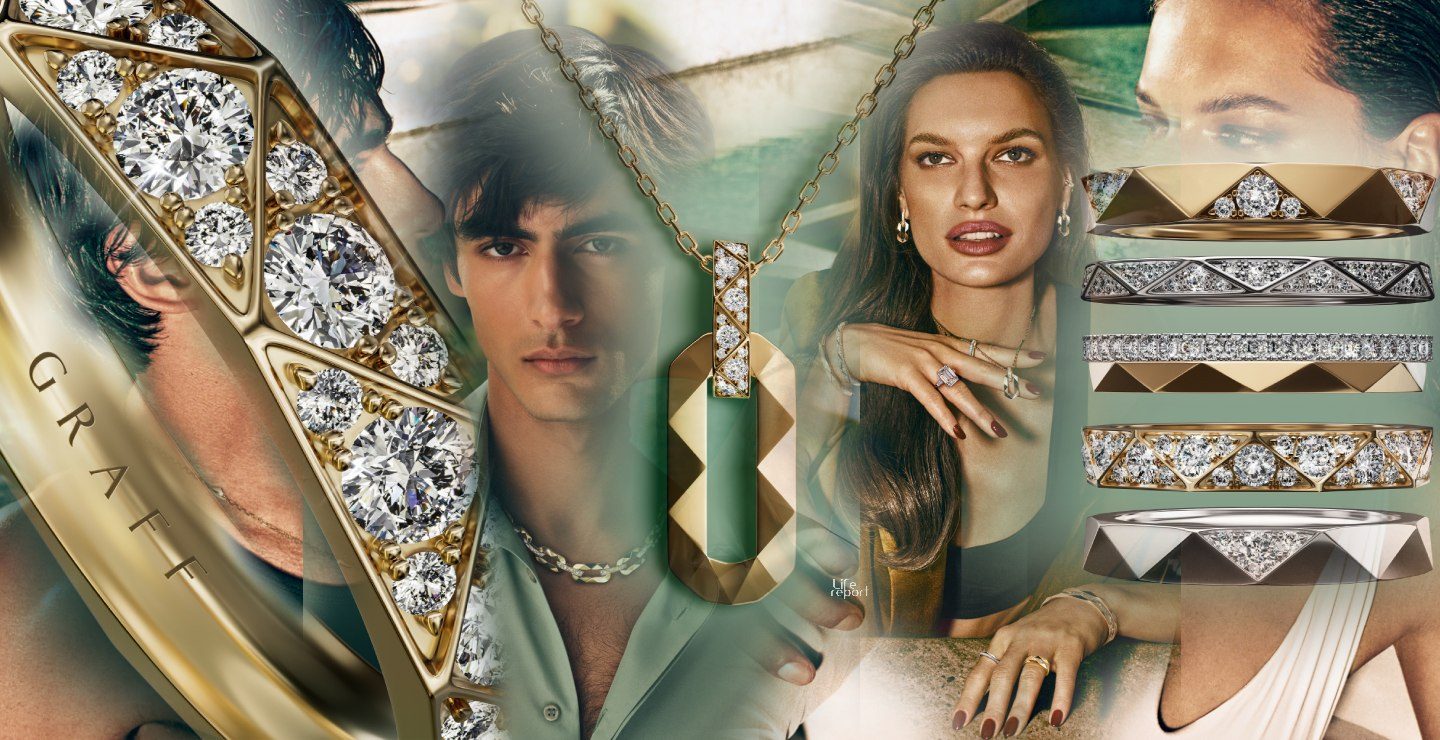
When Graff commandeered the Sheats–Goldstein Residence – John Lautner’s 1963 concrete-and-glass fever dream cantilevered above Los Angeles – the phrase “golden hour” seemed to recover something of its original alchemy. For a house built on the relentless pursuit of diamond fire, a campaign devoted to solid gold feels like watching a master perfumer abandon oud in favour of the crystalline clarity of bergamot. It should not work. Yet somehow, it does.
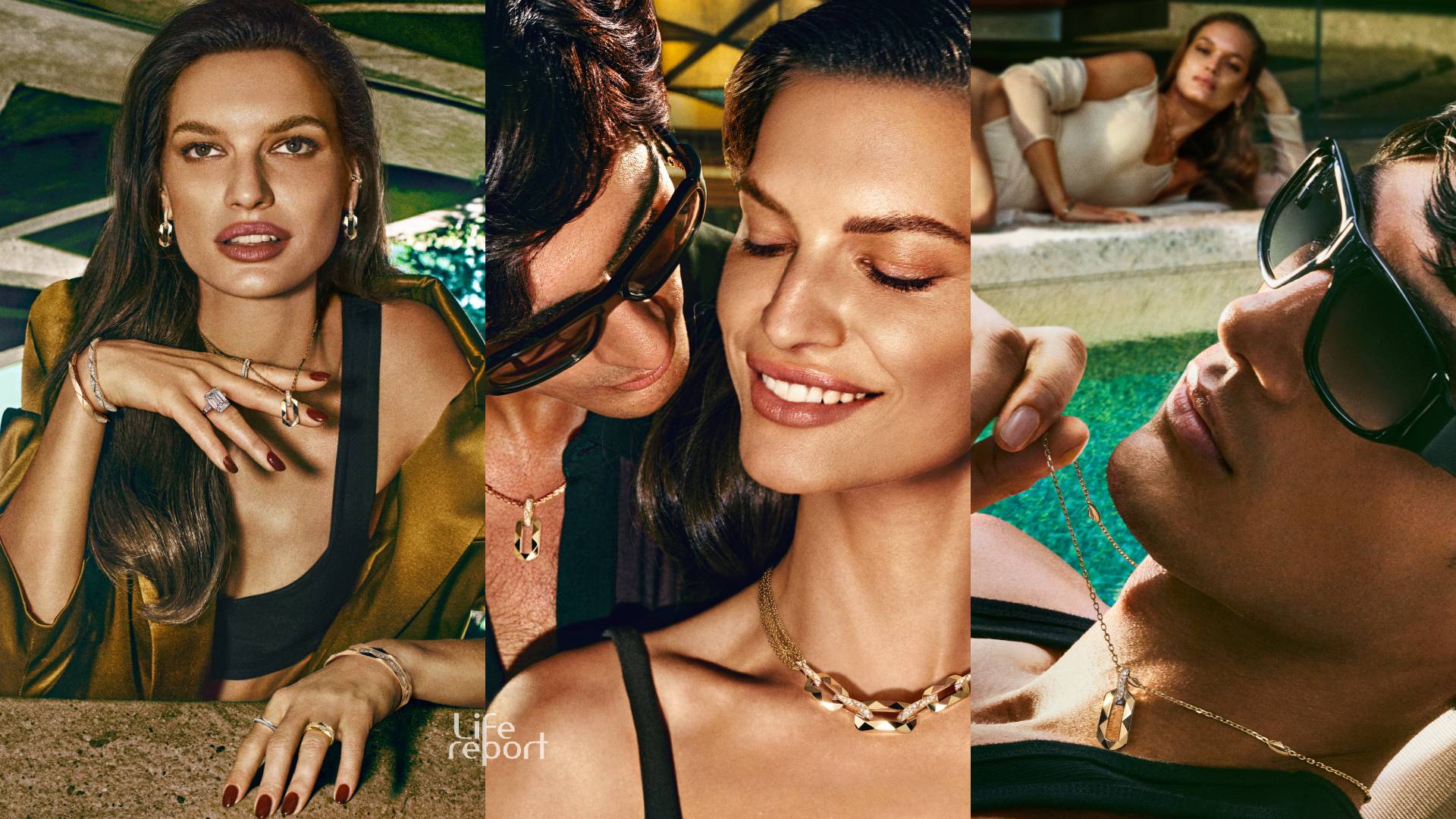
Shot by Steven Klein, the photographer who has built a career on making even the most angelic celebrities appear as though they know something you do not, the new Laurence Graff Signature campaign is a cinematic argument for gold’s second act. Models Faretta Radic and Akbar Shamji smoulder beneath the fading Californian light, their silhouettes sharply defined against Lautner’s triangulated ceiling coffers and uninterrupted walls of glass. The architecture, famously owned by James Goldstein and featured everywhere from The Big Lebowski to Snoop Dogg music videos, becomes a co-star: an angular, mid-century temple of hedonism mirroring every faceted link of jewellery. It is a location that could easily descend into fashion-shoot cliché – another heritage maison chasing Hollywood nostalgia – but Klein, with his characteristic dark wit, manipulates transparency and reflection until the house feels less like a backdrop than a manifesto. The message is unapologetically clear: this gold is not a softening. It is the architecture of light.
The collection itself is a paradox – one that Graff seems to relish. A diamond house, founded in 1960 by Laurence Graff on the principle that exceptional stones require no ornamental distraction, has spent more than six decades convincing the world that nothing shines quite like a flawless D-colour diamond. Now, with the Laurence Graff Signature collection, it poses a quietly subversive question: what happens when you remove the gemstone altogether and allow the metal to speak? The answer, it turns out, is volume – not in decibels but in presence. Each necklace, bangle and ear cuff is sculpted from a single piece of solid yellow, white or rose gold, its surface fractured into precise, diamond-inspired facets that capture the light from every conceivable angle. The effect is liquid architecture: imagine Frank Gehry’s fish sculptures rendered in 18-carat gold, or a Richard Serra ellipse reduced to the scale of a wrist.
François Graff, the House’s Chief Executive Officer, describes the collection as “unapologetically bold and deeply rooted in the DNA of Graff”, a statement that initially sounds like familiar luxury-house rhetoric. Yet one glance at the new chain-link iterations – a statement necklace, bracelet and earrings composed of faceted gold links substantial enough to anchor a small yacht – reveals a genuine evolution in design. The links reinterpret the signature motif as interconnected armour, sometimes left in sleek, molten gold, sometimes pavé-set with diamonds as though the metal itself had erupted into light. In another campaign image, Radic wears a pendant suspended from a doubled chain, its restrained geometry hovering at the collarbone like a modernist exclamation mark. Paired with triple-layered hoops and an ear cuff that climbs the cartilage with sculptural elegance, the effect feels less like jewellery than a system of wearable sculpture. This is gold for a generation that understands layering as a form of syntax – each bangle a clause, each chain another sentence in a carefully curated narrative.
Design Director Anne-Eva Geffroy speaks of the collection’s “endless versatility” and its invitation to mix metals, proportions and pavé intensities with an approach that feels almost algorithmically driven. It is a shrewd nod to the Gen Z and millennial luxury consumer in Dubai, a demographic that has elevated personal styling into something approaching competitive sport. In a city where the Gold Souk offers a nostalgic masterclass in 22-carat opulence, the Laurence Graff Signature collection arrives as an elegant counterpoint: gold stripped of filigree and floral ornament, engineered for the minimalist who nevertheless appreciates the reassuring gravity of precious metal. The irony is irresistible. A house synonymous with some of the world’s rarest diamonds – the 302.37-carat Graff Lesedi La Rona, the Wittelsbach-Graff and the legendary Graff Pink – is now making some of its most compelling arguments in plain gold. Perhaps that is the ultimate luxury: when craftsmanship alone can command the attention of an audience accustomed to billion-year-old carbon, one has entered an altogether different league.
View this post on Instagram
The campaign succeeds not simply because of the jewellery but because of its remarkable atmospheric precision. Klein, renowned for introducing a subtle thread of unease into even the most immaculate imagery, uses Lautner’s glass walls to multiply and refract the models’ reflections until Radic and Shamji appear simultaneously tangible and spectral. The golden hour light, far removed from soft-focus romanticism, slices across the interiors in dramatic diagonals, echoing the angular facets of the jewellery itself. The mood recalls less the glamour of Hollywood than a scene from a J.G. Ballard novel scored by Angelo Badalamenti – seductive, faintly alien and impeccably dressed. For Dubai’s luxury audience, raised on architectural spectacle and carefully curated perfection, the campaign occupies a particularly satisfying intersection: aspirational yet intellectually engaging, opulent yet rigorously restrained.
One might gently mock the solemnity with which high-jewellery campaigns continue to invoke the notion of a “golden era”, as though the metal itself had only recently emerged from a laboratory in Geneva. Graff, however, neatly sidesteps the obvious trap by rooting its gold not in nostalgia but in the uncompromising geometry of its diamond heritage. The collection does not whisper of ancient empires or Egyptian pharaohs; instead, it speaks in the exacting language of light refraction. That every piece is fashioned from solid gold – with no hollow construction and no hidden cavities – feels like a quiet rebuke to an industry often addicted to surface spectacle. This is gold for the investment-minded millennial, the one who enquires about carat weight and long-term value between sips of a single-origin cortado.
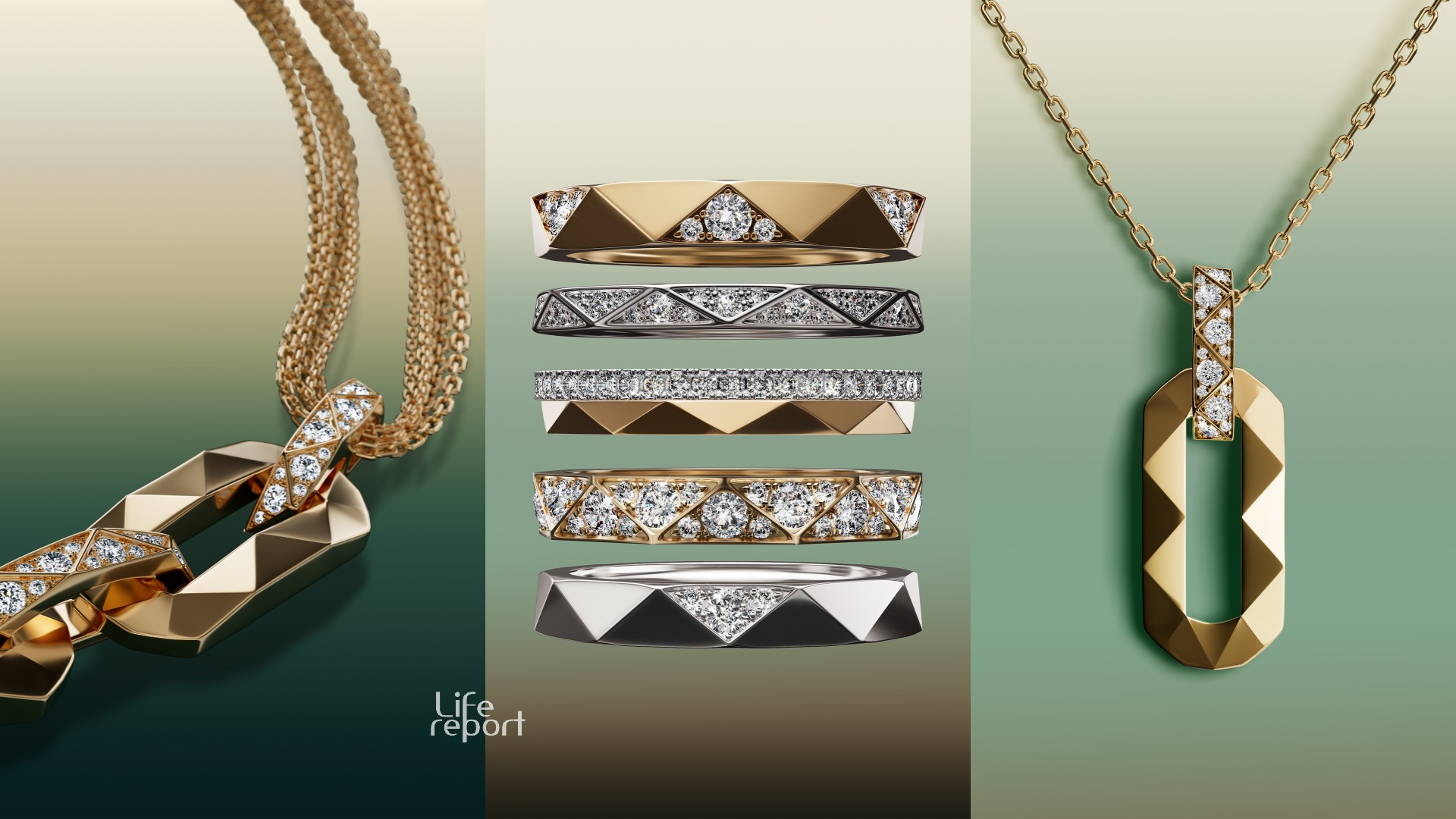
From a cultural perspective, the timing is impeccable. Gold jewellery has been steadily reclaiming its place at the centre of fashion for several seasons, championed by everyone from Jacquemus’s oversized chain necklaces to the quiet-luxury devotees of Brunello Cucinelli. Graff, however, is not following a trend; it is refining its own visual language. The faceted motif has been one of the House’s defining signatures since Laurence Graff first began cutting diamonds in Hatton Garden, and watching it migrate from pavé settings to sculptural solid-gold forms reveals a subtle but meaningful shift. Graff is inviting its clientele to appreciate gold not merely as a setting for gemstones but as a precious material worthy of admiration in its own right – with its own brilliance, warmth and intrinsic value. It is, ultimately, a lesson in connoisseurship disguised as a fashion campaign.
For those in the UAE searching for the season’s most enduring investment piece, the Laurence Graff Signature chain-link necklace in yellow gold – weighty, commanding and entirely free from unnecessary ornament – may well answer the perennial question of what to wear when there is nothing left to prove. Pair it with an immaculate white linen suit and the effortless tan acquired over too many weekends in AlUla, and the day has effectively been won before noon. The collection’s ear cuffs offer a quieter point of entry: a single sculpted arc that catches the light with every turn of the head, functioning as the perfect punctuation mark for a face that already speaks volumes.
View this post on Instagram
Graff’s decision to stage the campaign in Los Angeles, a city built upon fantasies of perpetual youth and relentless reinvention, perfectly mirrors the ambitions of the collection itself. Dubai, too, understands something about constructing the impossible and calling it home. Both cities recognise that gold, in the right hands, can become a form of architecture worn against the skin – a second skeleton, a personal skyline. As this latest campaign demonstrates, when the light is right, even the world’s most familiar precious metal can appear radically new. The Laurence Graff Signature collection does not simply celebrate a golden era; it melts one down and recasts it into something sharper, bolder and infinitely more compelling. One imagines John Lautner, surveying the scene from some celestial mid-century paradise, would have approved of the angles.
Also Read: In a City of Trends, This Café Stayed Real – And That Changed Everything