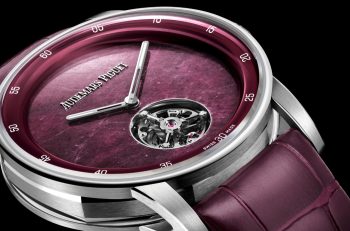
On the shore of the Lac de Joux, where winter mists erase the line between water and sky, a pebble sits – and, if you look closely, it tells the time. It is in this silence that Swiss watchmaking was born: not in the clamour of a manufacture, but in the hush of a farmhouse, where a Jura farmer, snowbound and idle, would turn a pinion under candlelight. This December stillness is, I think, the true sound of haute horlogerie, and it is precisely the sound Audemars Piguet sought to resurrect when it unveiled the Atelier des Établisseurs at Watches and Wonders Geneva.
The genesis of the Atelier reads like a scene from a particularly stylish screenplay. A few months into her tenure as CEO, Ilaria Resta found herself in the Musée Atelier with Heritage and Museum Director Sébastian Vivas, leafing through the astonishing biodiversity of AP’s back catalogue – watches that existed only because a small, agile network of external artisans had once made them possible. That moment of quiet archival ecstasy gave rise to a programme that is, at once, a return to the 18th-century établissage system and a pointed reversal of everything the industry has spent the past fifty years insisting we should value. In an era in which the words “in-house” and “vertical integration” are intoned with the solemnity of High Mass, AP has decided to publish the names of its collaborators as though they were credits on a Criterion Collection film. The move is either breathtakingly generous or a deft exercise in halo marketing – perhaps both. Either way, it works.

Among the inaugural trio – the nomadic skeletonised Nomade and the baroque automaton Peacock – the Galets is the quietest, the most contained, and, to my eye, the most seductive. This is a watch that reads as jewellery first and timepiece second, a reversal that will unsettle chronometric purists who still believe a watch should resemble a dashboard instrument. But the purists, bless their monochromatic souls, are not the audience here. The audience is the UAE’s new generation of luxury consumers – a demographic that, according to recent studies, is projected to constitute 80 per cent of the global luxury market by 2030, with more than 60 per cent of GCC populations currently under the age of thirty-five. These are buyers who walk into boutiques on Al Maryah Island not looking for a price tag, but for a story – a provenance, a texture, a conversation that will photograph beautifully in the golden-hour light on a Dubai Creek terrace.
The Poetry of the Pebble
The Galets (French for “pebbles”) takes its formal cue from an unlikely source: the water-smoothed stones that line the shores of the Lac de Joux, a half-hour bicycle ride from AP’s headquarters in Le Brassus. The watch is a compact 31 mm oval – pebble-shaped in the most literal sense – fashioned from 18-carat yellow gold, with a natural turquoise-stone dial so devoid of indices that it feels almost monastic. This deliberate absence is the first hint that the Galets is not interested in telling you the time so much as inviting you into a relationship with it – a meditative, almost pre-industrial rapport that feels faintly subversive in an age in which our wrists vibrate with Slack notifications.
The bracelet, designed by independent Swiss designer Xavier J. Perrenoud, is where the poetry becomes physical. It consists of irregular, asymmetrical gold links, each shaped like a small pebble and connected by tiny gold ball joints that allow the entire assembly to move like a liquid organism rather than a rigid mechanical chain. The Genevan jeweller Nadia Morgenthaler – a name that carries the sort of rarefied pedigree that makes collectors’ eyes narrow – crafted the bracelet in her atelier, while lapidarist Mario Senape, working from his workshops in Cossonay, inlaid each link with alternating turquoise and tiger’s-eye stones. Here is the truly remarkable detail: every stone is shaped to follow the curves of its gold host, with not a single flat edge or surface in sight. This is lapidary work of a level that would make a Bulgari tutta cromia piece seem almost mass-produced and is, frankly, a flex of the highest order.
The Movement: A Shaped Soul
Beneath the turquoise expanse, the hand-wound Calibre 3098 beats with the quiet dignity of a movement that has been adapted – not merely dropped in – to follow the organic silhouette of the case. The Calibre 3098 is a revival of AP’s first in-house movement, the Calibre 3090, which debuted in 1999 and was, at the time, the brand’s declaration of independence from its ébauche-dependent past. That AP has chosen to resurrect this particular calibre for a programme that explicitly celebrates collaborative, extra-manufacture craftsmanship is a pleasing irony that I suspect is not lost on the brand’s strategists.
View this post on Instagram
Movement constructor Arthur Gallezot modified the base calibre to achieve its unique pebble-following shape, while the finishing was entrusted to Luca Soprana – a name that connoisseurs of anglage will recognise instantly from his collaborations with Massena LAB and Atelier de Chronométrie. Soprana’s hand-grained bridges and pronounced anglage render the movement’s architecture as sensuous as the case that contains it, while the entire assembly is adjusted and cased by a single watchmaker, Aline Gagneux, in the atelier within the Musée Atelier Audemars Piguet, fully visible to the visiting public. This is, in other words, a watch made in a museum by people whose names you can Google. The transparency is either a revolution in luxury communication or the most elegant PR manoeuvre since Cartier placed the Tank on a soldier’s wrist. I lean towards the former, though I admit to being a congenital romantic.
A Watch for the Dubai That Wants Depth, Not Decibels
The Galets arrives at a cultural moment in which the UAE’s luxury market is undergoing a subtle but seismic recalibration. Dubai Watch Week, now firmly established as a global horological capital, has doubled its footprint for 2026, drawing more than 90 brands and an expected 30,000 visitors, many of them younger collectors who are less interested in a Royal Oak’s wait-list status than in the sort of craft narrative the Galets embodies. Reports from the region indicate that 55 per cent of younger luxury consumers still want to buy traditional watches – often pre-owned – drawn precisely to the craftsmanship, authenticity, and value retention that a piece like the Galets so effortlessly telegraphs. Meanwhile, Knight Frank’s 2026 luxury investment report notes that wealthy collectors are prioritising rarity, provenance, and cultural resonance – the very trinity upon which the Atelier des Établisseurs is built.

The Galets is not, however, a watch for everyone. It is small. It is explicitly feminine in its proportions and jewellery-first in its demeanour, which means it will largely be ignored by the sort of male collector who judges a watch’s worth by its water resistance and the number of sub-dials. That is precisely why it matters. In a region in which luxury has historically been gendered in ways that now feel as dated as a Vertu handset, the Galets’ refusal to conform to sports-watch hegemony is its most radical gesture. It is a watch for a woman – or, let us be honest, a man of sufficient confidence – who understands that true elegance whispers when everyone else is shouting, and that a pebble, smoothed by centuries of water, is infinitely more interesting than a boulder.
The Quiet Revolution
The Atelier des Établisseurs is, at its core, an act of preservation disguised as a product launch. Many of the techniques featured in the programme – hand-graining, traditional lapidary work, hacksaw skeletonisation – are no longer taught in watchmaking schools. Vivas has noted that, for chamfering, hand open-working, and stone-cutting, there are simply no schools to attend and no diplomas to be earned. The only way to ensure these skills endure is to give them work. The Galets, with its five variations and one-off production model, will not change all that many lives. Yet it is a halo project of the most sophisticated kind: one that elevates the humans behind the craft without diminishing the brand that hosts them – an acknowledgement that the most valuable thing a manufacture can produce is not a movement, but a legacy.
View this post on Instagram
In the end, the Galets is a watch that feels less designed than discovered – a pebble lifted from the Lac de Joux, polished by a constellation of artisan hands, and placed upon the wrist with a quiet self-assurance that says: I am not for the algorithm; I am for the archive. For the UAE’s rising generation of collectors, weary of hype-driven drops and wait-list theatrics, that may well be the most luxurious proposition of all.
For those wishing to encounter the Établisseurs Galets in person, Audemars Piguet Dubai Boutiques at The Dubai Mall and Mall of the Emirates offer the sort of hushed, appointment-only setting in which a pebble can properly sing.
Also Read: After Years of Dining for the Camera, Dubai Is Learning to Taste Again