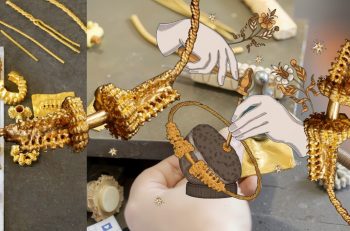
In a sun-drenched jewellery room during Paris Fashion Week, Stéfère’s creative director unveils a monochrome meditation on duality – proving that in an era of algorithmic certainty, the most sophisticated statement is a walk on the dark side.
The light in Paris during couture week possesses a particular, almost conspiratorial quality. It filters through tall windows with the sort of deliberate grace that makes even the most hardened editor momentarily consider abandoning her espresso for a watercolour set. It was in one such room – all crisp linen and the faint, expensive perfume of fresh flowers – that I recently found myself watching Corina Larpin arrange diamonds with the focused nonchalance of a conductor tuning an orchestra before the curtain rises.

The pieces spread before her were not merely new additions to Stéfère’s iconic collections. They were propositions. A monochrome symphony of black and white diamonds, inspired – Larpin explained with a gesture that managed to be both theatrical and entirely unaffected – by what she calls “the eternal duality of nature”. Light and shadow. Strength and delicacy. The glam-rock audacity that has made Stéfère a favourite among those who understand that real luxury is not about being noticed, but about being remembered.
Let us be honest with one another: the jewellery industry produces a great deal of noise. There are the heritage houses trotting out their greatest hits with the predictability of a farewell tour that never quite ends, and there are the newcomers whose idea of disruption involves making everything larger and louder, as if scale alone could substitute for soul. Larpin’s work at Stéfère, whose helm she took in 2014 after joining the maison in 2009, occupies that far more interesting territory where craftsmanship meets conviction. These are pieces that do not shout – they imply.
The Tattoo You Can Take Off
Consider, if you will, the Tattoo Ring. The name itself is a small act of semantic rebellion. A black-diamond climber that coils around the finger “like ink on skin”, as the brand’s literature puts it – but the description, however poetic, cannot quite convey the sensation of watching someone gesture while wearing it. The diamonds catch the light not in a single, declarative flash but in a sequence of small illuminations, each movement writing a new sentence in a language without words. (Also available in an all-white iteration, for those whose relationship with the dark is more… negotiated.)
View this post on Instagram
This is jewellery that understands something many of its peers have forgotten: we do not exist in static tableaux. We move. We fidget. We reach for coffee cups, gesture at taxi drivers, and brush hair from our faces. The Tattoo Ring moves with you because it was designed by someone who clearly spends time around actual human bodies rather than merely studying them in design sketches.
The Architecture of Androgyny
Then there is the Diamond Eclipse Necklace – a reimagined Cuban link subjected to what one might call the full Larpin treatment. Every angle, every facet, every possible line of sight has been considered and encrusted with diamonds. Three hundred and sixty degrees of brilliance, which sounds like marketing copy until you see one in person and realise that yes – they actually meant it. Every angle.
It can be worn as a necklace or separated into bracelets. It is, as the designer herself notes with a slight smile, “chic, rock, and androgynous” – an emblem of versatility in an era when rigid categories feel increasingly like artefacts from a less interesting century. The androgyny here is not the result of subtraction (removing the feminine to achieve something neutral) but of addition: the piece possesses enough confidence to be whatever its wearer needs it to be on any given day.
This matters more than one might think. In Dubai, where the luxury conversation has historically been conducted in the declarative mood – the language of gleaming towers, supercars purring at valet stands, and logos displayed like heraldic crests – a shift is underway. Walk through the perfume-tinged air of a gallery opening in Alserkal Avenue or the serene lounge of a members-only beach club on Palm Jumeirah, and you will detect a new dialect emerging. Quieter. More personal. Concerned less with transaction than with transformation.
By 2030, Gen Z will command an astonishing eighty per cent of the luxury market, and they have fundamentally rewritten its dictionary. The prized words are no longer simply “prestige” and “price”, but “intention”, “individuality”, and “emotional connection”. In the Gulf, this manifests not as a rejection of opulence but as a refinement of it. The desire is for pieces that function as talismans rather than trophies – and Larpin, whether by instinct or calculation (I suspect the former), has positioned Stéfère precisely at this intersection.

The Garden After Dark
The Black Diamond Flower, a bloom from what the maison calls its “midnight garden”, encapsulates this philosophy with particular elegance. A flower that thrives in darkness. A symbol of beauty that does not require sunlight to validate its existence. It is the sort of paradox that could easily tip into pretension if executed with less conviction, but in precious metals and stones it reads instead as a quiet manifesto.
This midnight garden motif extends throughout the collection, drawing on what Larpin calls “the eternal duality of nature” – but the reference points are not merely botanical. There are serpents (power and mystery), butterflies (freedom and metamorphosis), and florals that bloom with what the designer describes as “quiet intensity”. Each piece is expressive and intentional, designed to be noticed, layered, and lived in – reserved for life, not the safe.
One thinks of Carl Jung and his writings on the shadow self – the parts of our psyche we prefer to keep hidden, which nevertheless contain the seeds of our most authentic expression. Larpin, who grew up in communist Romania and retains the particular alertness of someone who has witnessed systems crumble and rebuild, seems to understand this intuitively. Her pieces do not deny darkness; they collaborate with it.
Hollywood Endings, New Beginnings
The celebrity following, one should note, has arrived organically rather than through the sort of calculated gifting campaigns that fill Instagram with photographs of actresses holding products they will never wear again. Taylor Swift chose Stéfère for her Reputation era – that serpent ring coiling around her finger in promotional images, a perfect visual metaphor for an artist reclaiming narrative control. Beyoncé has worn the pieces for her On the Run II tour. Cardi B’s 2019 Met Gala appearance, featuring 44 carats of ruby nipple covers custom-created by Stéfère, remains the sort of cultural touchstone that separates those who understand fashion from those who simply wear it.
The list extends: Zendaya, Michelle Yeoh, Lady Gaga, Janelle Monáe. Women who understand that jewellery is not ornament but armour – or perhaps, more accurately, that the distinction between ornament and armour has always been a matter of perspective.
The Dubai Proposition
For the UAE’s new guard of collectors – globally minded, culturally fluent, increasingly interested in pieces that function as extensions of self rather than displays of status – Stéfère offers something increasingly rare: sincerity without sentimentality. The brand’s presence in the region has grown through word of mouth and the sort of quiet cultivation that resists easy measurement but produces lasting affinity.
Larpin extends this philosophy beyond the atelier through #TRAVELWITHSTEFÈRE – curated journeys where exotic destinations become living galleries and clients form something approaching genuine community. It is an offer of experiential luxury that resonates powerfully in a region where high-value experiences are increasingly prized over passive acquisition. It transforms the client from spectator into participant in the Stéfère narrative – a narrative that, like the pieces themselves, rewards those who pay attention.
The Alchemy of Becoming
Ultimately, the question Larpin’s work poses is not whether a piece of jewellery can be beautiful – that is the baseline, the minimum entry requirement – but whether it can be meaningful. Whether it can hold space for the wearer’s complexity, for the contradictions that make us interesting rather than merely coherent. Jung again: “The shadow is ninety per cent gold.”
The pieces spread across that linen table in Paris, catching the late afternoon light with the quiet confidence of objects that know their own worth, seemed to understand this perfectly. They were not denying the darkness. They were mining it.
The Tattoo Ring on my finger caught the light as I reached for my notebook. A small, private illumination. A reminder that the most sophisticated statement one can make, in an era of algorithmic certainty and performative transparency, is simply this: I contain multitudes. And I have the jewellery to prove it.